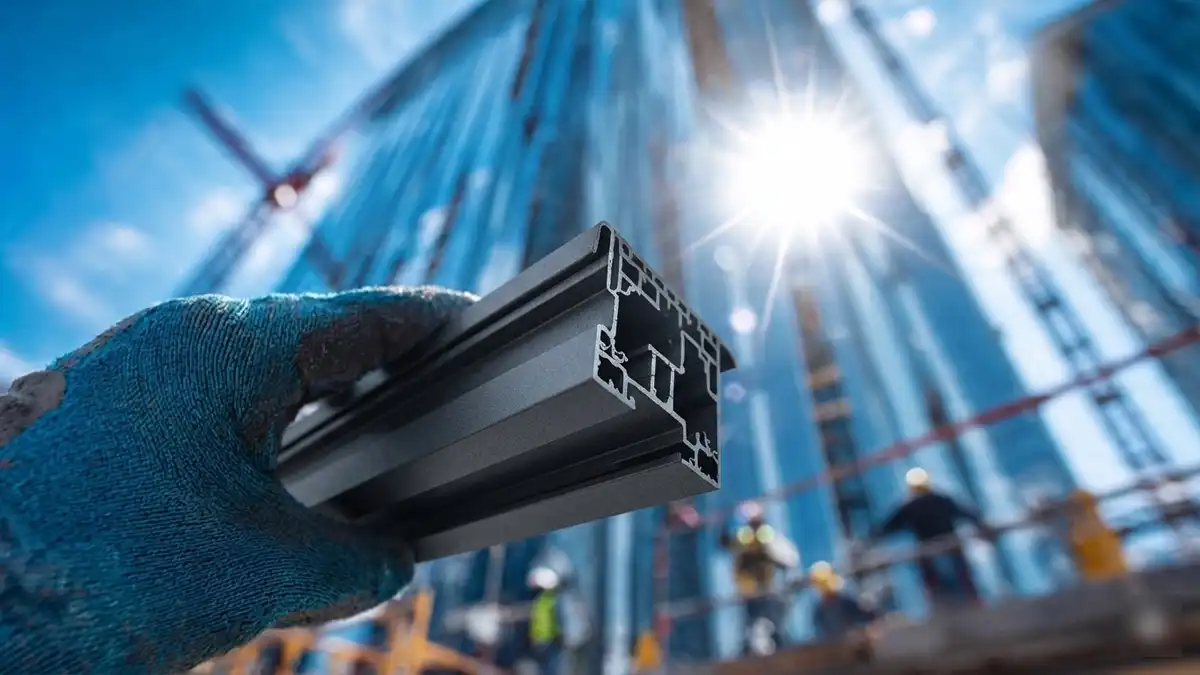
Walk through any major city and look up. The shimmering glass and metal envelopes of skyscrapers are almost always built around aluminium. It’s not a coincidence. Steel, wood, fiberglass, and even concrete have been tried, but aluminium has emerged as the global standard for curtain wall framing.
Why? Because no other material delivers the perfect balance of strength, weight, corrosion resistance, formability, and cost — all at once.
This article breaks down the scientific and practical reasons why aluminium dominates curtain wall construction, from low-rise buildings to supertall towers.
Exceptional Strength-to-Weight Ratio
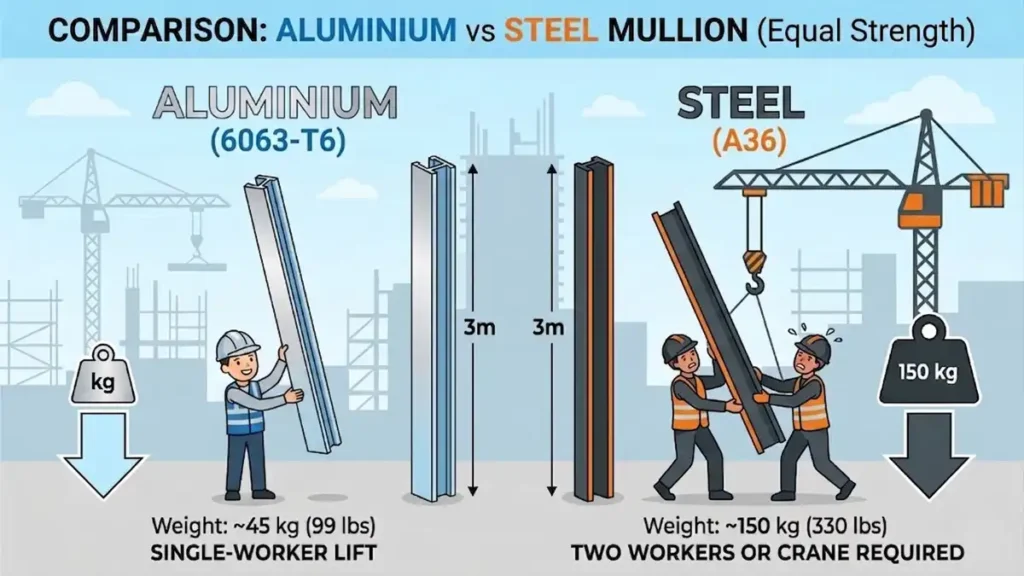
Curtain walls are non-structural cladding — they only carry their own weight and wind loads, not floor or roof loads. But that self-weight still matters. A heavy facade requires massive anchors, stronger slab edges, and more crane capacity.
Aluminium has a density of approximately 2.70 g/cm³ — about one-third that of steel (7.85 g/cm³). Yet, with the right alloy and temper, its strength rivals mild steel.
| Material | Density (g/cm³) | Yield Strength (MPa, typical) | Strength-to-Weight Ratio |
|---|---|---|---|
| Aluminium 6063-T6 | 2.70 | 210 | 78 |
| Aluminium 6061-T6 | 2.70 | 275 | 102 |
| Mild Steel (A36) | 7.85 | 250 | 32 |
| Stainless Steel 304 | 8.00 | 215 | 27 |
Result: Aluminium offers 2–3 times better strength-to-weight ratio than steel. This means thinner, lighter frames that are easier to handle, ship, and install — while still resisting high wind loads.
-Ads-
For a detailed look at specific alloys used in curtain walls, check our guide on aluminium 6063 alloy for windows, doors, and extrusion.
Natural Corrosion Resistance (No Rust)
Steel rusts. Wood rots. Aluminium? It passivates.
When exposed to oxygen, aluminium instantly forms a thin, transparent, and self-healing oxide layer (Al₂O₃). This layer is only 2–3 nanometers thick but is incredibly stable and adheres tightly to the metal. If scratched, the oxide reforms within milliseconds.
This is why aluminium curtain walls last 50+ years without structural degradation — even in coastal salt spray or industrial pollution.
Enhanced Protection Options
For aggressive environments, architects specify:
- Anodizing – Electrochemically thickens the natural oxide layer. Offers 25+ years of maintenance-free life. Colors range from clear to bronze to black.
- Powder Coating – Adds a durable, colored polymer layer (usually 60–80 microns). Excellent UV resistance and design flexibility.
Learn the difference between these two finishes in our article: powder coating vs anodizing.
Infinite Extrudability – Complex Shapes Made Easy
Curtain walls are not simple rectangles. They require:
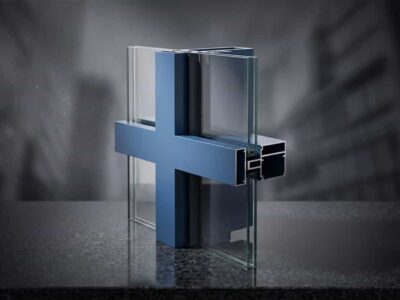
- Pressure-equalized drainage cavities (internal gutters)
- Gasket retention grooves
- Thermal break slots (for inserting polyamide strips)
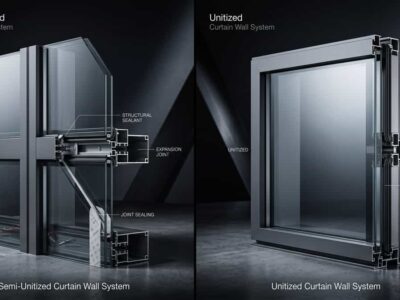
- Interlocking male-female connectors (for unitized systems)
- Weep hole channels (pre-formed, not drilled)
Aluminium is extruded by forcing a heated billet through a steel die. This process can create virtually any cross-section with tolerances as tight as ±0.1 mm.
No other curtain wall material — steel, fiberglass, or uPVC — offers such design freedom at a reasonable cost. Complex multi-cavity profiles are produced in a single pass, reducing fabrication and assembly time.
For more on extrusion technology, read our overview of the aluminium extrusion process.
Thermal Break Compatibility
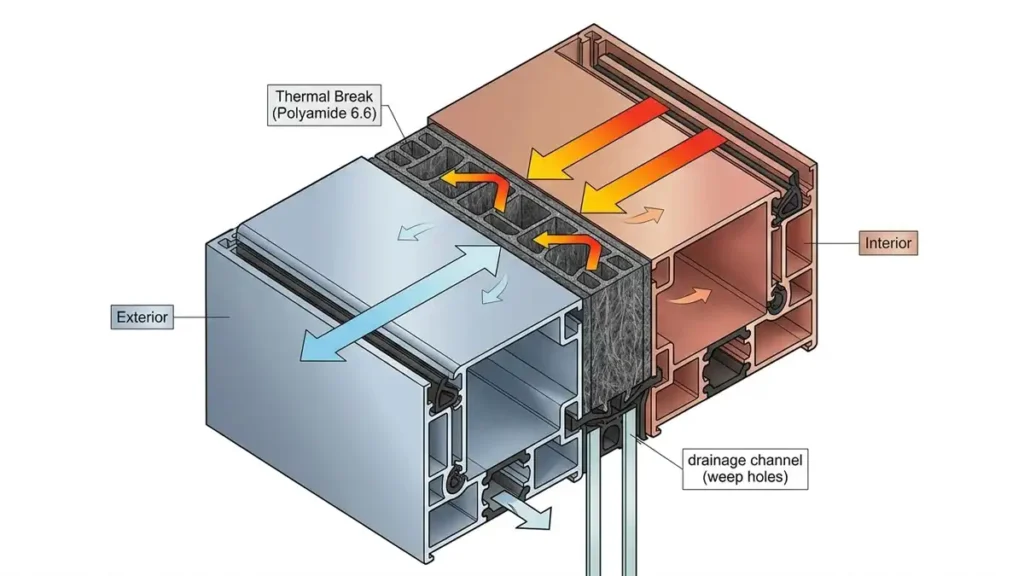
Raw aluminium conducts heat efficiently (approx. 205 W/m·K). In cold climates, this can cause thermal bridging — heat escaping through the frame, leading to condensation and energy loss.
The solution? Thermal break technology.
A thermal break curtain wall uses a low-conductivity material (typically polyamide 6.6 or polyurethane foam) inserted between the interior and exterior aluminium sections. This reduces frame U-values from ~5.7 W/m²·K (non-thermal) to as low as 1.4 W/m²·K or better.
Aluminium’s machinability allows precise crimping or pouring of thermal break strips directly into the extrusion profile. This is far more reliable than attempting thermal breaks with steel or uPVC.
To understand how thermal breaks work in fenestration, explore our guide: what are thermal break aluminium windows?.
Dimensional Stability & Low Maintenance
Unlike wood, aluminium does not swell, warp, crack, or rot. Unlike some plastics, it does not creep under sustained load or become brittle from UV exposure.
- Coefficient of thermal expansion: 23.1 × 10⁻⁶ /°C (similar to glass and concrete, reducing differential movement stress).
- Modulus of elasticity: 69 GPa (stiff enough to limit deflection to L/175 or better).
- Maintenance: Occasional washing is all that’s needed. No painting, sealing, or rust removal.
This stability means curtain wall gaskets and seals last longer because the frame doesn’t deform unpredictably.
Compatibility with Glass & Other Infills
Curtain walls are glass-dominant. Aluminium and glass are thermally and mechanically compatible:
- Similar thermal expansion rates reduce seal shear stress.
- Aluminium’s stiffness provides uniform support to glass edges, preventing stress fractures.
- Anodized or powder-coated aluminium offers neutral color matching to glass tones (clear, bronze, gray, black).
Additionally, aluminium frames can accommodate spandrel panels, metal infills, or ventilation louvers within the same system — a flexibility not possible with glass-only systems.
For the best glass pairings with aluminium, read our article: best aluminium window glass for hot climates.
Recyclability & Sustainability
Sustainability is no longer optional — it’s a requirement for LEED, BREEAM, and other green building certifications.
Aluminium is infinitely recyclable without loss of properties. Recycling uses only 5% of the energy required to produce primary aluminium. Today, many curtain wall systems use profiles containing 70–80% post-consumer recycled content.
Stick and unitized systems can be fully disassembled at end-of-life. The frames are melted down and reborn as new extrusions. No other curtain wall material closes the loop so cleanly.
For more on aluminium’s environmental advantages, see our article: why aluminium reigns supreme in packaging — the same recycling logic applies to building envelopes.
Cost-Effectiveness Over Lifecycle
Initial material cost: Aluminium is more expensive than uPVC or basic steel. But total lifecycle cost is far lower:
| Cost Factor | Aluminium | uPVC | Steel | Wood |
|---|---|---|---|---|
| Initial material | Medium | Low | Low-Medium | Medium-High |
| Fabrication | Low (extrude once) | Medium | High (welding) | High (joinery) |
| Installation | Low (lightweight) | Low | High (heavy) | Medium |
| Maintenance (50 years) | Very Low | Medium (re-sealing, fading) | High (rust, painting) | High (painting, sealing) |
| Replacement value | High (recyclable) | Low (landfill) | Medium | Low-Medium |
Verdict: Aluminium offers the lowest lifecycle cost for buildings over 20 years — and most curtain walls last 50+ years.
Common Aluminium Alloys for Curtain Walls
| Alloy | Temper | Yield Strength (MPa) | Primary Use |
|---|---|---|---|
| 6063 | T5 / T6 | 145–210 | Standard extrusions, windows, doors, stick curtain walls |
| 6061 | T6 | 275 | High-strength mullions, unitized anchors, heavy-load areas |
| 6005 | T5 | 215 | Thicker extrusions for high wind zones |
| 6082 | T6 | 260 | Marine and industrial facades (higher corrosion resistance) |
For a complete list of alloy properties, browse our aluminium alloys series guide.
A Note on Limitations (And How Engineers Overcome Them)
Aluminium is not perfect. Two key limitations exist — and both have proven solutions:
| Limitation | Solution |
|---|---|
| High thermal conductivity (energy loss) | Add polyamide thermal breaks — reduces heat transfer by up to 80% |
| Lower strength than steel | Use deeper mullions (150–200 mm) or switch to 6061-T6 / 6082-T6 alloys |
These solutions are mature, proven, and widely available from every major curtain wall manufacturer.
Final Verdict: Why Aluminium Wins
Other materials have niche applications:
- Steel is still used for mega-spans or bomb-blast resistance.
- uPVC is common in residential windows but lacks strength for high-rise curtain walls.
- Wood is beautiful but requires constant maintenance and has limited span capacity.
But for the vast majority of commercial curtain walls — from 5-story offices to 100-story skyscrapers — aluminium is the undisputed champion because it uniquely offers: