

Curtain walls are the unsung heroes of modern skyscrapers. They are lightweight, visually stunning, and engineered to withstand immense forces from nature. But two critical performance challenges define a successful curtain wall: wind load resistance and water drainage management.
A failure in either can lead to catastrophic glass blowouts or annoying, destructive leaks. So, how do stick and unitized systems handle these challenges? Let’s break down the physics, engineering, and hidden design features that keep buildings dry and intact.
How Curtain Walls Resist Wind Load
Wind exerts tremendous pressure on tall buildings — often hundreds of tons of force. A curtain wall must transfer these loads to the building’s structural frame without excessive deflection or failure.
The Load Path: From Glass to Structure
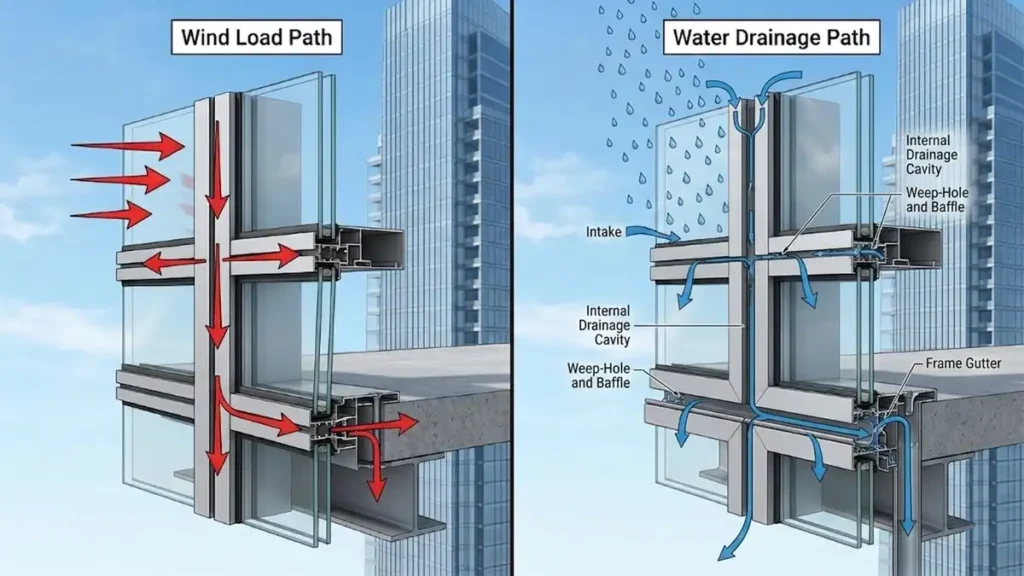
Every curtain wall follows a simple load path:
- Wind hits the glass → pressure is applied to the glass pane.
- Glass transfers load to the framing members (mullions/transoms) via setting blocks and gaskets.
- Framing transfers load through anchor brackets to the slab edge or spandrel beam of the building.
- Building structure (columns, floors, shear walls) absorbs and dissipates the load into the ground.
Key Engineering Factors
| Factor | Stick System | Unitized System |
|---|---|---|
| Mullion Depth | Typically 50–200 mm | 50–200 mm (similar) |
| Alloy Grade | 6063-T5 or T6 (extrusion) | 6063-T6 or 6061-T6 for higher strength |
| Anchor Type | Two-piece adjustable brackets | Heavy-duty interlocking anchors |
| Deflection Limit | L/175 or L/200 of span (approx. 10–20 mm) | Same, often tighter (L/250) |
| Wind Load Testing | ASTM E330 (air pressure) | ASTM E330 + seismic movement test |
How Unitized Systems Excel at High Winds
Unitized systems have a structural advantage: the interlocking male-female mullions act as continuous splines. When panels are stacked and side-joined, they create a redundant load-sharing mechanism. Wind load on one panel is partially distributed to adjacent panels, reducing peak stress on any single anchor.
This is why unitized walls can achieve wind load ratings up to ±4000 Pa (approx. 83 psf) — enough for supertall towers in cyclone-prone regions.
💡 Pro Tip: Always ask for a full-scale mock-up test (ASTM E330 + seismic racking) for any project over 20 stories. Mock-ups reveal weak points no calculation can catch.
For a deeper dive into structural grades and standards, visit our guide on global aluminium standards: ASTM, AAMA, EN, DIN, BS.
How Curtain Walls Manage Water Drainage
Water is the enemy of building envelopes. A curtain wall must keep rain out while handling condensation, pressure differences, and capillary action. The solution is a multi-stage pressure-equalized rain screen system.
The Science: Pressure Equalization
A curtain wall is not perfectly sealed — it can’t be, because thermal expansion and building movement would break rigid seals. Instead, engineers use a clever trick:
- Outer seals (primary weather gaskets) block most water.
- A small amount of water may bypass the outer seal.
- This water enters a cavity (the “drainage chamber”).
- The cavity is vented to the exterior via weep holes.
- When wind blows, the pressure inside the cavity equalizes with outside pressure. No pressure difference = no force pushing water through the inner seal.
- Gravity then carries captured water down the cavity and out through weeps at the sill.
This is called a pressure-equalized, drained, and ventilated curtain wall. It’s the industry standard for high-performance facades.
Water Drainage in Stick vs. Unitized
| Feature | Stick System | Unitized System |
|---|---|---|
| Primary Seal | Face gasket or wet sealant | Pre-compressed foam or EPDM gaskets |
| Cavity | Continuous vertical and horizontal gutters | Integrated in each module with cross-drains |
| Weep Holes | Drilled or punched at transoms | Precision-molded or machined |
| Drainage Path | Gravity down mullions | Module-to-module via jump seals or tubes |
| Testing Standard | ASTM E1105 (water penetration) | Same + AAMA 501.2 (leakage) |
Where Unitized Systems Shine (and Fail)
Unitized systems have factory-installed gaskets and pre-drilled weep paths, which are more reliable than field-applied sealants. However, if the inter-module jump seals (horizontal or vertical connections) are poorly designed or damaged, water can migrate between modules and cause hidden leaks.
The most common failure point: clogged weep holes from construction dust or insect nests. Regular maintenance and removable weep covers are essential.
For an in-depth look at glass types that work best with these drainage systems, check out our article on types of glass for aluminium doors and windows.
Testing: How We Know It Works
Before any curtain wall is approved, it undergoes rigorous testing. The three most important standards:
| Test | What It Measures | Acceptance Criteria |
|---|---|---|
| ASTM E330 | Structural wind load resistance | No permanent deformation at 1.5× design pressure |
| ASTM E283 | Air infiltration | Less than 0.06 cfm/ft² at 75 Pa |
| ASTM E1105 / AAMA 501.2 | Water penetration under dynamic pressure | No uncontrolled water entry after 15 minutes of spray + cyclic wind |
A full-scale mock-up is built on a test stand and subjected to these tests. Engineers also add seismic racking (cyclic movement) to simulate earthquakes or building sway.
If you’re considering a career in this field, understanding testing and commissioning is key. Explore our facade glazing jobs, salaries, and skills roadmap for more insights.
Real-World Failure Examples (And How to Avoid Them)
- Hurricane-force winds in Miami (2017) – A unitized wall failed because the pressure equalization chamber was not vented properly, causing hydrostatic pressure (the weight of pooled water pushing itself through seals) to blow out inner gaskets. Fix: Always verify weep hole placement and vent sizing per AAMA TIR-A11.
- Leaking stick-built wall in Seattle (2019) – Field-applied sealant cracked after one winter freeze-thaw cycle. Fix: Use pre-compressed foam gaskets instead of wet sealants in high-rain, freeze-thaw climates.
- Module joint leak in Singapore high-rise – Jump seals were missing horizontal weeps, so water pooled and migrated inward. Fix: Specify cross-drain tubes or integrated drip edges on every module.
To understand basic facade terminology before diving into these technical fixes, read our introduction to facade meaning and definition.
Best Practices for Architects and Engineers
- For high-wind zones (typhoon/hurricane regions): Specify unitized with 200mm+ mullion depth, 6061-T6 alloy, and dynamic water testing (AAMA 501.2).
- For high-rain zones (tropical monsoon): Use dual drainage cavities with independent weeps and oversized scuppers.
- For seismic zones (California, Japan, Turkey): Require two-axis seismic racking test (ASTM E2126) with interlocking unitized connectors that allow ±50mm movement (some advanced systems are engineered for even greater inter-story drift — up to ±75mm or more — to accommodate the highest seismicity in Tokyo or San Francisco).
- For cold climates (Canada, Russia): Specify heated mullions or weep hole de-icing cables to prevent ice dams blocking drainage.
Curtain wall performance directly impacts building energy efficiency. Learn more about thermal break aluminium windows and their energy savings.
Frequently Asked Questions
Q: Can a curtain wall ever be 100% watertight?
A: No. All curtain walls are designed to be “weeped and drained” — they expect some water entry but manage it safely. “Dry” systems (fully sealed) exist but are rare and expensive; they rely on perfect installation and never move.
Q: How often should weep holes be inspected?
A: Annually for low-rise, biannually for high-rise. Construction debris, dirt, and insects are common blockers.
Q: What’s the maximum wind load a typical curtain wall can handle?
A: Most quality systems are rated for ±2400 Pa (±50 psf). Special high-wind systems go to ±4000 Pa (±83 psf). Ask for a project-specific calculation.
Q: Does a unitized system always outperform stick in water drainage?
A: Not automatically. A poorly designed unitized system with misaligned jump seals can leak worse than a well-installed stick system with continuous gaskets. The key is factory quality + proper inter-module detailing.
Related Articles


Featured


You May Also Like
15 Best 6-Step Aluminium Ladders for Home Under ₹5,000
Storm Door Installation Cost: What Homeowners Should Expect
Aluminium Windows Problem: Weather Stripping Deterioration

The Ultimate Guide to Glass Pane Replacement

What Frame Material is Best for Pleated Mesh Mosquito Net?
