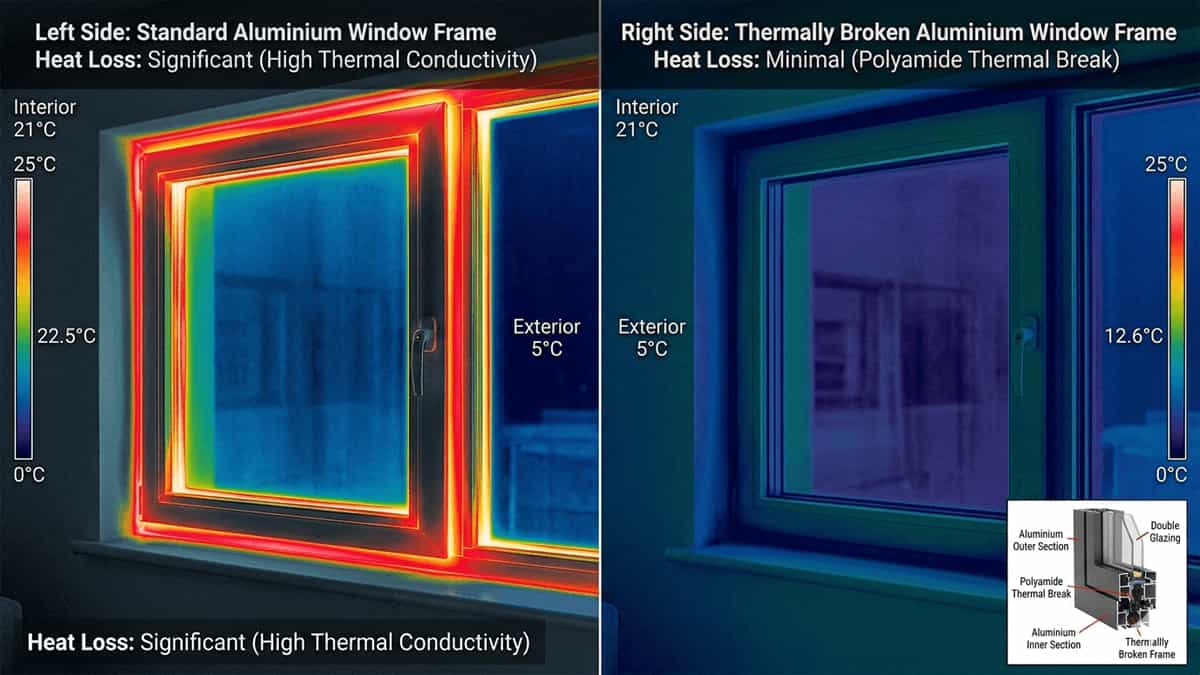
A Costly Cold Bridge. Traditional Aluminium frames without thermal breaks conduct heat readily, resulting in U‑values as high as 2.7 W/m²K for double‑glazed units. This high thermal conductivity creates a “thermal bridge” – a direct path for heat to escape in winter and enter in summer. The consequence is higher energy bills, uncomfortable drafts, condensation, and a significant environmental footprint. This guide explains why standard Aluminium frames are thermally poor, what you can do to improve them, and when it’s time to call a professional.
The Problem & The Decision (DIY or Call a Pro?)
What Makes Traditional Aluminium Frames Thermally Inefficient?
Aluminium is an excellent conductor of heat. Without a barrier, the frame acts like a radiator, transferring heat freely between the inside and outside of your home.
- High U‑Values: A standard non‑thermally broken Aluminium frame can have a U‑value of 5.0–7.0 W/m²K. By comparison, a thermally broken Aluminium frame achieves 1.4–3.0 W/m²K or lower.
- Heat Loss in Winter: Warm indoor air escapes through the frame, making rooms cold near windows and forcing your heating system to work harder.
- Heat Gain in Summer: In hot weather, outdoor heat travels through the frame into your home, increasing cooling costs and making rooms uncomfortable.
- Condensation: Cold frame surfaces can fall below the dew point, causing water to form on the Aluminium profiles. This can lead to mould growth and damage to surrounding plasterboard.
The Thermal Break Solution
A thermal break is a non‑conductive barrier (typically made of polyamide plastic) inserted between the inner and outer parts of an Aluminium frame. The polyamide strip reduces thermal conductivity by a factor of nearly 100 compared to Aluminium. This barrier forces heat to travel a longer, insulated path, dramatically improving the frame’s energy performance. Thermal break technology can reduce the heat transfer coefficient by 29–35%.
Comparing Materials: Aluminium vs. uPVC vs. Vinyl
When considering thermal efficiency, it is worth comparing Aluminium against other common window frame materials:
| Material | Thermal Performance | Notes |
|---|---|---|
| Standard Aluminium | Poor (U‑value up to 7.0 W/m²K) | High heat transfer without a thermal break. |
| Thermally Broken Aluminium | Good (U‑value as low as 1.4 W/m²K) | A polyamide barrier greatly improves insulation. |
| uPVC (Unplasticised Polyvinyl Chloride) | Good to Excellent | Naturally low thermal conductivity, often with multi‑chamber designs for added insulation. |
| Vinyl | Good | Hollow cavities can be filled with insulation, making them thermally superior to standard Aluminium. |
| Timber | Excellent | Wood is a natural insulator. Alu‑wood combinations offer the best of both worlds. |
While standard Aluminium frames lag behind uPVC and vinyl in raw thermal performance, thermally broken Aluminium frames can achieve U‑values as low as 0.8–1.3 W/m²K, matching or exceeding the efficiency of many other materials. When comparing materials, the choice depends on your climate, budget, and aesthetic preferences.
The Decision Matrix
| If this sounds like you… | Your Skill Level | Recommended Action |
|---|---|---|
| You have standard (non‑thermally broken) Aluminium windows and experience high energy bills or condensation. You are comfortable with basic DIY and weatherisation. | Intermediate | Proceed with DIY Guide (retrofit improvements). |
| You have no tools or experience, or the windows are severely degraded. | Beginner / Zero Knowledge | STOP. CALL A PRO. A professional can advise on thermal break retrofits or full window replacement. |
| The frames are old, single‑glazed, and the building is in a cold or hot climate. You want a permanent, high‑performance solution. | All Levels | CALL A PRO. Full replacement with thermally broken Aluminium frames is the best long‑term investment. |
The DIY Guide (Retrofit Improvements for Existing Aluminium Windows)
If replacing your windows is not an option, you can improve the thermal performance of your existing Aluminium frames with cost‑effective, non‑invasive measures. These DIY solutions are best suited for standard, non‑thermally broken Aluminium windows that are in good structural condition.
Tools & Materials You Will Need
- Hygrometer (to monitor indoor humidity)
- Weatherstripping (self‑adhesive foam tape or rubber seals)
- Secondary Glazing Film (heat‑shrink window insulation kit)
- Draught Excluder (for window sills and frames)
- Expanding Foam (Low‑Pressure) – for filling hollow cavities in the frame (use with caution)
- Caulking Gun & Neutral‑Cure Silicone
- Insulating Curtains or Thermal Blinds
- Soft Cloth & Mild Detergent (for cleaning)
Step‑by‑Step Instructions
Step 1: Seal Air Leaks Around the Frame
- Inspect the perimeter of the Aluminium window frame for gaps and cracks.
- Apply weatherstripping tape to the inside of the frame where the sash meets the fixed frame.
- Use neutral‑cure silicone to seal any gaps between the Aluminium frame and the wall. This prevents cold drafts from bypassing the frame.
Step 2: Apply Secondary Glazing Film
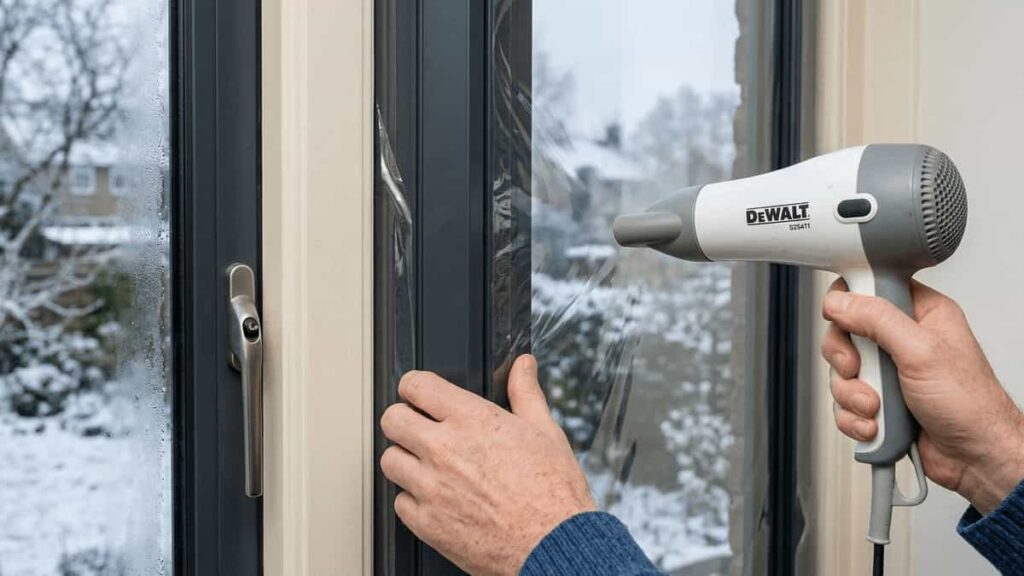
- One of the most effective DIY measures is to install heat‑shrink secondary glazing film on the interior side of the window.
- Clean the Aluminium frame thoroughly. Apply double‑sided tape around the frame perimeter.
- Cut the plastic film to size, press it onto the tape, and use a hairdryer to shrink it tight.
- The film creates an insulating air pocket between the glass and the room, significantly reducing heat loss and condensation.
Step 3: Insulate Hollow Frame Cavities (Advanced DIY)
- If your Aluminium frame has hollow sections, you may be able to inject low‑pressure expanding foam into the cavities. This fills the void and adds a layer of insulation.
- Caution: Use only foam designed for window frames. High‑expansion foam can distort the Aluminium profile. If in doubt, skip this step.
- Drill small pilot holes (if necessary), inject the foam, and allow it to cure before sealing the holes.
Step 4: Control Internal Humidity
- Condensation on cold Aluminium frames is a sign of high humidity. Use a hygrometer to monitor levels.
- Improve ventilation by opening trickle vents (but do not seal them) and using extractor fans in kitchens and bathrooms.
- If humidity remains above 60%, use a dehumidifier.
Step 5: Install Insulating Window Coverings
- Heavy curtains, thermal blinds, or cellular shades provide an additional layer of insulation.
- Ensure the coverings extend beyond the Aluminium frame to prevent cold air from circulating around the edges.
Step 6: Monitor and Maintain
- After applying these measures, check the window frame regularly for condensation.
- Reapply weatherstripping and film annually, as they degrade over time.
Why You Might Need to Call a Professional
If you fall into the “Pro” category, here is what a specialist will do that you cannot safely achieve at home:
- Thermal Break Retrofit: Some Aluminium window profiles can be retrofitted with a thermal break by cutting the frame and inserting a polyamide strip. This is a complex, precision job that requires specialised equipment.
- Polyurethane Foam Injection: Professionals can inject high‑density polyurethane foam into the hollow cavities of existing Aluminium frames. This quick, non‑destructive solution significantly improves thermal performance.
- Full Window Replacement: For older, single‑glazed Aluminium windows, replacement with modern thermally broken Aluminium frames and double or triple glazing is the most effective long‑term solution.
- Low‑E Glass Retrofit: A professional glazier can replace existing glass with low‑emissivity (low‑E) glass, which reflects heat back into the room in winter and blocks solar heat in summer.
- Structural Assessment: If the Aluminium frame is warped or the wall around it is damaged, a professional can assess whether a full replacement is necessary.
Summary
- Identify the Problem: Standard Aluminium frames without thermal breaks have high U‑values (5.0–7.0 W/m²K), leading to heat loss, heat gain, condensation, and high energy bills.
- Know Your Limits: Minor improvements like weatherstripping and secondary glazing are DIY. Thermal break retrofits and full replacements require a professional.
- DIY Steps: Seal air leaks, apply secondary glazing film, insulate hollow cavities with caution, control humidity, and use thermal curtains.
- Professional Help: If condensation persists or the Aluminium frames are old and single‑glazed, consult a professional about thermal break retrofits or replacement with high‑performance thermally broken Aluminium frames.
- Compare Materials: Thermally broken Aluminium can match or exceed the efficiency of uPVC and vinyl, making it a viable choice for energy‑conscious homeowners.
Further Reading & Related Issues
To understand more about Aluminium window thermal performance and energy efficiency, explore these articles from our archive:
- For an overview of Aluminium window problems (including thermal insulation):
Aluminium Window Problems Guide
This article covers poor thermal insulation as one of the 25 most common issues, along with many others in this series. - To understand thermal break technology in depth:
What are Thermal Break Aluminium Windows?
Learn how polyamide strips reduce heat transfer and eliminate condensation. - For a direct comparison of frame materials:
Comparison Between Aluminum vs Vinyl vs uPVC Windows
A detailed breakdown of cost, durability, maintenance, insulation, and aesthetics.