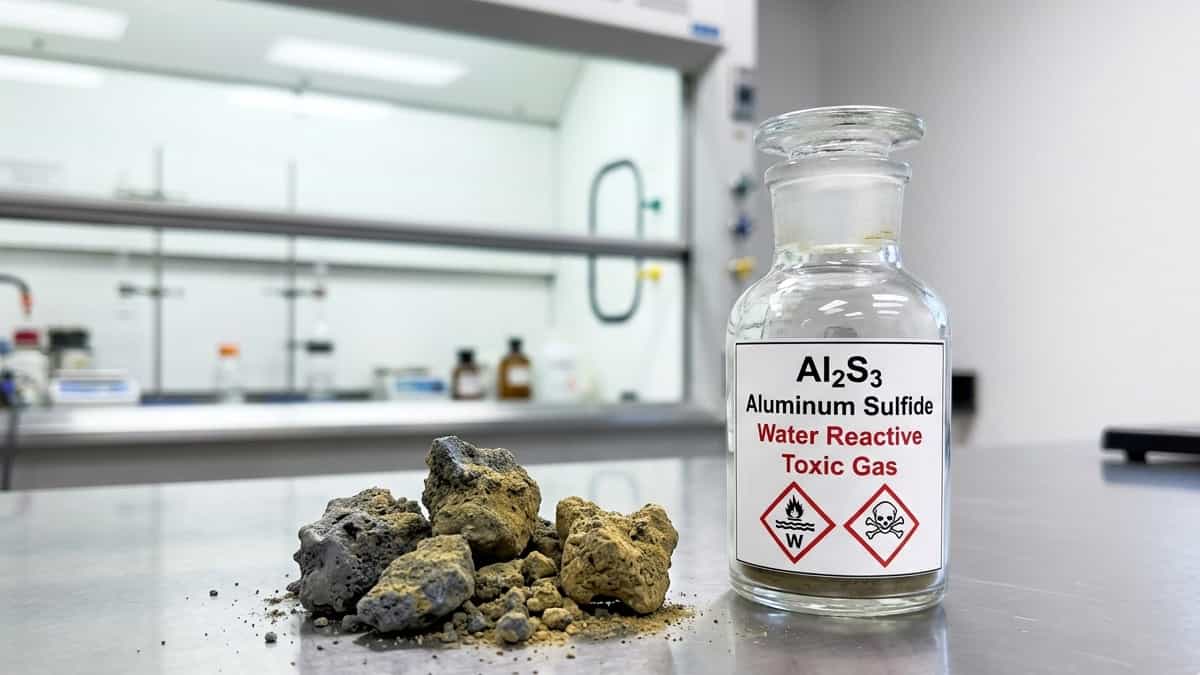
Aluminium sulfide is a highly moisture‑sensitive inorganic compound. It appears as a dull grey to yellowish solid and is infamous for its foul odor resulting from reaction with ambient moisture. It serves as a specialized laboratory reagent to generate hydrogen sulfide gas on demand.
1. Basic Identification
- Chemical Formula: Al₂S₃
- Alternative Names: Aluminium sulfide, dialuminum trisulfide
- Molecular Weight: 150.16 g/mol
- CAS Number: 1302-81-4
- Appearance: Dull grey to yellowish‑brown crystalline solid or powder
2. Physical Properties
| Property | Aluminum Sulfide |
|---|---|
| Melting Point | 1100 °C (2010 °F) |
| Boiling Point | Sublimes/decomposes ~1500 °C |
| Density | 2.02 g/cm³ |
| Crystal Structure | Hexagonal (α), Trigonal (β) |
| Solubility | Insoluble in organic solvents; reacts violently with water |
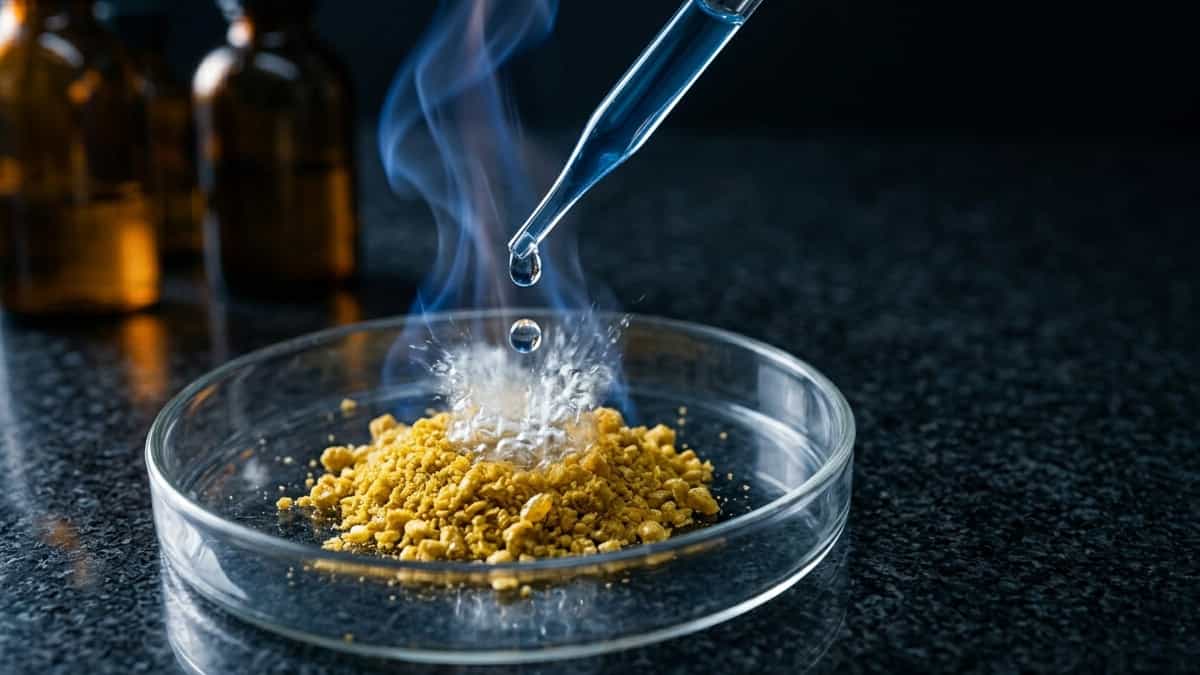
Pure Al₂S₃ forms hard greyish clumps. Older samples often have a white crust of aluminium hydroxide and emit a noxious stench due to moisture exposure.
3. Chemical Behavior & Synthesis
3.1 Reaction with Water – H₂S Generation
Al₂S₃ + 6 H₂O → 2 Al(OH)₃ + 3 H₂S ↑
Even atmospheric humidity triggers localized hydrolysis, releasing hydrogen sulfide (H₂S) gas. Dropped into water, it bubbles violently, producing a white sludge and toxic H₂S clouds.
3.2 Synthesis
2 Al + 3 S → Al₂S₃
Fine aluminum powder and sulfur are mixed and ignited. The reaction is violently exothermic, fusing the elements into pure aluminum sulfide.
4. Applications
4.1 Hydrogen Sulfide (H₂S) Generation
In analytical chemistry, Al₂S₃ provides a controlled source of H₂S for testing heavy metal ions (metal sulfide precipitation) without storing pressurized toxic gas tanks.
4.2 Inorganic Synthesis Precursor
Used as a reactive sulfur precursor to generate thio‑compounds without introducing water or handling gaseous H₂S.
4.3 Battery Research
Aluminum‑sulfur battery lattices based on Al₂S₃ are studied for lightweight, high‑capacity energy storage as an alternative to lithium‑ion.
5. Safety & Hazard Management
| GHS Symbol | Meaning |
|---|---|
| ☠️ GHS06 | Toxic gas releaser |
Critical Warning: The reaction product – hydrogen sulfide (H₂S) – is extremely toxic, attacks the nervous system, and can be fatal.
5.1 Health Effects
| Route of Exposure | Effect |
|---|---|
| Inhalation (H₂S gas) | H₂S paralyzes olfactory nerves (rotten‑egg smell disappears). Continued exposure causes pulmonary edema, coma, death. |
| Skin Contact | Solid may irritate; moisture on skin causes localized gas burns. |
| Eye Contact | Severe irritation due to hydrolysis on eye moisture. |
| Ingestion | Stomach acid accelerates H₂S release → internal poisoning, shock, potentially fatal. |
5.2 PPE
- Respiratory: Fume hood mandatory. For large spills, SCBA (H₂S is not filtered by particulate masks).
- Hands: Thick nitrile or butyl rubber gloves
- Eyes: Tight chemical splash goggles
5.3 First Aid
- Inhalation: Evacuate to fresh air immediately. Administer oxygen. Seek emergency medical help.
- Skin: Brush off dry chemical; flush with water 15+ minutes.
- Eyes: Flush 15‑20 minutes; see ophthalmologist.
5.4 Firefighting
- H₂S is highly flammable and forms explosive mixtures with air.
- Use: Dry chemical powder or dry sand.
- Do NOT use: Water or foam – will increase toxic/flammable gas release.
6. Storage & Handling
- Container: Tightly sealed glass or heavy plastic
- Atmosphere: Under dry inert gas (nitrogen/argon)
- Location: Cool, ventilated hazardous storage, away from humidity
- Incompatibles: Water, moisture, strong acids, strong oxidizers
6.1 Disposal
Do not discard in trash or drain. In a fume hood, suspend in non‑polar solvent, then slowly drip into dilute bleach (sodium hypochlorite) to oxidize sulfide to non‑toxic sulfate.
7. Environmental Impact
Exposed Al₂S₃ breaks down in rainwater. Aluminum becomes inert mud, but sudden H₂S release can devastate wildlife and acidify streams. Spills must be kept away from groundwater/sewers.
8. Comparison with Other Reactive Aluminum Compounds
| Compound | Formula | Byproduct in Water | Primary Hazard |
|---|---|---|---|
| Aluminium Sulfide | Al₂S₃ | Hydrogen sulfide (H₂S) | Toxic, flammable “rotten egg” gas |
| Aluminium Phosphide | AlP | Phosphine (PH₃) | Highly lethal fumigant |
| Aluminium Carbide | Al₄C₃ | Methane (CH₄) | Flammable gas explosion risk |
| Aluminium Chloride | AlCl₃ | Hydrogen chloride (HCl) | Corrosive acid clouds |
9. Frequently Asked Questions
Q: I found a bottle that smells strongly of rotten eggs. Is it leaking?
A: Yes. Even brief exposure to humid air generates H₂S, which escapes through threads.
Q: Why do chemistry teachers demonstrate this reaction?
A: Mixing aluminum and sulfur powders creates a dramatic flash of heat and light, illustrating exothermic reactions and activation energy.
Q: Are aluminum‑sulfur batteries available to buy?
A: No. Research is ongoing; engineering challenges remain for long‑cycle stability.
10. Summary Data Sheet
| Property | Value |
|---|---|
| Chemical Name | Aluminum Sulfide |
| Formula | Al₂S₃ |
| Appearance | Grey to yellowish solid clumps |
| Melting Point | 1100 °C |
| Defining Trait | Emits H₂S (rotten egg) in humid air |
| Primary Utility | Laboratory H₂S generator |
| Storage | Watertight, inert gas blanket |
Related Articles

Featured



You May Also Like

Why Aluminium Cans Have a Curved Bottom
Discover Why Aluminum Cans Will Replace Plastic Water Bottle…

Aluminium in Pharmaceuticals: Safeguarding Lives & Drivi…

How Aluminium Industry Drives Sustainable Development
Aluminium Carbide (Al₄C₃): The Complete Guide