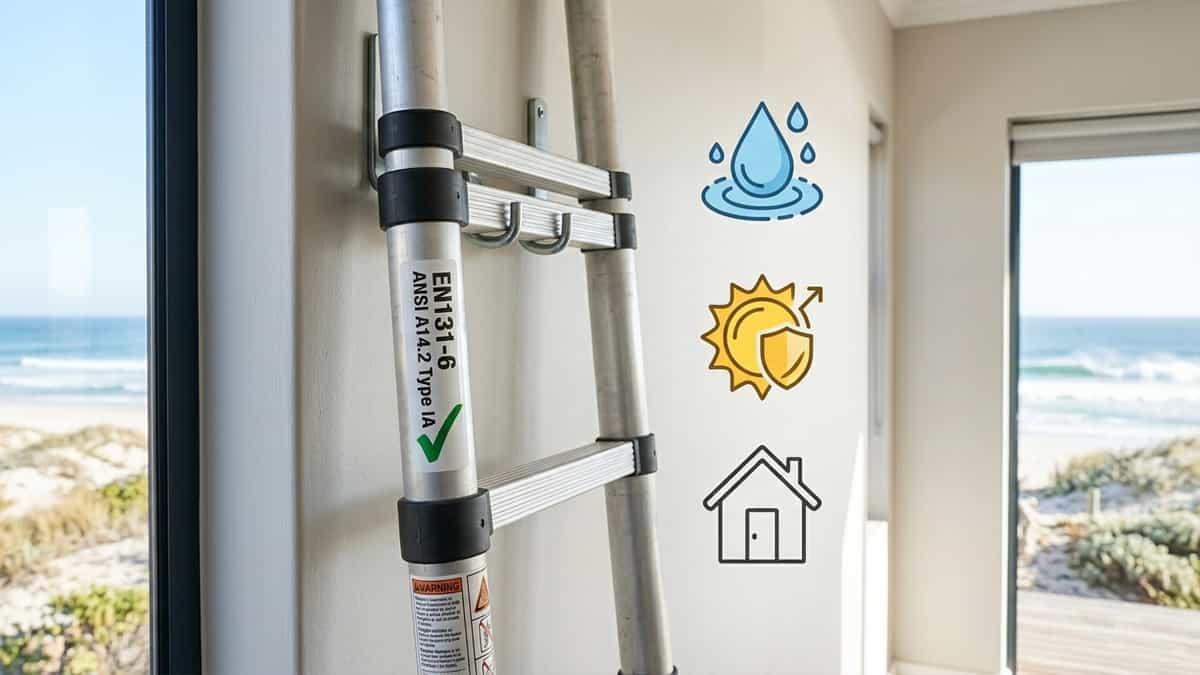
If you live near the ocean, in a tropical monsoon region, or anywhere with high humidity, storing your aluminium telescopic ladder requires special care. While aluminium does not rust like steel, humidity and salt air are aggressive enemies that can cause pitting, lock failure, and structural weakening.
This guide provides practical, climate‑specific storage tips for humid and coastal areas – from India’s monsoon belt to Australia’s salt‑laden breezes, the UK’s damp winters, and North America’s coastal zones. Follow these rules to keep your ladder safe and extend its life by years.
🌊 Coastal Warning – Salt Air Destroys Aluminium
Even if you live a mile from the ocean, airborne salt can attack your ladder. Rinse with fresh water after each use and never store outdoors.
Why Storage Matters
In dry, temperate climates, an aluminium ladder can survive years of casual storage in a garage. But in humid and coastal environments, improper storage accelerates damage dramatically.
Lifespan Comparison in Humid/Coastal Areas
| Storage Condition | Expected Lifespan |
|---|---|
| Stored indoors (air‑conditioned or dry closet) | 10–15 years |
| Stored in garage (uninsulated, high humidity) | 3–6 years |
| Stored outdoors (covered, but open air) | 1–2 years |
| Stored outdoors (exposed to salt spray) | <1 year |
The difference is indoor vs. outdoor storage. A $20 wall hook inside your home can add a decade of life.
🔗 Related reading: How Long Do Aluminium Telescopic Ladders Last?
Humidity Damage Explained
High humidity (above 70% relative humidity) creates a persistent thin film of moisture on metal surfaces. This moisture:
- Supports electrolytic corrosion – especially where aluminium touches steel (lock pins, rivets).
- Promotes mould growth – mould exudes organic acids that attack aluminium’s oxide layer.
- Traps contaminants – dust, pollen, and salt particles dissolve in moisture and concentrate as water evaporates.
High‑Humidity Regions (Examples)
| Country | High‑Humidity Areas | Risk Level |
|---|---|---|
| India | Kerala, West Bengal, coastal cities (Mumbai, Chennai, Kolkata) | Very High |
| Australia | Queensland (Brisbane, Cairns), Northern Territory, Sydney (summer) | High |
| United Kingdom | All regions – persistent damp | Moderate to High |
| Canada | Southern Ontario (summer), Vancouver (winter) | Moderate |
| United States | Southeast (Florida, Georgia, Alabama, Louisiana), Gulf Coast | Very High |
How Humidity Damages Your Ladder
- Inside telescopic tubes – Moisture seeps into the gaps between sections and cannot evaporate.
- Lock mechanisms – Steel springs and pins rust, losing tension and smooth operation.
- White oxidation – Aluminium hydroxide (white powder) forms in crevices.
- Plastic degradation – High humidity accelerates hydrolysis of nylon bushings, making them sticky.
Storage Rule #1 – Keep Ladder Dry
- Never collapse and store a damp ladder. Always extend, wipe, and air dry for at least 1 hour before retracting.
- Use silica gel packs inside the ladder bag for long‑term storage (replace every 3 months).
- Store in a room with air circulation – not a sealed plastic bag.
🔗 Related reading: Do Aluminium Telescopic Ladders Rust? – Section on Humidity
-Ads-
Salt Air Corrosion Risks
Salt air (airborne sodium chloride from ocean spray) is the most aggressive threat to aluminium ladders. Chloride ions penetrate and destroy the protective oxide layer, causing pitting corrosion.
How Far Does Salt Air Travel?
| Distance from Coast | Salt Concentration | Corrosion Risk |
|---|---|---|
| 0–500 metres | Very high | Extreme |
| 500 metres – 2 km | High | Severe |
| 2–10 km | Moderate | Significant |
| 10–50 km | Low | Mild |
| >50 km | Negligible | Minimal |
Even if you are 5 km inland, you are still at risk. Many coastal residents are surprised to find their “indoor” ladders corroding – but salt air enters homes through open windows, vents, and doors.
Real‑World Coastal Regions
| Country | High‑Risk Coastal Zones |
|---|---|
| India | Mumbai, Chennai, Goa, Kochi, Puri, Visakhapatnam |
| Australia | Sydney, Brisbane, Perth, Gold Coast, Newcastle, Wollongong |
| United Kingdom | Brighton, Bournemouth, Cornwall, Welsh coast, Scottish coast |
| Canada | Halifax, St. John’s, Vancouver Island, Prince Edward Island |
| United States | Florida (entire coast), California (coastal cities), Gulf Coast (Texas to Alabama), Hawaii |
Protection Against Salt Air
| Measure | Effectiveness |
|---|---|
| Rinse with fresh water after every use | Essential – removes salt deposits before they attack |
| Anodised or powder‑coated ladder | Adds a barrier layer |
| Indoor storage | The only reliable long‑term solution |
| Wax or sealant (marine‑grade) | Helps on outer rails |
| Silicone spray on locks | Prevents salt from reaching steel parts |
Storage Rule #2 – Rinse and Dry Every Time
If you live within 10 km of the coast:
- After using the ladder, hose it down with fresh water (or wipe with a wet cloth).
- Extend fully and dry with a clean towel.
- Leave extended for 1 hour to air dry completely.
- Apply silicone spray to locking mechanisms.
- Collapse and store inside your home – not the garage.
🔗 Related reading: How Long Do Aluminium Telescopic Ladders Last?
Garage Storage Problems
Many people store their ladder in the garage. In humid or coastal areas, a garage can be worse than outdoors.
Why Garages Are Problematic
| Issue | Consequence |
|---|---|
| Poor ventilation | Moisture builds up; never fully dries |
| Temperature swings | Condensation forms inside tubes daily |
| Car exhaust / salt | If you park a car that has driven on salted roads or near the coast, you bring salt into the garage |
| Water leaks | Garages often have damp floors or walls |
| Chemicals | Paints, solvents, fertilisers emit corrosive vapours |
Garage Storage – Acceptable Only If…
- Insulated and ventilated – Not a metal shed or attached garage without airflow.
- No car parked inside – Car brings in road salt, moisture, exhaust.
- Dehumidifier running – In very humid climates, a small dehumidifier makes a huge difference.
- Ladder stored vertically on a wall hook – Not leaning against the wall where moisture pools.
Better Alternative
Store the ladder inside your living space. A collapsed telescopic ladder takes up very little room – under a bed, in a closet, behind a door. The few seconds of inconvenience are worth years of added ladder life.
Best Wall Mount Methods
If you must store in a garage or shed, vertical wall mounting is the best method.
Why Vertical?
- Water drains out – Any residual moisture runs down and out of the tubes.
- No pressure on locks – Horizontal storage can cause locking pins to sag over time.
- Saves floor space – Ladder occupies a few inches of wall width.
Wall Mount Options
| Method | Pros | Cons |
|---|---|---|
| Ladder wall hooks (rubber‑coated) | Inexpensive ($10–20), easy to install | Requires solid wall (studs) |
| Vertical ladder rack | Holds ladder securely, often with locking strap | More expensive ($30–50) |
| Heavy‑duty tool hangers | Strong, can hold multiple ladders | May scratch ladder if not coated |
| DIY wooden cleats | Custom fit | Requires woodworking skills |
Installation Tips
- Mount into wall studs – Drywall anchors will not hold a ladder’s weight over time.
- Space hooks 1–2 feet apart – One at the top (near the ladder’s head), one near the base.
- Store with feet down – So any moisture drips out through the feet (not into the top caps).
- Keep away from windows – UV from sunlight degrades plastic parts even indoors.
Indoor vs Outdoor Storage
This is the most important decision you will make.
| Storage Location | Humidity/Coastal Suitability | Lifespan Impact |
|---|---|---|
| Inside living space (closet, under bed, behind door) | ✅ Best | +10 years |
| Inside air‑conditioned workshop | ✅ Excellent | +8 years |
| Inside garage (insulated, no car) | ⚠️ Acceptable with precautions | +0–5 years |
| Inside garage (with car, uninsulated) | ❌ Poor | -50% lifespan |
| Outdoors under carport | ❌ Very poor | -80% lifespan |
| Outdoors open air | ❌ Never | Ladder dead in 1–2 years |
Why “Outdoors Under Cover” Is Still Bad
A carport or covered porch does not protect against humidity or salt air. Moisture in the air still reaches the ladder. Temperature swings still cause condensation inside tubes. Rodents and insects can nest in collapsed sections.
If you cannot store indoors, consider a small, lockable plastic shed – but even then, drill ventilation holes to prevent trapped moisture.
🔗 Related reading: Can Aluminium Telescopic Ladders Be Left Outside?
Cleaning Before Storage
Proper cleaning is the single most effective way to prevent humidity and salt damage.
Step‑by‑Step Cleaning for Humid/Coastal Areas
- Extend the ladder fully on a clean, dry surface (not grass or soil).
- Remove loose dirt with a soft brush or compressed air.
- Wash with mild soap and fresh water – Use a soft cloth or sponge. Do not submerge the ladder.
- Rinse thoroughly – Ensure no soap residue remains (soap can attract moisture).
- Dry immediately – Use a clean towel to wipe every section, including inside tube ends.
- Leave extended for 1–2 hours in a dry, shaded area to air dry completely.
- Apply dry silicone spray to all telescopic sections and lock pins.
- Inspect rubber feet and end caps – Replace if cracked or missing.
- Collapse and store vertically indoors.
What NOT to Use
- ❌ Pressure washer – forces water into joints and locks.
- ❌ Steel wool or abrasive pads – scratches the protective oxide layer.
- ❌ Vinegar or acidic cleaners – attacks aluminium.
- ❌ Bleach or ammonia – can react with aluminium.
- ❌ WD‑40 – attracts dust and dries out locks.
Frequency
| Usage Frequency | Cleaning Minimum |
|---|---|
| Used daily (professional) | Daily wipe down; deep clean weekly |
| Used weekly | Wipe after each use; deep clean monthly |
| Used monthly | Clean before storage |
| Coastal area (any use) | Rinse with fresh water after every use |
Moisture Prevention Tips
Beyond cleaning, use these techniques to keep your ladder dry.
Silicone Spray
- Apply to telescopic sections – Extend fully, spray lightly, wipe excess. Creates a water‑repellent film.
- Apply to lock pins – Spray into the mechanism, work the lock several times.
- Frequency: Monthly in humid areas; weekly in coastal areas.
Silica Gel Packs
- Place inside ladder storage bag – 50–100 gram packs work well.
- Replace every 3 months – Or when the pack changes colour (if indicating type).
- Do not let silica gel touch aluminium directly – Use a cloth pouch.
Desiccant Dehumidifiers (for garages)
- Small rechargeable units – Cost $20–40, absorb moisture, plug in to dry.
- Place near stored ladder – Within 2–3 feet.
Air Circulation
- Never store ladder in a sealed plastic bag – Traps moisture.
- Storage bags should be breathable – Nylon or canvas is better than vinyl.
- Leave slight gap at bag opening – Prevents condensation.
Storage Orientation – Vertical vs. Horizontal
- Vertical is best – Water drains out, air circulates through tubes.
- If horizontal is unavoidable – Store with feet slightly elevated (on a block) so water can drain.
Monsoon Season Checklist (India & Tropical Regions)
Monsoon seasons – typically June to September in India, November to March in Southeast Asia – bring weeks of continuous rain and near‑saturation humidity. Use this weekly checklist.
Before Monsoon Begins
- [ ] Deep clean and dry the ladder thoroughly.
- [ ] Apply fresh silicone spray to all sections.
- [ ] Inspect plastic parts – replace any cracked end caps or feet.
- [ ] Designate an indoor storage spot (closet, under bed) – not the garage.
- [ ] Buy silica gel packs (100g) for ladder bag.
During Monsoon (Weekly)
- [ ] If ladder was used – Rinse with fresh water, dry completely, leave extended overnight indoors before retracting.
- [ ] If ladder was not used – Inspect storage area for dampness. Wipe down ladder with dry cloth.
- [ ] Check for white powder – clean immediately.
- [ ] Test locks – extend and retract once to ensure no seizing.
After Monsoon
- [ ] Full deep clean and dry.
- [ ] Apply protective wax (marine grade) to outer rails.
- [ ] Replace silica gel packs.
- [ ] Inspect for any hidden corrosion – look inside tube ends with a flashlight.
Monsoon‑Specific Warning
Do not store the ladder in a car or metal shed during monsoon. The temperature difference between day and night causes condensation inside the tubes, leading to internal water pooling and corrosion.
🔗 Related reading: Why Cheap Telescopic Ladders Feel Unsafe
Long-Term Maintenance
Even with perfect storage, a ladder in humid or coastal areas needs regular long‑term care.
Annual Maintenance (Every 12 Months)
- [ ] Full disassembly cleaning? – Only if manufacturer permits (most do not). Instead, extend fully and use compressed air to blow out tube interiors.
- [ ] Check for pitting – Look for small dark spots or white powder clusters. Shallow pitting can be sanded (fine grit) and touched up with clear coat. Deep pitting requires ladder replacement.
- [ ] Replace plastic bushings – If available from manufacturer. Worn bushings cause metal‑on‑metal contact.
- [ ] Test every lock – Apply 50 lbs of downward force on each rung while extended. No movement allowed.
- [ ] Recertify? – Not possible. Replace if any doubt.
When to Replace (Coastal/Humid Edition)
| Condition | Action |
|---|---|
| White powder covering >10% of surface | Clean and coat. Monitor. |
| Pitting deeper than 1 mm | Replace ladder. |
| Any visible crack | Replace immediately. |
| Lock pins rusted or rounded | Replace ladder (locks not user‑serviceable on most models). |
| Sections wobble excessively | Bushings worn – replace ladder. |
| Ladder >8 years old in coastal area | Strongly consider replacement. |
Expected Lifespan with Perfect Care
- Indoor storage, non‑coastal humid: 12–15 years
- Indoor storage, coastal (rinsed after every use): 8–12 years
- Garage storage, coastal: 3–5 years
- Outdoor storage, any humid/coastal: <2 years
Final Verdict
Aluminium telescopic ladders can survive in humid and coastal areas – if you store them correctly. The rules are simple:
- ✅ Store indoors – Not in the garage, not under a carport. Inside your living space.
- ✅ Rinse with fresh water after every coastal use – Salt is the enemy.
- ✅ Dry completely before collapsing – Never put away a damp ladder.
- ✅ Store vertically – On wall hooks, feet down.
- ✅ Use silicone spray monthly – Protects locks and repels moisture.
- ✅ Inspect before each use – Even well‑stored ladders can hide corrosion.
If you follow these tips, your ladder will serve you safely for a decade or more – even in the toughest humidity and salt air.
🔗 Further reading:
Related Articles

Featured


You May Also Like

What is a Picture Window?

Different Types of Aluminum Rods and Their Uses

Stop Doing This! 5 Common Aluminum Foil Mistakes That Could …

Why the Aluminum Industry is Essential for Modern Infrastruc…
Best Full View Storm Doors for Modern, Minimalist Homes