
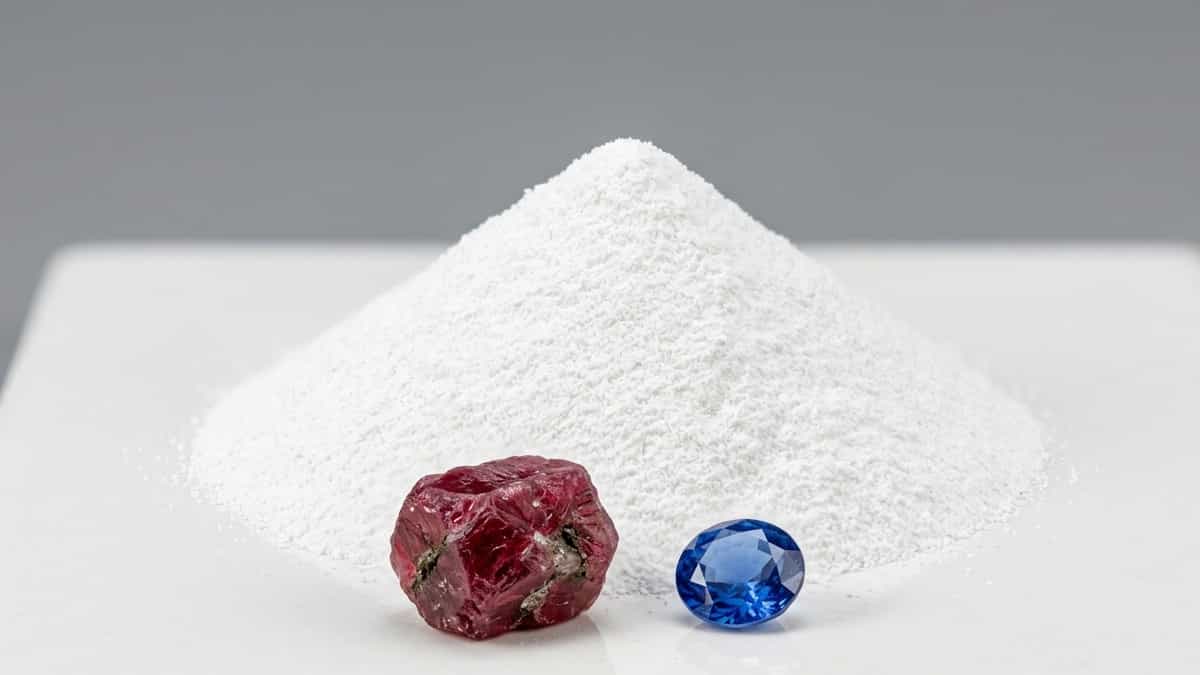
Aluminum oxide, commonly called alumina, is the most abundant and industrially important aluminum compound. It occurs naturally as the mineral corundum (which forms rubies and sapphires when colored by impurities). Industrially, it is produced as a white powder used primarily for aluminum metal production, as a high‑hardness abrasive, and as a base for technical ceramics and filtration media.
1. Basic Identification
- Chemical Formula: Al₂O₃
- Alternative Names: Alumina, corundum, bauxite ore extract
- Molecular Weight: 101.96 g/mol
- CAS Number: 1344-28-1
- Appearance: Bright white, odorless crystalline powder
2. Physical Properties
| Property | Aluminum Oxide (Alumina) |
|---|---|
| Melting Point | 2072 °C (3762 °F) |
| Boiling Point | 2977 °C (5391 °F) |
| Density | 3.95 – 4.10 g/cm³ (varies by crystalline phase) |
| Hardness (Mohs) | 9.0 (only diamond at 10 is harder on Mohs scale) |
| Solubility | Insoluble in water and most organic solvents |
Refined alumina is a fine white powder resembling flour. In its single‑crystal form (corundum), it is transparent unless metal impurities create colored gemstones (ruby, sapphire).
3. Chemical Behavior & Synthesis
3.1 Amphoteric Nature
Alumina is chemically inert in most environments but is amphoteric – it reacts with both strong acids and strong bases at elevated temperatures.
- With hot concentrated H₂SO₄:
Al₂O₃ + 3 H₂SO₄ → Al₂(SO₄)₃ + 3 H₂O - With hot NaOH solution:
Al₂O₃ + 2 NaOH + 3 H₂O → 2 NaAl(OH)₄ (sodium tetrahydroxoaluminate)
3.2 Synthesis – The Bayer Process
Over 90% of industrial alumina is refined from bauxite ore using the Bayer process:
- Crushed bauxite is mixed with hot sodium hydroxide, dissolving aluminum compounds while leaving iron and titanium impurities (red mud).
- The solution is cooled, precipitating pure aluminum hydroxide.
- The hydroxide is calcined at >1000 °C to remove water, yielding anhydrous Al₂O₃.
4. Industrial Applications
4.1 Aluminum Metal Production (Over 90% of Use)
Alumina is the feedstock for the Hall‑Héroult smelting process. It is dissolved in molten cryolite and electrolyzed to produce pure aluminum metal, which underpins the aviation, automotive, and packaging industries.
4.2 Abrasives and Machining
With a Mohs hardness of 9, alumina is a premier industrial abrasive. It is used in sandpaper, grinding wheels, and metal‑polishing compounds.
4.3 Refractories and Ceramics
Due to its high melting point (>2000 °C), alumina lines blast furnaces and steel smelters. It is also used in spark plug insulators, electrical mounts, and advanced technical ceramics.
4.4 Catalysis and Chromatography
Activated alumina (highly porous) is used to dry gases (e.g., natural gas). In laboratories, alumina columns are used in chromatography to separate chemical mixtures.
5. Safety & Hazard Management
General Safety: Alumina is low in toxicity but can cause mechanical irritation from dust.
| Route of Exposure | Effect |
|---|---|
| Inhalation | Mechanical irritation. Chronic exposure to fine dust may cause lung fibrosis (aluminosis). |
| Skin Contact | Abrasive irritation; may chafe skin. |
| Eye Contact | Mechanical scratching of the cornea. |
| Ingestion | Essentially non‑toxic; passes through GI tract unabsorbed. |
PPE: N95 dust mask, safety glasses, work gloves.
Firefighting: Non‑combustible; no special measures.
Storage: Standard dry storage; no special atmosphere.
Disposal: Can be disposed as construction/industrial waste; not hazardous.
6. Environmental Impact
Alumina itself is environmentally benign – it is abundant in the earth’s crust. However, the Bayer process produces red mud (highly alkaline slurry containing iron and titanium oxides), which requires careful containment to prevent environmental damage.
7. Comparison with Other Aluminium Compounds
| Compound | Formula | Primary Nature | Primary Industrial Use |
|---|---|---|---|
| Aluminium Oxide | Al₂O₃ | Inert ceramic ore | Aluminum smelting, abrasives, refractories |
| Aluminium Nitride | AlN | Thermally conductive ceramic | Semiconductor heat management |
| Aluminium Chloride | AlCl₃ | Highly reactive Lewis acid | Petrochemical catalyst |
8. Frequently Asked Questions
Q: Does aluminum oxide cause rust on aluminum?
A: Yes and no. Aluminum instantly forms a microscopically thin, transparent layer of Al₂O₃ that protects the metal from further corrosion – unlike iron rust which flakes apart.
Q: How is this related to rubies?
A: A ruby is a single crystal of aluminum oxide with a small amount of chromium impurities (≈1%) that give it a red color. Pure Al₂O₃ is transparent.
Q: Can I use aluminum oxide for sandblasting?
A: Yes. It is a common sandblasting media due to its high hardness and sharp edges, effectively removing rust and paint.
9. Summary Data Sheet
| Property | Value |
|---|---|
| Chemical Name | Aluminum Oxide |
| Common Name | Alumina |
| Formula | Al₂O₃ |
| Appearance | White powder |
| Melting Point | 2072 °C |
| Key Attribute | Very high hardness and refractory stability |
| Primary Utility | Feedstock for aluminum metal production |
Related Articles

Featured



You May Also Like

Aluminium Flat Bar – Types, Sizes Chart

Career in Aluminium/Aluminum Windows & Doors Business: J…

Aluminium vs Wooden Front Doors

Aluminium 5005 (Aluminum 5005): The Architect’s Alloy for Su…
Aluminium 5454 (Aluminum 5454): The Elevated Marine Alloy fo…
