
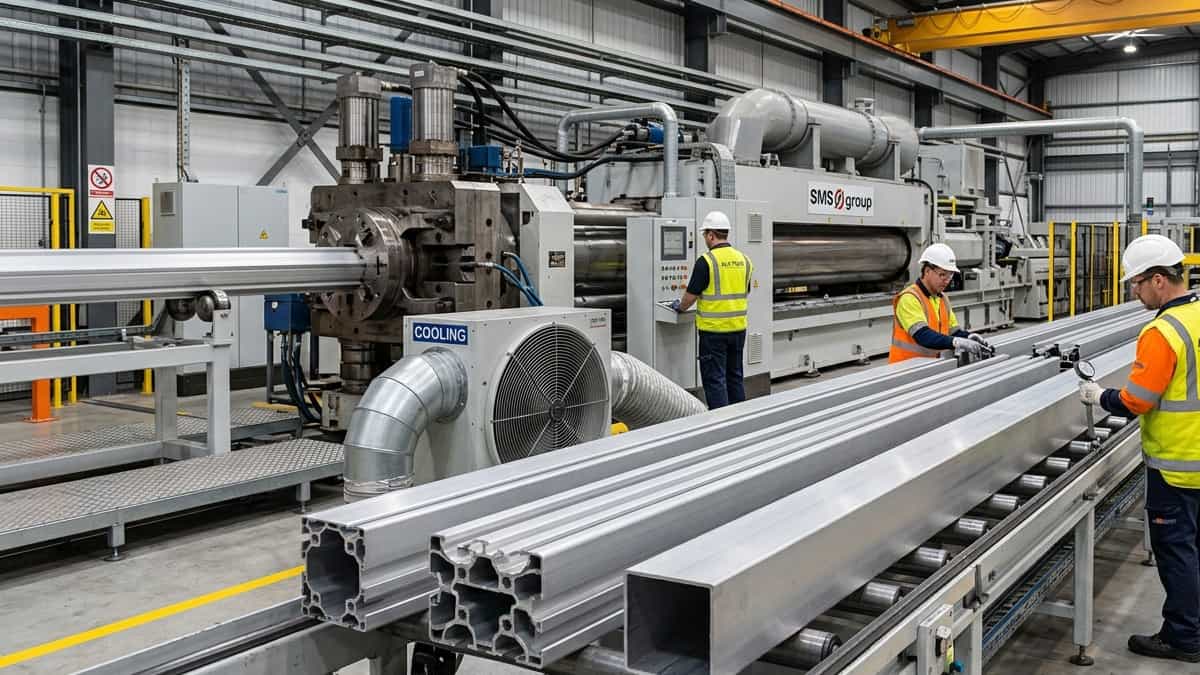
Aluminium 6005 and 6005A – also known as Aluminum 6005 and 6005A – are heat‑treatable aluminium‑magnesium‑silicon alloys that form a unique pair in the 6xxx series. While often mentioned together, they are distinct alloys: 6005 contains higher silicon levels for superior extrudability and surface finish, while 6005A adds manganese and chromium to improve toughness and reduce stress‑corrosion susceptibility. Together, they serve as medium‑strength, highly extrudable alternatives to 6061 and 6082, finding widespread use in architectural profiles, structural tubing, railway components, portable ladders, and automotive parts where excellent corrosion resistance and good bending properties are required.
What are Aluminium 6005 and 6005A?
Aluminium alloys 6005 and 6005A belong to the 6xxx series (aluminium‑magnesium‑silicon), the most versatile and widely used family of extruded aluminium alloys. Like 6060, 6063, and 6061, both 6005 and 6005A are heat‑treatable and achieve their mechanical properties through controlled thermal processing.
What makes the 6005/6005A pair special is their excellent extrusion characteristics. They are designed to flow through extrusion dies more easily than many other 6xxx alloys, producing profiles with a superior mill surface finish. This combination of extrudability and surface quality has made them favourites for applications where both strength and appearance matter.
Within the 6000 series, 6005 and 6005A occupy a middle ground: stronger than 6060 and 6063, but often more extrudable than 6061 and 6082. Their properties sit between those of 6061 and 6082, and they can sometimes be used interchangeably with those alloys – though 6005/6005A offer better extrusion characteristics and a better mill surface finish.
The Difference Between 6005 and 6005A
Understanding the distinction between 6005 and 6005A is essential for correct specification. While closely related, they are not identical.
The primary difference lies in their alloying strategies:
- Alloy 6005 contains higher amounts of silicon. This reduces the melting temperature and improves extrudability. When produced to a T5 temper, it has the same minimum tensile and yield strength as 6061‑T6, with better machinability and strength properties than 6063‑T6.
- Alloy 6005A is distinguished by its manganese and chromium content. The additional chromium (up to 0.3%) reduces stress‑corrosion susceptibility and improves toughness, while the extra manganese (up to 0.5%) enhances strength as well as extrudability.
6005A also has a slightly higher minimum aluminium content than 6005 (96.5–99.1% versus 97.5–99%), meaning it is marginally more heavily alloyed. However, the difference in mechanical properties between the two is relatively small, and in many applications they can be considered near‑equivalents.
Chemical Composition
The composition of both alloys falls within the Al‑Mg‑Si system, with magnesium and silicon as the principal strengthening elements.
Aluminium 6005 (A96005)
| Element | Percentage (%) |
|---|---|
| Aluminum (Al) | 97.5 – 99.0 |
| Silicon (Si) | 0.60 – 0.90 |
| Magnesium (Mg) | 0.40 – 0.60 |
| Iron (Fe) | ≤0.35 |
| Copper (Cu) | ≤0.10 |
| Manganese (Mn) | ≤0.10 |
| Chromium (Cr) | ≤0.10 |
| Zinc (Zn) | ≤0.10 |
| Titanium (Ti) | ≤0.10 |
| Others (Each) | ≤0.05 |
Sources: MakeItFrom, AZoM, Hydro Extrusion
Aluminium 6005A (A96005A)
| Element | Percentage (%) |
|---|---|
| Aluminum (Al) | 96.5 – 99.1 |
| Silicon (Si) | 0.50 – 0.90 |
| Magnesium (Mg) | 0.40 – 0.70 |
| Manganese (Mn) | 0.00 – 0.50 |
| Chromium (Cr) | 0.00 – 0.30 |
| Iron (Fe) | ≤0.35 |
| Copper (Cu) | ≤0.30 |
| Zinc (Zn) | ≤0.20 |
| Titanium (Ti) | ≤0.10 |
| Mn + Cr | 0.12 – 0.50 |
| Others (Each) | ≤0.05 |
| Others (Total) | ≤0.15 |
Sources: Aalco, AZoM, Hydro Extrusion
The magnesium (0.4–0.7%) and silicon (0.5–0.9%) form fine Mg₂Si precipitates during aging, providing the primary strengthening mechanism. The manganese and chromium in 6005A control grain structure and improve stress‑corrosion resistance.
Key Properties of Aluminium 6005/6005A
💪 Medium Strength – Heat Treatable
Both 6005 and 6005A are medium‑strength alloys whose properties can be significantly enhanced through heat treatment. The most common temper is T5 (cooled from an elevated temperature shaping process and then artificially aged) and T6 (solution heat‑treated and artificially aged).
Typical Mechanical Properties (6005 – T6 Temper, Rod & Bar up to 25mm):
| Property | Value |
|---|---|
| Proof Stress (0.2%) | 225 MPa (min) |
| Tensile Strength | 270 MPa (min) |
| Elongation (A50 mm) | 8% |
| Shear Strength | 205 MPa |
| Hardness (Brinell) | 90 HB |
Source: Aalco, AZoM
For thicker sections (50–100mm), slightly lower values apply: proof stress 215 MPa (min), tensile strength 260 MPa (min), hardness 85 HB.
Typical Mechanical Properties (6005A – T6 Temper, Extrusions):
| Property | Value |
|---|---|
| Proof Stress (0.2%) | 215–225 MPa |
| Tensile Strength | 260–270 MPa |
| Elongation | 8–10% |
| Hardness (Brinell) | 85–90 HB |
Source: Aalco, AZoM
In broader ranges, 6005 aluminium exhibits ultimate tensile strength from 190 to 300 MPa and yield strength from 100 to 260 MPa, depending on temper and product form.
🌊 Excellent Corrosion Resistance
Both 6005 and 6005A offer excellent corrosion resistance, a hallmark of the 6xxx series. The protective oxide film that forms naturally on aluminium surfaces is stable across a wide range of environments, including:
- Marine atmospheres – good performance in coastal and offshore settings
- Industrial environments – resistant to many chemical exposures
- Urban and rural atmospheres – long‑term durability without protective coatings
6005A’s additional chromium content (up to 0.3%) further reduces stress‑corrosion susceptibility – a critical advantage for applications involving sustained tensile stress in corrosive environments.
🏭 Excellent Extrudability – The Defining Advantage
This is where 6005 and 6005A truly excel. They are among the most extrudable alloys in the 6xxx series, offering:
- Superior mill surface finish – smoother, cleaner surfaces directly from the extrusion press, reducing or eliminating the need for post‑extrusion finishing
- Faster extrusion speeds – allowing higher productivity in extrusion plants
- Lower extrusion pressure requirements – reducing die wear and energy consumption
- Ability to produce complex profiles – though thin‑wall or highly complicated shapes remain challenging
Both alloys have excellent bending properties, with 6005A tube particularly noted for its ability to be bent without cracking.
⚡ Good Weldability
Aluminium 6005/6005A can be welded or brazed using various commercial methods (MIG, TIG, resistance welding). However, the heat from welding reduces strength in the heat‑affected zone (HAZ) , and designers should account for this when specifying welded structures.
🎨 Excellent Finishing Characteristics
Both alloys respond well to common anodising methods, including:
- Clear anodising – enhances corrosion resistance while maintaining the natural aluminium appearance
- Colour dye anodising – produces consistent, attractive colours
- Hardcoat anodising – provides enhanced wear and abrasion resistance
They are also suitable for powder coating and painting, making them versatile choices for architectural and decorative applications.
🛑 Limitations: Not for Impact or Overloading
Both alloys are not recommended for applications where the structure may be susceptible to impact or overloading. They are medium‑strength alloys, not designed for high‑impact or shock‑loading conditions. For such applications, higher‑strength alloys such as 6061‑T6, 6082‑T6, or 7000 series alloys are more appropriate.
Applications of Aluminium 6005 & 6005A
The combination of excellent extrudability, good strength, corrosion resistance, and surface finish makes these alloys popular across a wide range of industries.
🚆 Railway & Transportation – A Core Application for 6005A
6005A has found particularly strong adoption in the rail industry, especially for railway and bus profile structures. It is widely used for:
- Rail vehicle body structures – including side panels, roof sections, and floor components
- Bus and coach profiles – lightweight structural members
- Truck, trailer, and automotive components
In China, 6005A is extensively employed in the manufacture of high‑speed train car bodies, including end beams and other structural extrusions. Its ability to be quenched online (using forced air cooling directly from the extrusion press) makes it particularly attractive for high‑volume production of large, thin‑walled extrusions.
🪜 Structural Tubing & Ladders – A Core Application for 6005
6005 alloy is commonly used for:
- Portable ladder structures – lightweight, strong, and corrosion‑resistant
- Hand rail tubing – where a good surface finish is essential
- Seamless and structural tubing
- Pylons, platforms, and pipelines
🏗️ Architectural & Building Construction
Both alloys are widely specified for:
- Window and door frames – particularly where a high‑quality surface finish is required
- Curtain wall systems – 6005A extrusions can achieve weight reductions of up to 20% compared to conventional 6063 extrudates
- Building and construction applications – including structural members and architectural profiles
🚗 Automotive & General Fabrication
- Automotive connector stock
- Structural members for vehicle bodies
- Platforms and general structures
🪑 Furniture & Consumer Goods
- Tubing for furniture – lightweight, strong, and aesthetically pleasing
- Sections where greater strength is needed than given by 6060 and 6063
Aluminium 6005/6005A vs. Other 6xxx Alloys
Rather than a dense table, here is a practical guide to understanding where 6005 and 6005A fit within the 6xxx series family:
| Alloy | Key Strengths | Extrudability | Surface Finish | Typical Applications |
|---|---|---|---|---|
| 6060 | Excellent extrudability, good corrosion resistance | Excellent | Good | General architectural sections, decorative trims |
| 6063 | Good extrudability, good surface finish, good anodising response | Very good | Very good | Window frames, door frames, architectural profiles |
| 6005 / 6005A | Better extrusion characteristics than 6061/6082, medium strength, superior mill surface finish | Excellent | Excellent | Railway profiles, ladders, structural tubing, architectural extrusions |
| 6061 | Higher strength, excellent weldability, good machinability | Fair | Fair | Structural components, heavy‑duty fabrication |
| 6082 | Highest strength in 6xxx series, good corrosion resistance | Fair | Fair | Heavy‑duty structures, cranes, bridges |
Pro Tip: Choose 6005 or 6005A when extrudability and surface finish are critical – for complex profiles, ladders, handrails, and railway components. Choose 6061 or 6082 when maximum strength is required and extrudability is less important. Choose 6063 when anodising appearance is the primary concern (though 6005/6005A also anodise well).
For a detailed, interactive side‑by‑side comparison of 6005 or 6005A with any other aluminium alloy – including 6061, 6082, 6063, or 7075 – visit the Aluminium Alloy Comparison Tool.
Fabrication & Workability Guide
🏭 Extrusion – The Primary Forming Method
Extrusion is the dominant forming method for both 6005 and 6005A. These alloys are specifically formulated for extrusion, offering:
- Excellent extrudability – higher extrusion speeds and lower pressures than 6061 or 6082
- Excellent bending properties – 6005A tube can be bent to tight radii without cracking
- Good ability to produce intricate sections – though thin‑wall or highly complicated shapes remain challenging
🔥 Heat Treatment
As heat‑treatable alloys, 6005 and 6005A can be strengthened through:
| Process | Typical Parameters |
|---|---|
| Solution Treatment | Heating to approximately 530–550°C to dissolve Mg₂Si |
| Quenching | Water quenching (or forced air cooling for 6005A sections) |
| Natural Aging (T4) | Aging at room temperature – produces good ductility |
| Artificial Aging (T5/T6) | Aging at 160–190°C for 4–12 hours to achieve maximum strength |
The most common temper is T5 (cooled from an elevated temperature shaping process and then artificially aged). 6005A’s wider quenching tolerance allows online quenching directly from the extrusion press – a significant manufacturing advantage for large‑volume production.
🔧 Welding
Both alloys can be welded using MIG (GMAW) and TIG (GTAW) methods. Recommended filler alloys include 4043 and 5356. However, welding reduces strength in the HAZ, and designers should consider this in structural calculations.
⚙️ Machining
6005/6005A have fair to good machinability – better than 6063 but not as good as 6061. 6005’s higher silicon content improves chip formation and reduces tool wear compared to lower‑silicon alloys.
🎨 Anodising & Finishing
Both alloys respond well to common anodising methods, including clear, colour dye, and hardcoat anodising. They also accept powder coating and painting effectively, making them suitable for decorative architectural applications.
Why Choose Aluminium 6005 or 6005A?
✅ Advantages
- Excellent extrudability – faster extrusion speeds, lower pressures, reduced die wear
- Superior mill surface finish – smoother surfaces directly from extrusion, reducing finishing costs
- Good medium strength – stronger than 6060/6063, with properties similar to 6061‑T6 in T5 temper
- Excellent corrosion resistance – suitable for marine, industrial, and outdoor applications
- Good anodising response – accepts clear, colour, and hardcoat anodising
- Good weldability – can be welded using MIG/TIG
- Excellent bending properties – particularly 6005A tube
- 6005A offers enhanced toughness – improved stress‑corrosion resistance from chromium addition
- 6005 offers higher strength potential – with properties matching 6061‑T6 in T5 temper
- Lightweight – density of just 2.70 g/cm³
- Fully recyclable – sustainable choice
❌ Limitations
- Not recommended for impact or overloading – medium‑strength alloys, not for high‑shock applications
- Difficult to produce thin‑wall or highly complicated shapes – despite good extrudability
- Welding reduces strength – HAZ properties are lower than parent metal
- Lower strength than 6061‑T6 and 6082‑T6 – not suitable for heavy‑duty structural applications
- Limited availability in sheet and plate – primarily produced as extrusions
Final Wrap
Aluminium 6005 and 6005A (Aluminum 6005 and 6005A) represent a specialised pair of alloys within the 6xxx series, designed specifically for applications where extrudability, surface finish, and good medium strength are required.
While often mentioned together, they are distinct alloys with different alloying strategies. 6005 offers higher silicon levels for superior extrudability and a better mill surface finish, achieving properties comparable to 6061‑T6 in T5 temper. 6005A adds manganese and chromium to improve toughness and reduce stress‑corrosion susceptibility, with wider quenching tolerance allowing online cooling for large‑scale production of railway and architectural profiles.
From the high‑speed trains of China to the portable ladders in your workshop, from architectural curtain walls to furniture tubing, Aluminium 6005 and 6005A deliver reliable, cost‑effective performance where extrudability and surface quality matter most.
For engineers and fabricators seeking a medium‑strength, highly extrudable alternative to 6061 or 6082, the 6005/6005A pair offers an excellent combination of properties. Explore their capabilities relative to other alloys using the Aluminium Alloy Comparison Tool.
📚 Related Articles
Deepen your understanding of aluminium alloys with these curated guides:
- Aluminium Alloy Comparison Tool – Compare 40+ aluminium alloys side by side to find the perfect material for your project
- Aluminium 6060 Alloy: Cost‑Effective Extrusion for Complex Profiles – The lower‑strength, highly extrudable alternative for architectural applications
- Aluminium 6061 T6: Properties, Machining & Applications – The higher‑strength 6xxx alloy for structural components
- Aluminium 6063: The Extrusion Standard for Windows & Doors – The most widely used 6xxx alloy for architectural profiles
- What Is Aluminium and How Is It Made? – A foundational guide to aluminium production and alloying
Related Articles

Featured


You May Also Like

Aluminum vs. Vinyl vs uPVC Windows

Who Buys Aluminium Lithographic Sheets and Why? Uses, Thickn…

Why Do My Windows Feel So Cold? Here’s What’s Really Going O…

How War and Rising Oil Prices Could Impact Shipping and Alum…
What Do Storm Doors Do for a Home?
