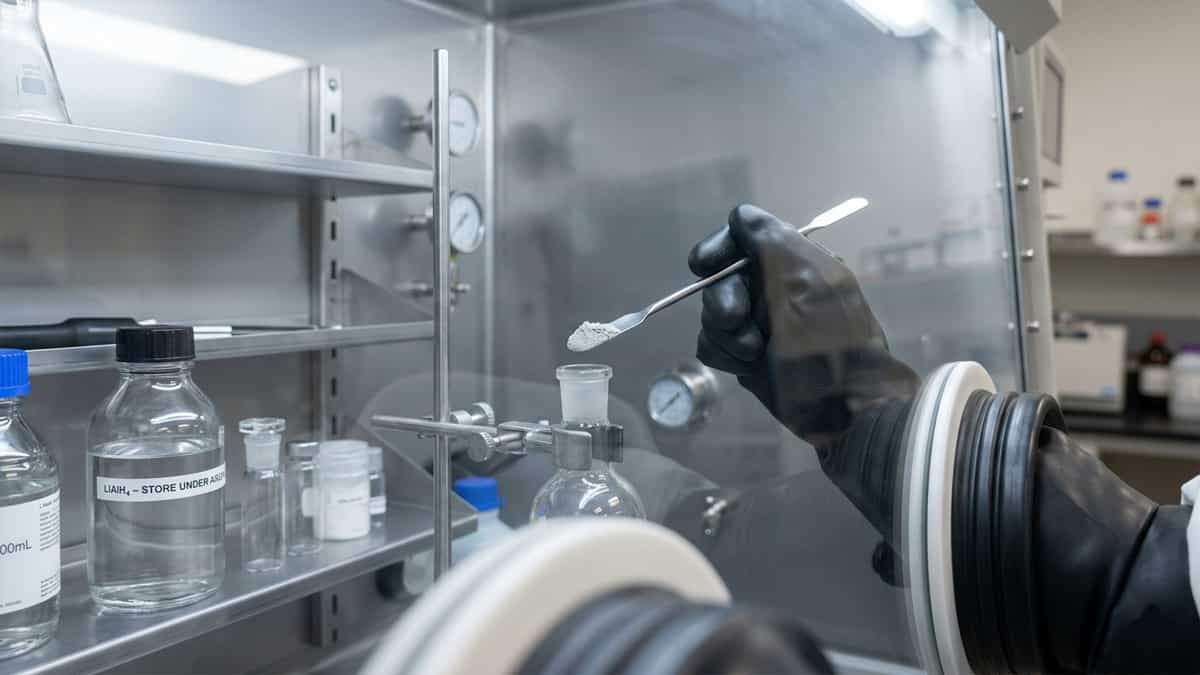
Lithium aluminum hydride, commonly abbreviated as LAH, is a complex ionic salt (Li⁺ AlH₄⁻) and one of the most powerful reducing agents used in organic chemistry. It appears as a white to gray microcrystalline powder. Due to its extreme reactivity with water and air, LAH must be handled under strictly inert conditions to prevent fires and explosions.
1. Basic Identification
- Chemical Formula: LiAlH₄
- Alternative Names: LAH, Lithal, lithium tetrahydridoaluminate
- Molecular Weight: 37.95 g/mol
- CAS Number: 16853-85-3
- Appearance: White powder (pure) or gray (commercial, due to trace aluminum metal)
2. Physical Properties
| Property | Lithium Aluminum Hydride |
|---|---|
| Melting Point | ~150 °C (decomposes while melting) |
| Boiling Point | Decomposes before boiling |
| Density | 0.917 g/cm³ (very light, floats on water – but never allow contact) |
| Solubility | Soluble in dry diethyl ether and tetrahydrofuran (THF); violently reacts with water and alcohols |
LAH is a fluffy, lightweight powder. It is typically purchased in sealed cans or as a solution in THF.
3. Chemical Behavior & Reactions
3.1 Powerful Reducing Agent
LAH delivers hydride ions (H⁻) to electron‑deficient carbon atoms. It reduces a wide range of functional groups:
- Carboxylic acids → primary alcohols
- Esters → primary alcohols
- Amides → amines
- Aldehydes and ketones → primary or secondary alcohols
It does not reduce isolated carbon‑carbon double bonds (alkenes) because the negatively charged hydride is repelled by the electron‑rich π bond.
3.2 Reaction with Water (The Primary Danger)
LAH reacts violently with water, releasing hydrogen gas and large amounts of heat:
LiAlH₄ + 4 H₂O → LiOH + Al(OH)₃ + 4 H₂ ↑
The heat can ignite the hydrogen, causing a fire or explosion. Even atmospheric humidity will cause the powder to fizz and degrade. Never expose LAH to open air without inert gas protection.
4. Applications
4.1 Pharmaceutical Synthesis
LAH is used to synthesize complex drug molecules where selective, powerful reduction is required. Many life‑saving drugs rely on LAH to convert amides to amines or esters to alcohols in the final steps of their synthesis.
4.2 Fragrance and Flavor Chemistry
High‑value alcohols and volatile esters for perfumes and flavors are often produced using LAH due to its clean reaction profile and high yield.
4.3 Polymer Analysis
LAH can cleave ester linkages in cross‑linked polymers, allowing researchers to analyze polymer structure by breaking them down into monomer units.
5. Safety & Hazard Management
| GHS Symbol | Meaning |
|---|---|
| 🔥 GHS02 | Highly flammable |
| ⚠️ GHS05 | Water‑reactive, corrosive |
5.1 Health Effects
| Route of Exposure | Effect |
|---|---|
| Inhalation | Severe burns to respiratory tract due to reaction with moisture |
| Skin Contact | Thermal and caustic burns (reaction with sweat) |
| Eye Contact | Catastrophic corneal destruction – permanent blindness |
| Ingestion | Life‑threatening; hydrogen gas release and severe internal burns |
5.2 Personal Protective Equipment (PPE)
- Respiratory: All handling of solid LAH must be inside an argon‑ or nitrogen‑purged glovebox.
- Hands: Neoprene gloves inside glovebox.
- Eyes: Face shield over tight‑seal goggles.
- Body: Fire‑resistant lab coat (Nomex or similar).
5.3 Firefighting Information
- Use: Class D dry powder extinguisher, dry sand, or powdered limestone.
- Do NOT use: Water, foam, CO₂ (LAH can react with CO₂).
6. Storage & Handling
- Container: Hermetically sealed glass or metal canisters.
- Atmosphere: Under dry argon or nitrogen.
- Location: Cool, ventilated flammable/water‑reactive storage, separate from incompatible chemicals.
- Incompatibles: Water, alcohols, acids, halocarbons, oxygen, oxidizers.
6.1 Disposal – “Quenching”
Quenching leftover LAH is a hazardous procedure. The standard Fieser method involves slow, controlled addition of ethyl acetate or a wet solvent to an ice‑cooled LAH solution behind a blast shield. Rapid addition can cause explosion. After complete quenching, the neutralized slurry can be disposed as hazardous waste.
7. Environmental Impact
LAH does not persist in the environment. It reacts violently with moisture, igniting or decomposing rapidly. The residues (lithium and aluminum hydroxides) are alkaline but localized. Large spills require professional hazmat response.
8. Comparison with Other Reducing Agents
| Agent | Formula | Reducing Power | Reactivity / Danger |
|---|---|---|---|
| Lithium Aluminum Hydride | LiAlH₄ | Extreme | Violently water‑reactive, flammable |
| Sodium Borohydride | NaBH₄ | Mild | Can be used in water/alcohol solutions |
| Aluminum Hydride | AlH₃ | Very strong | Unstable, experimental rocket fuel |
9. Frequently Asked Questions
Q: My LAH is gray instead of white – is it ruined?
A: No. Commercial LAH often contains trace aluminum metal, which gives a gray color. It is usually still active. Test with a small reduction if unsure.
Q: I left a spatula with LAH crust on the bench – is that safe?
A: No. Immediately quench the spatula with ethyl acetate or isopropanol in a fume hood. The crust can absorb humidity and ignite nearby flammables.
Q: Why can’t LAH reduce a carbon‑carbon double bond?
A: LAH delivers hydride (H⁻), a negatively charged species. Carbon‑carbon double bonds are electron‑rich and repel the hydride, so no reaction occurs.
10. Summary Data Sheet
| Property | Value |
|---|---|
| Chemical Name | Lithium Aluminum Hydride |
| Acronym | LAH |
| Formula | LiAlH₄ |
| Appearance | White to gray fluffy powder |
| Solubility | Soluble in ether/THF; explodes in water |
| Primary Utility | Powerful reducing agent in organic synthesis |
| Hazard Note | Violently water‑reactive; causes fires |
Related Articles

Featured

You May Also Like
Aluminium Silicate (Al₂SiO₅): The Complete Guide

Bifold Vs. French Casement Vs. Sliding for Patio Door

Why Awning Windows Are Perfect for Rainy, Windy, and Humid H…
If Plastic Bottles Can Be Reclosed, Why Can’t Aluminum…
The Density of Powder Coating on Aluminium Extrusions