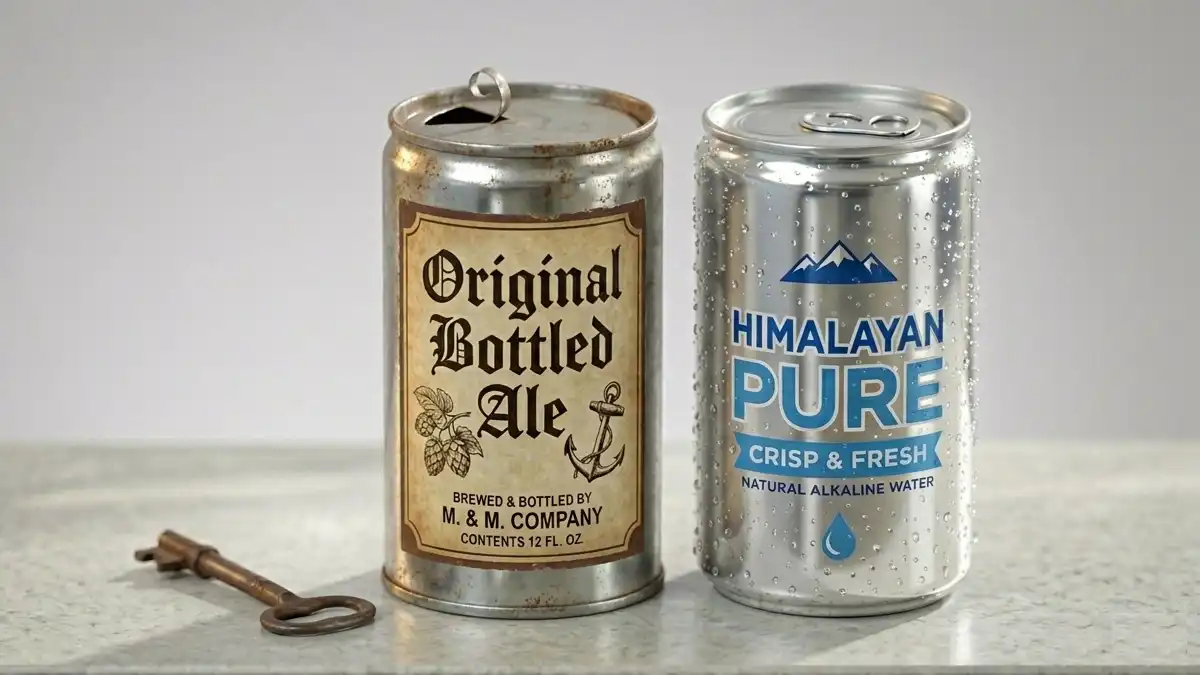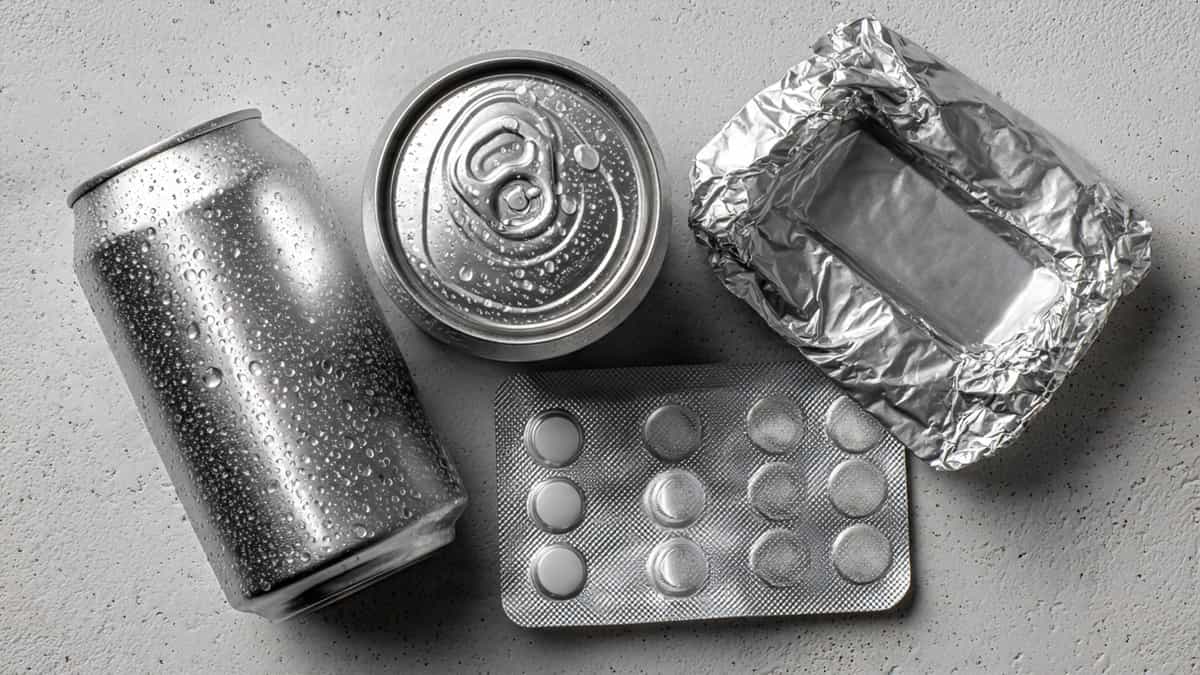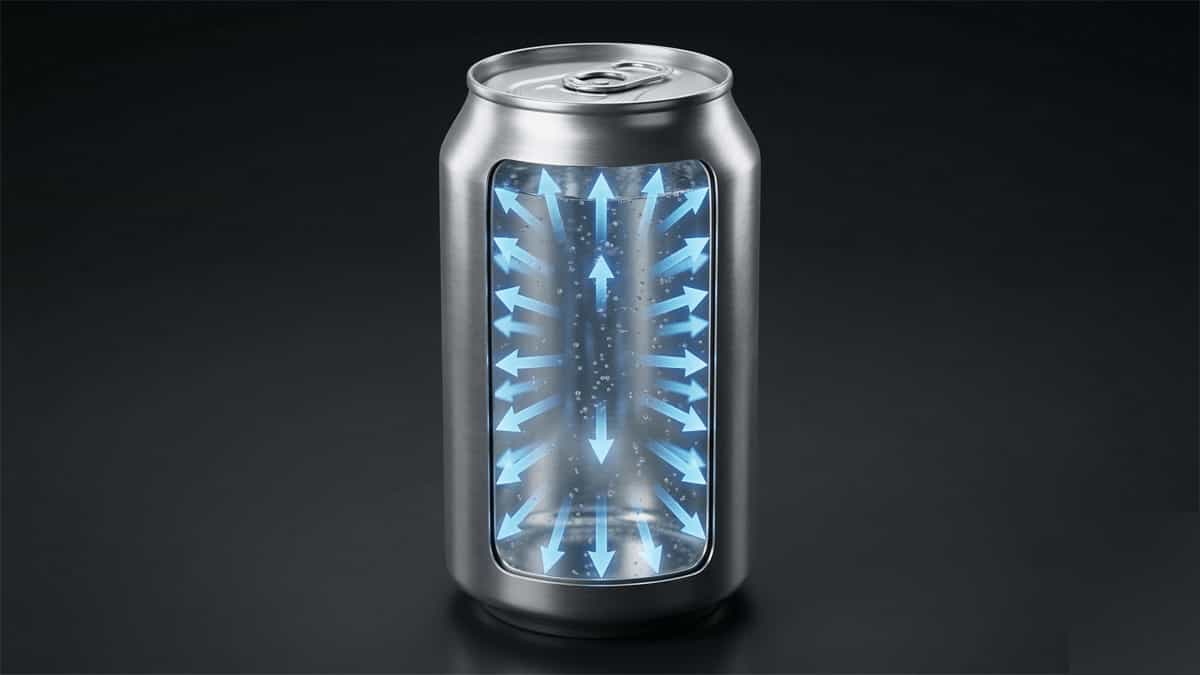
Walk into any supermarket, and you’ll see rows of beverage cans stacked high, shipped across countries, and dropped onto conveyor belts. They survive all of this while holding liquids under pressure, yet they feel almost impossibly light. Here is the engineering paradox: a standard aluminium (aluminum) can has a wall thickness of just 0.1 mm—about the thickness of two human hairs—yet it can hold internal pressure up to 90 PSI without bursting.
The secret to this incredible performance lies in a combination of precision metallurgy, advanced structural design, and high-speed manufacturing.
Exactly How Thin is an Aluminium Can?
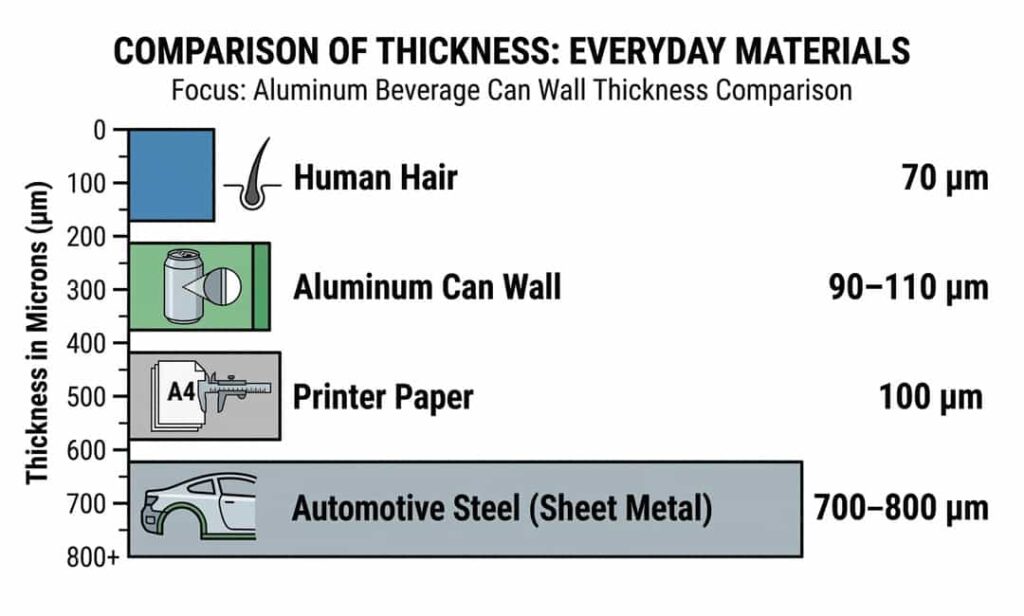
When people first learn the dimensions of a beverage can, the numbers seem too extreme to believe. A standard 12-ounce aluminium can has a wall thickness typically ranging between 90 and 110 microns.
To put that in perspective:
- Human hair: Roughly 70 microns thick.
- Printer paper: About 100 microns—roughly the same as the can wall.
- Automotive steel: Typically 700–800 microns—nearly eight times thicker than the can wall.
While the sidewall is astonishingly thin, the top and bottom are thicker (300 to 400 microns) to handle the concentrated stress of sealing, stacking, and opening.
The Metallurgy: Why Alloy Selection Matters
You cannot make a can this thin from pure aluminium; it would be too soft and rupture instantly. Instead, the industry relies on specific “workhorse” alloys designed for both formability and strength.
The Body: Alloys 3004 & 3104
These alloys contain Magnesium (0.8–1.3%) for solid solution strengthening and Manganese (1.0–1.5%) to pin grain boundaries. This allows the metal to be stretched into thin walls without tearing while resisting corrosion from acidic beverages.
The Lid: Alloy 5182
The can lid uses a different material: Aluminium 5182. This alloy is significantly stronger than the body alloys, providing the necessary structural integrity to support the tab opening mechanism.
Manufacturing at Impossible Speeds
The transformation from a flat sheet to a finished vessel happens through the Draw and Wall Ironing (DWI) process. Modern manufacturing plants are marvels of efficiency, producing:
- 2,000 cans per minute
- 120,000 cans per hour
- 370 billion cans globally every year
Modern can plants operate continuously, often producing more than 1.5 million cans per day on a single production line. This massive scale is achieved through the DWI process:
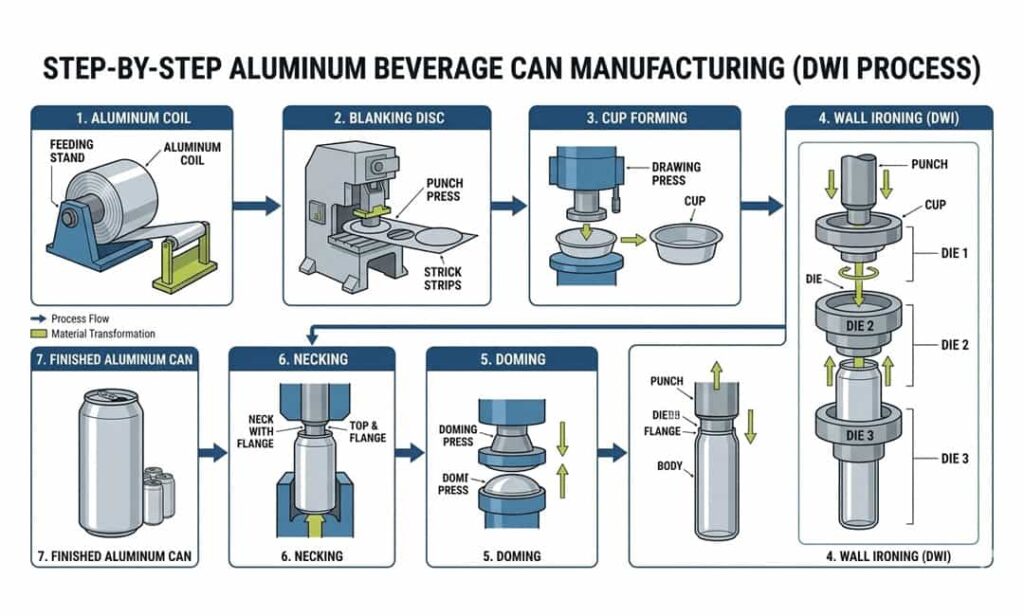
- Blanking: Circular discs are punched from a 0.3 mm thick coil.
- Cup Forming: The disc is pressed into a shallow cup, maintaining its original thickness.
- Wall Ironing: The cup is pushed through progressively smaller rings that squeeze and stretch the walls down to 0.09–0.10 mm.
- Necking: The top diameter is reduced in 10 to 12 stages to fit the smaller lid without buckling the wall.
Engineering Authority: The Hoop Stress Formula
To understand why the can doesn’t burst, engineers look at Hoop Stress—the force acting circumferentially against the cylinder wall.
The Hoop Stress Equation is defined as:
σ = Pr / t
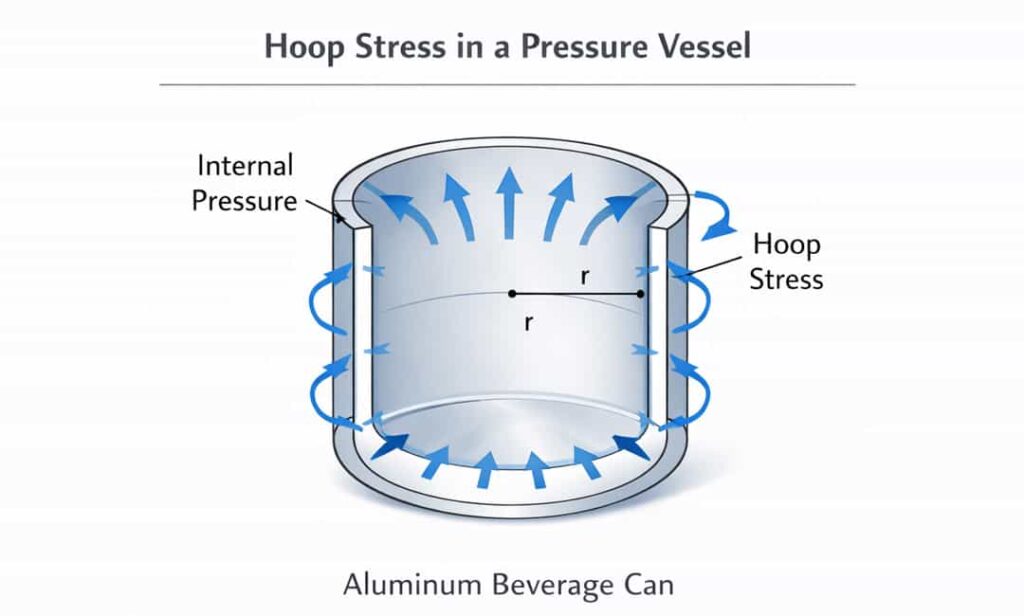
Where:
- σ = Hoop stress
- P = Internal pressure
- r = Radius of the can
- t = Wall thickness
Because the wall thickness (t) is in the denominator, any decrease in thickness significantly increases the stress the metal must endure. Aluminium cans survive this because the Wall Ironing process causes Work Hardening. By deforming the metal, the atomic lattice becomes tangled with dislocations, exponentially increasing the material’s yield strength.
Structural Design: The Dome and the Pressure
Look closely at the base of any beverage can and you will notice that it curves inward instead of remaining flat. This design is one of the most important structural features of the entire container.
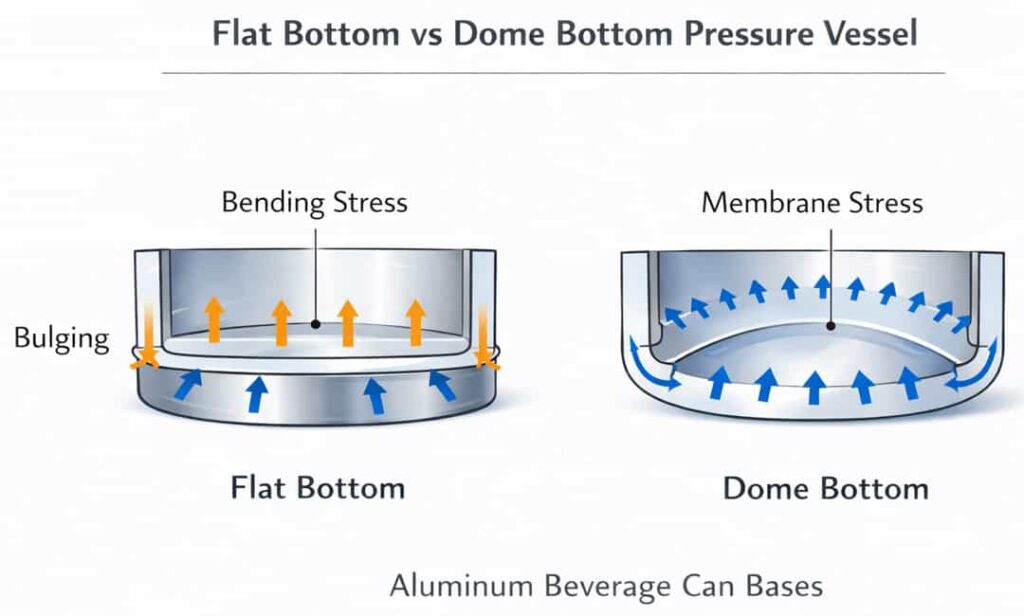
- Avoiding Failure: A flat bottom would fail quickly as internal pressure creates bending stress, leading to bulging or ruptures.
- Membrane Stress: A curved dome distributes internal pressure as uniform tension along its surface. This “arch” principle allows a thin bottom to withstand high pressure with minimal material.
- Stabilizing Pressure: A full, pressurized can is actually stronger than an empty one. Internal pressure (50–90 PSI) keeps the thin walls in tension, acting as a structural support that resists buckling.
Why Empty Cans Crush So Easily
An empty can lacks the internal pressure that provides structural stability. Without this outward force, the thin 0.1 mm walls are highly susceptible to buckling instability—a single small dent causes the entire structure to lose its load-bearing capacity and collapse.
Why the Can Has Rings and Grooves
Subtle circular grooves near the top and bottom of a can are not decorative—they are structural reinforcements. Thin cylindrical walls are naturally vulnerable to buckling. These rings interrupt the smooth surface to create stiffening bands that significantly increase resistance to deformation.
Key Benefits of Reinforcement Rings:
- Anti-buckling: Stabilizes the thin wall against external pressure during shipping.
- Stacking Strength: Reinforces the area most likely to buckle under the weight of full pallets.
- Consumer Grip: Improves handling, especially when the surface is wet with condensation.
Comparing Materials: Why Aluminium Wins
| Material | Strength-to-Weight | Recycling Energy | Recyclability | Barrier Properties |
| Aluminium | Excellent | 95% energy saving | 100% (Infinite) | Excellent |
| Steel | Good | ~60% energy saving | High | Good |
| Plastic (PET) | Low | ~20% energy saving | Downcycled | Poor |
| Glass | Moderate | High melting energy | High | Excellent |
Aluminium remains the dominant choice because it can be recycled indefinitely without losing its metallurgical properties. A used can can be back on the shelf as a new product in as little as 60 days.
FAQs
- What is the specific lid alloy?
The lid uses Aluminium 5182, which is stronger than the body to support the opening tab. - How much does a modern can weigh?
Through “lightweighting,” a 12-ounce can now weighs approximately 13 grams, down from 85 grams in the 1960s. - How thick is the wall exactly?
It is roughly 0.1 mm, which is equivalent to two human hairs or a single sheet of printer paper.
This article is part of our comprehensive coverage of aluminum applications. For more on aluminum alloys, read about Aluminum 3004 properties and the aluminum can recycling process. For environmental comparisons, see aluminum cans vs plastic bottles.