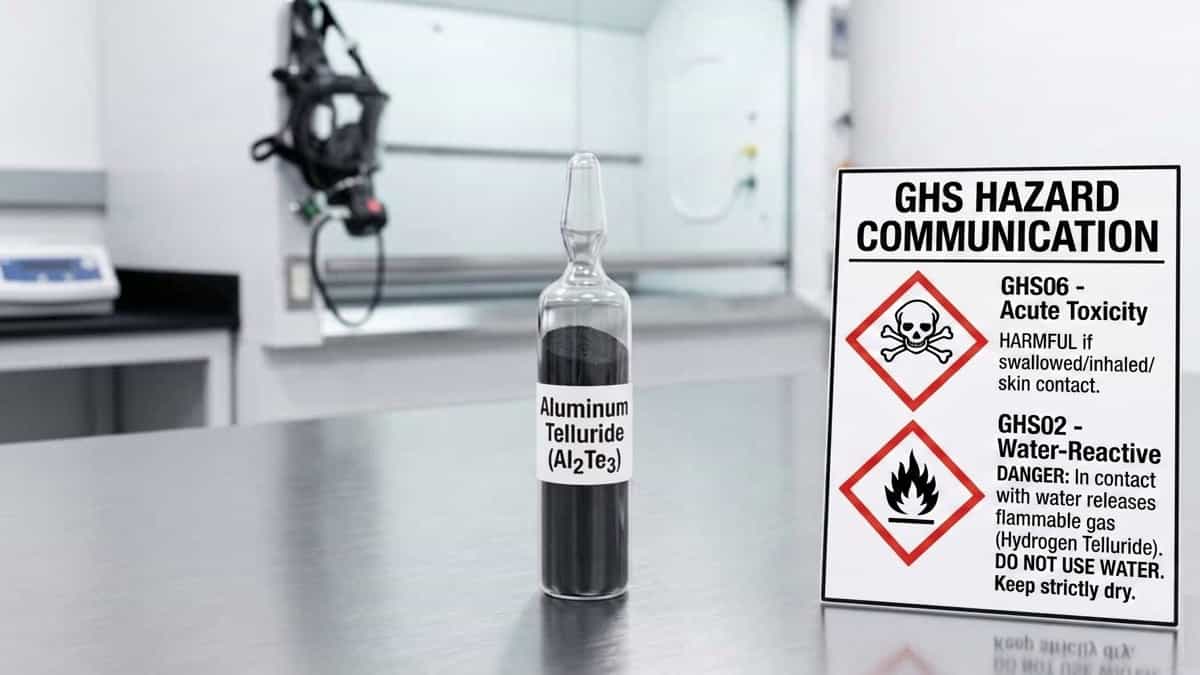
Aluminium telluride is a binary compound of aluminium and tellurium. It is a highly moisture‑sensitive, rare chalcogenide that decomposes in water to release hydrogen telluride (H₂Te) – an extremely toxic, foul‑smelling gas similar to hydrogen sulfide but even more hazardous. Due to its instability and toxicity, it has no consumer applications and is used only in specialized research.
1. Basic Identification
- Chemical Formula: Al₂Te₃
- Alternative Names: Aluminium(III) telluride, dialuminum tritelluride
- Molecular Weight: 436.76 g/mol
- CAS Number: 12043-29-7
- Appearance: Dark grey to black crystalline solid or powder
2. Physical Properties
| Property | Aluminum Telluride |
|---|---|
| Melting Point | 895 °C (1643 °F) (under inert atmosphere) |
| Density | ~4.5 g/cm³ |
| Crystal Structure | Hexagonal or cubic (dependent on preparation) |
| Solubility | Reacts violently with water; insoluble in organic solvents |
Aluminum telluride is a dense, dark grey/black solid. It is stable only in completely dry, oxygen‑free environments. Exposure to air causes rapid decomposition.
3. Chemical Behavior & Synthesis
3.1 Reaction with Water – Hydrogen Telluride Generation
Al₂Te₃ + 6 H₂O → 2 Al(OH)₃ + 3 H₂Te ↑
Observations:
- The solid fizzes and releases hydrogen telluride (H₂Te) gas.
- H₂Te is extremely toxic (more so than H₂S), has a foul garlic‑like odor, and is unstable in air (decomposes to elemental tellurium).
- The gas is also flammable and can form explosive mixtures.
3.2 Synthesis
Prepared by direct combination of the elements under high heat in a sealed, inert atmosphere:
2 Al + 3 Te + Heat → Al₂Te₃
The reaction is exothermic and must be performed in sealed quartz ampoules or under flowing argon to exclude oxygen and moisture.
4. Applications
Aluminum telluride has no commercial or consumer applications due to its extreme moisture sensitivity and toxicity. Its uses are restricted to fundamental research:
4.1 Laboratory Source of H₂Te
In specialized chemistry research, Al₂Te₃ can be used to generate small amounts of hydrogen telluride for studies of tellurium‑containing compounds or as a tellurium precursor.
4.2 Materials Science Research
Al₂Te₃ is studied as a potential thermoelectric material or as a component in chalcogenide glasses for infrared optics, though practical applications remain experimental.
Note: Due to safety hazards, most researchers prefer alternative tellurium sources (e.g., tellurium metal + reducing agents) over handling Al₂Te₃ directly.
5. Safety & Hazard Management
| GHS Symbol | Meaning |
|---|---|
| ☠️ GHS06 | Acute toxicity (fatal if inhaled) |
| 🔥 GHS02 | Flammable gas (H₂Te) |
Critical Warning: Aluminium telluride itself is hazardous, but the real danger is the hydrogen telluride gas released upon contact with water or humid air. H₂Te is more toxic than hydrogen sulfide and can be fatal even at low concentrations.
5.1 Health Effects
| Route of Exposure | Effect |
|---|---|
| Inhalation (H₂Te gas) | Pulmonary edema, respiratory failure, headache, nausea. High concentrations cause rapid collapse and death. |
| Skin Contact | Solid may cause irritation; moisture on skin leads to localized gas burns. |
| Eye Contact | Solid dust is abrasive; H₂Te gas severely irritates eyes. |
| Ingestion | Stomach acid accelerates H₂Te release → internal poisoning. |
5.2 Personal Protective Equipment (PPE)
- Respiratory: SCBA (Self‑Contained Breathing Apparatus) – mandatory if any moisture contact risk exists. Particulate masks do NOT protect against H₂Te gas.
- Hands: Heavy butyl rubber or nitrile gloves
- Eyes: Tight‑sealing chemical goggles + face shield
- Body: Fully encapsulating chemical‑resistant suit
5.3 First Aid Measures
- Inhalation: Remove victim to fresh air immediately. Administer oxygen. Seek emergency medical help urgently.
- Skin: Brush off dry chemical, then wash with copious water.
- Eyes: Flush with water for 15+ minutes; seek ophthalmologist.
- Ingestion: Do not induce vomiting. Seek immediate medical attention.
5.4 Firefighting Information
- H₂Te gas is flammable and can explode in confined spaces.
- Use: Dry sand, Class D powder, or CO₂ (for small fires).
- Do NOT use: Water – will generate more H₂Te gas.
6. Storage & Handling
- Container: Sealed glass ampoules or metal containers under inert gas (argon)
- Atmosphere: Strictly dry, inert – never open in humid air
- Location: Cool, dry, well‑ventilated, locked hazardous materials storage
- Incompatibles: Water, moisture, acids, oxidizing agents
6.1 Disposal
Do not discard in trash or down drains. Small quantities must be deactivated in a fume hood by slow, controlled addition to a strong oxidizing solution (e.g., concentrated bleach) which converts telluride to non‑volatile tellurite/tellurate. This must be done by trained professionals.
7. Environmental Impact
Hydrogen telluride is highly toxic to aquatic life. Tellurium compounds can bioaccumulate but are not as well studied as selenium analogs. Large spills require hazmat response. Aluminum telluride itself, if released, rapidly hydrolyzes to H₂Te (disperses or oxidizes to elemental tellurium) and aluminum hydroxide (inert).
8. Comparison with Other Aluminum Chalcogenides
| Compound | Formula | Gas Released in Water | Toxicity of Gas |
|---|---|---|---|
| Aluminium Telluride | Al₂Te₃ | Hydrogen telluride (H₂Te) | Extremely toxic (more than H₂S) |
| Aluminium Selenide | Al₂Se₃ | Hydrogen selenide (H₂Se) | Extremely toxic |
| Aluminium Sulfide | Al₂S₃ | Hydrogen sulfide (H₂S) | Highly toxic |
| Aluminium Oxide | Al₂O₃ | None | Non‑toxic |
9. Frequently Asked Questions
Q: Does aluminum telluride occur naturally?
A: No. Tellurium is a rare element, and Al₂Te₃ is entirely synthetic. It is produced only in research laboratories.
Q: Is this used in any consumer products?
A: Absolutely not. It is a specialist laboratory chemical with no household, medical, or agricultural use. Its extreme toxicity and moisture sensitivity make it unsuitable for any consumer application.
Q: What does hydrogen telluride smell like?
A: H₂Te has a pungent, garlic‑like odor at low concentrations. However, like H₂S, it can paralyze the sense of smell at higher concentrations, making it even more dangerous.
Q: What should I do if I suspect a spill?
A: Evacuate the area immediately, ventilate if possible, and call professional hazmat responders. Do not attempt cleanup without SCBA and full protective suit.
10. Summary Data Sheet
| Property | Value |
|---|---|
| Chemical Name | Aluminum Telluride |
| Formula | Al₂Te₃ |
| Appearance | Dark grey to black solid/powder |
| Melting Point | 895 °C |
| Density | ~4.5 g/cm³ |
| Defining Trait | Releases lethal H₂Te gas on contact with water |
| Primary Utility | Laboratory research only (no commercial use) |
| Storage | Sealed, dry, inert atmosphere; strict hazard protocols |