
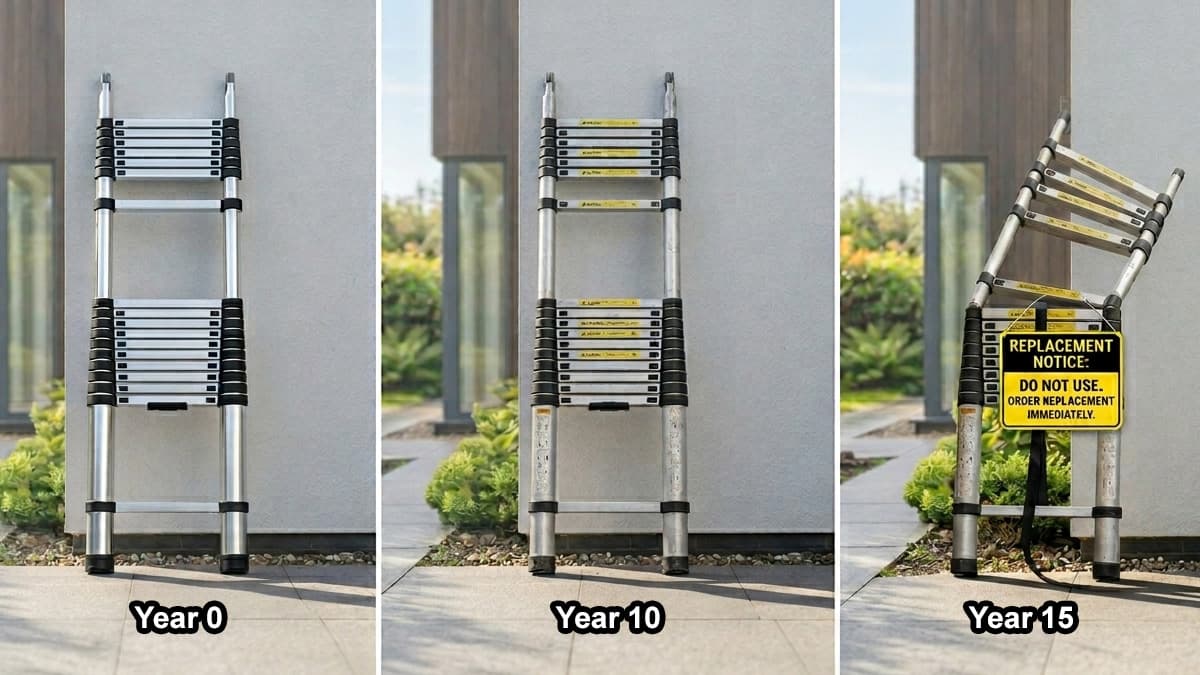
If you are investing in a telescopic ladder, you want to know how many years of service you can expect. The answer depends on how you use it, where you store it, and how well you maintain it. A high‑quality aluminium telescopic ladder can last 15–20 years for residential use, 5–10 years for professional use, and 3–5 years for heavy industrial use.
This guide breaks down every factor that affects ladder lifespan, provides real‑world expectations for different climates and usage patterns, and helps you recognise when it is time to replace your ladder.
⏰ Safety Reminder – Age Alone Is Not a Failure Criterion
A well‑maintained 20‑year‑old ladder can be safer than a neglected 2‑year‑old ladder. Always inspect before each use, regardless of age. Replace based on condition, not just years.
Average Lifespan
Here are realistic lifespan expectations for aluminium telescopic ladders from reputable brands (certified to EN131 or ANSI).
| Usage Type | Typical Lifespan | Notes |
|---|---|---|
| Residential (occasional) | 15–20 years | Used a few times per month, stored indoors, light loads. |
| Residential (frequent DIY) | 10–15 years | Used weekly, some outdoor exposure, moderate care. |
| Professional (tradesperson) | 5–10 years | Used daily, carried between sites, some outdoor storage. |
| Industrial (factory/warehouse) | 3–5 years | Heavy daily use, harsh environment, multiple users. |
| Outdoor stored (any use) | 1–3 years | Regardless of usage frequency, outdoor storage kills ladders quickly. |
🔗 Related reading: Aluminium Telescopic Ladders: Complete Guide
Factors Affecting Durability
Lifespan is not just about years – it is about cycles, environment, and care. The following table shows how each factor influences longevity.
| Factor | Impact on Lifespan | Best Practice |
|---|---|---|
| Storage location | Indoor adds 10+ years; outdoor subtracts 10+ years | Store vertically indoors |
| Frequency of use | Daily use wears locks and bushings faster | Inspect more often with heavy use |
| Climate (humidity/salt) | Coastal/humid reduces lifespan by 50–70% | Rinse after use, use anodised ladder |
| Temperature extremes | Heat expands, cold embrittles | Avoid storing in cars or metal sheds |
| Load management | Overloading causes hidden fatigue | Never exceed rated capacity |
| Cleaning frequency | Dirt accelerates wear | Wipe down after every use |
| Lock lubrication | Keeps mechanisms smooth | Dry silicone spray monthly |
| UV exposure | Destroys plastic parts | Keep out of direct sun |
Frequency of Use
The more you extend and retract the ladder, the faster components wear.
Typical Cycle Counts
| Usage Level | Extend/Retract Cycles per Year | Lifespan (years) |
|---|---|---|
| Occasional home use | 50–100 | 15–20 |
| Weekend DIY | 200–500 | 10–15 |
| Professional (daily) | 1,000–2,000 | 5–8 |
| Heavy industrial | 3,000–5,000 | 3–5 |
Why cycles matter: Each extension and retraction wears the plastic bushings, stresses the lock springs, and abrades the aluminium surface. EN131‑6 certified ladders are tested to 4,000 cycles – that is the minimum for professional certification. Cheap ladders may fail at 500 cycles.
How to Track Usage
You do not need a counter. Instead:
- Feel for smoothness – If sections become gritty or hard to slide, wear is advanced.
- Listen for clicks – If locks stop clicking positively, internal springs may be tired.
- Look for metal dust – Fine aluminium powder near tube ends indicates excessive wear.
🔗 Related reading: Why Cheap Telescopic Ladders Feel Unsafe – Section on Lock Wear
Industrial vs Residential Usage
The demands on a ladder are completely different for a homeowner versus a construction worker.
Residential Use
- Frequency: Once or twice a month.
- Loads: Usually well below capacity.
- Environment: Mostly indoors or brief outdoor use.
- Storage: Typically in a garage or closet.
- Transport: Rarely moved far.
Expected lifespan with good care: 15–20 years. Many homeowners inherit ladders from parents and use them safely for decades.
Professional Use (Trades)
- Frequency: Multiple times daily.
- Loads: Often near capacity (user + tools).
- Environment: Construction sites – dust, mud, rain, sun.
- Storage: In a truck or job site shed.
- Transport: Banged around in vehicle.
Expected lifespan with good care: 5–10 years. Professionals should budget for replacement every 5–7 years, even with maintenance.
Industrial Use (Warehouse, Factory)
- Frequency: Constant – ladder may be used by multiple shifts.
- Loads: Consistently near maximum.
- Environment: Harsh – chemicals, temperature swings, impacts.
- Storage: In a tool crib or on a wall hook.
- Transport: Minimal, but rough handling.
Expected lifespan: 3–5 years. Industrial ladders should be replaced on a fixed schedule regardless of appearance, because invisible fatigue is common.
Climate Damage Effects
Climate is the single largest factor outside of usage. Below are region‑specific impacts and lifespan estimates.
🇮🇳 India (Tropical, Monsoon, Coastal)
| Climate Factor | Effect on Ladder | Lifespan Reduction |
|---|---|---|
| Monsoon humidity | Internal corrosion, sticky bushings | 30–50% |
| Coastal salt air (Chennai, Mumbai) | Pitting, white oxide, lock rust | 60–80% |
| Extreme heat (45°C+) | Plastic bushing creep, expansion misalignment | 20–30% |
Expected lifespan (indoor storage): 8–12 years
Expected lifespan (outdoor/garage): 2–4 years
Recommendation: Use anodised aluminium. Store inside living area during monsoon. Rinse weekly.
🇦🇺 Australia (Heat, UV, Coastal)
| Climate Factor | Effect on Ladder | Lifespan Reduction |
|---|---|---|
| UV (extreme) | Plastic levers crack, bushings degrade | 40–60% |
| Desert heat (50°C) | Expansion, sticky locks, feet harden | 20–30% |
| Coastal (Sydney, Perth, Brisbane) | Salt corrosion | 50–70% |
Expected lifespan (indoor storage): 10–15 years
Expected lifespan (outdoor/tradie ute): 2–4 years
Recommendation: Use ladder bag for transport. Never leave in parked car. Replace plastic parts every 2 years.
🇬🇧 United Kingdom (Damp Cold, Rain)
| Climate Factor | Effect on Ladder | Lifespan Reduction |
|---|---|---|
| Persistent rain | Internal moisture, lock rust | 20–30% |
| Freeze‑thaw cycles | Ice expansion, cracked bushings | 15–25% |
| Mould / damp storage | Organic acids attack aluminium | 10–20% |
Expected lifespan (indoor storage): 12–18 years
Expected lifespan (outdoor shed): 4–6 years
Recommendation: Dry thoroughly after every use. Apply silicone spray monthly. Store indoors if possible.
🇨🇦 Canada (Extreme Cold, Snow, Ice)
| Climate Factor | Effect on Ladder | Lifespan Reduction |
|---|---|---|
| Extreme cold (< -20°C) | Aluminium brittle, lock springs stiff | 10–20% |
| Snow / ice | Freeze‑thaw damage, water ingress | 20–30% |
| Road salt (if stored in garage) | Chloride corrosion | 30–40% |
Expected lifespan (heated indoor storage): 15–20 years
Expected lifespan (unheated garage): 5–8 years
Recommendation: Bring ladder inside during cold snaps. Never store in a garage that gets road salt from cars.
🇺🇸 United States (Regional)
| Region | Primary Threat | Expected Lifespan (Indoor Storage) |
|---|---|---|
| Northeast / Midwest | Freeze‑thaw, road salt | 12–15 years |
| Southeast / Gulf Coast | Humidity, salt air, heat | 8–12 years (anodised) |
| Southwest (desert) | UV, extreme heat | 10–14 years |
| Pacific Northwest | Rain, damp | 12–16 years |
| Coastal California | Salt air, moderate | 10–14 years |
🔗 Related reading: Climate Effects on Aluminium Ladders by Region
-Ads-
Lock Wear and Tear
The locking mechanism is the most wear‑prone component and the most critical for safety.
How Locks Wear
| Component | Wear Mechanism | Signs |
|---|---|---|
| Steel lock pins | Rounded edges from repeated engagement | Pin doesn’t fully extend; slips out |
| Aluminium lock holes | Elongation from pin pressure | Loose fit; ladder drops slightly when loaded |
| Lock springs | Loss of tension | Pin doesn’t pop out automatically |
| Plastic levers | UV + fatigue cracking | Lever feels loose, cracks visible |
| Bushings | Abrasion from sliding | Sections wobble; metal‑on‑metal contact |
Lock Lifespan Expectations
| Usage | Lock Life (cycles) | Rough Years (daily use) |
|---|---|---|
| Certified ladder (EN131) | 4,000+ cycles | 4–5 years (professional) |
| Mid‑range ladder | 2,000–3,000 cycles | 2–3 years |
| Cheap ladder | 500–1,000 cycles | <1 year |
Testing Locks for Wear
Every time you extend the ladder:
- Listen for a sharp click.
- Look for the lock indicator (green = locked).
- Gently push down on the rung above the lock – it should not move.
- Check that both side pins are visible and symmetrical.
If any lock fails this test, do not use the ladder. Replace the lock if possible; otherwise retire the ladder.
Aluminum Frame Fatigue
Aluminium, unlike steel, has a finite fatigue life. Repeated loading and unloading – even below the rated capacity – can eventually cause cracks.
What Causes Fatigue
- Repeated flexing – Every time you climb, the rails bow slightly. Over thousands of cycles, microscopic cracks form.
- Overloading – Even once can cause permanent micro‑damage.
- Vibration – Transporting the ladder in a truck bed causes constant small vibrations.
- Thermal cycling – Expansion and contraction stress the metal.
Fatigue Life Estimates
| Load Level | Cycles to Failure (Approx.) |
|---|---|
| 50% of rated capacity | >1,000,000 (never fails in normal use) |
| 75% of rated capacity | 500,000+ |
| 100% of rated capacity | 100,000–200,000 |
| 120% of rated capacity | 10,000–20,000 |
For a professional using the ladder 10 times per day at full capacity:
100,000 cycles ÷ 10 per day ÷ 250 working days = 40 years – well beyond the ladder’s practical life. Fatigue is rarely the failure mode for residential or professional use unless the ladder is overloaded.
However: Impact damage (dropping the ladder, hitting it with a tool) creates stress risers that accelerate fatigue dramatically. A dented rail may fail in weeks.
Visual Fatigue Signs
- “Crazing” – Very fine hairline cracks in the aluminium surface.
- White lines – Localised stress marks near rivet holes.
- Bowing – The ladder no longer extends perfectly straight.
🔗 Related reading: Signs of a Damaged Aluminium Ladder
-Ads-
Signs It’s Time to Replace
Do not wait for a ladder to fail completely. Replace it immediately if you see any of these signs.
Red Flags – Replace Now
| Sign | Why It’s Dangerous |
|---|---|
| Crack anywhere in aluminium | Will propagate under load, sudden failure |
| Bent or warped rail | Rail cannot bear load evenly |
| Lock pin missing or broken | Section will collapse |
| Lock does not click / hold | Partial engagement – may slip |
| Deep pitting or flaking corrosion | Structural metal loss |
| Ladder wobbles excessively | Tolerances worn out |
| Rungs are loose or dented | Footing failure |
| Ladder has been in a significant fall | Invisible internal damage |
Yellow Flags – Monitor Closely, Plan Replacement
| Sign | Action |
|---|---|
| Surface pitting (shallow) | Clean, apply protective coating. Inspect monthly. |
| Sections hard to extend | Clean and lubricate. If persists, bushings worn. |
| Locks feel “mushy” | Replace lock mechanism or plan for new ladder. |
| Plastic levers cracked but still functional | Order replacements or budget for new ladder. |
| Ladder over 15 years old (heavy residential use) | Increase inspection frequency. |
The 10‑Year Professional Rule
If you use your ladder daily for trade work, replace it every 5–8 years even if it looks fine. The cost of a new ladder ($150–250) is trivial compared to injury costs.
The 20‑Year Homeowner Rule
If you have a well‑maintained ladder stored indoors, you can safely use it for 20 years – but inspect it carefully every single time. After 20 years, replace it regardless of condition.
Maintenance to Extend Lifespan
You can dramatically extend ladder life with simple, regular maintenance.
Daily / After Each Use
- [ ] Wipe down all sections with a dry cloth (remove dirt, paint, glue).
- [ ] If ladder got wet, extend fully and air dry for 1 hour before retracting.
- [ ] Check locks click and hold.
- [ ] Store vertically indoors or in a dry, shaded place.
Weekly (Professional) / Monthly (Residential)
- [ ] Deep clean with mild soap and water.
- [ ] Apply dry silicone spray to telescopic sections – extend, spray, wipe, retract.
- [ ] Inspect plastic parts (end caps, levers, feet) for cracks.
- [ ] Check for any white powder (clean immediately).
Every 6 Months
- [ ] Inspect every lock pin – look for rust or rounding.
- [ ] Check rivets – none should be loose.
- [ ] Verify certification label is still legible (for resale/inspection).
- [ ] Test ladder on level ground – no wobble.
Yearly
- [ ] Full disassembly cleaning? (Only if manufacturer allows – most do not). Usually not needed.
- [ ] Consider professional inspection if ladder is used professionally.
- [ ] Apply UV protectant to plastic parts (303 Aerospace or similar).
What Shortens Lifespan – Avoid These
- ❌ Storing outdoors (rain, sun, snow).
- ❌ Leaving ladder in a parked car.
- ❌ Retracting a wet or dirty ladder.
- ❌ Using oil or WD‑40 on locks (attracts dust).
- ❌ Standing on the top two rungs.
- ❌ Exceeding weight rating.
- ❌ Dropping the ladder.
🔗 Related reading: Ladder Maintenance and Cleaning – Guide
Final Verdict
How long do aluminium telescopic ladders last?
With proper care and indoor storage, a certified ladder lasts 15–20 years for residential use and 5–10 years for professional use. Outdoor storage cuts lifespan to 1–3 years regardless of brand.
Key Takeaways
| Factor | Impact on Lifespan |
|---|---|
| Store indoors | Adds 10–15 years |
| Store outdoors | Reduces to 1–3 years |
| Clean after every use | Adds 5+ years |
| Lubricate locks monthly | Prevents wear, adds years |
| Use certified ladder (EN131/ANSI) | Built to last – 4,000+ cycles |
| Buy cheap ladder | May fail in months |
| Live in coastal area | Reduce expectation by 50% |
| Use daily (professional) | Replace every 5–8 years |
| Use occasionally (homeowner) | 15–20 years is realistic |
The Bottom Line
Your aluminium telescopic ladder is an investment in safety. A quality ladder from a reputable brand, stored indoors and cleaned regularly, will serve you for decades. Cheap ladders and outdoor storage are the two fastest paths to early failure – and to injury.
Inspect before every climb. Maintain regularly. Replace when uncertain. Your life is worth far more than the cost of a new ladder.
🔗 Further reading:
Related Articles

Featured


You May Also Like

Aluminium Windows in Public Buildings
Storm Door Installation Cost: What Homeowners Should Expect

Reflective Glass Pros and Cons: Benefits, Drawbacks, and Usa…
EN131 and OSHA Ladder Safety Standards Explained

How to Properly Recycle Aluminum Foil (and Why It Matters)
