
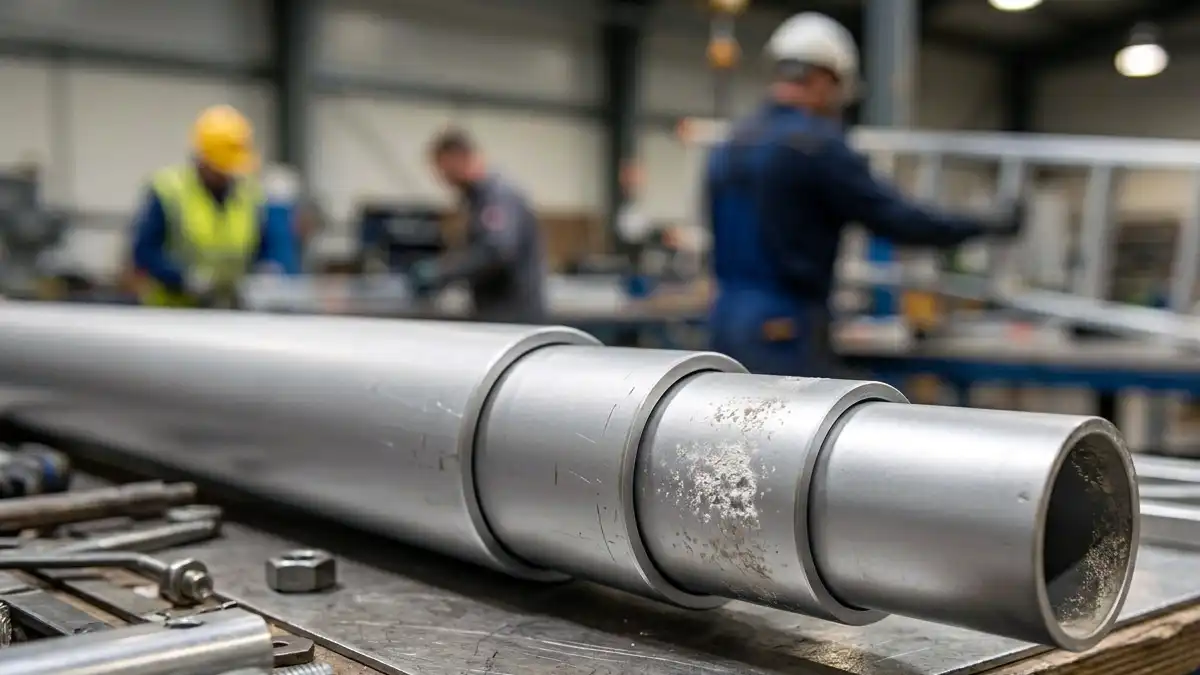
If you own or are considering buying an aluminum telescopic ladder, you have probably wondered: Will it rust over time? The short answer is no – aluminium does not “rust” in the way steel does. However, aluminium can corrode under certain conditions. Understanding the difference between rust and aluminium oxidation is essential for keeping your ladder safe and long‑lasting.
⚠️ Safety First – Even if it doesn’t rust, inspect regularly
Corrosion weakens aluminium. Always inspect your ladder before each use. Never climb a ladder with visible pitting, white powdery residue, or structural damage.
Can Aluminium Actually Rust?
No – aluminium does not rust. Rust is the common name for iron oxide, which forms only when iron or steel (ferrous metals) reacts with oxygen and moisture. Aluminium contains no iron, so it cannot produce rust.
Instead, aluminium undergoes oxidation, forming aluminium oxide (Al₂O₃). This process is fundamentally different from rust in one critical way: aluminium oxide is protective, while rust is destructive.
| Property | Rust (Iron Oxide) | Aluminium Oxide |
|---|---|---|
| Appearance | Orange‑brown, flaking | Transparent or white/grey |
| Adhesion | Poor – flakes off, exposing fresh metal | Excellent – tightly bonded |
| Porosity | Porous – lets moisture through | Non‑porous – seals metal |
| Protective? | No – accelerates destruction | Yes – stops further oxidation |
That said, aluminium can still be damaged by corrosion – especially in aggressive environments like coastal areas, industrial pollution, or prolonged contact with moisture. This article explains when and how that happens.
🔗 Related reading: Why Anodizing Fails in Coastal Areas – Prevention Guide
Oxidation vs Rust Explained
How Rust Destroys Steel
When steel is exposed to water and oxygen, iron atoms lose electrons and form iron oxide. Iron oxide occupies more volume than the original metal, causing it to flake, swell, and crack. Each flake exposes fresh metal, and the process continues until the steel is entirely consumed.
How Aluminium Oxide Protects
Aluminium reacts with oxygen instantly – within picoseconds of a fresh surface being exposed. The resulting aluminium oxide layer is:
- Extremely thin (4–5 nanometres)
- Transparent (you normally cannot see it)
- Hard and dense (much harder than aluminium itself)
- Self‑repairing – if scratched, it reforms immediately in air
This is why aluminium kitchen foil does not “rust” in the dishwasher, and why aluminium window frames last decades without painting.
So Why Do Aluminium Ladders Sometimes Corrode?
The protective oxide layer works well in normal environments. However, certain conditions overwhelm it:
- Chlorides (salt air, sea spray, de‑icing salts) – chloride ions penetrate the oxide layer and cause pitting.
- Strong alkalis (e.g., concrete, mortar, some cleaning agents) – dissolve the oxide layer.
- Galvanic contact – touching a different metal (steel, copper) in a wet environment creates a battery that corrodes aluminium.
- Prolonged dampness in crevices – telescopic joints can trap moisture, leading to localised attack.
When corrosion occurs, you typically see:
- White or grey powdery deposit (aluminium hydroxide / oxide)
- Pitting (small holes in the surface)
- Sticking or seized locking mechanisms
This is not rust, but it is still damage. Left unchecked, it can weaken the ladder.
Salt Air and Coastal Damage
Coastal environments are the biggest threat to aluminium telescopic ladders. Salt spray from waves contains sodium chloride (table salt) and other chlorides. Even if you live several miles from the ocean, airborne salt can reach you.
Why Salt Air Is So Aggressive
- Chloride ions break down aluminium’s protective oxide layer.
- Once the oxide is compromised, the exposed aluminium corrodes rapidly.
- Corrosion products (white powder) are not protective – they can be porous and allow further attack.
- In severe cases, pitting can go deep, creating stress risers that lead to cracking.
High‑Risk Areas
| Country | High‑Risk Coastal Regions |
|---|---|
| India | Mumbai, Chennai, Goa, Kochi, Kolkata (near Bay of Bengal) |
| Australia | Sydney, Brisbane, Perth, Gold Coast, Darwin |
| United Kingdom | Brighton, Bournemouth, Cornwall, Welsh coast |
| Canada | Halifax, Vancouver Island, St. John’s |
| United States | Florida, California coast, Gulf Coast (Texas to Alabama), Hawaii |
Protection for Coastal Users
- Choose an anodised or powder‑coated ladder – These finishes add a barrier against salt.
- Rinse with fresh water after every coastal use – A quick hose‑down removes salt deposits.
- Store indoors – Never leave a ladder outside overnight in a coastal area.
- Apply protective wax or spray – Use a non‑conductive, silicone‑based protectant on the rails.
- Consider fiberglass – In extreme coastal environments, fiberglass may be more durable (but protect from UV).
🔗 Related reading: Hard Anodizing vs Architectural Anodizing
-Ads-
Rainwater Exposure
Rainwater alone is not highly corrosive to aluminium. However, rainwater can become corrosive due to:
- Acid rain – Industrial areas may have slightly acidic rain (pH 4–5), which can attack the oxide layer over years.
- Pollen and dust – Organic matter mixed with rain can create acidic or alkaline patches.
- Prolonged wetness – If the ladder stays wet for days, moisture can seep into telescopic joints and cause localised corrosion.
Best Practices After Rain
- Do NOT retract a wet ladder – Moisture trapped inside tubes leads to corrosion and frozen locks.
- Dry the ladder thoroughly – Use a clean cloth to wipe all sections, especially near locking mechanisms.
- Stand it vertically to drain – If you cannot dry immediately, stand the ladder upright so water runs out.
- Store in a dry place – Even a carport is better than open rain.
Humidity Effects
High humidity (above 70–80%) does not instantly damage aluminium, but it creates a persistent damp environment that can promote corrosion, especially in:
- Unventilated storage (sheds, garages, closets)
- Alongside the sea (humidity + salt = aggressive)
- Tropical climates (India, Southeast Asia, tropical Australia)
How Humidity Attacks
- Thin films of moisture form on the surface.
- Dissolved pollutants (salts, acids) become concentrated as water evaporates.
- Crevices (tube ends, lock housings, rivet holes) trap moisture.
Humid Climate Recommendations
- Wipe the ladder dry before collapsing – every single time.
- Store indoors with air circulation – a closet is fine if dry; avoid sealed plastic bags.
- Use silica gel packs inside storage bags for long‑term storage.
- Apply silicone spray to telescopic sections – this repels moisture without attracting dust.
Lock Mechanism Corrosion
The locking mechanisms are the most vulnerable part of any telescopic ladder. They are often made of steel (or steel cores) and small springs – materials that do rust.
Why Locks Rust Even When Aluminum Doesn’t
- Lock pins are often steel for strength and wear resistance.
- Steel rusts readily when exposed to moisture.
- Rust on lock pins causes:
- Sticking (pin does not pop out)
- Jamming (pin cannot be retracted)
- Weak engagement (pin only partially enters the hole)
Signs of Lock Corrosion
- Difficulty extending or retracting.
- Grinding or scraping sounds.
- Locks that do not “click” into place.
- Visible orange‑brown rust on pin ends.
Prevention
- Keep the ladder dry. This is the number one rule.
- Lubricate locks occasionally with dry silicone spray (not oil, which attracts dust).
- Inspect lock pins regularly – look for rust through the access holes.
- If a lock is rusty, do not force it. Clean with a wire brush and apply penetrating oil (then wipe off excess). Replace the ladder if the lock is damaged.
🔗 Related reading: Common Problems with Aluminium Windows (lessons for ladder locks) – many lock issues are similar.
Outdoor Storage Risks
Storing an aluminium telescopic ladder outdoors is strongly discouraged. Even “weather‑resistant” models will eventually suffer:
| Risk | Consequence |
|---|---|
| Rain | Water inside tubes → corrosion, frozen locks |
| Sun | UV degrades plastic feet, end caps, bushings |
| Salt air (coastal) | Pitting, white corrosion, weakened rails |
| Temperature swings | Condensation inside tubes |
| Dirt and debris | Jams locks, scratches oxide layer |
If You Must Store Outdoors
- Use a waterproof, UV‑resistant ladder cover.
- Store vertically to allow water to drain.
- Elevate the base off the ground (on bricks or a pallet) to avoid standing water.
- Bring the ladder indoors at least once a month for a thorough cleaning and drying.
Better yet: Find indoor space – even a hallway corner or under a bed works for collapsed telescopic ladders.
Protective Coatings and Anodizing
To extend the life of your aluminium ladder, consider models with surface treatments.
Anodizing
Anodizing is an electrochemical process that thickens the natural oxide layer to 5–25 microns (vs ~0.01 microns naturally). Benefits:
- Much harder and more wear‑resistant
- Provides excellent corrosion protection
- Can be dyed (coloured) for aesthetics
Best for: Coastal areas, humid climates, professional use.
Powder Coating
Powder coating applies a baked‑on polymer layer (epoxy or polyester). Benefits:
- Very thick (60–120 microns)
- Excellent barrier against salt and chemicals
- Available in many colours
Drawback: Scratches can expose bare aluminium; once chipped, corrosion can creep under the coating.
Which Is Better for Ladders?
- Anodising is preferred for telescopic ladders because it does not add thickness that could affect sliding tolerances.
- Powder coating can be too thick for precision telescoping sections, but some manufacturers use it on outer rails only.
Uncoated (“Mill Finish”) Aluminium
- Lowest cost, but also lowest corrosion resistance.
- Acceptable for indoor use only or very dry climates.
- Not recommended for coastal, humid, or outdoor storage.
Cleaning Tips
Regular cleaning prevents corrosion by removing corrosive deposits before they attack.
What to Use
| Acceptable | Avoid |
|---|---|
| Mild dish soap + water | Strong alkalis (oven cleaner, concrete remover) |
| Soft cloth or sponge | Abrasive pads (steel wool, Scotch‑Brite) |
| Dry silicone spray (for locks) | Acidic cleaners (vinegar, lemon juice) |
| Microfiber towel | Pressure washer (forces water into joints) |
Step‑by‑Step Cleaning
- Extend the ladder fully on a clean, dry surface.
- Brush off loose dirt with a soft brush.
- Mix mild soap with warm water. Dip cloth, wring well.
- Wipe each section – focus on rungs and tube ends.
- Rinse with clean water (use a damp cloth, not running water).
- Dry immediately with a clean towel.
- Apply silicone spray to telescopic tubes and lock pins.
- Leave extended for 10–15 minutes to air dry completely.
- Collapse and store vertically indoors.
Special Care for Coastal Areas
- Add a freshwater rinse after every coastal use (even if you do not see salt).
- Wipe dry immediately.
- Once a month, apply marine‑grade aluminium wax (e.g., for boat hulls) to outer rails.
Maintenance Checklist
Use this weekly/monthly checklist to keep your ladder corrosion‑free.
Before Each Use (Visual Inspection)
- [ ] No white powder, pitting, or black spots.
- [ ] Lock pins move freely and click into place.
- [ ] No rust on steel lock components.
- [ ] Rungs are clean and dry.
- [ ] Feet are intact and flexible.
Weekly (Light Use) / Daily (Heavy Use)
- [ ] Wipe down all sections with a dry cloth.
- [ ] Remove any mud, paint, or glue before collapsing.
- [ ] Check for sticking sections – clean if needed.
Monthly
- [ ] Deep clean with mild soap (see Section 9).
- [ ] Lubricate telescopic joints with dry silicone spray.
- [ ] Inspect end caps – replace if cracked.
- [ ] Check label for EN131/ANSI certification (still legible).
Every 6 Months
- [ ] Apply protective wax (coastal areas only).
- [ ] Inspect for any bent or dented rails.
- [ ] Tighten any loose rivets (small punch or replace ladder).
Warning Signs of Corrosion
Do not ignore these signs. Corrosion weakens aluminium over time.
| Sign | What It Means | Action |
|---|---|---|
| White/grey powdery residue | Surface oxidation (aluminium hydroxide) | Clean immediately; if heavy, consider protective coating. |
| Pitting (small holes) | Localised corrosion that has penetrated oxide layer | Monitor closely; deep pits weaken the rail. Replace if widespread. |
| Black or dark grey spots | Galvanic corrosion from contact with dissimilar metal | Isolate or replace affected section. |
| Flaking or peeling coating | Coating failure – corrosion underneath | Strip and recoat, or replace ladder if structural. |
| Lock pins rusty or seized | Steel parts corroding – may not lock safely | Clean or replace lock; if multiple failures, replace ladder. |
| Cracks near rivet holes | Stress corrosion cracking (advanced) | Immediately retire the ladder. |
When to Replace
- Any crack in aluminium – do not attempt repair.
- Deep pitting covering more than 5% of a rail.
- Bent or deformed tube from corrosion weakening.
- Lock mechanisms fail despite cleaning.
Your safety is worth more than the cost of a new ladder.
Final Answer
Do aluminium telescopic ladders rust?
No – aluminium does not rust. However, aluminium can corrode in aggressive environments, especially coastal salt air, high humidity, and prolonged moisture exposure. The corrosion appears as white powder or pitting, not orange‑brown flaking rust.
Key takeaways:
- ✅ Aluminium’s natural oxide layer protects it – that is why it does not rust like steel.
- ⚠️ Salt air, chlorides, and alkalis can overcome that protection.
- 🧼 Regular cleaning and drying prevent most corrosion.
- 🏠 Store indoors – never leave your telescopic ladder outside.
- 🔒 Lock mechanisms rust because they contain steel – lubricate and keep dry.
- 🛑 Replace the ladder if you see cracks, deep pitting, or failed locks.
With proper care, a good quality aluminium telescopic ladder will last 15–20 years without significant corrosion – even in moderate outdoor use. In coastal areas, choose an anodised model and rinse after each use.
🔗 Further reading:
Related Articles
Featured

You May Also Like

Aluminum Wheels: The Raw, Lightweight, and Performance Alloy…

Modern Shade Goals? Why Aluminum Patio Umbrellas Are the New…

Eloxiertes Aluminium
Double Hung Window vs Single Hung Window: Pros, Cons & S…

20ft Aluminium Ladder vs. Extension: Finding Your Ideal Ladd…
