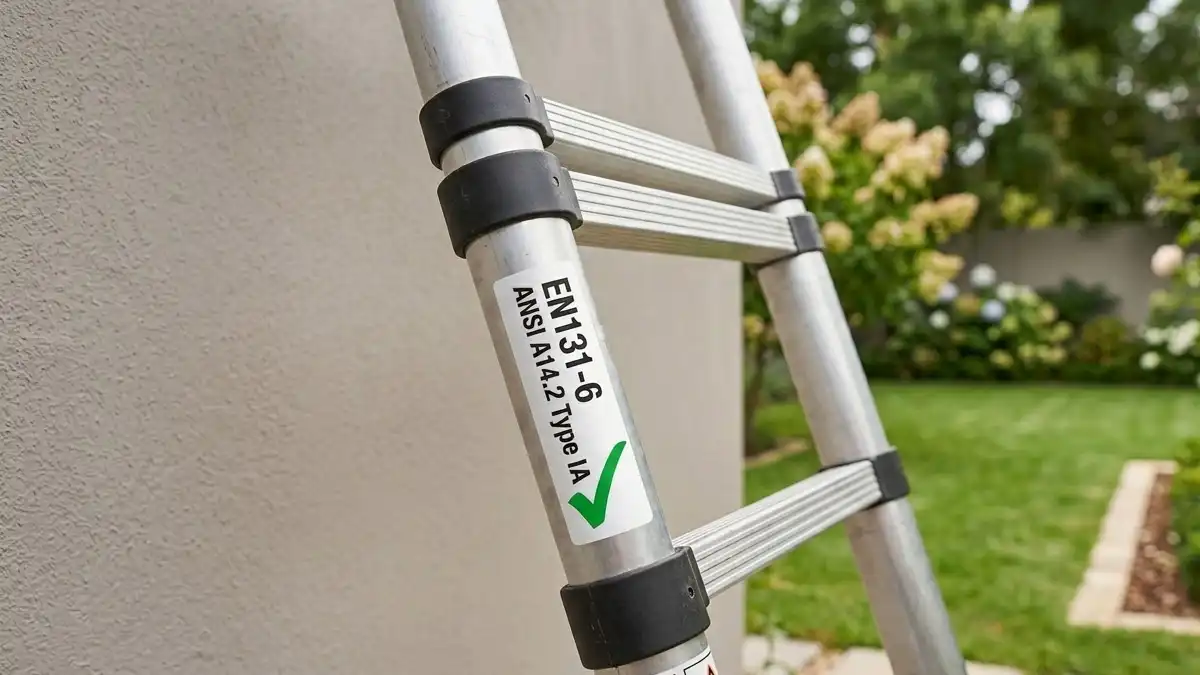
When you buy a telescopic ladder, you will see labels like EN131, OSHA, or ANSI. These are not just marketing stickers – they are safety certifications that tell you the ladder has passed rigorous testing. Understanding what these standards mean can save your life.
This guide explains EN131, OSHA, ANSI, and other global ladder standards, what they require, how to spot fake certifications, and why you should never climb an uncertified ladder.
🚨 CRITICAL SAFETY WARNING
A ladder without a legitimate safety certification is an untested product. It may fail under normal use. Always look for EN131, ANSI, or OSHA compliance before buying. Your life depends on it.
What Is EN131?
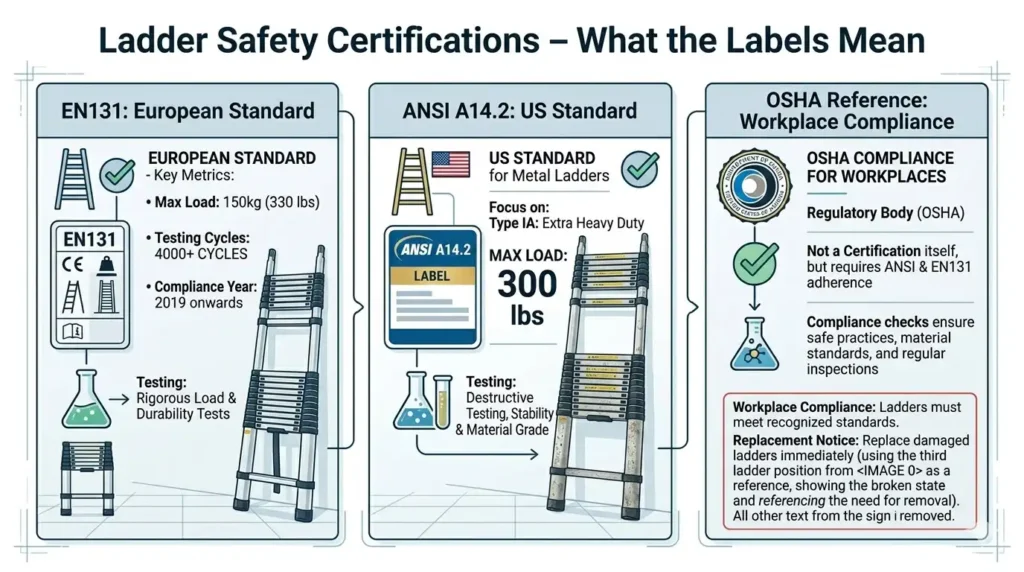
EN131 is the European safety standard for portable ladders (including telescopic, extension, step, and combination ladders). It is published by CEN (European Committee for Standardization) and is mandatory for ladders sold in the EU.
History and Versions
| Version | Year | Key Changes |
|---|---|---|
| EN131-1,2,3 | 1993 | Original standard |
| EN131-1,2,3 | 2007 | Updated testing methods |
| EN131-1 to -8 | 2015–2019 | Complete rewrite. EN131‑6 covers telescopic ladders specifically. |
| EN131-6:2019 | 2019 | Current professional standard for telescopic ladders. |
What EN131‑6 (2019) Requires for Telescopic Ladders
| Test | Requirement |
|---|---|
| Load capacity | Minimum 150 kg (330 lbs) for professional use |
| Durability | 4,000 extension/retraction cycles without failure |
| Torsional rigidity | Ladder must not twist more than specified amount under load |
| Slip resistance | Rungs must have anti‑slip surface |
| Marking | Permanent label with EN131‑6, load rating, manufacturer |
| Instruction manual | Must be included |
Professional vs. Household EN131
There are two classes under EN131:
| Class | Marking | Minimum Load | Durability Cycles | Intended Use |
|---|---|---|---|---|
| Professional | EN131‑6 | 150 kg (330 lbs) | 4,000 | Trade, industrial, daily use |
| Household | EN131‑1 to ‑5 (older) or “EN131” without class | 125 kg (275 lbs) | Not specified | Occasional home use |
Important: Many cheap ladders claim “EN131” but are the old household class (125 kg, no cycle test). For professional safety, look specifically for EN131‑6.
Where EN131 Applies
- European Union – Mandatory for sale.
- United Kingdom – Retained as UK standard post‑Brexit.
- Many other countries accept EN131 as a de facto quality mark (India, Australia, Middle East, Africa, Southeast Asia).
What Is OSHA?
OSHA (Occupational Safety and Health Administration) is the United States federal agency that sets and enforces workplace safety standards. OSHA itself does not certify ladders – instead, it requires that ladders used in workplaces meet certain standards, primarily ANSI A14.2 (portable metal ladders).
OSHA Requirements for Ladders (29 CFR 1910.23 & 1926.1053)
Key OSHA rules for portable ladders:
| Requirement | Detail |
|---|---|
| Load capacity | Minimum 250 lbs for Type I (heavy duty) |
| Construction | No cracks, splinters, or corrosion |
| Rungs | Spaced 10–14 inches apart, slip‑resistant |
| Locks | Must be positive locking (telescopic ladders) |
| Inspection | Before each use by the user |
| Training | Employers must train workers on ladder safety |
OSHA Does NOT “Certify” Ladders
A common misconception: “OSHA approved” or “OSHA certified” is not an official designation. OSHA does not test or approve products. What a manufacturer means is: “This ladder meets OSHA’s requirements as specified in the regulations.”
Legitimate phrasing: “Meets OSHA standards for portable ladders” (and then citing the specific regulation).
Misleading phrasing: “OSHA certified” or “OSHA approved” (implies official approval – not possible).
Enforcement
If an OSHA inspector finds an uncertified or damaged ladder at a worksite, the employer can be fined – and if an injury occurs, liability is severe.
🔗 Related reading: Why Cheap Telescopic Ladders Feel Unsafe
Why Ladder Certifications Matter
Certifications exist for one reason: preventing injuries and deaths.
Real‑World Impact
| Without Certification | With Certification |
|---|---|
| Ladder may be made from recycled, weak aluminium | Tested to known alloy standards |
| Lock mechanisms untested – may fail unexpectedly | Tested to 4,000+ cycles |
| Weight rating could be fictional | Independently verified |
| No liability for manufacturer | Traceable to a testing lab |
| User has no recourse after injury | Legal protection, recall system |
The Cost of an Uncertified Ladder
- You fall – medical bills ($10,000–$100,000+), lost work, permanent disability.
- You cannot sue – cheap ladder companies often disappear.
- The ladder was $60 – false economy.
Certification Is Not a Guarantee, But a Minimised Risk
Even certified ladders can fail if damaged or misused. But they have been statistically proven to be much safer than uncertified ones.
🔗 Related reading: Why Aluminium Is Used in Telescopic Ladders – Aircraft‑Grade Aluminium
Weight Testing Requirements
Weight rating is the most important specification – and the most frequently lied about.
EN131 Weight Testing
| Test | Procedure | Pass/Fail Criterion |
|---|---|---|
| Static load | 150 kg (330 lbs) placed on the ladder for 1 minute | No permanent deformation |
| Dynamic load | 150 kg dropped from a small height onto the ladder | No cracks or lock failure |
| Overload | 4x working load (600 kg / 1,320 lbs) applied | No catastrophic failure (safety margin) |
ANSI Weight Classifications (A14.2)
| ANSI Type | Load Capacity (lbs) | Typical Use | Colour Code |
|---|---|---|---|
| Type III | 200 | Light household | Yellow |
| Type II | 225 | Medium‑duty commercial | Blue |
| Type I | 250 | Heavy‑duty industrial | Orange |
| Type IA | 300 | Extra heavy‑duty professional | Orange with “IA” |
| Type IAA | 375 | Extreme heavy‑duty | Orange with “IAA” |
What This Means for You
- Homeowner (150–200 lbs body weight + light tools): Type II (225 lbs) minimum, but Type I (250 lbs) is safer.
- Professional (any weight + tools): Type IA (300 lbs) is the standard.
- Heavy industrial / large user: Type IAA (375 lbs).
Do not buy a ladder rated only for your body weight. Tools, reaching, and dynamic loads add force. A 200 lb person can exert 300+ lbs of force when stepping down hard.
Stability Standards
A ladder can hold the weight but still be unstable. Both EN131 and ANSI test for stability.
EN131 Stability Tests
| Test | What It Simulates |
|---|---|
| Sideways tilt | User reaching sideways – ladder not tipping |
| Forward/backward tilt | User climbing or descending |
| Twist (torsion) | Uneven floor or user shifting weight |
| Sway | Ladder’s natural flex |
A ladder passes if it does not tip beyond a certain angle (typically 5–7 degrees) during these tests.
ANSI Stability Tests
ANSI A14.2 requires the ladder to have non‑slip feet and be tested on a steel surface to ensure no sliding. It also tests for spreader bars (for step ladders) and locking mechanisms (for telescopic).
User’s Role in Stability
Even a certified ladder will tip if you:
- Place it on uneven ground
- Overreach (belt buckle outside rails)
- Climb with wet, slippery shoes
- Set the angle too shallow (less than 70°) or too steep (more than 80°)
Rule of thumb: For every 4 feet of ladder height, the base should be 1 foot away from the wall (75° angle).
🔗 Related reading: Aluminium Telescopic Ladders: Complete Guide – Stability Section
Industrial vs Household Ratings
One of the most common confusions is between professional/industrial and household ratings.
| Feature | Household (EN131 Household / ANSI Type II) | Professional/Industrial (EN131‑6 / ANSI Type IA) |
|---|---|---|
| Minimum load | 125–150 kg (275–330 lbs) | 150 kg (330 lbs) or 300 lbs (ANSI IA) |
| Cycle testing | Not required or fewer cycles | 4,000+ cycles |
| Durability | Assumes occasional use | Assumes daily use |
| Materials | May use thinner aluminium | Thicker walls, better alloys |
| Lock durability | Basic springs | Heavy‑duty springs, steel pins |
| Price | Lower ($60–120) | Higher ($150–300) |
| Suitable for | Homeowner, few times per month | Tradesperson, daily use |
Can You Use a Household Ladder Professionally?
No. A household ladder tested to 1,000 cycles might fail after 6 months of daily use. Professional ladders are built for 4,000+ cycles – roughly 4–5 years of daily use.
Can You Use a Professional Ladder at Home?
Yes, and it is safer. A professional ladder is over‑built for home use and will last decades. The extra cost is worth it for peace of mind.
Common Misleading Claims
Manufacturers of cheap ladders use deceptive language to imply certification without actually having it.
Misleading Claim #1: “Meets OSHA Standards”
What it means: The manufacturer claims the ladder complies with OSHA regulations – but no independent testing verifies this. OSHA does not issue certificates.
How to check: Look for ANSI A14.2 or EN131 marks. Those are testable standards.
Misleading Claim #2: “EN131 Tested”
What it means: Possibly tested internally by the factory, not by an independent lab. Or tested to an old version (1993) that did not include telescopic ladders.
How to check: Look for EN131‑6:2019 specifically. The year matters.
Misleading Claim #3: “300 lb Capacity”
What it means: May be the static load (ladder not moving). Dynamic load (climbing) could be much lower.
How to check: Look for ANSI Type IA (300 lbs dynamic) or EN131 (150 kg dynamic). Ignore claims without a standard.
Misleading Claim #4: “Aircraft Grade Aluminium”
What it means: Not a defined term. Any aluminium can be called “aircraft grade” without proof.
How to check: Look for specific alloy numbers (e.g., 6061-T6) on the label or in specifications.
Misleading Claim #5: “OSHA Approved” (with an official‑looking sticker)
What it means: 100% fake. OSHA does not approve ladders.
How to check: Report the product to the retailer. Do not buy.
Real vs. Fake Labels – A Quick Guide
| On the Label | Interpretation |
|---|---|
| “EN131‑6:2019” + logo of testing lab (TÜV, SGS, etc.) | ✅ Legitimate professional certification |
| “EN131” (no year, no class) | ⚠️ Possibly old standard or household class |
| “Meets OSHA” (alone) | ⚠️ Vague – no proof |
| “ANSI A14.2 Type IA” | ✅ Legitimate US standard |
| “OSHA certified” | ❌ Fake – OSHA does not certify |
| No certification marks | ❌ Avoid – untested |
🔗 Related reading: Why Cheap Telescopic Ladders Feel Unsafe – Section on Fake Certifications
How to Check Certification
Before buying a ladder, verify its certification in three steps.
Step 1 – Look at the Ladder Label
A genuine certified ladder has a permanent label (usually riveted or embossed) on the side rail or near the base. The label includes:
- Standard (EN131‑6, ANSI A14.2, etc.)
- Load rating (kg or lbs)
- Manufacturer name
- Country of origin
- Warnings (not to stand on top rungs, etc.)
If the label is a cheap sticker that peels off – be suspicious.
Step 2 – Search the Manufacturer
Go to the manufacturer’s website. Reputable brands (Werner, Little Giant, Louis, Telesteps) publish their certifications and test reports. If you cannot find any certification information, do not buy.
Step 3 – Check for Testing Lab Logo
Look for logos from independent testing organisations:
| Lab | Region |
|---|---|
| TÜV (Rheinland, SÜD) | Germany / Europe |
| SGS | Global |
| UL | United States (mostly electrical, but also ladders) |
| BSI | United Kingdom |
| Intertek | Global |
A label with “TÜV tested” or “SGS certified” is more trustworthy than one without.
Step 4 – Verify Online (If Possible)
Some manufacturers provide a certificate number on the ladder. You can enter this number on the testing lab’s website to verify authenticity. Cheap ladders never have this.
What About Second‑Hand Ladders?
If you buy a used ladder:
- The original label may be worn off – assume it is not certified.
- Never buy a used ladder that does not have a legible certification label.
- Even with a label, the ladder may have been damaged. Inspect carefully.
Safety Labels Explained
Safety labels are required on certified ladders. Here is what each common warning means.
EN131 Required Markings
| Marking | Meaning |
|---|---|
| EN131‑6 | Professional telescopic ladder standard |
| 150 kg | Maximum load (user + tools) |
| Do not stand on top 2 rungs | Loss of stability |
| Only use on level ground | Prevent tipping |
| Max extension height | E.g., 3.8 m (12.5 ft) |
| Manufacturer name / logo | Traceability |
ANSI Required Markings
| Marking | Meaning |
|---|---|
| ANSI A14.2 | Portable metal ladder standard |
| Type IA | 300 lb capacity |
| Duty rating (e.g., “300 lbs”) | Maximum load |
| Do not overreach | Stability warning |
| Inspect before use | User responsibility |
Universal Warning Symbols
- Red circle with slash – Prohibited action (e.g., no climbing on top two rungs).
- Black triangle with exclamation – General warning.
- Figure reaching – “Do not overreach” symbol.
Final Thoughts
EN131, OSHA, and ANSI standards exist to keep you safe. They are not bureaucratic red tape – they are the result of decades of injury data and engineering testing.
Summary Table
| Standard | Region | Covers | Key Requirement for Telescopic Ladders |
|---|---|---|---|
| EN131‑6:2019 | Europe & global | Professional telescopic ladders | 150 kg load, 4,000 cycles, torsion test |
| EN131 Household | Europe | Home use ladders | 125 kg load, fewer tests |
| ANSI A14.2 | USA | Portable metal ladders | Type IA = 300 lbs dynamic load |
| OSHA | USA (workplaces) | Requires ANSI ladders; sets inspection/training rules | Not a certification – compliance required |
What You Must Do
- ✅ Always buy certified ladders – EN131‑6 or ANSI Type IA.
- ✅ Look for independent lab logos (TÜV, SGS, UL).
- ✅ Ignore vague claims like “meets OSHA” without a standard number.
- ✅ Check the label on the ladder itself – not just the box.
- ✅ Inspect before every use – even certified ladders can be damaged.
What You Must Avoid
- ❌ Ladders with no certification marks.
- ❌ Ladders that say “OSHA approved” (fake).
- ❌ Ladders from unknown brands sold only on marketplaces.
- ❌ Ladders that look identical to a certified model but cost half as much – corners were cut.
The Bottom Line
A certified ladder costs more upfront – typically $120–250 for a good telescopic model. An uncertified ladder might cost $50–80. That $50–150 difference is the cost of engineering, testing, and quality materials.
Your safety is not a place to save money. Buy certified, inspect regularly, and climb with confidence.
🔗 Further reading:
Related Articles

Featured


You May Also Like
Aluminium vs Fiberglass Telescopic Ladder: Which One Should …

Thermal Break Material for Aluminium Windows

Global Temperature Rise is Driving the Demand for Energy-Sav…

Casement Windows: Best Locations, Worst Mistakes, and What t…
Forged Aluminum vs Hard-Anodized Aluminum Fry Pans: What’s t…