
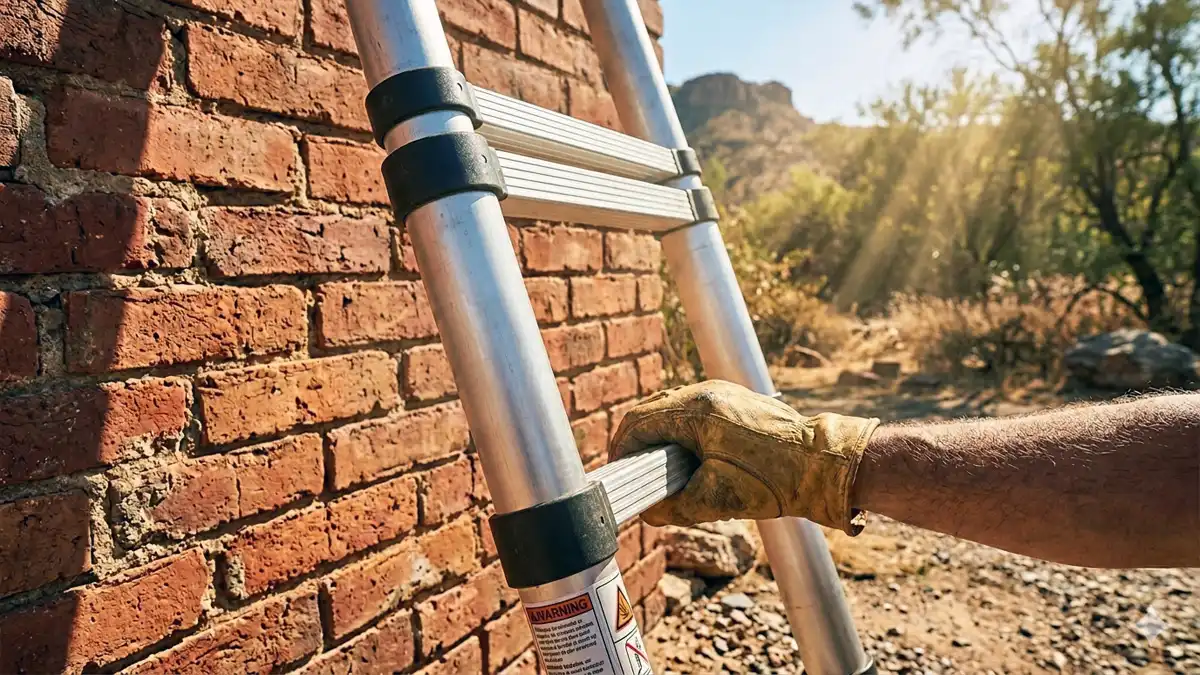
Heat is one of the most underestimated threats to aluminum telescopic ladders. While aluminium is a metal known for its strength and durability, extreme temperatures – especially high heat – can affect its performance, safety, and lifespan. Whether you live in the scorching deserts of Australia, the hot plains of India, or the summer heatwaves of the US Southwest, understanding how heat impacts your ladder is essential.
🥵 HOT SURFACE WARNING
In direct sunlight or a hot vehicle, aluminium ladder surfaces can reach 60–70°C (140–160°F) – hot enough to cause skin burns on contact. Always check the temperature before climbing. Wear gloves if necessary.
Does Aluminium Expand in Heat?
Yes – aluminium expands when heated. This property is called thermal expansion. The rate of expansion is described by the coefficient of thermal expansion (CTE). For aluminium, the CTE is approximately 23.8 × 10⁻⁶ per degree Celsius (about 13.2 × 10⁻⁶ per degree Fahrenheit).
How Much Does a Ladder Expand?
Let’s do the math. A 12‑foot (3.66 metre) aluminium ladder exposed to a 30°C temperature rise (e.g., from 20°C to 50°C / 68°F to 122°F) expands by:
Expansion = length × CTE × temperature change
= 3.66 m × (23.8 × 10⁻⁶) × 30
≈ 0.0026 metres ≈ 2.6 millimetres (about 0.1 inches)
That is roughly the thickness of two credit cards. It does not sound like much – but in a telescopic ladder with tight tolerances between sections, even 2–3 mm of expansion can cause:
- Sections that are difficult to extend or retract
- Locking pins that no longer align perfectly
- Increased friction and wear on plastic bushings
What About Even Higher Temperatures?
If you leave a ladder inside a parked car on a 40°C day, the interior can reach 70–80°C (158–176°F). A 50°C temperature rise (20°C → 70°C) leads to expansion of 4–5 mm over 12 feet. That is enough to noticeably affect performance.
🔗 Related reading: Aluminium 6061-T6 Alloy Properties – includes thermal expansion data
Hot Garage Storage Problems
Many people store their telescopic ladders in garages or sheds. In hot climates, these spaces become ovens.
Garage Temperature Comparison
| Climate | Outdoor Temperature | Uninsulated Garage/Shed Temperature |
|---|---|---|
| Moderate summer | 30°C (86°F) | 40–45°C (104–113°F) |
| Hot summer (India/Australia/US Southwest) | 40–45°C (104–113°F) | 55–65°C (131–149°F) |
| Parked car (any hot climate) | 35–40°C (95–104°F) | 70–80°C (158–176°F) |
Problems Caused by Hot Storage
- Permanent expansion – While expansion is reversible (aluminium contracts when cooled), repeated extreme heat cycles can cause creep – gradual, permanent dimensional change.
- Lubricant breakdown – Any factory grease or oil on locking mechanisms can dry out or become gummy.
- Plastic bushing creep – Covered in detail in Section 3.
- Rubber foot hardening – Feet can become stiff and lose grip.
- Lock spring fatigue – Springs under tension in high heat may lose their temper (springiness).
Real‑World Example
India (Rajasthan, Delhi, Tamil Nadu): Summer temperatures often exceed 45°C. A ladder stored in a metal shed can reach 60–65°C daily. After one summer, users may notice:
- Sections that used to slide smoothly now feel “sticky”
- Locks require more force to engage
- White powder (oxidation) appears faster
Solution: Always store ladders inside your home – not in garages or sheds – during extreme heatwaves.
Sun Exposure Effects
Direct sunlight is a double threat: heat + UV radiation.
Surface Temperature Rise
A study by the Occupational Safety and Health Administration (OSHA) found that dark metal surfaces in direct sun can reach 30–40°C above ambient temperature.
Example:
- Air temperature: 40°C (104°F)
- Aluminium ladder in sun: 70–80°C (158–176°F)
At 70°C, skin contact for 1 second causes a first‑degree burn (redness, pain). At 80°C, burns occur almost instantly.
Structural Effects of Sun Exposure
- Uneven heating – One side of the ladder in sun, the other in shade, causes differential expansion, leading to bending stress.
- Accelerated oxidation – Heat speeds up chemical reactions, including corrosion. Sun‑exposed aluminium oxidises faster than shaded metal.
- Paint/coating degradation – Powder coating and anodised finishes degrade under prolonged UV exposure, becoming chalky or peeling.
Shading Your Ladder
- Never leave a ladder lying flat in direct sun – one side bakes, the other stays cooler, causing warping risk.
- Store vertically or under cover – A simple tarp or ladder bag blocks UV.
- Use light‑coloured ladders – White or silver reflects more heat than black or dark colours.
Locking Mechanism Expansion
Locking mechanisms are the most heat‑sensitive part of a telescopic ladder. They contain:
- Aluminium rails (expand)
- Steel lock pins (expand less – steel CTE ~12 × 10⁻⁶, about half that of aluminium)
- Plastic or nylon bushings (expand more than aluminium)
Differential Expansion
When heated, aluminium expands more than steel. This means:
- The holes in the aluminium rails become slightly larger (diameter increases).
- Steel pins do not expand as much, so they may fit more loosely in the holes.
- A loose pin may not lock securely – dangerous.
Conversely, if the ladder cools rapidly after being very hot, the aluminium contracts faster than steel, potentially trapping the pin in the locked position.
What Users Report
- In hot weather, locks that usually “click” firmly may feel mushy or incomplete.
- After cooling, the same locks work normally again – this is a sign of thermal expansion, not a broken ladder.
- Never climb a ladder if locks do not fully engage – wait for it to cool or use a different ladder.
Manufacturer Testing
Quality ladders (EN131‑6 certified) are tested for operation from –20°C to +50°C. Above 50°C, performance is not guaranteed. If you live in a region that regularly exceeds 50°C (e.g., parts of India, Australia, or the Middle East), store your ladder in air conditioning.
Grip and Handle Temperature Issues
Heat affects not only the metal but also the touch points that keep you safe.
Rung Temperature
- Aluminium rungs conduct heat extremely well. In direct sun, they become dangerously hot within minutes.
- Serrated or textured rungs – the texture does not reduce heat. Bare skin can burn.
- Rubber or plastic‑coated rungs – better insulation, but can soften or melt in extreme heat.
Handle and End Caps
- End caps (plastic or rubber) can soften and deform in a hot car, losing their seal and allowing dirt inside the tubes.
- Carrying handles – integrated plastic handles may become too hot to hold or can crack.
Prevention
- Wear gloves – light‑coloured, breathable work gloves protect against heat and improve grip.
- Test rung temperature – place your palm lightly on a rung for 1 second. If it feels painfully hot, do not climb.
- Cool the ladder – pour cool (not ice‑cold) water over the rungs, or move the ladder to shade for 15 minutes.
🔗 Related reading: 5 Powerful Benefits of Ladders Top Handle and Top Plate
UV Damage to Plastic Components
While aluminium itself is UV‑resistant, every telescopic ladder contains plastic or rubber parts that degrade in sunlight.
Vulnerable Components
| Component | Material | UV Damage |
|---|---|---|
| End caps | Rubber or plastic | Become brittle, crack, fall off |
| Lock release levers | Nylon / ABS | Fade, become weak, snap |
| Bushings (between sections) | Nylon / POM | Weep sticky residue, then crack |
| Rung covers (if any) | Rubber or TPU | Harden, lose texture |
| Feet | Rubber | Hard drift, lose grip |
The “Plastic Bushing Creep” Problem
Between each telescopic section, there is a plastic bushing (often nylon or acetal) that reduces friction. Under high heat (60°C+), these bushings can weep – plasticisers migrate to the surface, leaving a sticky, oily residue. This residue:
- Attracts dust and dirt
- Gums up the locking mechanisms
- Causes sections to slide with difficulty
What to do: If your ladder feels sticky after being in a hot car or garage, wipe all telescopic tubes thoroughly with a dry cloth before extending. Do not use oil or WD‑40 – use dry silicone spray only.
UV Protection
- Store ladders indoors – a closet or interior room is best.
- Use a ladder bag – many telescopic ladders come with a storage bag. Use it.
- Apply UV‑protectant spray – products designed for outdoor plastics (303 Aerospace Protectant, etc.) can extend bushing life.
- Inspect annually – replace any cracked plastic components. Some manufacturers sell replacement end caps and feet.
Desert and Tropical Climate Concerns
🇮🇳 India
Challenges: Extreme summer heat (45–50°C), high monsoonal humidity, and intense sun.
Effects:
- Ladders left in metal sheds become sticky and hard to extend.
- Rubber feet crack after one season.
- Lock pins rust due to humidity + heat.
Recommendations:
- Store ladders inside the home, not in the garage.
- After monsoon use, dry thoroughly and apply silicone spray.
- Choose anodised aluminium for better heat and corrosion resistance.
🇦🇺 Australia
Challenges: Desert heat (50°C+ in inland areas), severe UV, bushfire embers.
Effects:
- Plastic bushings fail within 2–3 years if stored outdoors.
- Powder coating blisters on cheap ladders.
- Left in a ute tray, ladders become too hot to touch.
Recommendations:
- Use a light‑coloured ladder bag or cover when travelling.
- Never leave a ladder in a parked car on a 40°C day – the interior exceeds 70°C.
- Inspect plastic lock levers every 6 months – replace if they feel brittle.
🇺🇸 US Southwest (Arizona, Nevada, California desert)
Challenges: Similar to Australia – extreme dry heat, intense UV.
Effects:
- Thermal expansion can cause lock misalignment during summer afternoons.
- Rungs hot enough to burn bare feet (if climbing in sandals – never do that).
Recommendations:
- Schedule outdoor ladder work for morning or evening.
- Store ladders in air‑conditioned spaces (garages are often not cooled).
🇬🇧 United Kingdom (Heatwaves)
The UK rarely sees extreme heat, but summer heatwaves (30–35°C) are becoming more common. Because UK homes and vehicles are not designed for high temperatures, ladders stored in conservatories or parked cars can still overheat.
Recommendations:
- Bring ladders indoors during heatwave warnings.
- Wipe down sticky bushings – a problem first noticed by UK users in 2022.
Safe Storage Recommendations
General Guidelines
| Storage Location | Acceptable? | Precautions |
|---|---|---|
| Indoor closet (air‑conditioned) | ✅ Best | None needed |
| Indoor closet (no AC, moderate climate) | ✅ Good | Avoid sealing in plastic bags |
| Garage (insulated, temperate climate) | ⚠️ Acceptable | Keep away from windows |
| Garage (uninsulated, hot climate) | ❌ Poor | Move indoors during summer |
| Shed (any climate) | ❌ Poor | Too hot in summer, damp in winter |
| Car / truck (parked) | ❌ Never | Extreme heat, even on mild days |
| Outdoors (direct sun) | ❌ Never | UV + heat destroy plastic, burn risk |
Best Storage Practices for Hot Climates
- Collapse the ladder fully – This minimises stress on extended sections.
- Store vertically – Hanging on a wall hook or standing in a corner. Vertical storage reduces pressure on locking pins (see main ladder guide).
- Keep away from windows – Sunlight through glass can still heat the ladder.
- Use a storage bag – Many ladders include a zippered bag. Use it – it blocks dust and reduces UV exposure.
- Do not store in a parked vehicle – Not even for “just an hour.” The greenhouse effect raises interior temperature by 20–30°C above outside.
Summer Safety Tips
Before Use
- Check the ladder temperature – Touch a rung lightly with the back of your hand. If it is too hot to hold for 3 seconds, cool it before climbing.
- Inspect plastic parts – Lock levers, end caps, feet – if they feel soft or sticky, let the ladder cool.
- Test each lock – Extend the ladder fully and verify every lock clicks into place. If any lock feels loose, do not use the ladder.
- Wear appropriate footwear – Closed‑toe shoes with rubber soles protect against hot rungs and improve grip.
During Use
- Take breaks – Hot ladders are physically exhausting. Rest in shade.
- Stay hydrated – Heat exhaustion impairs balance and judgment.
- Watch for slippery rungs – Sweat from your hands can make metal rungs slick. Use gloves.
After Use
- Allow the ladder to cool before retracting – Hot aluminium expands; retracting while hot can jam sections permanently.
- Wipe down – Remove sweat, dirt, and any sticky residues.
- Store indoors – Never leave a ladder outside overnight in summer.
What to Do If Locks Stick in Heat
Do not force them. Forcing a hot, expanded lock can break the mechanism.
- Move the ladder to a shaded or air‑conditioned area.
- Wait 15–30 minutes for it to cool.
- Spray dry silicone lubricant into the locking mechanism.
- Gently work the lock back and forth until it moves freely.
- If the lock still does not engage, do not use the ladder – contact the manufacturer.
Final Thoughts
Heat is a silent enemy of aluminium telescopic ladders. While aluminum itself does not weaken dramatically until very high temperatures (above 200°C / 392°F), the combination of thermal expansion, UV degradation, plastic bushing creep, and surface heat creates real safety and performance issues – especially in hot climates like India, Australia, and the US Southwest.
Key takeaways:
- ✅ Aluminium expands – enough to affect locking mechanisms above 50°C.
- ✅ Surfaces become dangerously hot – check before climbing; wear gloves.
- ✅ Plastic bushings “weep” – wipe sticky residue with a dry cloth.
- ✅ UV destroys plastic components – store ladders indoors, in a bag, or under cover.
- ✅ Never store ladders in parked cars – even for short periods.
- ✅ If locks feel loose or mushy in heat – cool the ladder before use.
With proper care – indoor storage, regular cleaning, and heat‑awareness – your aluminum telescopic ladder will serve you safely for many years, even in the world’s hottest regions.
🔗 Further reading:
Related Articles
Featured

You May Also Like
11 Key Energy Efficiency Terms for Windows & Doors Expla…

Everything About Aluminum Cans You Need to Know!
Good Climate for Anodized Aluminium
Aluminum Water Bottles vs. Stainless Steel: Which Hydration …

ALUMINIUM CHINA 2024 to Unveil in Shanghai this July: Regist…
