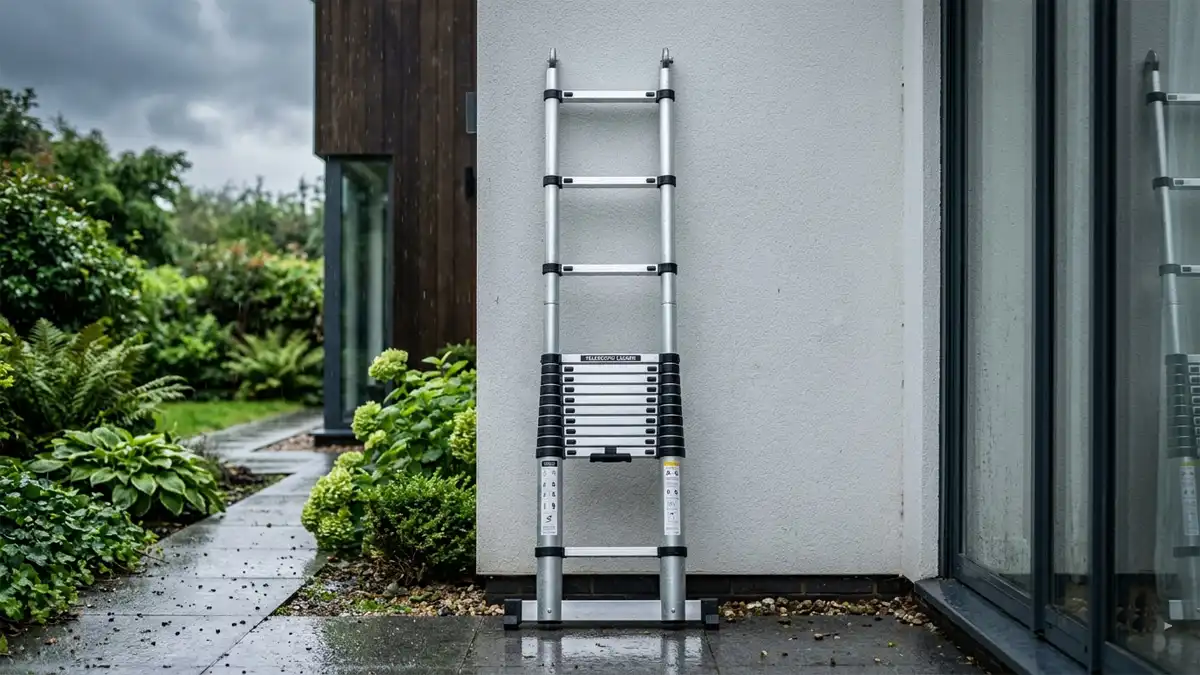
One of the most common questions from telescopic ladder owners is: Can I leave my aluminium ladder outside? The short answer is no – you should not leave an aluminum telescopic ladder outdoors for extended periods. While aluminium is naturally corrosion‑resistant, prolonged exposure to rain, sun, humidity, and temperature swings will damage the ladder, shorten its lifespan, and create safety hazards.
This guide explains exactly what happens when you leave a telescopic ladder outside, how different climates affect it, and the best storage practices to keep your ladder safe and functional for years.
⚠️ Safety Warning – Deterioration is Invisible at First
Ladders left outside may look fine on the surface while internal corrosion, UV‑damaged plastic, or seized locks develop. Always inspect a stored‑outdoors ladder carefully before each use. Never climb if you have any doubts.
Outdoor Storage Reality
Many people assume that because aluminium “doesn’t rust,” they can leave the ladder outside year‑round. This is false. While aluminium does not rust like steel, it suffers from four distinct outdoor threats:
| Threat | Effect on Ladder |
|---|---|
| Rain & moisture | Internal corrosion, frozen locks, oxidation |
| Humidity | Persistent dampness → pitting, white powder |
| Sun (UV) | Plastic/rubber degrades, becomes brittle |
| Temperature swings | Expansion/contraction stresses locks, condensation inside tubes |
| Salt air (coastal) | Accelerated pitting, structural weakening |
| Snow & ice | Freeze‑thaw damage, seized mechanisms |
Realistic Lifespan Comparison:
| Storage Condition | Expected Lifespan (Residential) |
|---|---|
| Indoor, climate‑controlled | 15–20 years |
| Indoor, unheated garage (moderate climate) | 10–15 years |
| Outdoor, covered (carport, under tarp) | 3–5 years |
| Outdoor, fully exposed | 1–3 years (or less in coastal/humid areas) |
🔗 Related reading: How Long Do Aluminium Telescopic Ladders Last?
Rain Exposure Risks
Rain is not just water – it carries pollutants, dust, and sometimes acids (acid rain). When rainwater seeps into a telescopic ladder:
Internal Moisture Trapping
Telescopic ladders have hollow tubes and overlapping sections. Water that enters between sections cannot easily escape, especially if the ladder is stored horizontally. Trapped moisture leads to:
- White aluminium oxide (powdery residue) inside tubes – jams sliding sections
- Corrosion of steel lock pins – they rust, stick, or fail
- Aluminium pitting – small holes that weaken the metal
What Happens If You Retract a Wet Ladder
If you collapse a wet ladder and store it, you seal moisture inside. Within weeks:
- Locks may freeze (cannot extend)
- Sections may become permanently stuck
- A musty smell indicates mould inside
Proper After‑Rain Procedure
- Extend the ladder fully in a dry area (garage, porch).
- Wipe every section with a dry cloth, including the inside of tube ends.
- Leave extended for 1–2 hours to air dry completely.
- Apply silicone spray to telescopic sections to repel future moisture.
- Store indoors – never put away damp.
Humidity and Corrosion
Humidity alone (without rain) also damages ladders, especially in tropical and subtropical climates.
High Humidity Regions
| Country | High‑Humidity Areas | Risk Level |
|---|---|---|
| India | Coastal cities (Mumbai, Chennai, Kolkata), Kerala, Northeast | Very High |
| Australia | Queensland (Brisbane, Cairns), Northern Territory, Sydney | High |
| United Kingdom | All regions – persistent damp | Moderate to High |
| Canada | Southern Ontario, Vancouver (winter humidity) | Moderate |
| United States | Southeast (Florida, Georgia, Alabama, Louisiana), Gulf Coast | Very High |
Mechanism of Humidity Damage
At relative humidity above 70%, a thin film of moisture forms on metal surfaces. This film:
- Supports electrolytic corrosion (especially near steel rivets or pins)
- Allows mould growth on organic residues (dirt, pollen) – mould exudes organic acids that attack aluminium
- Promotes galvanic corrosion where different metals touch (aluminium + steel lock pins)
Humidity Protection
- Store ladders indoors – air conditioning or dehumidifiers make a huge difference.
- Use silica gel packs inside a ladder storage bag for long‑term storage.
- Wipe down weekly even if not used – removes accumulated moisture film.
- Choose anodised aluminium – the thickened oxide layer resists humidity better than mill finish.
🔗 Related reading: Do Aluminium Telescopic Ladders Rust?
Sun and UV Damage
Sunlight damages the non‑metal parts of your ladder – and those parts are critical for safety.
UV‑Vulnerable Components
| Component | Material | Sun Damage | Consequence |
|---|---|---|---|
| Lock release levers | Nylon / ABS | Become brittle, snap off | Cannot retract locks |
| End caps | Rubber / plastic | Crack, fall off | Dirt enters tubes, jams sections |
| Bushings (between sections) | Nylon / POM | Weep sticky residue, then crack | Sections stick, lock failure |
| Feet (anti‑slip) | Rubber | Harden, lose grip | Ladder slides on smooth surfaces |
| Carrying handle | Plastic | Fade, become weak | Handle breaks while carrying |
How Fast Does UV Damage Occur?
- Full sun exposure (daily, 6+ hours): Visible fading/cracking within 6–12 months
- Partial sun (under carport): 2–3 years before replacement needed
- Indoor storage: 10+ years
The “Sticky Bushing” Problem
Under sunlight, ladder surface temperatures can reach 70°C. This heat causes plasticisers in nylon bushings to migrate to the surface, leaving a sticky, oily residue. The residue:
- Attracts dust and dirt
- Makes sections hard to extend
- Can gum up locking pins
Fix: Wipe all telescopic tubes with a dry cloth after sun exposure. Do not use oil – it makes the problem worse. Use dry silicone spray.
UV Protection
- Store indoors – the only reliable solution.
- Use a ladder bag – many ladders come with a storage bag; use it even indoors to block dust.
- Apply UV protectant – 303 Aerospace Protectant or similar (test on small area first).
- Replace degraded parts – end caps and feet are often user‑replaceable. Contact the manufacturer.
5. Winter Snow Concerns
Snow introduces freeze‑thaw cycles – one of the most damaging processes for telescopic ladders.
How Freeze‑Thaw Damages Ladders
- Water seeps into telescopic joints or small cracks.
- Temperature drops below freezing → water expands by ~9%.
- Expansion forces aluminium outward, deforming sections or cracking plastic bushings.
- Ice also locks sections together – you cannot extend the ladder.
- When it thaws, the deformed sections may never slide smoothly again.
Snow and Ice on Locks
If snow melts on the ladder and refreezes inside the lock mechanism:
- The lock pin may freeze in the unlocked position – dangerous if not noticed.
- Or freeze in the locked position – you cannot collapse the ladder.
- Forcing a frozen lock can break the lever or pin.
Winter Storage Rules
- Never leave a ladder outside in snow. Even one overnight freeze can cause damage.
- If the ladder gets snow on it: Bring it inside, extend fully, let it dry completely, then collapse and store.
- Do not use hot water to melt ice – rapid thermal shock can crack plastic. Use warm air (hair dryer on low).
Regional Winter Advice
| Region | Recommendation |
|---|---|
| Canada (Prairies, Ontario, Quebec) | Store ladder inside heated space – never in unheated garage if temperatures drop below -10°C. |
| Northern US (Minnesota, Dakota, New England) | Same as Canada – indoor storage mandatory. |
| UK (freeze‑thaw common) | Bring ladder indoors during cold snaps; dry after any snow exposure. |
| India (Himalayan regions) | Same as Canada – indoor storage only. |
🔗 Related reading: Winter Performance & Cold Weather Safety
-Ads-
Locking Mechanism Problems
The locking mechanism is the most vulnerable part of any telescopic ladder when left outside.
How Outdoor Exposure Kills Locks
| Condition | Effect on Lock | Timeframe |
|---|---|---|
| Rain moisture | Rust on steel pins | 1–3 months |
| Humidity | Corrosion on springs | 3–6 months |
| Sun/heat | Plastic levers become brittle | 6–12 months |
| Dust/dirt | Grinding, jamming | Weeks |
| Freeze‑thaw | Ice jams, deformed housings | Single event |
Warning Signs of Lock Damage
- Grinding sound when extending – dirt or rust inside
- No “click” when section reaches position – pin not engaging
- One‑sided lock – only one of the two side pins engages
- Lever feels loose or floppy – internal spring broken
- Visible rust on pin ends
What to Do If Locks Are Damaged
- Do not use the ladder – a single failed lock can cause the section to collapse.
- Clean thoroughly – extend, spray dry silicone lubricant into locks, work back and forth.
- If still not engaging, contact the manufacturer. Some locks are replaceable; many are not.
- If multiple locks fail, retire the ladder. Cost of replacement is far less than injury.
Best Outdoor Storage Methods
If you absolutely must store your ladder outdoors (e.g., no indoor space), follow these rules to minimise damage.
Acceptable Outdoor Storage (Least Bad)
- Under a roof overhang (carport, porch, balcony) – protects from direct rain and most sun.
- In a locked shed – better than open air, but still subject to temperature extremes.
- In a ventilated ladder bag – bags designed for telescopic ladders offer dust and UV protection.
Minimal Requirements
| Requirement | Why |
|---|---|
| Off the ground (on pallet or hooks) | Prevents standing water, ground moisture |
| Vertical orientation | Water drains out, no pooling in tubes |
| Covered from direct sun | Protects plastic and rubber parts |
| Ventilated (not sealed) | Allows trapped moisture to escape |
| Not in a parked vehicle | Extreme heat kills bushings and locks |
What “Outdoor Storage” Should Never Mean
- ❌ Lying flat on grass or soil – traps moisture.
- ❌ Leaning against a wall in the open – rain enters tubes.
- ❌ Inside a plastic bag – seals moisture in, promotes mould.
- ❌ In a metal shed in summer – oven temperatures.
- ❌ Near salt spray (coastal) – even with a cover, salt air infiltrates.
Protective Covers and Maintenance
A ladder cover or storage bag is not a solution for permanent outdoor storage, but it helps for short‑term protection (e.g., overnight at a job site).
Choosing a Cover
| Feature | Importance |
|---|---|
| UV‑resistant fabric | Required – otherwise cover degrades in months |
| Waterproof but breathable | Prevents rain entry while allowing moisture to escape |
| Zippered or drawstring closure | Keeps out insects and dust |
| Light colour | Reflects heat |
DIY Cover Alternatives
- Heavy‑duty tarp – better than nothing, but traps moisture underneath. Elevate ladder on blocks.
- BBQ grill cover – often fits telescopic ladders well.
- PVC pipe storage tube – seal one end, drill small vent holes.
Maintenance for Outdoor‑Stored Ladders
If you store outdoors (even with a cover), perform this checklist every time before use:
- ✅ Extend fully – check for sticking sections.
- ✅ Inspect every lock – does each pin click and hold?
- ✅ Check for white powder – clean immediately with dry cloth.
- ✅ Examine plastic parts – any cracks? Replace if found.
- ✅ Test feet – rubber should be flexible, not rock‑hard.
- ✅ Wipe tubes – remove any sticky residue before extending.
Monthly Deep Maintenance
- Bring ladder indoors (bathroom or kitchen).
- Extend, clean with mild soap and water.
- Dry thoroughly for 2 hours.
- Apply silicone spray to telescopic sections.
- Collapse and store indoors (even just for a few days) to allow plastics to recover.
When Outdoor Storage Becomes Dangerous
Outdoor storage is not just about reducing lifespan – it can create active safety hazards.
Hazard 1: Hidden Corrosion
Aluminium corrosion (white powder) may look superficial, but it removes metal. A deeply pitted rail can snap under load. You cannot see internal pitting without disassembling the ladder.
Hazard 2: Brittle Plastic Locks
UV‑damaged plastic lock levers can snap off when you need to retract the ladder. If a lever breaks while you are at height, you may not be able to collapse the ladder to bring it down – a serious problem.
Hazard 3: Rusted Lock Pins
A rusted pin may not fully extend, so the section locks partially – only 2–3 mm of engagement instead of 8–10 mm. Under load, the pin can shear, causing sudden collapse.
Hazard 4: Freeze‑Damaged Sections
Ice expansion can deform aluminium tubes. A slightly swollen tube may still extend, but the lock holes no longer align. The lock pin may miss the hole entirely – no engagement at all.
Real‑Life Example
Case study: A homeowner in Florida left his aluminium telescopic ladder outside under a carport for 18 months. The ladder looked fine externally. One day, while cleaning gutters on a 10‑ft roof, a lock failed. The section collapsed, and he fell, breaking his wrist. Inspection revealed rusted lock pins and internal pitting. The ladder was less than 2 years old.
Moral: Outdoor storage is false economy. The cost of a new ladder is far less than medical bills.
Final Verdict
Can aluminium telescopic ladders be left outside?
No – not for extended periods. While occasional short‑term outdoor use (a few hours in dry weather) is fine, permanent outdoor storage will destroy your ladder within 1–3 years – and create serious safety risks.
Quick Summary
| Storage Method | Lifespan | Safety | Recommendation |
|---|---|---|---|
| Indoor, climate‑controlled | 15–20 years | Excellent | ✅ Best |
| Indoor, unheated garage (dry climate) | 10–15 years | Good | ✅ Acceptable |
| Covered carport (no direct rain) | 3–5 years | Moderate | ⚠️ Only if unavoidable |
| Open outdoors (rain + sun) | 1–2 years | Poor | ❌ Not recommended |
| Coastal outdoor (salt air) | <1 year | Dangerous | ❌ Never |
If You Have No Indoor Space
- Buy a storage shed – a small plastic shed ($100–200) provides UV and rain protection.
- Use a heavy‑duty ladder bag – store ladder vertically inside the bag, off the ground.
- Rent a small storage unit – extreme, but worth it for expensive professional ladders.
- Consider a fiberglass ladder – more UV‑resistant (but still not outdoor‑proof).
The Bottom Line
Your telescopic ladder is a safety device. Treat it like one. Indoor storage is free (a closet corner works) and adds years of life. Outdoor storage saves you 10 seconds of walking but costs you a ladder and potentially your health.
🔗 Further reading: