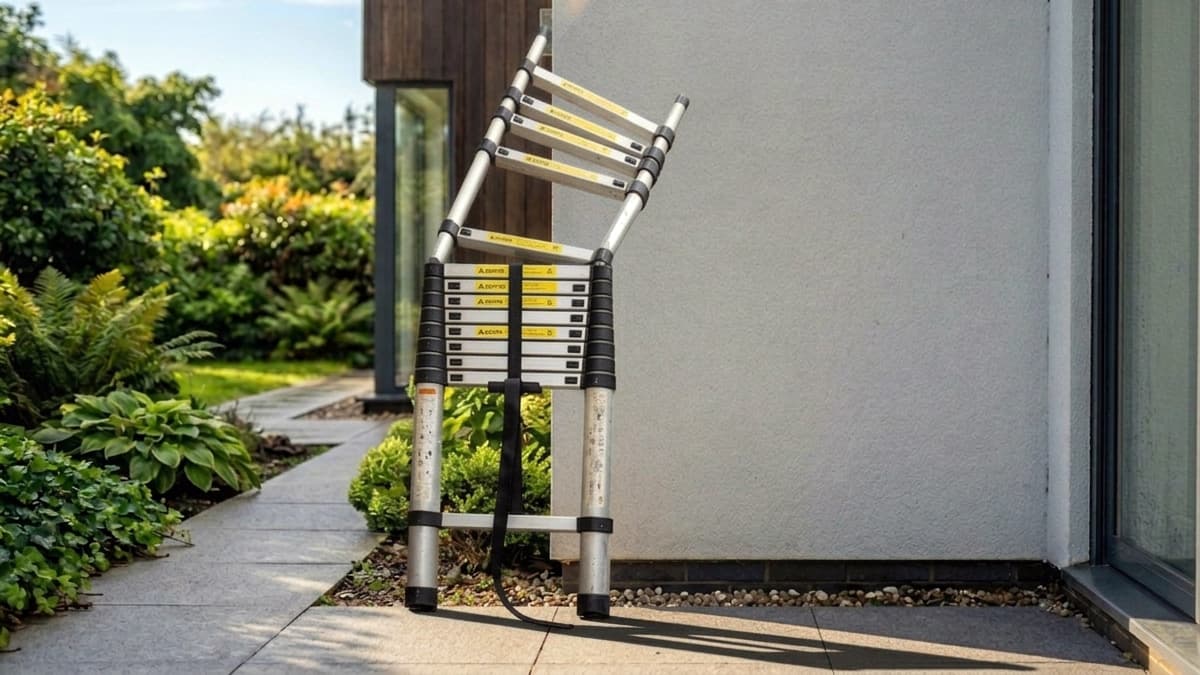
You have seen them online – telescopic ladders priced at $50–$80, claiming to support 300 pounds while extending to 15 feet. They look identical to reputable brands costing three times as much. But when you climb one, something feels wrong. The ladder wobbles. The locks don’t click confidently. The rungs flex under your weight.
That uneasy feeling is your survival instinct. Cheap telescopic ladders are not just uncomfortable – they are dangerous. This guide explains exactly why budget ladders fail, what safety features they omit, and how to choose a ladder that won’t put you at risk.
🚨 CRITICAL SAFETY WARNING
Your life depends on your ladder. A fall from 10 feet can cause spinal injury, broken bones, or death. Never compromise safety to save money. If a ladder feels unsafe, do not climb it – return or discard it.
Common User Complaints
If you read reviews of cheap telescopic ladders, you will see the same complaints repeated:
| Complaint | What It Means |
|---|---|
| “Feels wobbly even on flat ground” | Poor manufacturing tolerances, thin rails |
| “Locks don’t click into place” | Cheap lock mechanisms, misaligned holes |
| “Sections are hard to extend/retract” | Rough finishes, poor quality control |
| “Rungs flex when I step on them” | Thin aluminium, inadequate wall thickness |
| “Ladder bent after a few uses” | Low‑grade alloy, no structural margin |
| “Locks got stuck after one month” | Steel pins rusted or plastic levers broke |
| “Weight rating seems fake – I’m only 150 lbs and it creaks” | Exaggerated specifications |
These are not minor annoyances. They are safety red flags. A ladder that wobbles or makes noise under normal load is already near failure.
🔗 Related reading: Are Cheap Telescopic Ladders Dangerous? – Full Analysis
Weak Aluminum Thickness
The single most important factor in ladder strength is wall thickness of the aluminium tubes. Cheap ladders use the thinnest material possible.
Typical Wall Thickness
| Ladder Quality | Wall Thickness | Weight Capacity (Claimed) | Actual Safe Capacity |
|---|---|---|---|
| Cheap budget | 0.8–1.0 mm | 300 lbs | 150–200 lbs |
| Mid‑range | 1.2 mm | 300 lbs | 250–275 lbs |
| Professional (EN131) | 1.4–1.6 mm | 330 lbs | 300–330 lbs |
How to Check Thickness Without Tools
- Lift the ladder – A cheap 12‑ft ladder may weigh 15–18 lbs. A quality ladder weighs 25–30 lbs. Weight = material.
- Squeeze the rails – If you can feel flex when squeezing with your hands, the walls are too thin.
- Look at the tube ends – Many cheap ladders have exposed ends where you can see the wall thickness. A 1.0 mm wall looks visibly thin.
Why Thin Walls Are Dangerous
- Bending under load – The rails bow outward when you climb, causing instability.
- Denting easily – A dropped tool can dent the rail. A dented rail is a weakened rail.
- Lock hole elongation – The holes where lock pins engage can stretch over time, creating loose fit.
- Sudden collapse – Thin rails can buckle, not just bend.
Real risk: A 150‑lb user on a cheap ladder with 1.0 mm walls creates significant flex. Add tools (20 lbs), reach sideways (increases leverage), and the ladder can twist or buckle.
Poor Locking Mechanisms
The lock is the heart of any telescopic ladder. Cheap ladders cut corners here – often fatally.
What Quality Locks Have
- Steel lock pins (hardened, corrosion‑resistant)
- Positive engagement (pin extends fully through the hole)
- Visual indicators (green = locked, red = unlocked)
- Independent locks per section (each locks separately)
- Spring‑loaded (automatically engages when extended)
- Dual‑sided levers (requires both hands to release – prevents accidental collapse)
What Cheap Locks Do
| Problem | Consequence |
|---|---|
| Plastic pins or thin steel | Pin bends or shears under load |
| Shallow engagement (2–3 mm) | Pin can slip out of hole |
| Single‑sided release | Can be accidentally bumped with one hand |
| No visual indicator | Cannot verify lock is engaged |
| Cheap springs | Lose tension, pin doesn’t extend fully |
| Rough machining | Pin sticks, doesn’t pop out |
The “Click” Test
A quality ladder makes a distinct, sharp “CLICK” when each section locks. You can feel it through the ladder. Cheap ladders may click quietly, not at all, or make a dull thud.
If you don’t hear and feel a positive click, do not climb.
🔗 Related reading: Common Locking Systems and Safety Features
Wobbling Problems
Wobble is the most common user complaint about cheap telescopic ladders – and the most frightening when you are at height.
Causes of Wobble
| Cause | Why It Happens |
|---|---|
| Loose tolerances | Section‑to‑section gaps too large |
| Thin rails | Rails flex under load |
| Poor rivet quality | Rivets allow movement at joints |
| Uneven section lengths | Sections don’t align perfectly |
| Weak bracing | No internal ribs in the extrusion |
How Much Wobble Is Acceptable?
- Quality ladder: Slight flex when you shift weight, but no side‑to‑side wobble. Feels solid.
- Cheap ladder: Visible lateral movement (1–2 inches at the top) when standing still. Wobble increases when you reach sideways.
The Wobble Test
- Extend the ladder fully on a level surface.
- Stand on the third rung from the bottom (not the top).
- Shift your weight side to side slowly.
- If the top moves more than a few inches, the ladder is unsafe for height.
Do not “get used to” wobble. Wobble indicates structural instability. One unexpected shift can tip the ladder.
Unsafe Weight Ratings
Weight rating is one of the most falsified specifications on cheap ladders.
How Ratings Are (Supposedly) Determined
Certified ladders (EN131, ANSI) are tested to four times the working load. A 250‑lb rated ladder must survive 1,000 lbs without failure. This is called the safety factor.
What Cheap Ladders Do
- Copycat ratings – They print “300 lbs” on the box even though the ladder failed at 200 lbs.
- No testing – No independent laboratory certification.
- Confusing language – “Max load 150 kg” but fine print says “static load only” (not dynamic – your weight moving).
- Over‑optimistic alloy – They claim “aircraft grade” but use recycled low‑grade aluminium.
Real‑World Example
A budget ladder advertised as 330 lbs (150 kg) was independently tested by a safety lab. Results:
- Static load (non‑moving weight): Failed at 220 lbs – rail bent.
- Dynamic load (simulating climbing): Failed at 180 lbs – lock pin sheared.
The ladder was unsafe for a 150‑lb user.
How to Verify Weight Rating
- Look for EN131 (Europe) or ANSI A14.2 (US) certification marks. These are legally regulated.
- Check the ladder’s own label – not just the box. Certified ladders have a permanent label.
- Compare weight: A genuine 300‑lb ladder weighs significantly more than a fake one.
- Read reviews for comments like “I’m 180 lbs and it creaks” – red flag.
🔗 Related reading: EN131 and OSHA Ladder Safety Standards Explained
Cheap Plastic Components
Aluminium may be the main material, but plastic parts are critical for safety. Cheap ladders use the lowest‑grade plastics.
Vulnerable Plastic Parts
| Component | Cheap Material | Failure Mode |
|---|---|---|
| Lock release levers | Recycled ABS, thin | Snap off when pulled |
| End caps | Thin polyethylene | Crack, fall off – dirt enters tubes |
| Bushings (between sections) | Low‑grade nylon | Weep sticky residue, crack |
| Rung covers (if any) | Soft rubber | Tear, become slippery |
| Feet | Hard recycled rubber | Harden, lose grip; crack |
| Carrying handle | Cheap polypropylene | Break when lifting |
Field Failures
- Lever snaps – You try to release a lock, the plastic lever breaks in your hand. Now you cannot collapse the ladder.
- End cap missing – Dirt enters the tube, jams the section permanently.
- Foot falls off – The ladder slides on concrete. You fall.
The Cost Difference
A quality nylon bushing costs the manufacturer $0.50 more than a cheap one. A reinforced lock lever costs $0.30 more. For a $30–50 price difference at retail, you get dramatically better safety.
Never buy a ladder with plastic lock pins or plastic lock engagement surfaces. Look for steel‑core pins visible through the lock housing.
Finger Pinch Risks
Cheap telescopic ladders often have sharp edges, poor alignment, and high pinch forces – a recipe for serious finger injuries.
How Pinching Happens
- When retracting sections, your fingers can get caught between collapsing tubes.
- Cheap ladders lack finger‑safe gaps (the space between sections is too small or inconsistent).
- Sections may drop suddenly due to poor lock design, slamming onto fingers.
Injury Severity
- Minor: Bruising, blood blisters.
- Moderate: Crushed fingernail, laceration.
- Severe: Amputation of fingertip (reported in online reviews of cheap ladders).
What Quality Ladders Do
- Designed finger‑safe gaps – Spaces are large enough to avoid trapping.
- Controlled retraction speed – Sections lower slowly, not free‑fall.
- Rounded edges – No sharp burrs.
- Two‑hand release – You must hold both sides, keeping fingers clear.
Test Before Buying
If possible, retract a section of the display model. Watch where your fingers go. Does the gap narrow dangerously? Does the section drop quickly? If yes – avoid.
Missing Safety Certifications
The single easiest way to identify a safe ladder is to look for independent safety certification. Cheap ladders almost never have them – or they fake them.
Legitimate Certifications
| Certification | Region | What It Requires |
|---|---|---|
| EN131 (latest: EN131‑6:2019) | Europe | Load testing, torsion testing, durability (4,000 cycles), marking |
| ANSI A14.2 | USA | Portable metal ladders – strength, slip resistance, stability |
| OSHA | USA | Workplace compliance – refers to ANSI standards |
| AS/NZS 1892 | Australia/NZ | Portable ladders – similar to EN131 |
| ISO 14122 | International | Industrial ladder safety |
How Certifications Are Faked
- Sticker only – No actual testing, just a printed label.
- Outdated standard – “EN131” but the old 1993 version, not 2019.
- Factory self‑certification – No third‑party laboratory involved.
- Vague claims – “Meets OSHA requirements” (without specifying which).
How to Verify
- Look for the certification body logo (TÜV, SGS, UL, BSI). A logo alone can be faked, but it’s a start.
- Check the manufacturer’s website – reputable brands publish test reports.
- Avoid no‑name brands sold exclusively on Amazon, eBay, or AliExpress.
- Price check – If a 15‑ft telescopic ladder costs $60, it cannot afford EN131 testing (which costs tens of thousands of dollars).
🔗 Related reading: Ladder Safety Certifications – What They Mean
-Ads-
Signs of a Low-Quality Ladder
Use this checklist when shopping (online or in store). If you see two or more of these signs – walk away.
Physical Inspection (In‑Store)
- [ ] Ladder feels unusually light for its size.
- [ ] Rails flex when you squeeze them.
- [ ] Lock pins are plastic or very thin steel.
- [ ] No visual indicators (red/green) on locks.
- [ ] Sections wobble side‑to‑side when extended.
- [ ] Rungs are smooth (no texture or slip resistance).
- [ ] Feet are hard plastic, not soft rubber.
- [ ] Rivets are loose or uneven.
- [ ] Ends of tubes have sharp burrs.
Box / Label Inspection
- [ ] No EN131, ANSI, or AS/NZS mark.
- [ ] “Meets OSHA” but no standard number.
- [ ] Weight rating seems too high for the ladder’s weight.
- [ ] Brand name is generic (e.g., “Heavy Duty Ladder Co.”).
- [ ] No manufacturer address or contact.
- [ ] Fine print says “For domestic use only” but claims professional capacity.
Online Reviews
- [ ] Multiple complaints about wobble, stuck locks, or bending.
- [ ] Photos show bent rails or cracked plastic.
- [ ] “One star – dangerous” reviews with photos.
- [ ] Five‑star reviews look fake (generic text, same date).
- [ ] No negative reviews (suspicious – every product has some).
How to Choose Safely
Choosing a safe telescopic ladder is simple if you follow these rules.
Rule 1 – Buy Only Certified Ladders
Non‑negotiable. Look for EN131‑6 (professional use) or ANSI Type IA (300 lbs) at minimum. Do not buy a ladder without certification.
Rule 2 – Buy From Reputable Brands
Known brands in the ladder industry:
- Werner (US)
- Little Giant (US)
- Louis (Europe)
- Telesteps (Sweden – invented telescopic ladder)
- Xpres (UK)
- Bauer (Australia)
Avoid alphabet‑soup brands (“EZ ladder Pro Max”) with no company history.
Rule 3 – Match the Ladder to Your Weight
If you weigh 200 lbs and carry 20 lbs of tools, you need at least a Type IA (300 lb) ladder. Do not buy a 225 lb rated ladder and assume it is fine.
Rule 4 – Check the Return Policy
Buy from a retailer that accepts returns. When the ladder arrives, extend it and test:
- Do locks click firmly?
- Does it wobble?
- Does it feel solid?
If anything feels wrong, return it immediately.
Rule 5 – Expect to Pay Fair Price
| Ladder Size | Safe Price Range (USD) |
|---|---|
| 8–10 ft | $80–120 |
| 12 ft | $120–180 |
| 14–15 ft | $180–250 |
| 16 ft+ | $250–400 |
If you see a 15‑ft ladder for $60, it is unsafe. There is no magic – good materials and testing cost money.
Final Thoughts
Why do cheap telescopic ladders feel unsafe? Because they are unsafe. Every corner cut – thinner aluminum, weaker locks, cheaper plastic, no testing – creates a ladder that may fail without warning.
Key Takeaways
- ✅ Thickness matters – 1.4–1.6 mm wall thickness for safe use. Cheap ladders use 0.8–1.0 mm.
- ✅ Locks must be steel – Plastic pins or shallow engagement will fail.
- ✅ Wobble is not normal – A ladder should feel solid at full extension.
- ✅ Weight ratings are often fake – Only trust certified ratings (EN131, ANSI).
- ✅ Plastic parts degrade quickly – UV and heat kill cheap plastics in months.
- ✅ Certification is non‑negotiable – No EN131/ANSI = no purchase.
- ✅ You get what you pay for – A safe ladder costs $120–250. Your life is worth that.
Your ladder is a safety device – not an accessory to save money. A fall from 10 feet can cost you tens of thousands in medical bills, lost work, and permanent injury. Invest in a certified ladder. Inspect it before every use. Never climb a ladder that feels wrong.
🔗 Further reading: