Article Index
What Is an Aluminum Cotter Pin?
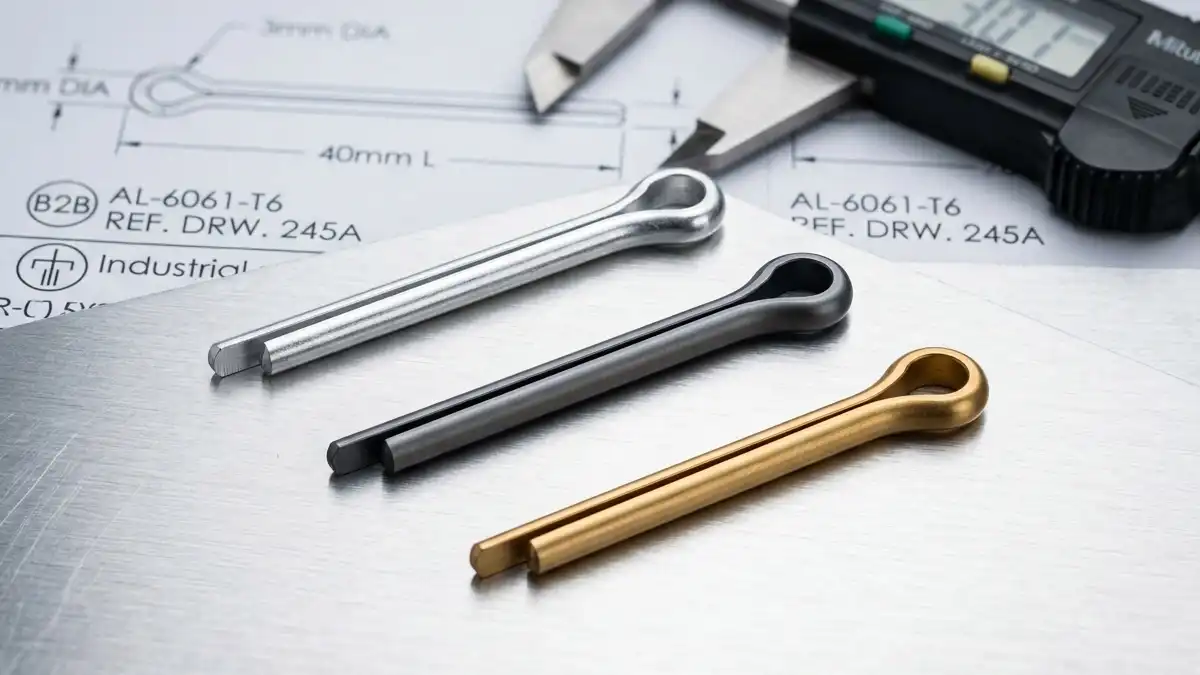
An aluminum cotter pin – also known as a split pin – is a small, lightweight fastener made from aluminum or aluminum alloys. It consists of a semicircular head and two prongs (legs) that are split apart. Once inserted through a hole in a bolt, shaft, or other component, the two legs are bent outward to lock the pin in place. This simple yet effective design prevents nuts from loosening, secures moving parts, and ensures mechanical assemblies remain intact under vibration or motion.
While steel cotter pins are more common in heavy‑duty applications, aluminum cotter pins are chosen when weight reduction, corrosion resistance, or non‑magnetic properties are critical. They are widely used in aerospace, marine, military, and high‑performance automotive sectors. For a broader comparison of aluminum versus steel in terms of weight, durability, and sustainability, see Advantages of Aluminum Over Steel for Lightweight Durability & Sustainability.
How Does an Aluminum Cotter Pin Work?
The working principle of an aluminum cotter pin is straightforward:
- Insertion – The pin is pushed through a pre‑drilled hole (often in a castellated nut or a clevis pin) until the head rests against the component.
- Spreading – Using pliers or fingers, the two prongs are bent apart in opposite directions – typically one leg is bent over the end of the bolt/shaft, and the other leg is bent in the opposite direction or wrapped around the side.
- Locking – Once bent, the pin cannot slide back through the hole. It mechanically blocks the rotation or axial movement of the nut or pin, keeping the assembly secure even under constant vibration.
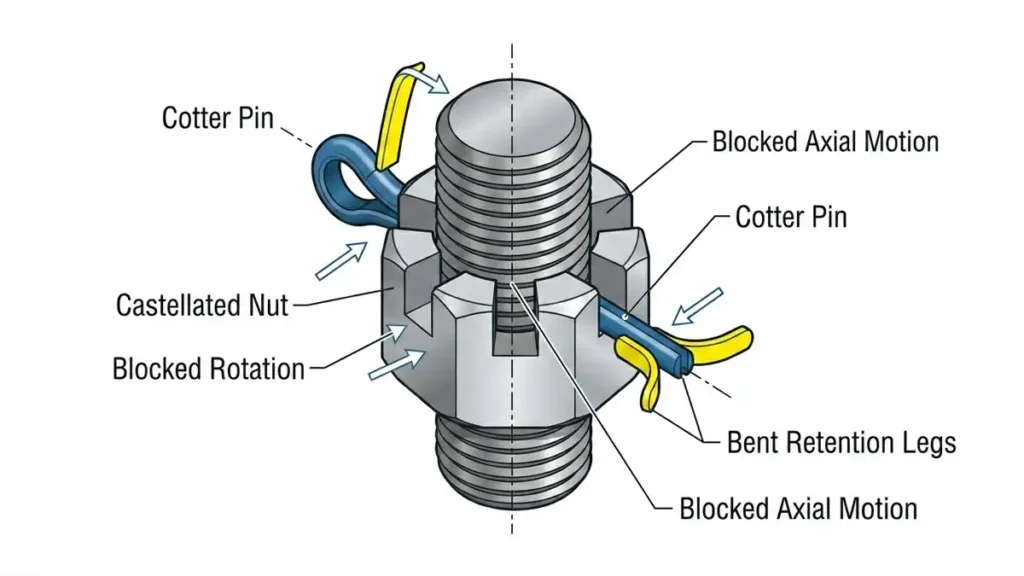
Aluminum’s malleability makes bending easy without cracking, yet certain heat‑treated alloys (e.g., 7075) retain enough spring strength to hold their shape reliably.
Common Types of Aluminum Cotter Pins
Aluminum cotter pins are available in several variants based on material, surface treatment, and design.
1. Pure Aluminum Cotter Pins
- Made from 1100 or similar commercially pure aluminum.
- Extremely soft and highly corrosion resistant.
- Suitable for non‑critical, light‑duty applications (e.g., hobby projects, outdoor furniture).
2. Aluminum Alloy Cotter Pins
- 2024 aluminum alloy – High strength, good fatigue resistance, often used in aircraft structures.
- 6061 aluminum alloy – Good balance of strength, workability, and corrosion resistance; common in general manufacturing.
- 7075 aluminum alloy – Very high strength (comparable to many steels), used in aerospace and military applications where weight is critical. Learn more about this alloy in our dedicated guide: Aluminium 7075 – Properties & Uses.
3. Anodized Aluminum Cotter Pins
- Treated with an electrochemical process that thickens the natural oxide layer.
- Benefits – Increased surface hardness, superior corrosion resistance, and optional color coding (e.g., gold, black, red) for easy identification.
- For a comparison of anodizing with other finishing methods, read Powder Coating vs Anodizing.
4. Non‑Anodized Aluminum Cotter Pins
- Natural oxide layer only.
- Lower cost but less durable in harsh environments (saltwater, chemicals).
5. Standard vs. Oversize Head Designs
- Standard head – Flush or slightly raised, fits most applications.
- Oversize head – Larger bearing surface, prevents pull‑through in soft materials.
Aluminum Cotter Pin Uses and Applications
Aluminum cotter pins are not for every job, but they excel in specific scenarios where their unique properties matter.
Aerospace & Aviation
- Securing control linkages, landing gear components, and engine accessories.
- Weight savings of up to 60% compared to steel pins directly improve fuel efficiency and payload capacity.
- Alloys like 7075‑T6 are common in military and civilian aircraft. Discover Why Aluminum Works for Aircraft Parts.
Marine Equipment
- Sailboat rigging, outboard motor mounts, and trailer hardware.
- Aluminum’s natural corrosion resistance prevents rust in saltwater environments.
- Anodized versions are preferred for long‑term exposure.
Military & Defense
- Lightweight fasteners for portable equipment, drones, and ground vehicles.
- Non‑magnetic property is critical for mine‑detection devices and sensitive electronic housings.
High‑Performance Automotive & Motorsports
- Securing brake caliper pins, suspension links, and engine bay components where every gram counts.
- Used in racing motorcycles, formula cars, and aftermarket performance parts.
General Industrial & Light‑Duty
- Outdoor furniture, bicycle components, agricultural machinery (non‑critical stress areas).
- Electrical enclosures where non‑magnetic fasteners are required.
Consumer Goods
- Telescopic ladders, camping gear, and folding tools – aluminum cotter pins keep pivot points secure without adding weight.
Advantages of Aluminum Cotter Pins
| Advantage | Explanation |
|---|---|
| Lightweight | Density of aluminum (≈2.70 g/cm³) is about one‑third that of steel (≈7.85 g/cm³). Ideal for aerospace, racing, and portable devices. |
| Corrosion Resistance | Naturally forms a protective oxide layer. Performs exceptionally well in humid, coastal, or chemical environments without rusting. |
| Non‑Magnetic | Essential for MRI machines, compass housings, electronic warfare systems, and any application where magnetic interference must be avoided. (Verify: Is Aluminum a Magnetic Material?) |
| Good Thermal & Electrical Conductivity | Useful in certain electronic or heat‑exchange assemblies (though rarely the primary function of a cotter pin). |
| Easily Bendable | Malleable enough to be installed and removed by hand or with basic pliers, reducing assembly time. |
| Aesthetic Options | Anodizing allows color coding for different sizes or applications – e.g., red for 1/8″, blue for 3/16″. |
Aluminum vs Steel Cotter Pins (Quick Comparison)
| Feature | Aluminum Cotter Pin | Steel Cotter Pin |
|---|---|---|
| Tensile Strength | Lower (varies by alloy: 200–570 MPa) | Higher (carbon steel: 400–700 MPa; stainless: 500–1000 MPa) |
| Weight | Very light (≈1/3 of steel) | Heavy |
| Corrosion Resistance | Excellent (especially anodized) | Poor for carbon steel; good for stainless or galvanized |
| Magnetic | Non‑magnetic | Magnetic (except some austenitic stainless steels) |
| Cost | Moderate to high (alloy dependent) | Low to moderate (carbon steel is cheap) |
| Typical Applications | Aerospace, marine, racing, lightweight mechanisms | Automotive, construction, agricultural machinery, general industrial |
| Installation Ease | Very easy to bend | Requires more force to bend; may need proper pliers |
| Temperature Resistance | Good up to ~200°C; loses strength above | Excellent up to 500°C+ for stainless |
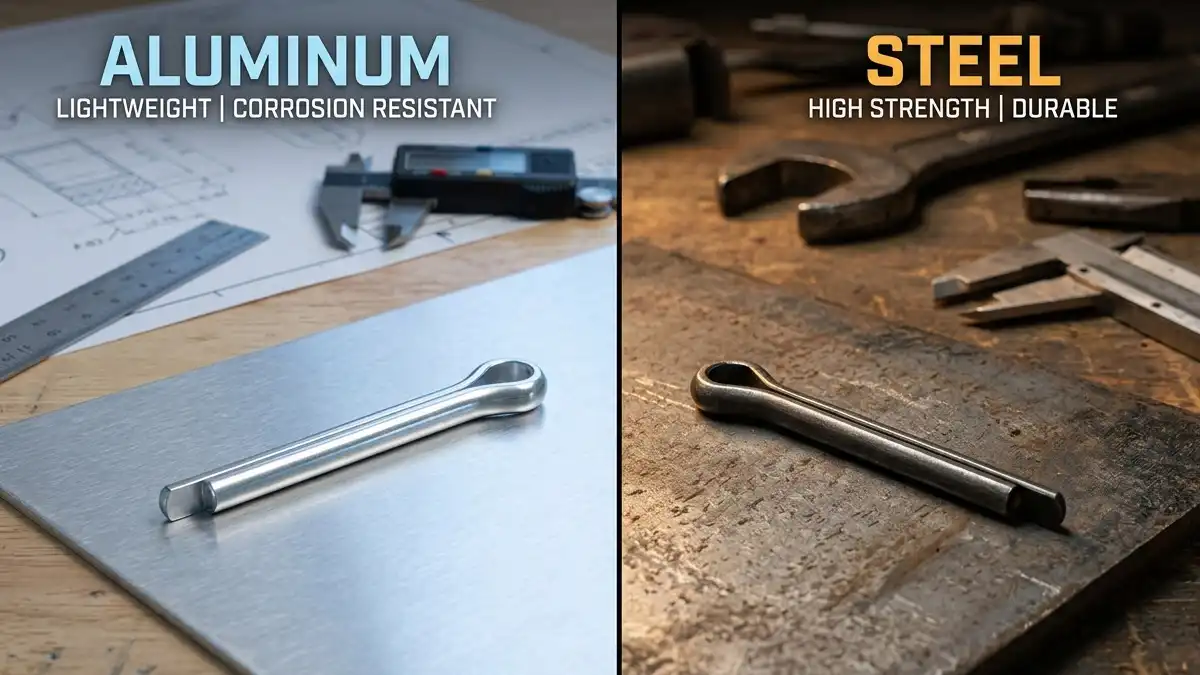
Verdict: Choose aluminum when weight, corrosion, or non‑magnetic properties are critical. Choose steel when maximum strength, low cost, or high‑temperature resistance is the priority.
-Ads--Ads-
FAQs
Q1: Can I use an aluminum cotter pin in a high‑vibration engine?
It depends. In low‑stress, non‑rotating applications (e.g., securing a linkage pivot), high‑strength alloys like 7075 can work. For high‑stress engine components (connecting rods, suspension), steel is safer. Always follow original equipment manufacturer (OEM) recommendations.
Q2: Do aluminum cotter pins rust?
No. Aluminum does not “rust” like iron or steel. It can oxidize (forming a dull gray film), but this oxide layer actually protects the metal beneath. In saltwater, anodized aluminum is highly recommended.
Q3: Are anodized aluminum cotter pins stronger than non‑anodized?
Anodizing improves surface hardness and wear resistance, but it does not significantly increase tensile or shear strength. The base alloy determines strength.
Q4: What is the typical size range for aluminum cotter pins?
Common diameters: 1/16″ (1.6 mm), 3/32″ (2.4 mm), 1/8″ (3.2 mm), 5/32″ (4.0 mm), and 3/16″ (4.8 mm). Lengths range from ½″ (12 mm) to 3″ (76 mm). Custom sizes are available from specialty suppliers.
Q5: Can I reuse an aluminum cotter pin?
Generally not recommended. Bending the prongs work‑hardens aluminum and can cause cracking. For safety‑critical applications, always use a new cotter pin after removal.
Q6: Where can I buy aluminum cotter pins?
Industrial suppliers (McMaster‑Carr, Grainger), aircraft hardware specialists (Aircraft Spruce, Wicks), and online marketplaces (Amazon, eBay). For alloys like 7075‑T6, aerospace supply houses are your best bet.
Q7: How do I remove a bent aluminum cotter pin?
Use diagonal cutters to snip the bent legs near the head, then pull the head through the hole. Alternatively, straighten the legs with pliers – but be careful not to break them inside the hole.
This guide covers everything you need to know about aluminum cotter pins. Whether you’re designing a lightweight aircraft, repairing a boat trailer, or simply looking for a corrosion‑proof fastener, aluminum cotter pins offer a reliable, high‑performance solution. Always match the alloy and finish to your specific environment and load requirements.

Featured


You May Also Like

Best Custom Storm Doors for Non-Standard and Historic Entryw…
Aluminium 5086 (Aluminum 5086): The Weldable Marine Alloy fo…

8 Different Types of Mosquito Net Options for Windows

Aluminium Element: Symbol, Properties, Uses, and Surprising …

Aluminium Casement Windows Design Ideas: Modern Frames for S…