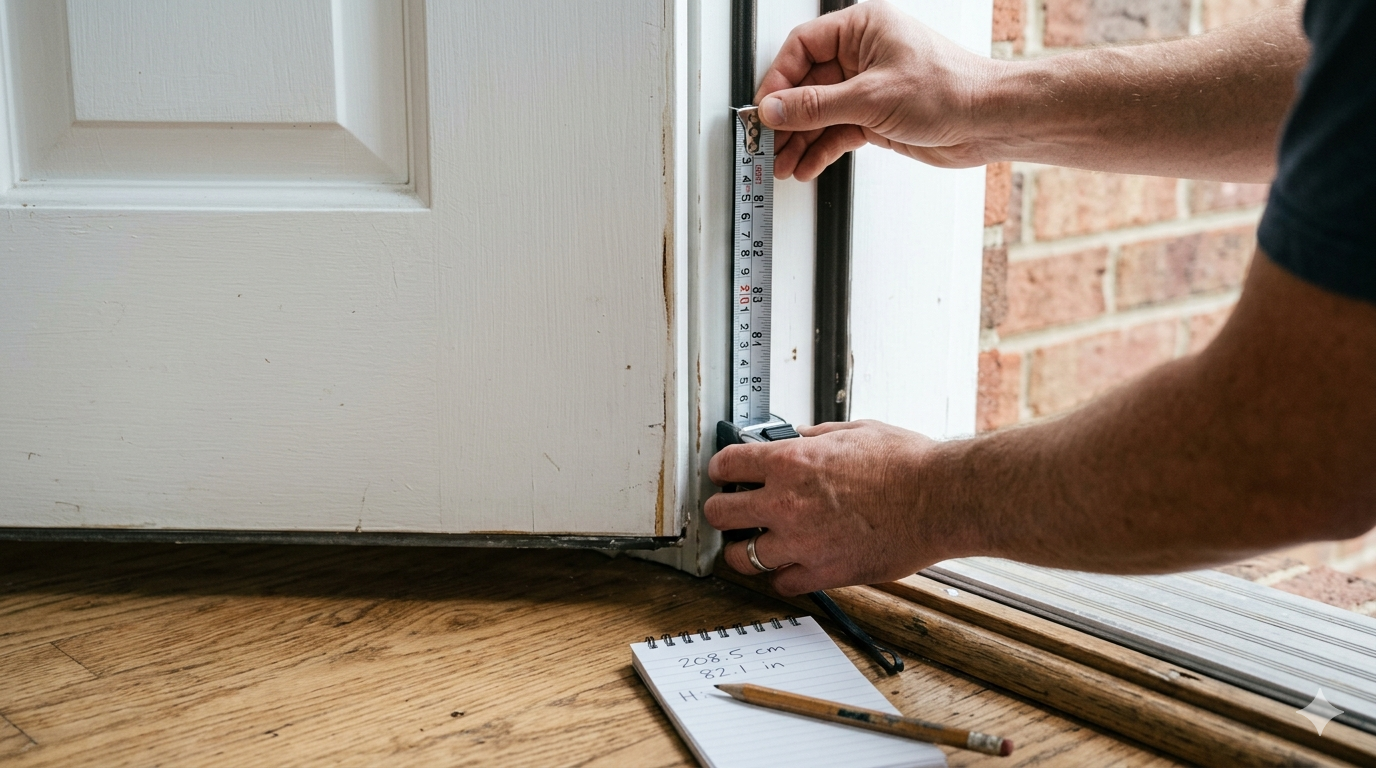
A storm door that doesn’t fit is worse than no storm door at all. Gaps let in drafts and insects. An oversized frame won’t close. A misaligned door binds on the threshold. And once you cut the box open, you usually can’t return it.
Measuring sounds simple – but most homeowners make at least one mistake. This guide walks you through every step: width, height, trim clearance, out‑of‑square checks, and mobile home specifics. Get these numbers right, and installation goes smoothly. Get them wrong, and you’ll be shimming, cutting, or returning the door.
Why Accurate Storm Door Measurements Matter
Storm doors are not “one size fits all.” Standard doors are designed to fit a range of rough openings (e.g., a 32” door fits 31.5”–33.5”), but the tolerances are tight. A 1/4” error can mean:
- The frame won’t sit flush against the brick mold
- Weatherstripping doesn’t compress, leaving air gaps
- The closer bracket doesn’t align with the jamb
- The bottom sweep drags or leaves a gap
Worse, if you order a custom door, measurements become legally binding. Most custom fabricators will not accept returns if your measurements were wrong. Measure twice – or three times.
For a full understanding of door sizing and costs, see our storm door cost guide for 2026.
Tools Needed Before Measuring
Gather these before you start:
- Steel tape measure (25’ minimum; cloth tapes stretch)
- Pencil and paper (or phone notes)
- Level (24” or longer)
- Carpenter’s square (or a speed square)
- Flashlight (to see behind trim)
- Step ladder (for header measurements)
Do not use a laser measure for rough openings – it can’t detect out‑of‑square conditions.
For a quick reference on standard sizes after measuring, see our what are storm doors types and benefits.
How to Measure Door Width
Width is the most common mistake. Follow this exact process:
- Open the primary door – You need clear access to the frame.
- Measure inside the existing door frame – Not the trim, not the brick mold. The frame (jamb) is the vertical surface where the weatherstripping sits.
- Take three measurements: top, middle, bottom
- Top: just below the header
- Middle: at handle height
- Bottom: just above the threshold
- Record the smallest of the three – This is your nominal width.
Example: Top = 32.5”, Middle = 32.25”, Bottom = 32.125”. Use 32.125” as your opening width. A standard “32-inch” storm door typically fits 31.5” – 33.5”, so 32.125” works.
If the smallest and largest differ by more than 1/2”, your frame is significantly out of square. You may need a custom door or heavy shimming.
How to Measure Door Height
Height mistakes are less common but still critical.
- Measure from the top of the threshold (the flat surface the door closes against) to the underside of the header (top of the frame).
- Take three measurements: left, center, right
- Left: near the hinge side
- Center: middle of the opening
- Right: near the latch side
- Record the smallest measurement.
Standard height for most homes: 80” – 82”. Mobile homes and older houses may be 78” or 79”.
If your height is under 78” or over 83”, standard doors may not fit. You’ll likely need a custom door or a specialized mobile home model. For mobile home specifics, see our best storm doors for mobile homes guide.
Measuring the Door Frame Opening (Rough Opening vs Finished Opening)
Most storm doors mount to the finished opening – the exterior brick mold or trim, not the rough stud framing. But you still need to know what’s behind the trim.
- Finished opening measurement = what you take above (jamb to jamb). This is what storm door manufacturers use.
- Rough opening = distance between wall studs. Rarely needed except for custom jobs.
However, check the depth of your trim (brick mold). Storm door frames need at least 3 inches of flat mounting surface on each side. If your brick mold is only 2” wide, the storm door frame will overhang – not ideal.
Pro tip: Use a flashlight to look behind the trim. If you see gaps or rot, fix those before measuring for a new storm door.
For help identifying trim issues, see our how to maintain aluminum windows and doors guide.
Checking Trim and Mounting Space
The storm door frame attaches to the exterior trim (brick mold) or directly to the siding. Verify:
- Trim width: At least 3” on hinge side, latch side, and top
- Trim condition: No rot, no loose nails, no large gaps
- Flatness: The trim surface should be flat within 1/8” across the width of the storm door frame
If the trim is rotted or too narrow, you’ll need to replace or extend it before installation. Factor that into your budget – see our storm door installation cost guide.
Standard Storm Door Sizes Explained
Manufacturers list storm doors by nominal width. Here’s what they actually fit:
| Nominal Size | Fits Rough Opening Width | Common Use |
|---|---|---|
| 30″ | 29.5″ – 31.5″ | Rare; mobile homes, small entries |
| 32″ | 31.5″ – 33.5″ | Most common for single doors |
| 34″ | 33.5″ – 35.5″ | Common for larger entries |
| 36″ | 35.5″ – 37.5″ | Wide single doors |
| 38″+ | custom | Double doors, custom builds |
Height is almost always adjustable within a range (e.g., 80–82”) via an expandable frame or spacer. But don’t assume – check the spec sheet.
If your measurements fall between these ranges, you need a custom door. For more, see our custom storm doors guide.
Measuring for Double Storm Doors (French Doors)
Double storm doors require two separate doors plus a center astragal. Measuring is more complex:
- Measure total width from left jamb to right jamb (top, middle, bottom). Use the smallest.
- Divide by two to get the width for each door.
- Measure each door’s height (left, center, right) – they must match.
- Check the center seam – The astragal will add about 1–2” of overlap. Ensure the total width minus the astragal leaves equal panels.
Double door warning: Even 1/8” difference between the two jambs causes alignment issues. Professional measurement and installation are strongly recommended. See our double storm doors for French doors guide.
Measuring Mobile Home Storm Doors
Mobile homes have unique challenges:
- Outswing doors – The main door opens outward, so handle clearance is critical. Measure from the jamb to the primary door handle when fully open.
- Narrow jambs – Many mobile homes have 2×3 walls. Storm door screws must bite into the thin studs without protruding inside.
- Odd widths – 30”, 31”, 33” are common. Standard 32” doors may not fit.
Measurement process for mobile homes:
- Follow the same width/height steps above
- Add a handle clearance check: open the main door fully and measure from the jamb to the furthest point of the handle. You need at least 1/2” clearance for the storm door frame.
- If clearance is tight, look for a “mobile home offset hinge” kit.
For door selection, see our best storm doors for mobile homes guide.
Common Measuring Mistakes to Avoid
| Mistake | Why It’s Wrong | Fix |
|---|---|---|
| Measuring only one spot | Misses out‑of‑square | Measure top/middle/bottom and left/center/right |
| Measuring the brick mold instead of the jamb | Brick mold is decorative; jamb is the frame | Use a flashlight to see the actual door frame |
| Including the threshold in height | Storm door sits on top of threshold | Measure from the top surface of the threshold |
| Forgetting handle clearance (outswing doors) | Storm door frame hits primary door handle | Open the main door and measure |
| Assuming standard size fits | Rough openings vary | Always measure; never trust “standard” |
| Rounding up | Door may not fit | Use the smallest measurement, never round up |
When in doubt, call the manufacturer or a local installer. A $100 service call to verify measurements is cheaper than a $500 door that doesn’t fit.
For finding a qualified professional, see our who installs storm doors near me guide (next in this series).
When to Choose a Custom Storm Door
Order a custom door if:
- Your width is under 29” or over 37.5”
- Your height is under 78” or over 83”
- The opening is out of square by more than 1/2”
- You have an arched or non‑rectangular top
- Your home is historic and requires matching trim profiles
Custom doors cost $600–2,500+ and take 4–8 weeks. But they fit perfectly and preserve architectural character.
For a deeper dive, see our custom storm doors for historic and non‑standard entryways guide.
Final Thoughts
Measuring for a storm door is not hard, but it must be done methodically. Take your time. Write down every number. Check for square. Verify trim depth. And when in doubt, hire a professional to measure – many installers will measure for a small fee that gets credited toward the installation.
Your measurement checklist:
- [ ] Width at top, middle, bottom – use smallest
- [ ] Height at left, center, right – use smallest
- [ ] Check for out‑of‑square (diagonals within 1/4”)
- [ ] Trim width at least 3” on all sides
- [ ] Handle clearance for outswing doors
- [ ] Compare to manufacturer’s rough opening range
- [ ] Consider custom if outside standard ranges
Get these numbers right, and your storm door installation will be straightforward. Get them wrong, and you’ll be making a trip back to the store.
For the next step, see our guide on who installs storm doors near you.
Related Articles
Featured



You May Also Like

Aluminum 2024: The High-Strength Workhorse for Aerospace and…

Aluminium Nitride (AlN): The Complete Guide

Aluminium Tariff War 2025–26: The Silent Shift Changing Pric…

Why Aluminium Bathroom Windows Work Best in South Africa’s C…

Copper vs Aluminum Wiring in Homes (2025): Which is Safer an…