
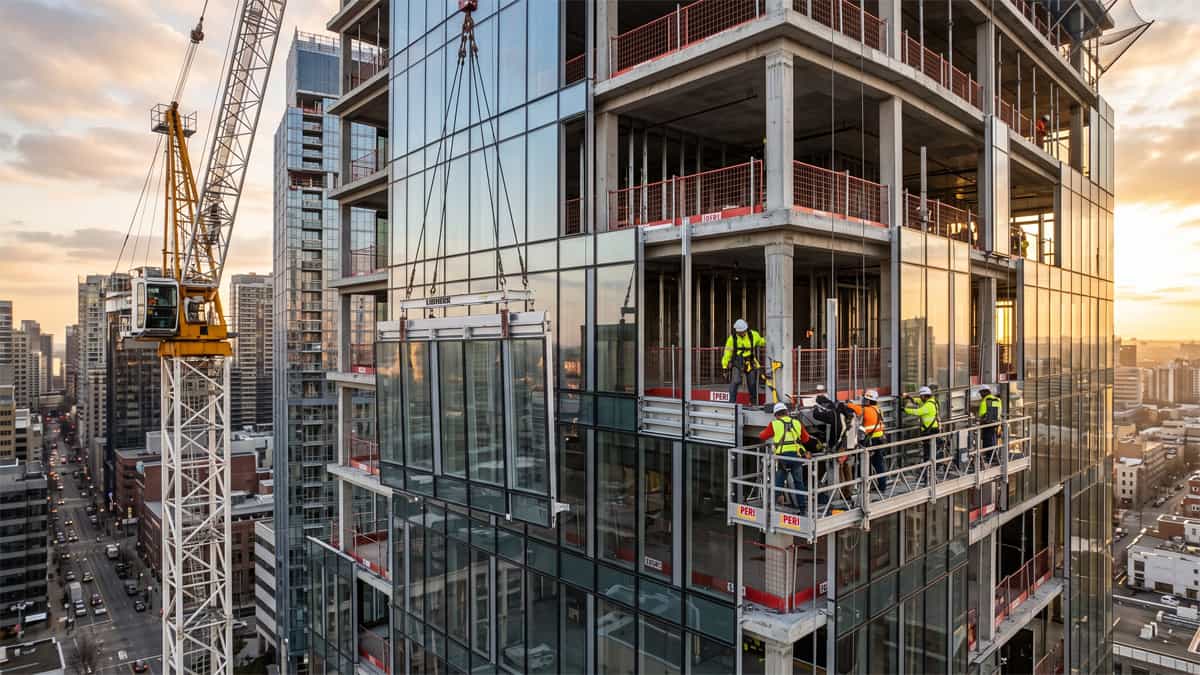
How Much Does a Curtain Wall System Cost?
There is no single answer. Curtain wall pricing varies dramatically based on system type, specification tier, building height, glass performance, finish, and location.
Before we dive into costs, it’s worth understanding what a curtain wall actually is and why it has become the default choice for modern glass buildings. Read our comprehensive introduction: Curtain Walls: The Hidden System Behind Modern Glass Buildings .
A realistic 2025–2026 range (fully installed):
| Market | Stick System | Unitized System |
|---|---|---|
| US | $60–$120 per sq ft | $90–$180 per sq ft |
| UK | £400–£600 per m² | £600–£900 per m² |
| Global average | ~$225 per m² installed | Higher than stick |
Important: The US figures above represent fully installed system costs (labour + materials + overhead). For supply-only / material-only costs, expect approximately 50–60% of these installed figures.
But these are just starting points. A basic residential project might cost as little as $80–$120 per m² (supply-only) . A premium commercial high-rise with triple glazing and custom finishes can exceed $250 per m² (supply-only) —and that’s before installation, shipping, engineering, and testing.
The rule of thumb: Hidden costs in shipping, installation, maintenance, and energy consumption can add 30–50% to your initial investment.
What Is Included in Curtain Wall System Cost?
A curtain wall quotation typically includes ten major cost components:
| Component | Typical Cost Share |
|---|---|
| Aluminium profiles | ~26% |
| Glass | ~24% |
| Labour & installation | ~16% |
| Hardware & accessories | Varies |
| Gaskets & seals | Varies |
| Thermal breaks | Varies |
| Fabrication | Varies |
| Finishing (coating/anodizing) | Varies |
| Engineering & testing | Varies |
| Shipping & logistics | Varies |
1. Aluminium Profile Cost
Aluminium extrusion is typically the single largest material cost in a curtain wall system, accounting for approximately 26% of total cost.
Aluminium prices fluctuate daily due to global supply chains, energy costs, and trade tariffs. These fluctuations directly impact profile costs and project budgets. Check live rates here: Current Aluminium Price – Live Market Rates .
What Drives Aluminium Profile Cost:
Profile Weight
- Mullion depths typically range from 150mm to 250mm; transoms from 100mm to 180mm
- Critical distinction for curtain walls: Commercial curtain wall systems require minimum structural profile wall thicknesses of 2.0 mm to 3.0 mm to satisfy deflection limits (L/175 or L/240 + 6 mm) and fastener pull-out strength under severe wind loads
- Heavier profiles = more aluminium = higher cost
- Anchor channels and screw flutes may require 4.0 mm–6.0 mm thickness for heavy load points
⚠️ Important Safety Note: Window and door systems often use 1.4 mm aluminium extrusions for residential applications. Do not use residential window-grade extrusions for structural curtain wall applications. The minimum 2.0 mm thickness is a critical safety requirement—not optional.
-Ads-
Extrusion Complexity
- Simple rectangular sections cost less than complex custom shapes
- Integrated gasket grooves, thermal break cavities, and drainage channels add cost
Alloy Grade
- 6063-T5 – Standard architectural grade, most common
- 6063-T6 – Higher strength, slightly more expensive
- Premium alloys for high-load applications cost more
Thermal-Break Requirements
- Polyamide thermal break strips add significant cost
- Two thermal breaks in a frame section improve thermal performance by up to 19%
- Thermal break width: minimum 19mm (¾ inch) for effective performance
Surface Finish
- Raw mill finish is cheapest
- Anodizing, powder coating, or PVDF coatings add $15–$50+ per m²
Aluminium dominates curtain wall framing for good reason. Its exceptional strength-to-weight ratio, natural corrosion resistance, and infinite extrudability make it the global standard. For a deep dive into the science behind this, see: Why Aluminium Is Used in Curtain Wall Systems .
2. Glass Cost
Glass accounts for approximately 24% of total curtain wall cost and is the second-largest cost driver after aluminium.
Glass Cost Tiers (Supply-Only):
| Tier | Glass Specification | Typical Supply-Only Cost |
|---|---|---|
| Economy | 5+12A+5 double glazed | $80–$120 per m² |
| Mid-Range | Low-E double glazed | $120–$180 per m² |
| Premium | Triple glazed / Low-E | $180–$250 per m² |
| Custom | Specialized (acoustic, blast-resistant, etc.) | Quote on request |
Note: Installed cost per m² is significantly higher—see the US table above for fully installed figures.
Glass Type Cost Factors:
Single vs Double vs Triple Glazing
- Double glazing is standard for most commercial projects
- Triple glazing can add 20–40% to glass cost but significantly improves U-values
Laminated Glass
- PVB or SGP interlayer adds security, sound insulation, and UV protection
- Typically 20–50% more expensive than monolithic glass of the same thickness
Tempered vs Heat-Strengthened Glass
| Type | Properties | Typical Use |
|---|---|---|
| Fully Tempered | Required by code in impact-hazardous zones (doors, low-level glass below 800mm/36″, overhead glazing) | Breaks into small cubes; high strength |
| Heat-Strengthened (HS) | Preferred for high-rise vision panes—avoids NiS spontaneous breakage; better optical flatness (less roller wave) | High-rise vision glass, spandrel panels |
Understanding Safety Glass Requirements:
- Standard building codes strictly require Safety Glazing (either Fully Tempered or Laminated glass) in impact-hazardous zones (e.g., doors, low-level vision glass below 800 mm/36 inches, or overhead glazing)
- For higher elevation vision panes, Heat-Strengthened (HS) glass is frequently specified instead of fully tempered glass because it:
- Avoids Nickel Sulfide (NiS) spontaneous breakage
- Reduces visual distortion (roller wave)
- Provides sufficient strength for most wind-load conditions
Low-E Coatings
- Reduces solar heat gain and improves energy efficiency
- Adds $5–$15 per m² depending on coating specification
Performance Requirements
- Higher wind load resistance = thicker glass = higher cost
- Acoustic performance = laminated or thicker glass = higher cost
3. Curtain Wall System Type
The system type is one of the biggest cost drivers. Here’s how they compare:
Stick System (Lowest Upfront Cost)
How it works: Components arrive on-site as individual pieces (mullions, transoms, glass panels) and are assembled piece-by-piece on-site.
Cost: $60–$120 per sq ft installed; £400–£600 per m² in the UK
Best for: Low- to mid-rise buildings, complex geometries, irregular facades, projects with limited crane access
Pros:
- Lower fabrication and transport costs
- Easier to adapt to irregular geometries
- Can be installed with smaller lifts and less gantry work
Cons:
- Labor-intensive installation
- More susceptible to quality variation from on-site conditions
- Longer installation timeline
Unitized System (Higher Upfront, Faster Installation)
How it works: Factory-assembled into large modules (typically one floor in height and one bay in width) and shipped to site ready to crane-lift into position.
Cost: $90–$180 per sq ft installed; £600–£900 per m² in the UK
Best for: High-rise buildings, repetitive facades, tight construction schedules
Pros:
- Factory-controlled quality and tighter dimensional tolerances
- Significantly faster on-site installation
- Reduced site labour and weather-related delays
Cons:
- Higher upfront manufacturing and logistics costs
- Requires larger transport and crane services
- Longer lead times
The Breakeven Point: For buildings above seven stories, unitized systems almost always win on total project cost once schedule value is counted. For mid-rise projects with simple geometry and available local labour, stick systems are often the most cost-effective.
Semi-Unitized System
How it works: Hybrid approach—some components pre-assembled, others installed on-site.
Cost: Falls between stick and unitized.
Best for: Projects requiring some factory quality control but with design flexibility.
Structural Silicone Glazing (Point-Fixed / SSG)
How it works: Glass is bonded to the frame with structural silicone; no visible pressure plates or cover caps.
Cost: £700–£1,100 per m² in the UK
Best for: Premium architectural projects, lobbies, feature facades requiring maximum transparency
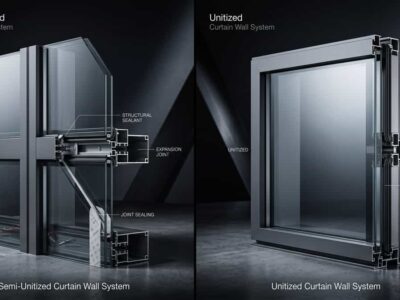
The choice between stick-built and unitized systems is one of the most consequential decisions in curtain wall design—impacting timeline, budget, quality, and long-term performance. For a complete head-to-head comparison, read: Stick Curtain Wall vs Unitized Curtain Wall – Which Is Better? .
4. Building Height and Wind Load
Building height directly impacts structural requirements—and cost.
Low-Rise vs High-Rise
| Building Type | Wind Load | Profile Sizing | Cost Impact |
|---|---|---|---|
| Low-rise (1–4 stories) | Low–moderate | Minimum 2.0mm profiles | Baseline |
| Mid-rise (5–10 stories) | Moderate–high | Heavier 2.5–3.0mm profiles | +10–20% |
| High-rise (10+ stories) | High–very high | Deep profiles with reinforced sections | +20–40%+ |
What Changes with Height:
- Wind pressure increases with height—mullions must be deeper and thicker
- Structural requirements for deflection (L/175 or L/240 + 6 mm) and load transfer increase
- Thermal movement (expansion/contraction) requires more sophisticated detailing
- Access equipment for installation becomes more expensive at height
- Fire-rated seals required at each floor slab
The Result: A curtain wall for a 40-story tower can cost 2–3× more per square meter than the same specification for a 4-story building.
Wind load resistance and water drainage are two critical performance challenges that define a successful curtain wall. A failure in either can lead to catastrophic glass blowouts or destructive leaks. Learn how curtain walls are engineered to handle these forces: Curtain Wall Wind Load & Water Drainage Explained .
5. Thermal Performance Requirements
Energy codes are getting stricter. Thermal performance requirements directly impact cost.
Thermal Breaks
- Standard aluminium frame (no thermal break): Lowest cost, poor thermal performance
- Single thermal break: Moderate cost, moderate performance
- Double thermal break: Higher cost, improved thermal performance by up to 19%
- Polyamide thermal breaks can further improve performance by over 4%
U-Value Requirements
| Requirement | Typical U-Value | Cost Impact |
|---|---|---|
| Basic (warm climate) | 2.0+ W/m²K | Baseline |
| Standard (temperate) | 1.6–2.0 W/m²K | Moderate |
| High-performance (cold climate) | 1.0–1.6 W/m²K | Significant |
| Passive house | <0.8 W/m²K | Very high |
Climate Considerations
- Cold climates require wider thermal breaks, triple glazing, and warm-edge spacers
- Hot climates require Low-E coatings, solar control glass, and proper shading
- Coastal climates require higher-grade corrosion-resistant finishes
6. Surface Finish
The finish on aluminium profiles is both aesthetic and protective. Costs vary significantly:
| Finish Type | Description | Relative Cost | Durability |
|---|---|---|---|
| Mill finish (raw) | Uncoated aluminium | Baseline | Poor—corrodes over time |
| Anodized | Electrochemical oxidation | Moderate | Good—20+ years |
| Powder coating | Dry paint applied electrostatically | Moderate | Good—15–25 years |
| PVDF (Kynar) | High-performance liquid coating | High | Excellent—30+ years |
| Custom finishes | Specialty colours, textures, woodgrain | Very high | Varies |
Cost Impact: Anodizing or powder coating typically adds $15–$50 per m² to profile cost. PVDF coatings can add $30–$80+ per m².
7. Fabrication and Manufacturing
Fabrication transforms raw extrusions into finished components ready for installation.
What’s Included:
- Cutting – Precision cutting of profiles to required lengths
- Machining – Drilling, routing, and notching for connections
- Assembly – Joining mullions, transoms, and other components
- Factory glazing – Glass installation into frames (unitized systems)
- Quality control – Dimensional checks, water testing, air testing
Cost Drivers:
- Complexity – More cuts, more machining = higher cost
- Tolerances – Tighter tolerances require more expensive equipment and more inspection
- Volume – Larger volumes typically reduce per-unit cost
- Factory glazing – Unitized systems require more factory labour but reduce site labour
8. Installation Cost
Installation typically accounts for approximately 16% of total cost, but can vary widely.
Installation Cost Components:
| Factor | Cost Impact |
|---|---|
| Labour | $15–$25 per sq ft |
| Access equipment (scaffolding, cranes) | Significant—higher for taller buildings |
| Site conditions | Tight sites, limited access = higher cost |
| Building height | Higher = more expensive access and slower installation |
| Installation method | Stick = more labour hours; Unitized = less labour, more crane time |
Stick vs Unitized Installation:
| Factor | Stick System | Unitized System |
|---|---|---|
| On-site labour | High | Low |
| Crane time | Low | High |
| Weather vulnerability | High | Low |
| Installation speed | Slow (piece-by-piece) | Fast (crane-lift modules) |
| Quality control | Site-dependent | Factory-controlled |
9. Engineering, Testing and Certification
These are often overlooked but essential costs that can add 5–15% to project cost.
What’s Required:
Structural Calculations
- Wind load analysis
- Deflection calculations (L/175 or L/240 + 6 mm)
- Anchor load verification
- Seismic design (where applicable)
Testing (ASTM, AAMA, or equivalent)
| Test Standard | What It Measures |
|---|---|
| ASTM E283 | Air infiltration resistance |
| ASTM E331 | Water penetration under static pressure |
| ASTM E1105 | Field water penetration testing |
| ASTM E330 | Structural performance (wind load resistance) |
| AAMA 501.1 | Dynamic Water Penetration Testing—simulates wind-driven rain with pressurized water spray; critical for high-rise buildings where water penetration occurs under dynamic (not static) conditions |
| NFRC | Thermal performance (U-factor, SHGC) |
Mock-ups
- Full-scale mock-up testing is often required for large projects
- Typically costs $50,000–$200,000+ depending on scope
Certification
- Fire-rated seal certification (1–2 hour rating typical)
- Energy code compliance documentation
- Warranty documentation
10. Location and Logistics
Location can dramatically impact total cost—especially for imported systems.
Cost Factors:
Distance from Manufacturer
- Local manufacturing = lower transport cost, shorter lead times
- Imported systems = higher shipping cost, longer lead times, potential import duties
Transportation
- Loose profiles (stick) = more compact shipping
- Pre-assembled units (unitized) = larger shipping footprint, higher cost
- Shipping adds $5–$10 per m² for volume shipments
Project Location
- Urban sites with good access = lower logistics cost
- Remote or congested sites = higher logistics cost
- Sites with limited crane access favour stick systems
Import/Export
- Tariffs and duties can add 5–25% to material cost
- Currency fluctuations affect pricing
Site Storage
- Limited site storage may require just-in-time delivery (higher logistics cost)
- Stick systems require less storage space than unitized modules
Curtain Wall Cost Comparison: Stick vs Unitized vs Semi-Unitized
| Factor | Stick System | Semi-Unitized | Unitized System |
|---|---|---|---|
| Material cost | Lowest | Moderate | Highest |
| Fabrication cost | Lowest | Moderate | Highest |
| Transport cost | Lowest | Moderate | Highest |
| Installation labour | Highest | Moderate | Lowest |
| Installation speed | Slowest | Moderate | Fastest |
| Quality control | Site-dependent | Mixed | Factory-controlled |
| Best for | Low-mid rise, complex facades | Mid-rise projects | High-rise, repetitive facades |
| Overall cost (low-rise) | Lowest | Moderate | Highest |
| Overall cost (high-rise) | Higher (labour) | Moderate | Lowest (schedule savings) |
What Can Increase Curtain Wall Costs?
Quick checklist of cost escalators:
- ☐ High-rise building – wind loads, structural requirements, access costs
- ☐ Complex geometry – curved or angled facades require custom fabrication
- ☐ Premium glass – triple glazing, Low-E coatings, laminated glass
- ☐ Thermal performance – double thermal breaks, low U-values
- ☐ Custom finishes – PVDF coatings, custom RAL colours, woodgrain
- ☐ Unitized system – higher upfront cost (but often lower total cost for high-rise)
- ☐ Remote location – higher transport and logistics costs
- ☐ Tight site – limited access increases installation time and cost
- ☐ Accelerated schedule – overtime, expedited shipping, multiple shifts
- ☐ Stringent testing – full mock-up, extensive field testing (including AAMA 501.1 dynamic water testing)
- ☐ Fire-rated requirements – fire-stops at each floor
- ☐ Seismic requirements – additional engineering and hardware
How to Reduce Curtain Wall Costs Without Cutting Performance
1. Standardize Profiles
- Limit the number of unique profile shapes
- Use standard mullion and transom depths where possible
- Custom profiles are significantly more expensive
2. Optimize Glass Specification
- Specify the minimum glass thickness required for wind loads
- Consider heat-strengthened glass instead of fully tempered for high-rise vision panes (where code permits)
- Use standard glass sizes to reduce waste
3. Reduce Unnecessary Customization
- Question every “unique” design element—does it add value?
- Standard finishes (anodized or standard powder coat colours) cost less than custom
- Standard hardware (ROTO, SIEGENIA) vs. custom hardware
- For structural curtain walls: Heavy structural anchors, brackets, pressure plate screws, and EPDM corner boots are essential components that should be specified from reputable manufacturers
4. Plan Procurement Early
- Early procurement allows for competitive bidding
- Avoid premium pricing for expedited orders
- Long lead times for unitized systems—plan ahead
5. Compare Suppliers
- Get at least 3–4 quotes from qualified suppliers
- Consider both local and international manufacturers
- Evaluate total cost of ownership, not just purchase price
6. Choose the Right System for the Project
- Don’t specify unitized for a 4-story building—stick is cheaper
- Don’t specify stick for a 40-story tower—unitized saves on labour and schedule
- Match the system to building height, geometry, and schedule
7. Consider Lifecycle Costs
- Premium systems cost more upfront but save on energy and maintenance
- A premium option at $200/m² may cost only $225–245/m² over 20 years vs. $120–155/m² for economy
- Energy savings from better U-values can be $15–30/m² over 20 years
- Premium hardware lasts longer—maintenance savings of $15–30/m² over 20 years
What Should a Curtain Wall Quotation Include?
A professional quotation should be transparent and detailed. If it’s not, ask questions.
| Item | What to Look For |
|---|---|
| System specification | Stick, unitized, semi-unitized, or structural glazing? |
| Aluminium quantity | Total square metres of profiles, profile depths, minimum wall thickness (2.0mm+ for structural) , alloy grade |
| Glass specification | Type (tempered, heat-strengthened, laminated, IGU), thickness, coatings, performance data |
| Finish | Anodized, powder coated, or PVDF—colour, gloss level, thickness |
| Hardware | Structural anchors, brackets, pressure plate screws, corner boots; brand (ROTO, SIEGENIA, etc.), type, quantity |
| Gaskets & seals | Material (EPDM), durometer, UV resistance |
| Thermal breaks | Material (polyamide), width, number of breaks |
| Fabrication | Cutting, machining, assembly—what’s included? |
| Installation | Labour, access equipment, timeline—is it included? |
| Engineering | Structural calculations, shop drawings—are they included? |
| Testing | What tests are included? Air (ASTM E283), water static (ASTM E331), dynamic water (AAMA 501.1), structural (ASTM E330), thermal? |
| Warranty | Duration, coverage, exclusions |
| Delivery | Lead time, shipping method, Incoterms (FOB, CIF, etc.) |
| Exclusions | What’s NOT included? (critical to understand) |
How to Compare Curtain Wall Suppliers and Quotes
Step 1: Normalize the Quotes
- Ensure all quotes are based on the same scope of work
- Check that the same system type is being quoted
- Verify that glass specification, finish, and hardware are comparable
Step 2: Look Beyond the Price Per Square Meter
- Check what’s included (and what’s not)
- Compare lead times and delivery terms
- Evaluate warranty terms
Step 3: Check Supplier Credentials
- ISO 9001 certification (quality management)
- ISO 14001 (environmental management)
- Relevant industry certifications (AAMA, CWCT, etc.)
- References from similar projects
Step 4: Evaluate Total Cost of Ownership
- Initial purchase price
- Installation cost
- Shipping and logistics
- Maintenance over 20 years
- Energy savings over 20 years
- Total 20-year cost is the real metric
Step 5: Ask About Hidden Costs
- Are testing and mock-ups included? (Especially AAMA 501.1 dynamic water testing for high-rise)
- Is engineering and shop drawing included?
- Are site visits and supervision included?
- What about spare parts?
Find Curtain Wall Manufacturers & Suppliers
Looking for curtain wall suppliers for your next project? Browse our curated directory of manufacturers and suppliers:
👉 Find Curtain Wall Manufacturers & Suppliers
Related Articles

Featured


You May Also Like
Aluminum Foil Food Storage: Myths & Truths You Should Kn…
Best Full View Storm Doors for Modern, Minimalist Homes
What Are Storm Doors? Types, Benefits & Common Uses
What Is an Aluminum Cotter Pin? Uses, Types and Applications

Home Window Tinting: The Benefits You May Not Know About
