Aluminium borate is an advanced, high-performance structural ceramic compound. Rather than engaging in chaotic chemical reactions like aluminum halides, it is prized strictly for its structural integrity at a microscopic level. Synthesized primarily as microscopic “whiskers” (single-crystal fibers), it acts as an invisible, heat-resistant reinforcing skeleton when mixed into plastics, lightweight metals, and specialized glass to create ultra-strong composite materials.
1. Basic Identification
Chemical Formula: AlBO₃ (simplest unit). Commercial whiskers often have the stoichiometry 9Al₂O₃·2B₂O₃ (Al₁₈B₄O₃₃).
Alternative Names: Aluminium borate, aluminium borate whiskers.
Molecular Weight: ~85.79 g/mol (for AlBO₃ unit).
CAS Number: 11121-16-7 (general form).
Appearance: Bright white, needle-like powder or microscopic crystalline fibers.
2. Physical Properties
The defining trait of aluminum borate is its exceptional mechanical strength and low thermal expansion, particularly when engineered into “whiskers.” A whisker is a flawless, single crystal grown with an enormous length-to-diameter ratio, giving it strength approaching the theoretical limit of its chemical bonds.
2.1 Key Data Table
| Property | Aluminium Borate (Whiskers) |
|---|---|
| Melting Point | 1050 °C – 1440 °C (depending on exact Al/B ratio) |
| Density | 2.93 – 3.0 g/cm³ |
| Hardness (Mohs Scale) | 7.0 – 8.0 (hard relative to most plastics/metals, softer than pure alumina) |
| Solubility | Insoluble in water. Slightly soluble in strong boiling mineral acids and hot alkalis. |
2.2 Physical Description
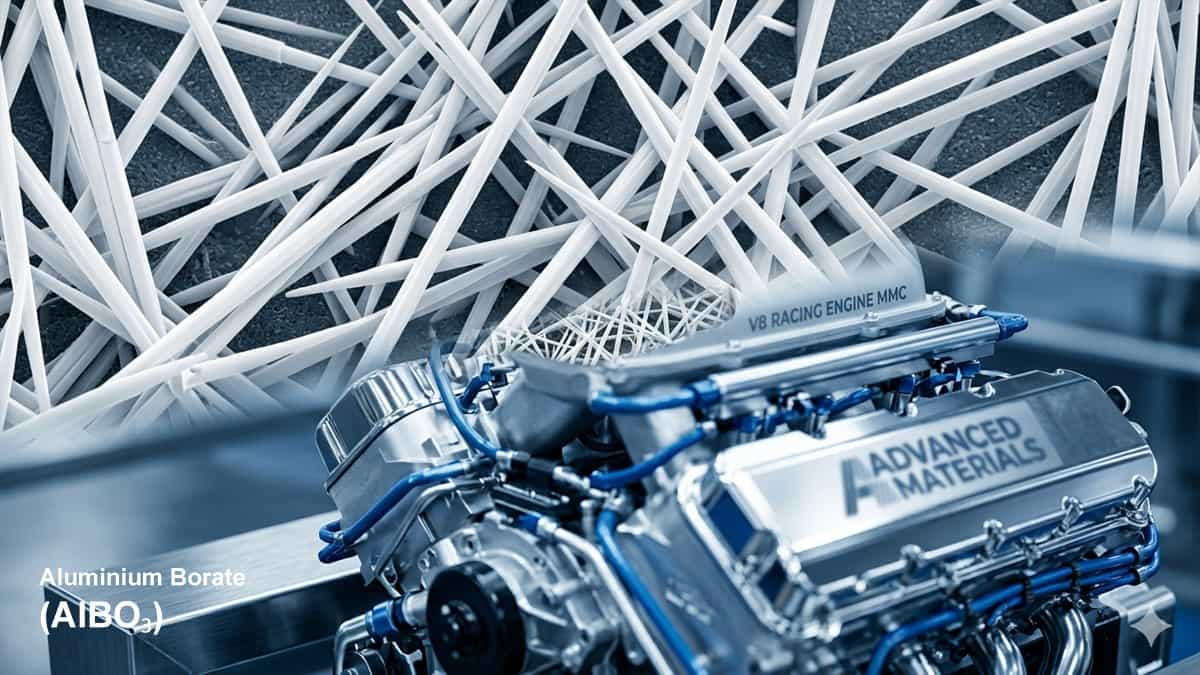
To the naked eye, bulk aluminum borate looks like unremarkable, fluffy white powder. However, under a scanning electron microscope (SEM), it reveals itself as millions of perfectly straight, sharp microscopic needles. It is completely odorless and highly stable in atmospheric humidity.
3. Chemical Behavior and Reactions
Chemically, it acts as a highly stable, refractory oxide composite. It does not actively seek out electron pairs, generate toxic gases when wet, or burst into flame.
3.1 Thermal Stability
Unlike organic structural fibers (such as Kevlar or carbon fiber), which burn or oxidize in open flames, aluminium borate whiskers do not burn. They maintain their tensile strength well past 1000 °C, meaning any metal alloy they reinforced remains stable at temperatures that would otherwise melt the metal.
3.2 Synthesis (How It Is Made)
Growing perfect microscopic needles requires careful metallurgical flux techniques.
Al₂O₃ + B₂O₃ + (Flux) → 2AlBO₃
Process: Aluminum oxide and boric acid are mixed in a crucible with a molten flux salt (usually potassium sulfate). The mixture is roasted at over 1000 °C. The flux melts, allowing aluminum and boron to assemble into flawless, straight crystal needles. After cooling, the flux is washed away with water, leaving behind insoluble aluminium borate whiskers.
4. Industrial and Laboratory Applications
This compound operates behind the scenes, reinforcing other materials to make them stronger, lighter, and more heat-resistant.
4.1 Metal Matrix Composites (MMCs)
Aluminum engine blocks in high-performance racing cars and aerospace components must be light, but pure aluminum is too soft and easily warped by extreme engine heat. By mixing billions of microscopic aluminium borate whiskers into molten aluminum before it cools, engineers create a metal matrix composite. The ceramic needles interlock, reinforcing the metal like steel rebar reinforces concrete, boosting heat resistance and wear strength without adding heavy steel.
4.2 Reinforced Plastics
Plastics used in electronics (such as circuit board substrates) expand when heated, potentially snapping microscopic copper wires. Injecting aluminum borate whiskers into the plastic pins the plastic molecules in place, drastically reducing thermal expansion and providing rigidity without conducting electricity.
4.3 Specialized Glass Production
It is used as a melting additive in the production of borosilicate glass (e.g., Pyrex laboratory beakers), making the glass more resistant to thermal shock.
5. Safety and Hazard Management
General Safety: The material is not chemically toxic, corrosive, or explosive. The entire hazard profile is mechanical due to its needle-like microscopic structure.
5.1 Health Effects
| Route of Exposure | Effect |
|---|---|
| Inhalation | Primary risk. Inhaling microscopic, insoluble ceramic needles can cause chronic mechanical lung irritation and potential long-term respiratory disease. |
| Skin Contact | Mechanical irritation. Can cause “fiberglass itch” if rubbed vigorously against skin. |
| Eye Contact | High risk of microscopic corneal scratching due to needle-like dust. |
| Ingestion | Low chemical toxicity, though large amounts may physically irritate the gastrointestinal tract. |
5.2 Personal Protective Equipment (PPE)
Because the main threat is inhalation of ceramic needles, lung and eye protection is mandatory.
- Respiratory: HEPA (P100) respirator is required when handling dry powder.
- Hands: Standard laboratory gloves to prevent skin irritation.
- Eyes: Tight-sealing splash and dust goggles.
- Body: Protective coveralls to prevent powder accumulation on clothing.
5.3 First Aid Measures
- Eyes: Flush thoroughly with copious water. Do NOT rub the eye, as the needles can drag across the cornea, causing deep abrasions. Seek ophthalmological review.
- Skin: Wash gently with soap and cool water to rinse needles away.
6. Storage and Handling Guidelines
6.1 Storage Conditions
- Container: Tightly sealed bags or drums to prevent dust from becoming airborne.
- Atmosphere: Normal air; humidity does not damage it.
- Location: Standard dry industrial storage.
6.2 Disposal Considerations
The compound is largely inert. However, due to its nature as a microscopic respiratory irritant, it should be wetted down before disposal to prevent dust clouds, then bagged securely and disposed of as non-hazardous specialized industrial solid waste.
7. Environmental Impact
Aluminum borate is chemically benign in the environment. It does not dissolve rapidly in rainwater, does not dramatically alter soil pH, and poses no systemic toxicological risk to aquatic life. Once released, it behaves similarly to inert sand and soil sediments, though the fibrous form may persist physically.
8. Comparison with Other Aluminium Compounds
| Compound | Formula | Primary Nature | Primary Industrial Use |
|---|---|---|---|
| Aluminum Borate | AlBO₃ | Inert micro-crystalline needle | Lightweight metal reinforcement (MMCs) |
| Aluminum Oxide | Al₂O₃ | Massive refractory ceramic | Bulk structural insulation; aluminum ore |
| Aluminum Nitrate | Al(NO₃)₃ | Strong oxidizer | Catalysts, chemical synthesis (hazardous) |
9. Frequently Asked Questions
Q: Is this the same thing as Borax?
A: No. Borax is sodium borate, an alkaline salt that dissolves in warm water and is used in laundry detergent. Aluminum borate is an ultra-hard, water-insoluble ceramic crystal used to reinforce metal.
Q: If it consists of tiny ceramic needles, is it dangerous like asbestos?
A: Aluminum borate whiskers are monitored by regulatory agencies. They generally lack the specific bio-durability and hooked shape of asbestos fibers that cause mesothelioma. Nevertheless, full HEPA respirators are used in factories to prevent any lung accumulation.
Q: Does aluminum borate burn or rust?
A: Neither. It is already fully oxidized and chemically stable. It cannot rust nor catch fire, even under a blowtorch.
10. Summary Data Sheet
| Chemical Name | Aluminum Borate |
|---|---|
| General Formula | AlBO₃ (or 9Al₂O₃·2B₂O₃) |
| Appearance | White powder; microscopic needles |
| Hardness | Mohs 7 – 8 |
| Solubility | Highly insoluble in water |
| Primary Utility | Reinforcement “whiskers” for metal composites |
| Hazard Note | Airborne fine dust poses lung irritation risk |