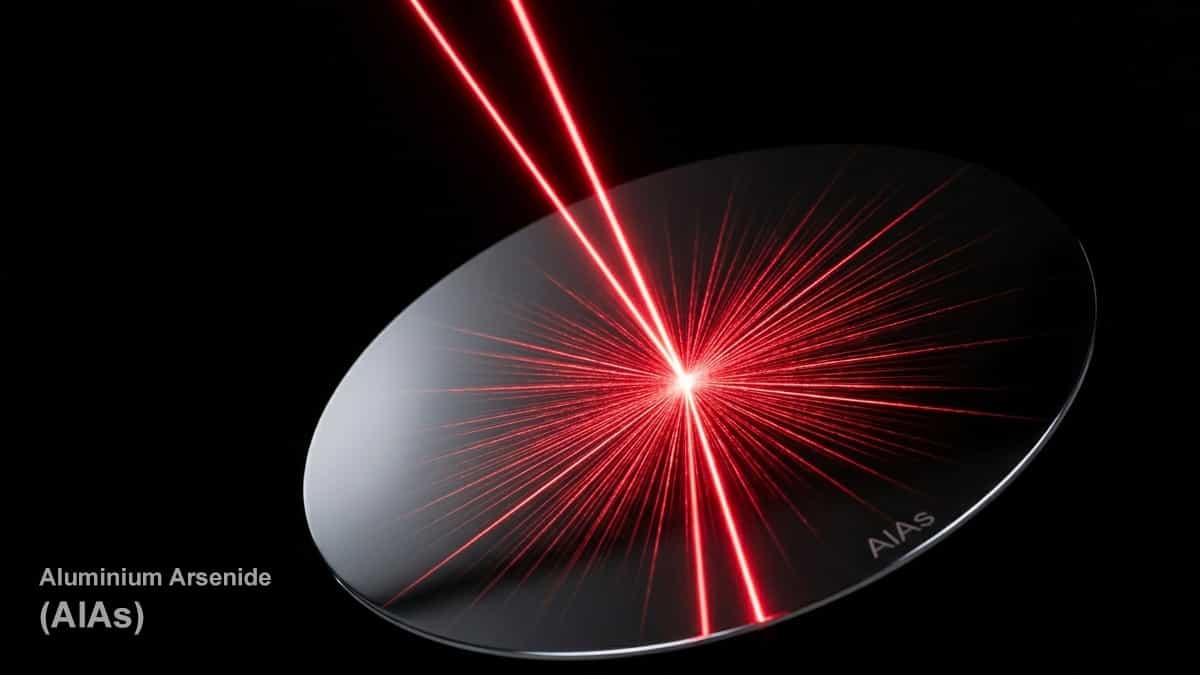
Aluminium arsenide is a powerful, highly specific wide-bandgap semiconductor. Completely segregated from traditional aluminium chemistry, it exists in the domain of elite optoelectronics alongside other group III-V semiconductors. Appearing as orange-brown cubic crystals, its primary function is structurally mirroring gallium arsenide (GaAs) lattice, allowing engineers to stack the two materials to manipulate photons in advanced quantum-well lasers and ultra-high frequency radar systems.
1. Basic Identification
Chemical Formula: AlAs
Alternative Names: Aluminium(III) arsenide.
Molecular Weight: 101.90 g/mol.
CAS Number: 22831-42-1.
Appearance: Unprocessed macro-crystals appear orange to brown. Fabricated semiconductor thin-films appear mirror-reflective.
2. Physical Properties
The identity of aluminum arsenide hinges on two physics parameters: its extremely close lattice match to gallium arsenide, and its specific wide bandgap energy.
2.1 Key Data Table
| Property | Aluminum Arsenide |
|---|---|
| Melting Point | 1740 °C (3164 °F) (only stable under elevated arsenic pressure) |
| Bandgap Energy | 2.12 eV (indirect at room temperature) |
| Density | 3.76 g/cm³ |
| Crystal Structure | Zincblende (F43m space group) |
| Solubility | Insoluble in pure water, but degrades in humid air. |
2.2 Physical Description
On a macro scale, blocks of AlAs look like brittle, brown-tinted rock. When machined into a semiconductor wafer, it takes on the flawless, mirror-like polish of standard silicon. The distance between its atoms (lattice constant) is 5.6605 Ångströms—remarkably close to that of gallium arsenide (5.653 Å), enabling high-quality heterostructures.
3. Chemical Behavior and Reactions
For a multi-million dollar semiconductor, AlAs performs poorly in normal atmospheres. Its instability is a major hurdle in arsenide-based integrated circuits.
3.1 Degradation into Lethal Gas
Like aluminium antimonide, AlAs lacks chemical immutability and reacts with atmospheric moisture.
Observation: If a polished wafer of AlAs is exposed to humid air over days or weeks, water molecules attack the crystal. The wafer may delaminate, turn cloudy white, and release trace amounts of highly toxic arsine gas (AsH₃). The reaction accelerates dramatically in the presence of acids.
3.2 Molecular Beam Epitaxy (MBE) Synthesis
Modern AlAs is not poured into test tubes; it is printed atom by atom.
Process: Inside an ultra-high vacuum chamber, pure ingots of aluminum and arsenic are heated until they form a gaseous plasma. The plasma streams are aimed at a spinning substrate. Layer by atomic layer, the aluminum arsenide crystal grows in an environment free of impurities.
4. Industrial and Laboratory Applications
Because AlAs costs far more than silicon and degrades in open air, it is reserved for tasks silicon cannot perform.
4.1 Gallium Arsenide Heterojunctions
This is where AlAs shines. Because AlAs and GaAs have very similar atomic spacing but different bandgaps, scientists stack them together like microscopic Legos without the crystal cracking. By sandwiching a thin layer of GaAs between two layers of AlAs, engineers trap electrons, forcing them to emit pure, powerful laser light. This mechanism forms the backbone of barcode scanners, fiber-optic telecom lasers, and CD/DVD readers.
4.2 Distributed Bragg Reflectors (Laser Mirrors)
By precisely alternating 30 to 40 layers of AlAs and GaAs, the resulting stack acts as a nearly 100% reflective mirror for specific laser wavelengths. These structures (DBRs) are built directly underneath laser diodes to bounce light out through the top of the chip.
5. Safety and Hazard Management
☠️
GHS06
Toxic (Chronic and Acute)
Critical Warning: Intact, sealed wafers of AlAs embedded inside a laser pointer are harmless. However, manufacturing, crushing, or exposing raw bulk AlAs to moisture introduces severe arsenic-based dangers.
5.1 Health Effects
| Route of Exposure | Effect |
|---|---|
| Inhalation (Gas/Dust) | Immediate danger. Arsine gas (AsH₃) causes red blood cell destruction (hemolysis), kidney failure, and can be fatal. Dust causes severe lung damage. |
| Skin Contact | Prolonged contact may cause dermatitis and localized arsenic absorption. |
| Eye Contact | Mechanical irritation and chemical burns if moistened by tears. |
| Ingestion | Acute toxicity: arsenic poisoning, gastrointestinal damage, multi-organ failure. |
5.2 Personal Protective Equipment (PPE)
No compromises during mechanical processing of AlAs ingots.
- Respiratory: SCBA or supplied-air hoods mandatory during polishing or if vacuum breach occurs.
- Hands: Thick nitrile gloves taped at wrists.
- Eyes: Tight-sealing chemical blast goggles.
- Body: Fully encapsulating cleanroom suits.
5.3 First Aid Measures
- Inhalation: If arsine exposure is suspected, move patient to fresh air, administer 100% oxygen, and seek immediate intensive care. Arsine may have a faint garlic-like odor at high concentrations, but do not rely on smell for detection.
6. Storage and Handling Guidelines
6.1 Storage Conditions
- Container: Vacuum-sealed bags or hermetically sealed jewel cases.
- Atmosphere: Hyper-dry desiccator back-filled with dry nitrogen to prevent hydrolysis.
- Location: Ventilated, restricted-access semiconductor storage.
- Incompatibles: Water, humidity, and all acids (acid contact rapidly generates large volumes of arsine gas).
6.2 Disposal Considerations
Do not dispose in normal waste streams.
- Toxic scrap is tracked, bagged, and documented.
- Shipped to licensed heavy-metal reclamation facilities, where arsenic is extracted chemically.
7. Environmental Impact
Dumping AlAs releases arsenic into the environment. Rainwater degrades the compound, washing soluble, toxic arsenic into groundwater. This can poison fish, insects, and agriculture. Semiconductor plants operate under strict regulations to prevent toxic release.
8. Comparison with Other Aluminum Semiconductors
| Compound | Formula | Primary Nature | Specific Engineering Partner |
|---|---|---|---|
| Aluminum Arsenide | AlAs | Laser Heterojunction Reflector | Gallium Arsenide (GaAs) |
| Aluminum Nitride | AlN | Insulator / Heat Sink | Gallium Nitride (GaN) |
| Aluminum Antimonide | AlSb | Infrared Detector Base | Gallium Antimonide (GaSb) |
9. Frequently Asked Questions
Q: If this is so lethal, why is it inside my cat’s laser pointer?
A: The amount used is microscopic (smaller than a grain of sand) and fully encapsulated in hard epoxy, preventing moisture from reaching the semiconductor and causing decay.
Q: Are all computer chips dangerous like this?
A: No. Over 95% of consumer chips (CPUs, memory) are made from silicon, which is non-toxic. AlAs is reserved for devices that generate light (lasers, LEDs) or very high-frequency transmitters.
Q: What does “indirect bandgap” mean?
A: It means AlAs is inefficient at emitting light on its own. While GaAs emits light easily (direct bandgap), AlAs requires additional energy to do so. Therefore, AlAs is used not to create light but to build reflective mirrors that bounce light out of the GaAs laser core.
10. Summary Data Sheet
| Chemical Name | Aluminum Arsenide |
|---|---|
| Formula | AlAs |
| Appearance | Orange/brown cubic crystals or dark reflective wafers |
| Lattice Constant | 5.6605 Å (closely matched to GaAs) |
| Hazard Note | Degrades in moisture/acid into lethal arsine gas |
| Primary Utility | Telecom lasers; distributed Bragg reflectors |
| Disposal | Arsenic reclamation hazard facilities only |
Related Articles

Featured



You May Also Like
Aluminium in Pharmaceuticals: Safeguarding Lives & Drivi…

Aluminium Windows Problem: Dropped Sash in Casement Windows

Why Modern Cars Are Switching to Aluminum Engine Blocks
Top 5 Pros & Cons of Fiberglass Windows – Powerfu…

Awning vs. Fixed Windows