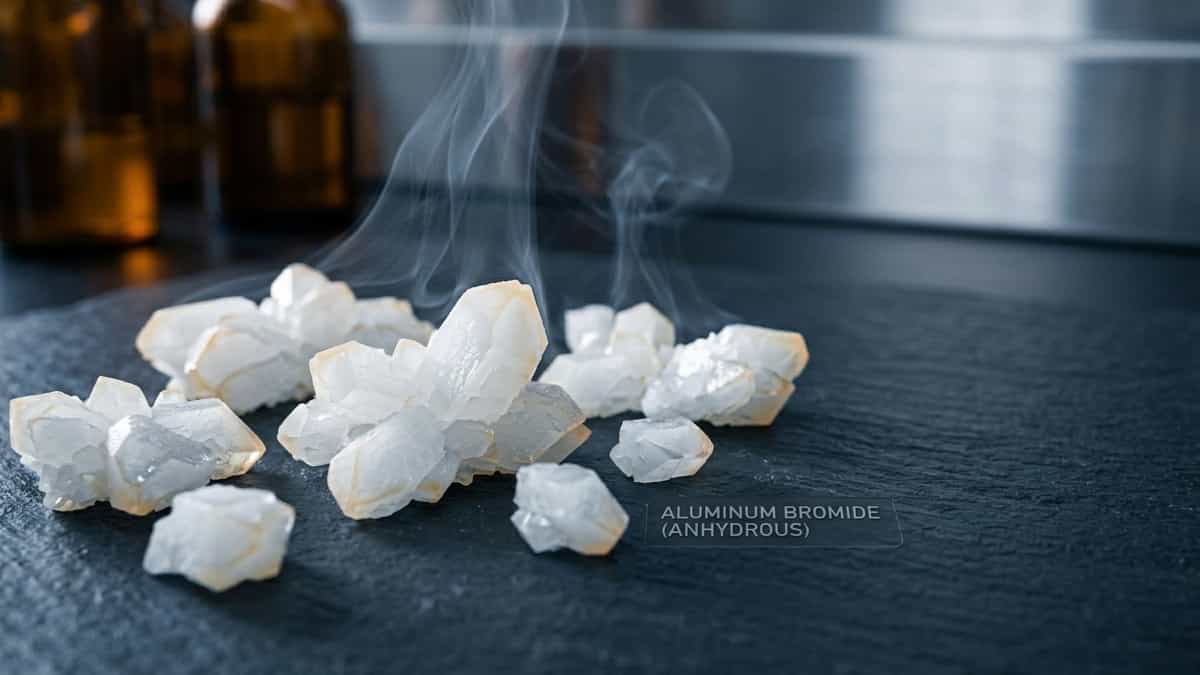
Aluminium bromide, properly known as aluminium tribromide, is a powerful Lewis acid. It appears as a white to pale yellow crystalline solid that fumes in moist air and reacts violently with water. Its most important role is as a catalyst in organic chemistry, specifically in Friedel-Crafts reactions used to make pharmaceuticals, fragrances, and advanced polymers. It is also a highly corrosive substance requiring strict safety protocols.
1. Basic Identification
Chemical Formula: AlBr₃ (monomer); commonly exists as the dimer Al₂Br₆ in solid and liquid states.
Alternative Names: Aluminum tribromide, tribromoalumane, anhydrous aluminium bromide.
Molecular Weight: 266.69 g/mol (anhydrous).
CAS Number: 7727-15-3 (anhydrous).
Appearance: White to yellowish-orange crystalline powder or lumps. Fumes strongly in humid air.
2. Physical Properties
Understanding how this compound behaves physically helps determine how to store and handle it.
2.1 Key Data Table
| Property | Anhydrous AlBr₃ |
|---|---|
| Melting Point | 97.5 °C (207.5 °F) |
| Boiling Point | 255 °C (491 °F) – sublimes without decomposition |
| Density | 3.2 g/cm³ |
| Vapor Pressure | 1 mmHg at 81 °C |
| Solubility | Reacts violently with water. Soluble in ethanol, diethyl ether, benzene, toluene, and carbon disulfide. |
2.2 Physical Description
In its pure state, aluminum bromide forms shiny, plate-like crystals. Because it is hygroscopic (pulls moisture from the air), it quickly forms a liquid film on its surface and releases dense white fumes of hydrogen bromide gas.
3. Chemical Behavior and Reactions
Aluminum bromide is best described as an electron pair acceptor – the definition of a Lewis acid. The aluminum atom is electron-deficient and aggressively seeks electrons from other molecules.
3.1 Reaction with Water (The Most Hazardous Reaction)
This is the single most important reaction to understand for safety.
AlBr₃ + 3H₂O → Al(OH)₃ + 3HBr ↑
Observation: Extremely vigorous, exothermic reaction. Produces heat and clouds of corrosive hydrogen bromide gas.
Result: Aluminum bromide cannot be dissolved in water to make a simple solution; it destroys itself and creates a dangerous acid cloud instead.
3.2 Synthesis (How It Is Made)
2Al + 3Br₂ → Al₂Br₆
Process: Aluminium metal shavings are heated with bromine vapor in an inert atmosphere (argon or nitrogen). This is the primary method for making high-purity anhydrous material.
3.3 Reaction with Alcohols and Carboxylic Acids
Aluminium bromide reacts rapidly with alcohols to form aluminium alkoxides and hydrogen bromide. It reacts with carboxylic acids to produce acyl bromides, a crucial step in the synthesis of many organic chemicals.
4. Industrial and Laboratory Applications
While you may not see aluminum bromide on a store shelf, it is a hidden workhorse in the creation of modern materials.
4.1 Friedel-Crafts Catalyst (Primary Use)
The most significant application is in Friedel-Crafts alkylation and acylation.
- What it does: It helps attach carbon chains (alkyl groups) or acyl groups to benzene rings.
- Why it matters: This reaction is fundamental to the manufacture of:
- Pharmaceuticals: Intermediate steps for drugs like ibuprofen.
- Fragrances: Synthesis of musk-scented ketones.
- Polymers: Production of high-performance thermoplastics.
4.2 Bromination Agent
AlBr₃ is used to introduce bromine atoms into organic molecules. In some reactions, it offers better selectivity (control over where the bromine atom attaches) compared to other bromine sources.
4.3 Isomerization and Polymerization
It is used as an initiator in the polymerization of specific monomers, such as those used in electronics manufacturing, and as a catalyst to rearrange molecular structures (isomerization) to produce more stable or desirable fuel additives.
5. Safety and Hazard Management
⚠️
GHS05
Corrosive
❗
GHS07
Irritant / Harmful
Critical Warning: Aluminum bromide is a corrosive, water-reactive solid. It is not explosive, but mixing it with water can generate enough heat to ignite nearby flammable materials.
5.1 Health Effects
| Route of Exposure | Effect |
|---|---|
| Inhalation | Severe irritation of nose, throat, and lungs. Can cause chemical pneumonia or pulmonary edema (fluid in lungs). |
| Skin Contact | Causes deep, painful chemical burns. Because it reacts with moisture on skin, the damage continues until the compound is completely removed or neutralized. |
| Eye Contact | Causes severe corneal burns and potential permanent vision loss. |
| Ingestion | Severe burning pain in mouth, throat, and stomach. Do NOT induce vomiting. |
5.2 Personal Protective Equipment (PPE)
Handling aluminum bromide requires full laboratory or industrial hygiene discipline.
- Respiratory: NIOSH-approved dust respirator (N95 or P100) at minimum. In case of fume release, use supplied-air respirator.
- Hands: Heavy-duty butyl rubber or neoprene gloves.
- Eyes: Chemical splash goggles (not just safety glasses).
- Body: Rubber apron or full Tychem suit.
5.3 First Aid Measures
- Skin: If dry powder is present and loose, brush off gently. Then flush skin with copious amounts of cool water for at least 15 minutes. Seek medical attention immediately.
- Eyes: Rinse with gentle stream of water for at least 20 minutes, holding eyelids open. Get to an ophthalmologist immediately.
- Inhalation: Move victim to fresh air. If breathing is difficult, administer oxygen. Seek medical help.
5.4 Firefighting Information
- Suitable Extinguishers: Dry sand, dry chemical powder, carbon dioxide.
- DO NOT USE: Water (causes violent reaction and toxic HBr gas cloud). Foam (contains water).
6. Storage and Handling Guidelines
6.1 Storage Conditions
- Container: Keep in a tightly sealed glass or HDPE container inside a secondary container.
- Atmosphere: Store under dry nitrogen or argon blanket.
- Temperature: Recommended storage at 2°C to 8°C (refrigerated).
- Incompatibles: Keep strictly separate from water, alcohols, strong bases (like sodium hydroxide), and oxidizing agents.
6.2 Disposal Considerations
Do not pour down the drain. The approved disposal method involves controlled hydrolysis:
- Dissolve in a dry, inert solvent (like dichloromethane) inside a fume hood.
- Slowly drip the solution into ice-cold water with vigorous stirring to neutralize the heat.
- Neutralize the resulting acidic mixture with a base (sodium carbonate).
- Dispose of the neutralized liquid according to local hazardous waste regulations.
7. Environmental Impact
Aluminum bromide is not persistent in the environment because it reacts instantly with atmospheric moisture or water in soil to form aluminum hydroxide and hydrogen bromide. However, the hydrogen bromide (HBr) released is highly toxic to aquatic life. It drastically lowers the pH of water (acidification), which can kill fish and aquatic insects. Spills must be contained and prevented from entering waterways or sewers.
8. Comparison with Other Aluminum Halides
| Compound | Formula | Melting Point | Lewis Acidity | Industrial Note |
|---|---|---|---|---|
| Aluminum Fluoride | AlF₃ | 1291 °C | Weak (Ionic) | Used in aluminum smelting (Cryolite mineral). |
| Aluminum Chloride | AlCl₃ | 190 °C | Very Strong | The “workhorse” catalyst, cheaper, used in dyes and detergents. |
| Aluminum Bromide | AlBr₃ | 97.5 °C | Very Strong | Preferred when higher selectivity or solubility in non-polar solvents is needed. |
| Aluminum Iodide | AlI₃ | 191 °C | Strong | Used less frequently, mostly in specialized organic reductions. |
9. Frequently Asked Questions
Q: Is aluminum bromide the same as the bromine in a hot tub?
A: No. Hot tubs use sodium bromide or bromine tablets. Aluminum bromide is an anhydrous solid used in manufacturing; it is never used in water treatment because it reacts violently with water, producing heat and acid gas.
Q: What happens if I leave the bottle open on the bench?
A: Within minutes, the white powder will turn into a brownish liquid sludge. It will draw moisture from the air, hydrolyze, and fill the room with corrosive hydrogen bromide fumes. The material will be ruined.
Q: Why is it sold as Al₂Br₆ and not AlBr₃?
A: In the solid and liquid state, two molecules of AlBr₃ join together (dimerize) to share bromine atoms, satisfying the aluminum atom’s need for a full electron shell. When vaporized at high temperatures, it breaks apart into single AlBr₃ units.
Q: Can I use it in a school science experiment?
A: No. This is an advanced chemical for university-level or industrial chemistry labs with proper fume hood ventilation. The risk of acid burns and inhalation injury is too high for general education settings.
10. Summary Data Sheet
| Chemical Name | Aluminum Bromide (Anhydrous) |
|---|---|
| Formula | AlBr₃ / Al₂Br₆ |
| Appearance | White to pale yellow-orange solid |
| Melting Point | 97.5 °C |
| Solubility | Reacts with water; soluble in benzene, toluene, ether |
| Primary Hazard | Corrosive, Water-Reactive (Releases Toxic Gas) |
| Primary Use | Friedel-Crafts Catalyst for Chemical Synthesis |
| Storage | 2–8 °C, sealed under dry inert gas |