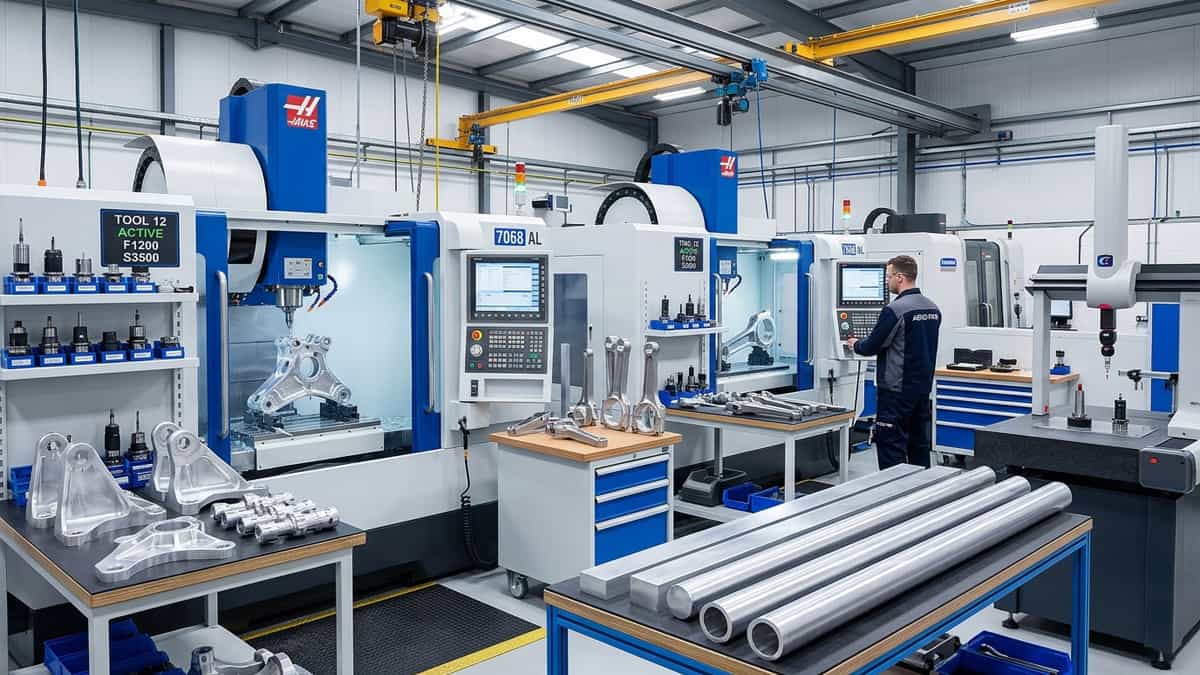
Aluminium 7068 – also known as Aluminum 7068 – is a heat-treatable aluminium-zinc-magnesium-copper alloy that holds the crown as the strongest commercially available aluminum alloy. Developed by Kaiser Aluminum as a higher-strength replacement for 7075 in ordnance applications, 7068 aluminum offers ultimate tensile strength exceeding 700 MPa (over 100 ksi) – putting it in the same league as some structural steels. With yield strength 15–30% higher than 7075, combined with good corrosion resistance, excellent fatigue strength, and good machinability, 7068 is the material of choice for applications where every gram counts and every megapascal matters.
What is Aluminium 7068?
Aluminium alloy 7068 is a member of the 7000 series (aluminium‑zinc‑magnesium‑copper) – the strongest family of aluminium alloys used in engineering. Like 7075 and 7475, 7068 is a heat‑treatable alloy that achieves its extraordinary mechanical properties through controlled solution heat treatment and artificial aging.
But 7068 is different. While 7075 set the standard for high‑strength aluminium for decades, 7068 was designed to push the boundaries further. Registered with the US Aluminium Association and produced to AMS 4331 (chemical and mechanical specifications) and AMS 2772 (heat treatment), 7068 represents the state of the art in aluminium alloy development. Its tensile strength is comparable to that of some steels, yet it retains aluminium’s characteristic low density of just 2.85 g/cm³.
Aluminium 7068 was originally developed as a higher-strength alternative to 7075 for ordnance applications, but its exceptional properties have since made it indispensable across aerospace, defence, automotive motorsport, and high‑end sporting goods.
Key Characteristics at a Glance:
| Property | Value |
|---|---|
| Density | 2.85 g/cm³ |
| Melting Range | 476 – 635 °C |
| Thermal Conductivity | 190 W/m·K |
| Modulus of Elasticity | 73 GPa |
| Electrical Resistivity | 5.50 × 10⁻⁶ ohm·cm |
Data compiled from industry specifications
Chemical Composition of Aluminium 7068
Aluminium 7068 is a zinc‑rich alloy with carefully balanced additions of magnesium, copper, and zirconium. The zinc content (7.3–8.3%) provides the primary strengthening mechanism through fine precipitate formation during aging. The copper (1.6–2.4%) enhances strength and improves stress‑corrosion resistance. The zirconium addition (0.05–0.15%) controls grain structure and improves toughness.
| Element | Percentage (%) |
|---|---|
| Aluminum (Al) | 85.43 – Balance |
| Zinc (Zn) | 7.3 – 8.3 |
| Magnesium (Mg) | 2.2 – 3.0 |
| Copper (Cu) | 1.6 – 2.4 |
| Zirconium (Zr) | 0.05 – 0.15 |
| Iron (Fe) | ≤0.15 |
| Silicon (Si) | ≤0.12 |
| Manganese (Mn) | ≤0.10 |
| Titanium (Ti) | ≤0.10 |
| Chromium (Cr) | ≤0.05 |
| Others (Each) | ≤0.05 |
| Others (Total) | ≤0.15 |
Source: AMS 4331 / US Aluminium Association
The combination of zinc and magnesium forms the strengthening precipitate MgZn₂ (eta phase) during artificial aging. Copper provides additional solid‑solution strengthening and improves resistance to stress‑corrosion cracking. The zirconium acts as a recrystallisation inhibitor, helping to maintain a fine, unrecrystallised grain structure that is essential for high toughness.
Key Properties of Aluminium 7068
💪 Unmatched Strength – The Highest of Any Aluminium Alloy
This is where Aluminium 7068 truly stands alone. Kaiser Aluminum alloy 7068 has the highest mechanical properties (tensile strength) of all commercially available aluminium alloys.
Typical Mechanical Properties by Temper:
| Temper | Ultimate Tensile Strength | Yield Strength (0.2%) | Elongation | Hardness (Brinell) |
|---|---|---|---|---|
| 7068-T6 | 698 MPa (101 ksi) | 648 MPa (94 ksi) | 9.0% | 185 |
| 7068-T6511 | 710 MPa (103 ksi) | 683 MPa (99.1 ksi) | 9.0% | 190 |
Data from MatWeb and HDM Industrial Supply
For context, a similar product produced from 7075‑T6511 has a typical ultimate tensile strength of 640 MPa (93 ksi) and a yield strength of 590 MPa (86 ksi). 7068‑T6511 offers a yield strength of 683 MPa (99.1 ksi) – a 15–20% improvement over 7075. Some sources even report improvements of up to 30% in certain tempers and product forms.
🧠 Excellent Fatigue Strength
Aluminium 7068 exhibits excellent fatigue strength, making it highly suitable for components subjected to cyclic loading – such as connecting rods, suspension components, and aerospace structural parts. Its fatigue properties have been ratified for inclusion in MIL Handbook 5 / MMPDS (Metallic Materials Properties Development and Standardization), confirming its reliability for safety‑critical aerospace applications.
🛡️ Good Corrosion Resistance
The corrosion resistance of 7068 is comparable to that of 7075, which is considered good for a high‑strength 7000 series alloy. However, like most 7xxx alloys, 7068 is susceptible to stress‑corrosion cracking (SCC) in certain tempers and orientations. For applications requiring maximum resistance to SCC, the T76511 temper is available to order.
Aluminium 7068 is also reported to offer improved corrosion resistance compared to 7075 while maintaining comparable or superior strength, making it a more reliable option for long‑term, high‑stress applications in harsh environments.
⚙️ Good Machinability
Aluminium 7068 has good machining characteristics, matching those of 7075 aluminium. The alloy machines well in both annealed and heat‑treated conditions. Best practices include:
- Using sharp, carbide‑tipped tools
- Applying adequate coolant to prevent work hardening and achieve a high‑quality surface finish
- Employing positive rake angles and high cutting speeds
The high strength of 7068 demands precision tooling for optimal results, but with proper setup, it machines efficiently.
🔧 Formability
Aluminium 7068 can be formed using conventional methods, but it is easier to form in the annealed (O) condition due to its high strength in heat‑treated tempers. For complex forming operations, forming in the annealed state followed by heat treatment is recommended.
🚫 Weldability – A Significant Challenge
Aluminium 7068 has limited weldability. Like other high‑zinc 7000 series alloys, it is sensitive to hot cracking during conventional fusion welding. According to industry welding ratings:
- B rating – Weldable with special techniques or for specific applications that justify preliminary trials or testing to develop welding procedure and weld performance
Friction stir welding (FSW) has been successfully demonstrated for AA 7068‑T6 plates, offering a potential solid‑state joining method for this alloy. However, for most applications, mechanical fastening (riveting, bolting) remains the preferred joining method.
🎨 Anodising – Excellent Response
Aluminium 7068 responds very well to anodising. Anodising is possible using all traditional techniques. When performing hard anodising, the surface becomes more abrasion resistant. This makes 7068 suitable for applications requiring both extreme strength and an attractive, corrosion‑resistant surface finish.
🔥 Heat Treatment
Like other 7000 series alloys, Aluminium 7068 is heat treatable. The typical heat treatment sequence is:
- Solution heat treatment – heating to approximately 465–480°C to dissolve alloying elements
- Quenching – rapid cooling (usually in water) to retain the dissolved elements in supersaturated solid solution
- Artificial aging – controlled heating (typically 120–175°C) to precipitate fine strengthening particles (MgZn₂)
Common tempers for 7068 include:
| Temper | Description |
|---|---|
| T6 | Solution treated and artificially aged – maximum strength |
| T651 | Solution treated, stress‑relieved by stretching, then artificially aged |
| T6511 | Similar to T651, for extruded rod and bar |
| T76511 | Overaged for improved stress‑corrosion cracking resistance |
Applications of Aluminium 7068
Aluminium 7068 is a premium, ultra‑high‑strength alloy whose exceptional strength‑to‑weight ratio makes it essential for applications where every gram of weight reduction is critical and failure is not an option.
✈️ Aerospace – The Primary Application
7068 aluminium is widely used in aerospace components where maximum strength and minimum weight are paramount:
- Landing gear parts and brackets – where extremely high strength is required for heavy loads and repeated landings
- Aircraft structural components – including wing fittings and fuselage frames
- Valve bodies for aerospace vehicles – requiring high strength and pressure resistance
Aluminium 7068 has been adopted by the Federal Aviation Administration (FAA) and the National Aeronautics and Space Administration (NASA) for critical applications.
🎯 Defence & Ordnance – The Original Purpose
7068 was initially developed for ordnance applications as a higher-strength alternative to 7075:
- Shell casings and munitions components – where high strength and consistent performance are essential
- Weapon system components
- Military vehicle parts
🏎️ High‑Performance Automotive & Motorsport
The combination of extreme strength, fatigue resistance, and light weight makes 7068 ideal for racing and high‑performance applications:
- Connecting rods – one of the most common applications
- Automotive valve bodies and link rods
- High‑performance suspension components
- Autosport gearbox actuators and wheel components
- Automobile shock absorbers and motorcycle gears
- Fuel pumps for racing engines
🩺 Medical & Precision Engineering
7068’s combination of high strength, corrosion resistance, and biocompatibility makes it suitable for:
- Prosthetic limbs
- Load cells
- High‑precision mechanical components
🎿 High‑End Sporting Goods & Recreation
The extreme strength‑to‑weight ratio of 7068 is highly valued in lightweight recreational equipment:
- Bicycle frames and components – particularly high‑end racing bicycles
- Tents, ski and backpack rods – where weight reduction is critical
- Mountain climbing equipment
- Snowmobile engine shafts
🔧 General Precision Engineering
- Hydraulic valve components
- High‑pressure solenoids
- Flexible shaft couplings
Aluminium 7068 vs. Aluminium 7075
The comparison between 7068 and 7075 is the most important one for engineers choosing an ultra‑high‑strength 7000 series alloy. Rather than presenting a dense table, here is a practical guide:
| Aspect | 7068 | 7075 |
|---|---|---|
| Ultimate Tensile Strength | 710 MPa (103 ksi) – the highest of any aluminium alloy | 570–640 MPa – excellent, but lower |
| Yield Strength | 683 MPa (99.1 ksi) – 15–30% higher | 590 MPa – the industry benchmark |
| Strength‑to‑Weight Ratio | Superior – permits lighter products with reduced cross‑sectional area | Excellent, but lower than 7068 |
| Elevated Temperature Performance | Better than 7075 – retains properties at higher temperatures | Good, but degrades above approximately 120°C |
| Corrosion Resistance | Comparable to 7075 (improved in some reports) | Good – established track record |
| Fatigue Strength | Excellent – among the best in 7000 series | Good, but lower than 7068 |
| Machinability | Good – comparable to 7075 | Good – widely machined |
| Weldability | Limited – requires special techniques or FSW | Very poor – generally not welded |
| Fracture Toughness | Moderate – similar to 7075‑T6 (K_IC ≈ 16.5 MPa·√m) | Moderate in T6, improved in T73 temper |
| Cost | Higher – premium alloy for specialised applications | Lower – the industry standard |
| Availability | Available, but less common than 7075 | Widely available globally |
| Primary Use | Maximum‑strength applications – where every gram counts | General high‑strength applications |
Pro Tip: Choose 7068 when you need the absolute highest strength possible from an aluminium alloy – in aerospace landing gear, racing connecting rods, or high‑end sporting goods. Choose 7075 when the application demands very high strength but the ultimate maximum is not required, or when cost and availability are primary drivers.
For a detailed, interactive side‑by‑side comparison of 7068 with any other aluminium alloy – including 7075, 2024, 7475, or 6061 – visit the Aluminium Alloy Comparison Tool. This tool allows you to compare over 40 alloy types across properties including strength, corrosion resistance, weldability, and thermal conductivity.
Fabrication & Workability Guide
🔨 Forming
Aluminium 7068 can be formed using conventional methods, but it is easier to form in the annealed (O) condition. In the heat‑treated condition (T6, T6511), the alloy has significantly higher strength and reduced ductility, making forming more difficult.
⚙️ Machining
Aluminium 7068 has good machining characteristics, comparable to 7075. Best practices include:
- Use carbide‑tipped tools with sharp cutting edges
- Apply adequate coolant to prevent work hardening
- Employ high cutting speeds with positive rake angles
- For best surface finish, use proper lubrication
🔥 Heat Treatment
As a heat‑treatable alloy, 7068 can be significantly strengthened by thermal processing:
| Process | Typical Parameters |
|---|---|
| Solution Treatment | 465–480°C – hold for sufficient time to dissolve soluble phases |
| Quenching | Cold water – rapid cooling to retain supersaturated solid solution |
| Aging (T6/T651) | 120–175°C – 12–24 hours (depending on specific temper) |
| Overaging (T76/T76511) | Higher aging temperatures for SCC resistance |
🚫 Welding – Important Considerations
Conventional fusion welding of Aluminium 7068 is challenging and not recommended for most applications. The alloy is rated B for weldability – weldable with special techniques or for specific applications that justify preliminary trials.
Alternative joining methods include:
- Riveting – the traditional aerospace approach for high‑strength 7xxx alloys
- Bolting – suitable for many structural applications
- Friction stir welding (FSW) – a solid‑state process that has been successfully demonstrated for AA 7068‑T6 plates
🎨 Anodising
Aluminium 7068 responds very well to anodising using all traditional techniques. Hard anodising can be applied to increase surface abrasion resistance.
❄️ Cold Working
Cold working is not typically applied to 7068 in heat‑treated tempers due to its high strength. In the annealed condition, the alloy can be cold worked, but this will affect subsequent heat treatment response.
Why Choose Aluminium 7068?
✅ Advantages
- Highest tensile strength of any commercially available aluminium alloy – ultimate strength up to 710 MPa (103 ksi)
- 15–30% higher yield strength than 7075 – up to 683 MPa
- Excellent fatigue strength – superior to most other high‑strength aluminium alloys
- Good machinability – comparable to 7075
- Good corrosion resistance – comparable to 7075
- Excellent anodising response – using all traditional techniques
- High thermal conductivity – 190 W/m·K
- Heat treatable – properties can be tailored through thermal processing
- Fully recyclable – sustainable for aerospace and defence applications
- Strength comparable to some steels – at approximately one‑third the density
❌ Limitations
- Limited weldability – conventional fusion welding is not recommended; FSW is possible but specialised
- Higher cost than 7075 – a premium alloy for maximum‑strength applications
- Lower availability than 7075 – less commonly stocked
- Moderate fracture toughness – similar to 7075‑T6; overaged tempers improve SCC resistance at the cost of some strength
- Susceptible to stress‑corrosion cracking in T6 temper – requires T76 or T76511 temper for SCC‑prone environments
- Not suitable for high‑temperature service above approximately 120–150°C – strength degrades with prolonged thermal exposure (though better than 7075)
Summary
Aluminium 7068 (Aluminum 7068) stands alone as the strongest commercially available aluminium alloy. With ultimate tensile strengths exceeding 700 MPa and yield strengths approaching 700 MPa, 7068 competes directly with structural steels – yet retains aluminium’s characteristic low density of just 2.85 g/cm³.
Developed by Kaiser Aluminum as a higher‑strength successor to 7075, 7068 has proven itself across the most demanding applications: from landing gear components and ordnance systems to racing connecting rods and high‑end bicycle frames. Its combination of extreme strength, excellent fatigue resistance, good corrosion resistance, and good machinability makes it the ultimate choice for engineers who need to extract the maximum possible performance from every gram of material.
If your application demands the absolute highest strength available from an aluminium alloy, Aluminium 7068 is the definitive solution. For the latest technical data and real‑time alloy comparisons, explore the Aluminium Alloy Comparison Tool.
📚 Related Articles
Deepen your understanding of aluminium alloys with these curated guides:
- Aluminium Alloy Comparison Tool – Compare 40+ aluminium alloys side by side to find the perfect material for your project
- Aluminium 7075: The Original High‑Strength Aerospace Alloy – The first‑generation 7000 series alloy that set the industry standard
- Aluminium 7475: The Second‑Generation Aerospace Alloy with Superior Fracture Toughness – The toughness‑optimised 7000 series alloy for damage‑tolerant designs
- Why Is Aluminum Used for Aircraft Bodies? – Understanding the role of 7000 series alloys in aerospace
- Aluminium 6061 T6: Properties, Machining & Applications – The general‑purpose heat‑treatable alloy for non‑critical structures
Related Articles


Featured


You May Also Like

Advantages of Aluminium Sheets
Aluminum Phosphate (AlPO₄): The Complete Guide

When Powder Coating Fails on Aluminium (And How to Fix It)

Aluminum (Bi-Fold)Folding vs. Sliding Doors – Which Design A…

Aluminium Carbonate (Al₂(CO₃)₃): The Complete Guide