
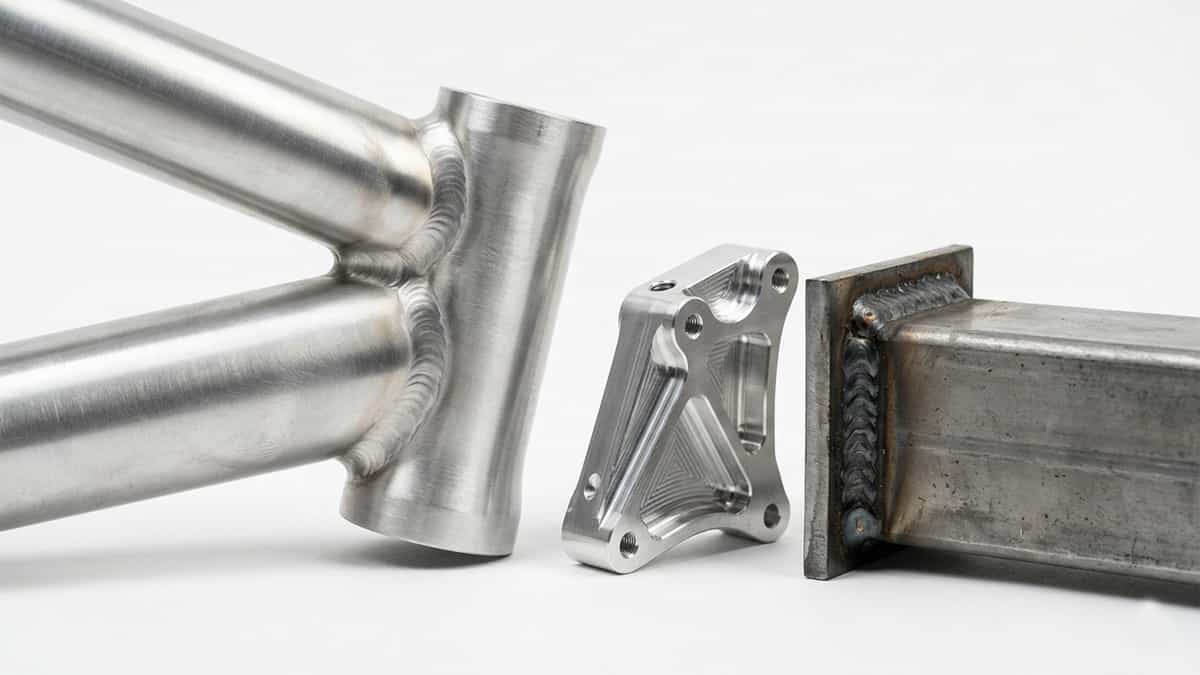
Aluminum 7005 belonging to the 7000 series of alloys, Aluminium 7005 is an age-hardenable material primarily alloyed with zinc and magnesium. It is renowned for offering a compelling balance of high strength, excellent corrosion resistance, and superior weldability, making it a highly sought-after material for structural and engineering applications where welding is a key requirement.
Chemical Composition
The unique properties of 7005 aluminium are derived from its specific chemical composition, which is tightly controlled to achieve the desired performance. The table below lists the typical composition limits for this alloy.
| Element | Percentage (%) |
|---|---|
| Aluminium (Al) | Balance (approx. 91.0 – 94.7) |
| Zinc (Zn) | 4.0 – 5.0 |
| Magnesium (Mg) | 1.0 – 1.8 |
| Manganese (Mn) | 0.20 – 0.70 |
| Chromium (Cr) | 0.06 – 0.20 |
| Zirconium (Zr) | 0.08 – 0.20 |
| Titanium (Ti) | 0.01 – 0.06 |
| Silicon (Si) | ≤ 0.35 |
| Iron (Fe) | ≤ 0.40 |
| Copper (Cu) | ≤ 0.10 |
| Others (Total) | ≤ 0.15 |
Physical & Mechanical Properties
7005 aluminium is known for its impressive mechanical properties, which contribute to its widespread use. The specific values can vary depending on the temper (heat treatment condition).
- Density: 2.78 g/cm³, which is slightly higher than some other aluminium alloys but still offers a great strength-to-weight ratio.
- Tensile Strength: In its T6 temper, 7005 can achieve an ultimate tensile strength in the range of 350–450 MPa.
- Yield Strength: The yield strength for the T6 temper typically falls between 290–350 MPa.
- Elongation: It demonstrates good ductility for a high-strength alloy, with elongation values of 8-12% in the T6 temper, indicating its ability to deform under tensile stress before fracturing.
- Fatigue Strength: It has a fatigue strength of 150 MPa, making it suitable for components subjected to cyclic loading.
- Elastic Modulus: The modulus of elasticity is 70-80 GPa.
Heat Treatment and Workability
Aluminium 7005 is a heat-treatable alloy, meaning its strength can be significantly enhanced through a controlled thermal process.
Heat Treatment Process
The alloy is typically solution heat-treated at 465–480°C, followed by rapid quenching and then artificial aging. The most common tempers are:
- T5 Temper: Achieved by cooling from an elevated temperature shaping process and then artificially aging. It offers a balance of properties and is often used for extrusions.
- T6 Temper: This involves solution heat treatment, quenching, and artificial aging to achieve maximum strength. In this state, the tensile strength is maximized.
- Natural Aging: Interestingly, 7005 can also be naturally aged to the T6 condition over a period of 2-3 weeks at room temperature.
Workability and Fabrication
- Weldability: This is the standout feature of 7005. It has excellent weldability and can be joined using all standard methods, including MIG and TIG welding. Unlike many other high-strength 7000-series alloys, it does not experience a significant loss of strength in the heat-affected zone after welding.
- Machinability: The alloy has good machinability, although sharp tools and slower speeds are recommended to prevent work hardening. Stress-relieving treatments are often applied post-machining.
- Formability: It is harder to form compared to lower-strength alloys like 6061, which makes its manufacture more challenging.
Applications
The unique combination of high strength, low density, and excellent weldability makes Aluminium 7005 the material of choice for a diverse range of high-performance applications across multiple industries.
Aerospace Industry
In the aerospace sector, where weight savings are critical, 7005 is used for structural components that require high damage tolerance. Applications include wing ribs, fuselage components, and helicopter skids. A notable innovation includes the use of a “hollow-structure 7005 aluminium alloy slide rail” for rocket ejection seats, a project that successfully increased product tensile strength while reducing weight.
Automotive Industry
The automotive industry utilises 7005 for parts that must be both strong and lightweight to improve performance and fuel efficiency. It is commonly found in roll cages, suspension parts, and other structural safety components where crashworthiness is essential.
Bicycle Industry
Perhaps the most famous application of 7005 is in the bicycle industry. It is a popular choice for bicycle frames because it offers an excellent strength-to-weight ratio, good vibration damping for a comfortable ride, and, crucially, it can be welded without the need for expensive post-weld heat treatment, making it a more cost-effective option than some other high-end alloys.
Marine and Transport
Due to its good corrosion resistance, 7005 is also used in marine environments for boat hull reinforcements. In the broader transport sector, its high initial and welded strength make it a preferred material for load-bearing members in road and rail vehicles, as well as for scaffolding and other structural components.
Welding Aluminium 7005
Welding is a key strength of the 7005 alloy, but to achieve the best results, specific procedures should be followed:
Filler Wire: ER5356 is a common and effective filler wire for MIG welding 7005.
Preheating: For thicker sections, preheating the material to 65–95°C can help prevent cracking.
Post-Weld Aging: To restore strength in the heat-affected zone, a post-weld aging treatment at 120°C for 24 hours is often recommended.
Comparison with Other 7000 Series Alloys
While 7005, 7050, and 7075 all belong to the 7000 series, they are optimised for different applications.
Aluminium 7005 vs. 7075: 7075 is the stronger alloy, with an ultimate tensile strength of approximately 570 MPa in its T6 temper. However, 7005 offers superior weldability, better fracture toughness, and greater resistance to stress corrosion cracking, especially in welded structures. Therefore, 7005 is often chosen for structural applications requiring welding, while 7075 is preferred for machined components where maximum strength is the sole priority.
Aluminium 7005 vs. 7050: 7050 is an aerospace-grade alloy designed for thick sections and offers a balance of strength, fracture toughness, and stress corrosion resistance. While 7005 is highly weldable, 7050 provides superior overall corrosion resistance and is often used for critical aircraft components like wing skins and fuselage frames. Conversely, 7005 is a more cost-effective and practical choice for welded structures.
Aluminium 7005 vs. 6061: 6061 is a general-purpose alloy known for its excellent formability and weldability. 7005 is significantly stronger than 6061 but is harder to form. While both weld well, 7005 retains more of its strength after welding, whereas 6061 properties can deteriorate in the heat-affected zone, requiring post-weld heat treatment.
Aluminium 7005 stands out as a highly versatile and practical alloy, particularly valued for its unique combination of high strength and excellent weldability. It successfully bridges the gap between ultra-high-strength alloys like 7075 and more formable alloys like 6061. While it presents some challenges in forming, its performance in welded structures, cost-effectiveness, and excellent strength-to-weight ratio make it the material of choice for applications ranging from bicycle frames to demanding aerospace components. For any project where a strong, lightweight, and reliably weldable structure is required, Aluminium 7005 is an outstanding candidate.
Related Articles

Featured

You May Also Like

Aluminium Is Quietly Becoming the Backbone of the Global Pow…
Why Aluminium Is Used in Telescopic Ladders

Aluminum Angle “L” Shaped
Aluminium Windows Problem: Difficulty Sliding (Sticking/Jerk…

You’ll Regret Skipping These 7 Aluminium Window Hacks
