
A Tale of Two Pure Tempers
The Pinnacle of Purity and Performance in the 1000 Series
Within the family of commercially pure aluminium alloys, the 1000 series stands out for its exceptional corrosion resistance, formability, and conductivity. While often grouped together, specific alloys and tempers are engineered for distinct peak performances. Aluminium 1100-H18 and 1145-H19 represent two such specialized variants: one optimized for maximum strength in a pure aluminium, and the other for supreme thinness and conductivity in foil applications. Understanding their nuances is key to selecting the right material for the job.
Composition: The Root of All Differences
The core distinction between these two alloys lies in their purity and, consequently, their controlled impurities.
Aluminium 1100-H18: The Slightly Fortified Pure Aluminum
- Aluminum (Al): 99.00% minimum (typically 99.0-99.3%).
- Iron (Fe): 0.40 – 1.00% (Adds slight strength but reduces conductivity).
- Silicon (Si): 0.20 – 0.60% (Also adds slight strength, reduces conductivity).
- Copper (Cu): 0.05 – 0.20% (Trace amounts, residual).
This controlled addition of iron and silicon gives 1100 a marginal strength advantage over purer grades, which is then maximized through the H18 temper.
Aluminium 1145-H19: The Ultra-Pure Foil Specialist
- Aluminum (Al): 99.45% minimum (typically higher than 1100).
- Iron + Silicon (Fe+Si): 0.55% maximum (combined, and typically lower).
- Other Elements: Present only in trace amounts.
The higher purity of 1145 is deliberate, minimizing elements that impede electrical flow and ductility, making it ideal for being rolled to extreme thinness. Learn more about the fundamentals in our guide, What is Aluminium and How is it Made?
Core Properties and Temper Designation: H18 vs. H19
The temper designation is crucial to understanding these materials’ behavior.
The “H” Temper: Strain Hardening
Both H18 and H19 are strain-hardened (cold-worked) tempers. Cold working involves mechanically deforming the metal at room temperature, which increases its strength and hardness while reducing its ductility.
- 1100-H18 (Full Hard): This is the strongest temper commercially practical for the 1100 alloy. The cold work has been taken to a point just short of making the metal too brittle for most uses.
- 1145-H19 (Extra Hard): This temper is harder than H18. It is achieved with a greater degree of cold reduction and is typically only applicable to foil products. It represents the ultimate in strength achievable through cold working for this alloy.
For a deeper dive into how these tempers are achieved, see our H-Tempers Strain Hardening Guide.
Head-to-Head: Property Comparison
| Property | Aluminium 1100-H18 | Aluminium 1145-H19 | Key Takeaway |
|---|---|---|---|
| Tensile Strength | ~150 MPa (Higher) | ~130 MPa | H18 temper gives 1100 superior strength. |
| Yield Strength | ~145 MPa (Higher) | ~125 MPa | 1100-H18 can withstand higher loads before deforming. |
| Elongation | ~5% (Lower) | ~1.5% (Very Low) | 1145-H19 is much less ductile; it fractures rather than bends. |
| Electrical Conductivity | ~59% IACS | ~62% IACS (Higher) | 1145’s purity gives it significantly better conductivity. |
| Formability | Low (in H18 state) | Very Low (in H19 state) | Neither are for severe forming; for that, use 1100 in O-temper. |
| Typical Thickness | Sheet, Plate (0.2mm & above) | Foil (0.006mm – 0.2mm) | 1145-H19 is the specialist for ultra-thin applications. |
Where Each Alloy Shines: Application-Based Selection
Choosing between 1100-H18 and 1145-H19 is a matter of prioritizing strength versus purity and thinness.
Applications of Aluminium 1100-H18:
- Sheet Metal Fabrication:
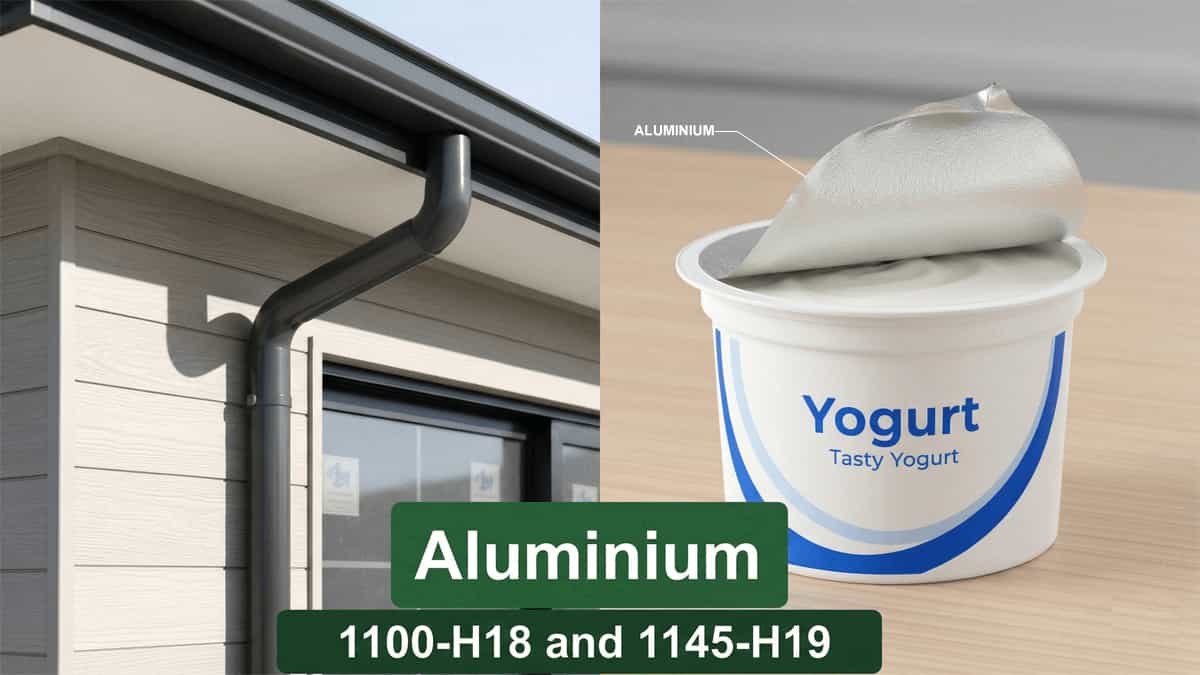
- Architectural: Roofing, flashing, and gutters where stiffness is needed without heat treatment.
- Signage: Rigid nameplates, tags, and license plates that require minimal bending.
- HVAC: Stiffeners, damper blades, and parts requiring corrosion resistance and rigidity.
- Packaging & Containers:
- Rigid Lids & Closures: Bottle caps and tamper-evident seals that must hold their shape under pressure.
- Semi-Rigid Containers: Thicker foil containers for pre-made meals or industrial packaging.
- Electrical:
- Busbars (Low/Medium Current): Where a balance of good conductivity, formability (for bending), and structural rigidity is required. For maximum conductivity, purer alloys are often chosen.
- General Manufacturing:
- Stamped Parts: Gaskets, washers, and brackets that do not require severe deformation.
Applications of Aluminium 1145-H19:
- Foil Packaging:
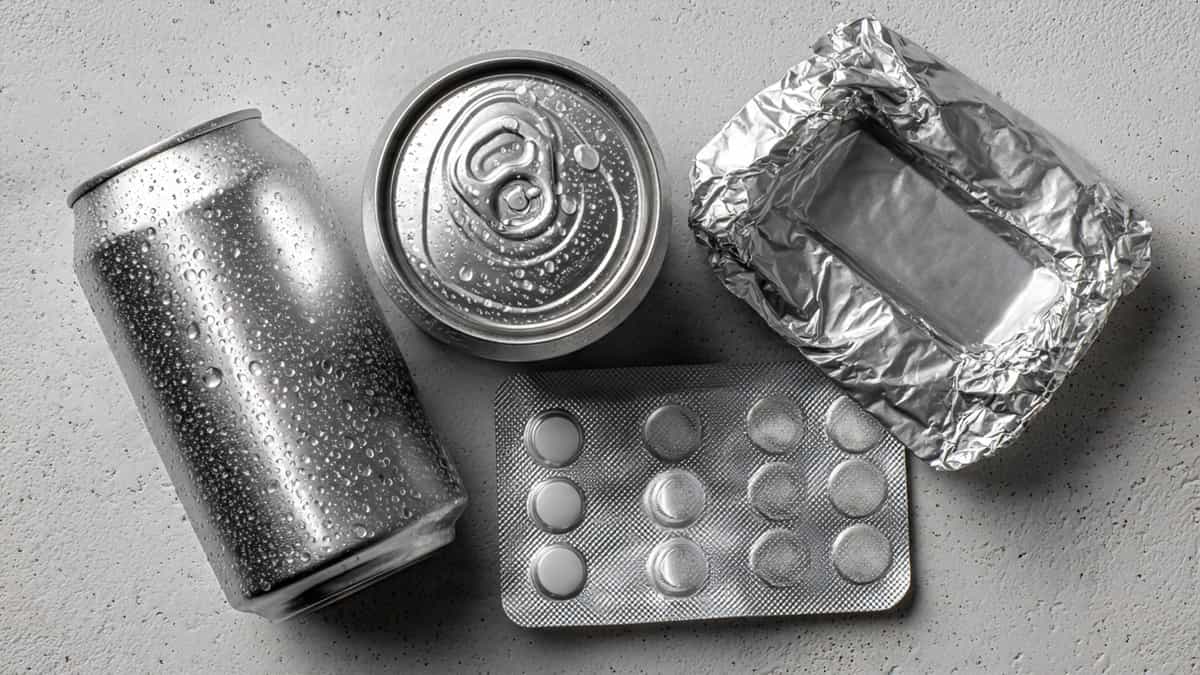
- Flexible Packaging: The primary alloy for ultra-thin, flexible household and industrial foil (e.g., for wrapping food).
- Laminates: Used in aseptic packaging (e.g., juice boxes) and pharmaceutical blister packs as a moisture and light barrier.
- Heat Seals: Foil lids for yogurt cups and other containers.
- Electrical:
- Capacitor Foil: Its high purity and thinness make it ideal for use in electronic capacitors.
- Cable Shielding: Used as a thin, conductive wrap around communication cables.
- Thermal Insulation:
- Reflective Barriers: The H19 temper provides enough handling strength for foil-backed insulation bats used in buildings. Discover more in Aluminum Foil Facts vs Myths.
Why Choose One Over the Other? The Trade-Offs
- Choose Aluminium 1100-H18 when you need:
- The highest possible strength from a commercially pure, non-heat-treatable aluminium.
- A material for sheet metal parts that must resist bending and denting.
- Good corrosion resistance and workability in a stiffer form.
- Choose Aluminium 1145-H19 when you need:
- Ultra-thin foil for packaging or industrial applications.
- Maximum electrical or thermal conductivity in a wrought product.
- A material for capacitors or shielding where purity is paramount.
Sourcing and Standards
Both alloys are produced globally by major rolling mills. 1100 is widely available as sheet, plate, and coil, while 1145 is predominantly supplied as foil stock.
Key Standards:
- ASTM B209: Covers 1100 alloy sheet and plate.
- ASTM B479: Standard Specification for Annealed Aluminum Foil for Flexible Barrier Applications (covers alloys like 1145).
- For a broader understanding of global specifications, refer to Global Standards: ASTM, AAMA, EN, DIN, BS.
Sustainability: Champions of the Circular Economy
Like all aluminium, both 1100 and 1145 are infinitely recyclable. The energy required to recycle them is a mere ~5% of that needed for primary production. The high volume of post-consumer aluminium foil and post-industrial sheet scrap makes these alloys pivotal in the circular economy. Learn about the process in Aluminum Can Recycling Process and the broader context in Understanding Aluminium Waste and Scrap.
Summary
Aluminium 1100-H18 and 1145-H19 are not interchangeable; they are two masterpieces of metallurgical tailoring. 1100-H18 is the workhorse you call upon when you need the sturdy, reliable strength of pure aluminium for sheet metal components. 1145-H19 is the specialist, the invisible enabler that provides the barrier in your food packaging, the charge in your electronics, and the reflection in your insulation.
From the rigid lid on a glass jar (1100-H18) to the thin foil protecting a chocolate bar (1145-H19), these two tempers demonstrate that even within the realm of “pure” aluminium, targeted properties can be engineered to meet the precise demands of modern industry and daily life. For more on the family they belong to, explore our overview of the Aluminum 1000 Series.
Related Articles
Featured
You May Also Like

5 Common Problems with Casement Windows (& How to Fix Th…

Trump Greenland Deal Puts Aluminum-Rich Minerals in Focus Am…
Alumil India Leads in Sustainability with ‘Loop 80’ Certifie…
Why Aluminium Reigns Supreme in Packaging
Aluminium 5052 (Aluminum 5052): The Marine-Grade Alloy for S…
