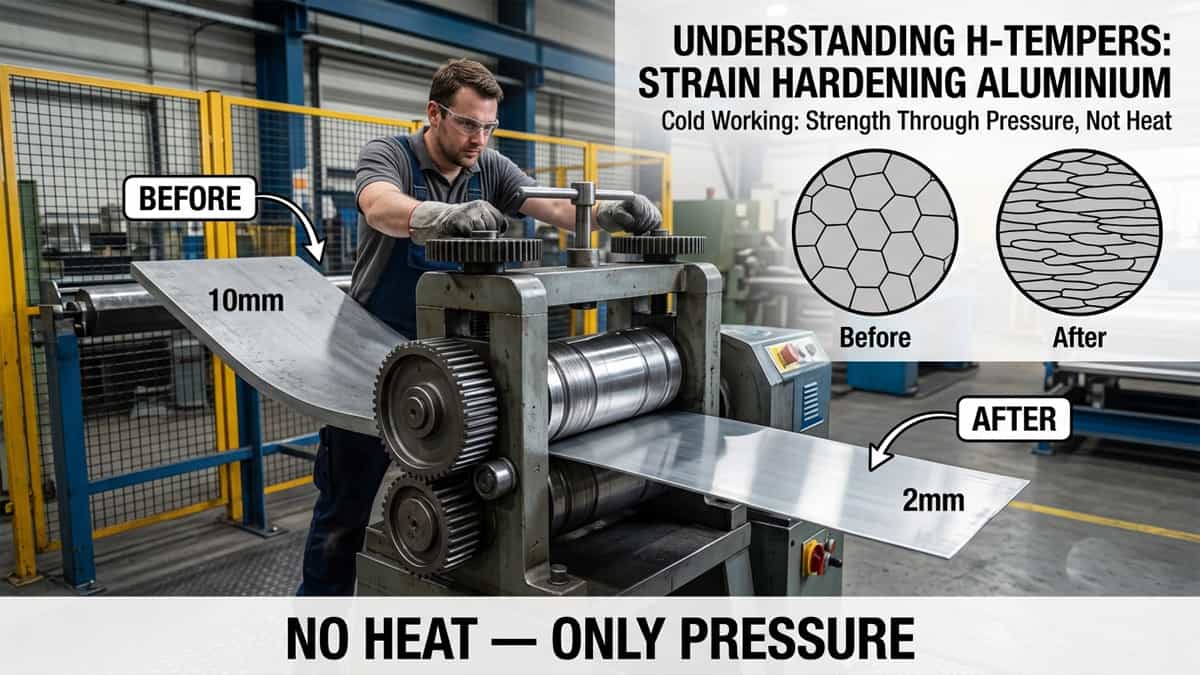
In the world of aluminium alloys, temper designations play a crucial role in determining the material’s mechanical properties and suitability for specific applications. Among these, H-tempers represent one of the most important categories for non-heat-treatable aluminium alloys, where strength is achieved through controlled strain hardening.
KEY TAKEAWAYS FOR STUDENTS
- Non-Heat-Treatable: H-tempers apply mainly to 1xxx, 3xxx, and 5xxx series alloys.
- Mechanism: Hardness and strength are gained via cold working (mechanical deformation at room temperature).
- System Breakdown: First digit indicates process (H1, H2, H3); second digit indicates hardness level (Hx2 to Hx9).
What Are H-Tempers?
H-tempers (Strain-Hardened Tempers) are applied to non-heat-treatable aluminium alloys—primarily from the 1xxx, 3xxx, and 5xxx series—that cannot be strengthened by heat treatment. Instead, these alloys gain their strength through cold working, a process where the aluminium is mechanically deformed at room temperature, increasing its dislocation density and consequently its strength and hardness.

The H-Temper Designation System
The H-temper system uses a numerical code to provide precise information about the alloy’s processing history and mechanical properties:
First Digit: Basic Treatment Process
- H1x – Strain-hardened only
- H2x – Strain-hardened and partially annealed
- H3x – Strain-hardened and stabilized (thermally treated to achieve stability). This stabilization is especially crucial for certain 5xxx series alloys to achieve long-term property stability by preventing natural aging after cold working.
Second Digit: Degree of Hardness
The second digit represents a multiple of one-eighth of the strain-hardening required to reach the full-hard state:
- Hx2 – 1/4 hard (2/8 reduction from full hard)
- Hx4 – 1/2 hard (4/8 reduction from full hard)
- Hx6 – 3/4 hard (6/8 reduction from full hard)
- Hx8 – Full hard
- Hx9 – Extra hard (exceeding full hard specifications)
Common H-Tempers in Practice
H32, H34, H36, H38
These are among the most commonly encountered tempers for marine and architectural applications. For instance, 5052-H32 is widely used in marine components, while 3003-H14 finds applications in chemical equipment and decorative trim.
H22, H24, H26
These tempers offer a balance between strength and formability, making them suitable for applications requiring moderate forming after the initial strain hardening process.
Applications in Key Industries
Marine Applications
Alloys like 5083-H116 and 5086-H32 are preferred for shipbuilding and marine structures due to their excellent corrosion resistance in saltwater environments combined with high strength. These alloys maintain their integrity even in the most demanding marine conditions.
Architectural and Building Products
In the construction industry, tempers such as 3005-H14 and 3105-H14 are commonly used for roofing, siding, and gutter systems. Their combination of strength, formability, and corrosion resistance makes them ideal for long-lasting architectural applications.
Consumer Goods and General Engineering
From aluminium ladders to kitchen utensils and various aluminium sheets, H-tempered alloys provide the necessary strength and durability for everyday products while maintaining good manufacturability.
You May Also Like
Top 10 Reasons to Choose Aluminium for Doors & Windows
Advantages & Limitations of H-Tempered Aluminium
ADVANTAGES
- ✓ Controlled Strength Levels via precise numerical designations
- ✓ Maintains native excellent corrosion resistance of aluminium
- ✓ Good formability and workability at lower tempers (e.g., H12/H14)
- ✓ Generally good weldability across most strain-hardened series
LIMITATIONS
- ✕ Cannot be heat-treated to gain strength
- ✕ Strength reduction occurs in the Heat-Affected Zone (HAZ) during welding
- ✕ Higher hardness tempers (H38/H39) offer limited ductility for severe bends
Selection Considerations
When choosing an H-temper for your application, consider:
- Required strength level vs. necessary formability
- Corrosion environment the material will face
- Fabrication processes involved (welding, bending, forming)
- Service temperature conditions
For applications requiring maximum strength with minimal forming, higher tempers like H38 or H39 are appropriate. For components needing significant forming after temper designation, lower tempers like H12 or H14 provide better workability.
Frequently Asked Questions About H-Tempers
What is the main difference between H1x, H2x, and H3x tempers?
H1x means the material is strain-hardened only. H2x means it is strain-hardened and partially annealed. H3x means it is strain-hardened and thermally stabilized to prevent natural aging.
Which aluminium alloy series use H-tempers?
H-tempers are applied to non-heat-treatable aluminium alloys, primarily from the 1xxx, 3xxx, and 5xxx series.
How does welding affect H-tempered aluminium?
While H-tempered alloys are generally weldable, heat from the welding process degrades the strain hardening, causing strength reduction in the heat-affected zone (HAZ).
Related Resources
- Understanding Aluminium Alloy Designations
- Aluminium 5052 Properties and Applications
- Marine Grade Aluminium Alloys
- Aluminium in Architectural Applications
- Corrosion Resistance of Aluminium
H-tempers represent a fundamental aspect of aluminium technology, providing engineers and designers with a versatile toolkit for achieving specific mechanical properties in non-heat-treatable alloys. Understanding this designation system is essential for selecting the right material for applications ranging from marine structures and architectural components to consumer products and industrial equipment.
By choosing the appropriate H-temper, manufacturers can optimize the balance between strength, formability, and corrosion resistance, ensuring optimal performance and longevity in their aluminium components and structures.