
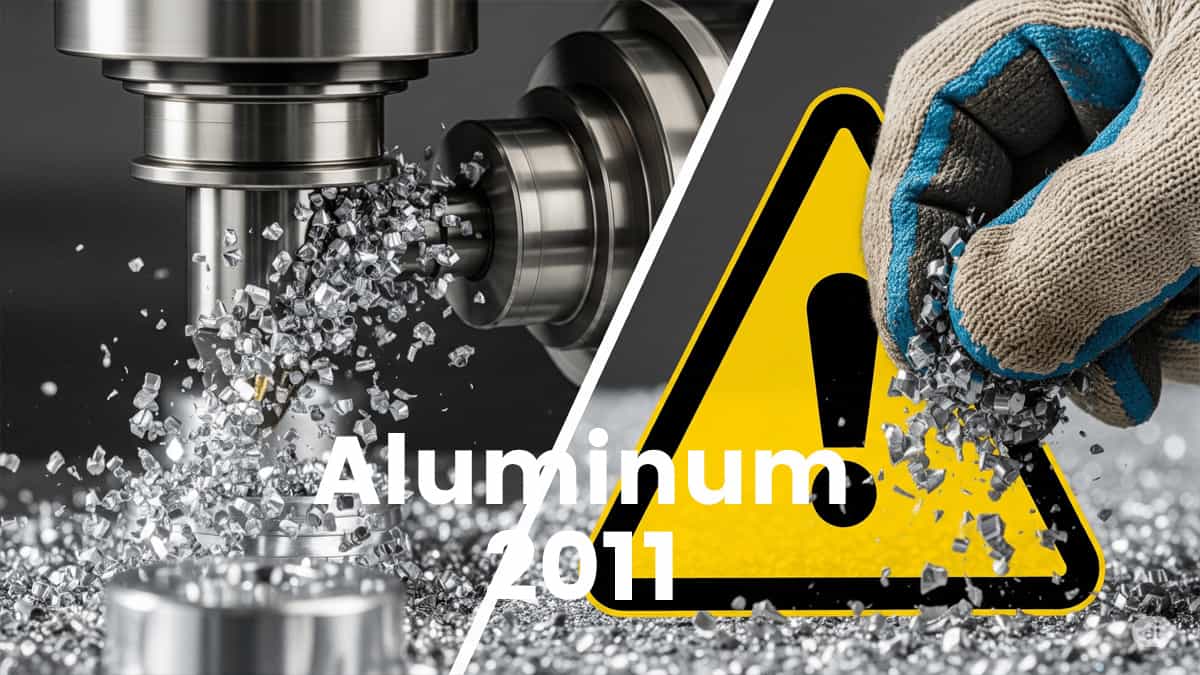
The Free-Machining Powerhouse (Handle with Care)
In the vast landscape of aluminium alloys, where properties like strength, corrosion resistance, or conductivity often dominate, Aluminium 2011 (Aluminum 2011) carves out a unique and essential niche. Known primarily as the free-machining champion of the aluminium world, this alloy delivers exceptional machinability, enabling high-speed production of complex, precision parts. However, its specialized composition comes with important considerations regarding corrosion resistance, weldability, and environmental handling. It’s a high-performance tool for specific manufacturing challenges.
The Secret Sauce: Composition Designed for Cutting
Aluminium 2011 belongs to the 2000 series (Al-Cu alloys), sharing its primary strengthening mechanism with aerospace alloys like 2024. However, its key differentiator is the deliberate addition of Lead (Pb) and Bismuth (Bi):
- Copper (Cu): 5.0 – 6.0% – The primary alloying element. Forms strengthening precipitates (Al2Cu) during aging, providing good mechanical strength.
- Lead (Pb): 0.2 – 0.6% – The primary free-machining agent. Lead forms small, soft, discrete particles that act as internal lubricants during machining. This dramatically reduces cutting forces, minimizes tool wear, promotes chip breaking, and allows for superior surface finishes at high speeds.
- Bismuth (Bi): 0.2 – 0.6% – Often used in conjunction with or as a partial substitute for lead (especially in more modern or “eco” versions). Bismuth also forms soft, low-melting-point particles that enhance chip formation and breakability, contributing to the free-machining characteristics.
- Other Elements:
- Iron (Fe): < 0.7% (Impurity)
- Silicon (Si): < 0.4% (Impurity)
- Zinc (Zn): < 0.3% (Impurity)
- Manganese (Mn): < 0.2% (May be added for grain refinement)
- Magnesium (Mg): < 0.05% (Minimized to avoid interfering with free-machining elements)
The presence of Pb and Bi is absolutely critical to achieving 2011’s legendary machinability but defines its limitations elsewhere.
Core Properties: Speed, Finish, Strength (with Caveats)
- Exceptional Machinability: This is 2011’s defining characteristic. It consistently achieves machinability ratings of 100% or higher (often benchmarked against free-cutting brass C36000 as 100%). Key benefits:
- High Cutting Speeds & Feeds: Significantly faster than other aluminium alloys.
- Superior Surface Finish: Produces smooth, fine finishes directly from machining.
- Excellent Chip Control: Forms small, broken chips, reducing tangling and improving safety/automation.
- Reduced Tool Wear: Extends tool life dramatically compared to alloys like 6061 or 2024.
- Tight Tolerance Holding: Ideal for precision components.
- Good Mechanical Strength: In the T3, T6, or T8 tempers, 2011 offers respectable strength:
- Tensile Strength: ~290 – 380 MPa (T3: ~290-330 MPa, T8: ~330-380 MPa)
- Yield Strength: ~165 – 300 MPa (T3: ~165-240 MPa, T8: ~270-300 MPa)
- Elongation: ~10-18% (T3), ~8-12% (T8)
This strength makes it suitable for structural components where machining is the primary fabrication method.
- Fair Thermal Conductivity: ~151-160 W/m·K (Lower than pure aluminium or 6000 series, but adequate for many applications).
- Limited Electrical Conductivity: ~40-45% IACS. Not suitable for primary electrical conductors.
- Lightweight: Density approx. 2.82 g/cm³.
Critical Limitations: The Trade-Offs for Machinability
- Poor Corrosion Resistance: This is a major drawback. The copper content and the presence of Pb/Bi particles create numerous galvanic corrosion sites. Aluminum 2011 has very poor resistance to atmospheric corrosion, salt water, and many chemicals. Protective coatings (anodizing, paint, plating) are almost always required for any exposed application. It should never be used in corrosive environments unprotected.
- Very Poor Weldability: The Pb/Bi additions severely compromise weldability. Fusion welding (TIG, MIG) causes hot cracking and porosity due to the low-melting-point phases. Welding is generally not recommended and should be avoided if possible. Mechanical fastening is the preferred joining method.
- Environmental & Safety Concerns: The lead content necessitates careful handling:
- Machining: Requires appropriate ventilation and coolant filtration systems to capture lead-containing swarf (chips and fines). Operators should follow strict hygiene practices (no eating/drinking in area, thorough hand washing).
- Chip Disposal: Machining swarf is classified as hazardous waste in many jurisdictions due to lead content and requires specialized, often costly, disposal/recycling streams. Never mix 2011 chips with other aluminium scrap.
- End-of-Life: Products made from 2011 require specific recycling considerations due to lead contamination.
- Limited Formability: While stronger than pure aluminium, its ductility is significantly lower than alloys like 1100 or 3003, especially in harder tempers. It’s not suitable for severe bending, deep drawing, or spinning.
Tempers: Optimizing for Machining and Strength
- T3 (Solution Heat Treated, Cold Worked, Naturally Aged): A common temper offering a good balance of machinability and strength. Used for parts requiring good formability after solution treatment but before final aging.
- T4 (Solution Heat Treated and Naturally Aged): Less common than T3. Slightly lower strength than T3/T8.
- T6 (Solution Heat Treated and Artificially Aged): Not typically used for 2011. Artificial aging can slightly reduce machinability.
- T8 (Solution Heat Treated, Cold Worked, Artificially Aged): Offers the highest strength. The cold work improves strength and dimensional stability. Machinability remains excellent. Very common for precision screw machine stock and rods.
- T351, T851: Similar to T3/T8 but with stress relief via stretching after solution treatment, improving dimensional stability for critical parts.
Star Applications: Where Machinability is King
Aluminum 2011 excels in high-volume, precision machining applications, particularly where corrosion resistance is managed or secondary:
- Screw Machine Products (Swiss Turned Parts): The quintessential application. Used for:
- Fasteners: Nuts, bolts, screws, fittings (especially complex geometries).
- Connectors: Electrical, hydraulic, pneumatic.
- Valve Components: Pistons, bodies, stems.
- Knobs, Handles, Control Wheels.
- Precision Bushings, Sleeves, Spacers.
- Automotive: Non-critical, interior, or protected components:
- Fuel System Components (non-pressurized, protected).
- Trim Hardware.
- Sensor Housings (protected).
- Bracket Assemblies (machined, then coated).
- Hydraulic & Pneumatic Systems: Fittings, valve bodies, pistons (protected systems, coated).
- Consumer Goods: Camera parts, power tool components, hardware fittings, plumbing fixtures (chromed or coated).
- Aerospace & Defense: Select non-structural fittings, bushings, spacers (where approved and corrosion protection is applied).
- Electrical: Non-conductive housings, connectors (plated), insulators.
Why Choose 2011? Comparing the Alternatives
- vs. 6061: 6061 offers superior corrosion resistance, weldability, and higher strength potential, but significantly lower machinability (~50% of 2011). Choose 2011 for high-volume precision machining where speed, finish, and tool life are critical; choose 6061 for general purpose, weldable, corrosion-resistant parts.
- vs. 2024: 2024 offers much higher strength (especially fatigue) but even worse machinability and corrosion resistance than 2011. 2024 is primarily an aerospace structural alloy; 2011 is a free-machining specialist.
- vs. Free-Cutting Brass (C36000): Brass has excellent machinability and corrosion resistance but is heavier and more expensive. 2011 offers weight savings and lower material cost. Choose brass for superior corrosion resistance or specific wear/bearing properties; choose 2011 for lightweight precision parts where corrosion can be managed.
- vs. 6262: A lead-free free-machining alternative (uses Bismuth and sometimes Tin). Machinability is very good (~90% of 2011) but often not quite as exceptional. Offers better corrosion resistance than 2011 and avoids lead handling issues. Increasingly popular as a “greener” substitute where machinability requirements allow.
- vs. 7075: Much higher strength but very poor machinability and corrosion resistance. Not a direct competitor.
Sourcing and Standards
Aluminium 2011 is widely available, primarily as:
- Round Rod / Bar: For screw machines and CNC turning (most common form).
- Hexagonal Bar.
- Square Bar.
- Wire.
- (Less commonly as sheet/plate).
Key Standards:
- ASTM:
- B211: Standard Specification for Aluminum and Aluminum-Alloy Bar, Rod, and Wire (Covers 2011).
- B316/B316M: Standard Specification for Aluminum and Aluminum-Alloy Rivet and Cold-Heading Wire and Rods.
- EN (Europe): EN 573-3 (Chemical Composition – Designation EN AW-2011), EN 754 (Bars). Note: Lead restrictions (RoHS, REACH) heavily limit 2011 use in the EU/EEA.
- SAE (Automotive): SAE J454 (Chemical Composition).
- AMS (Aerospace): AMS 4180 (2011-T3 Bar & Rod). Use is selective and often requires specific approval due to corrosion/lead.
Environmental & Safety Imperatives
The lead content in traditional Aluminium 2011 dictates stringent protocols:
- Machining Environment: Use closed machines with mist collectors, effective ventilation, and coolant filtration systems designed to capture lead fines.
- Operator Safety: Strict PPE (gloves, eye protection), hygiene practices (no eating/drinking, hand washing), and regular area monitoring are essential.
- Waste Management: Swarf and grinding dust MUST be collected separately from other aluminium scrap. Classify and dispose of as hazardous waste according to local regulations. Recycling requires specialized lead-bearing aluminium streams.
- Design for End-of-Life: Consider the challenges of recycling lead-containing components. Explore lead-free alternatives (like 6262) where feasible.
The Future: Niche but Necessary, with Green Alternatives Rising
While environmental regulations (like RoHS, REACH) increasingly restrict lead-containing alloys, Aluminium 2011 remains vital in regions with less stringent rules and for applications where its unparalleled machinability justifies the handling requirements. Its future lies in:
- Continued use in high-precision screw machining: Where its performance is unmatched.
- Strictly controlled manufacturing environments: Adhering to the highest safety standards.
- Growth of Lead-Free Alternatives: Alloys like 6026 (Cu-Mg-Sn-Pb-free) and optimized 6262 are gaining ground where machinability close to (but not quite equal to) 2011 is acceptable, offering better corrosion resistance and simpler environmental compliance.
Aluminium 2011 (Aluminum 2011) is the undisputed high-speed machining champion of the aluminium world. Its unique lead/bismuth additions deliver unmatched chip control, surface finish, and tool life, enabling the cost-effective production of complex precision components. However, this capability comes at a significant cost: poor corrosion resistance, non-existent weldability, and critical environmental and safety responsibilities due to lead content. It is not a general-purpose alloy but a powerful, specialized tool. Engineers and manufacturers must carefully weigh its exceptional machinability against its limitations and handling requirements, ensuring strict safety and environmental protocols are followed throughout its lifecycle. In the right, controlled applications, 2011 remains an indispensable solution, while the search for equally capable but more sustainable lead-free alternatives continues to evolve.
Related Articles
Featured

You May Also Like

Understanding the Basics of Aluminium Fabrication Processes

Starting Your Own Business: Aluminium Door Windows Dealershi…

Aluminum Over Steel: Why the Lightweight Metal is Winning th…

What is a Picture Window?

ALUMINIUM CHINA 2024 to Unveil in Shanghai this July: Regist…
