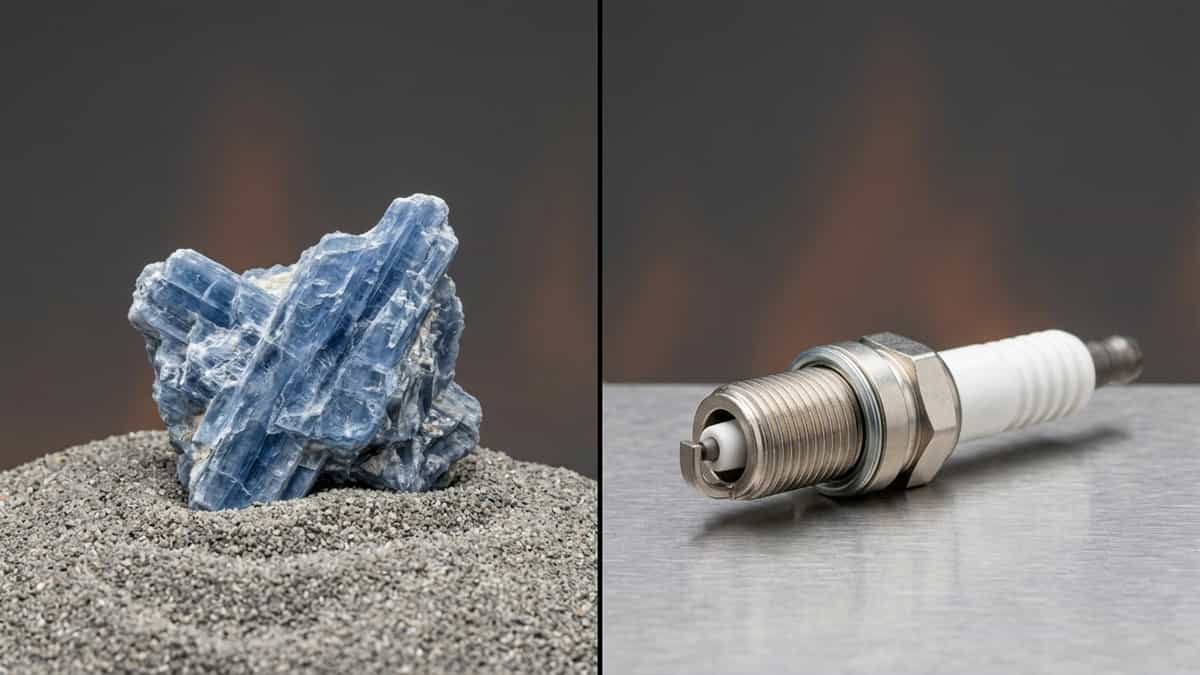
Aluminum silicate represents a family of naturally occurring minerals – andalusite, kyanite, and sillimanite – all sharing the same chemical formula but differing in crystal structure due to formation under different pressures and temperatures. Industrially, it is valued for its extreme refractoriness (heat resistance) and is used in spark plugs, kiln linings, and catalyst supports.
1. Basic Identification
- Chemical Formula: Al₂SiO₅ (also written as Al₂O₃·SiO₂)
- Alternative Names: Aluminium silicate; mineral names: andalusite, kyanite, sillimanite; heated product: mullite
- Molecular Weight: 162.05 g/mol
- CAS Number: 12141-46-7
- Appearance: Raw minerals range from blue (kyanite) to brown/pink/gray; processed form is white or off‑white granular powder
2. Physical Properties
| Property | Aluminum Silicate (Sillimanite phase – typical) |
|---|---|
| Melting Point | Transitions to mullite ~1450‑1550 °C; fully melts >1850 °C |
| Boiling Point | Decomposes before boiling |
| Density | 3.12 – 3.24 g/cm³ |
| Hardness (Mohs) | 6.5 – 7.5 (kyanite is anisotropic: 4.5‑7 depending on direction) |
| Solubility | Insoluble in water, oils, and most industrial solvents |
The material is inert, non‑hygroscopic, and feels like heavy crushed glass or sand.
3. Chemical Behavior & Synthesis
3.1 Thermal Transformation – Mullitization
When heated above ~1450 °C, the natural polymorphs convert irreversibly to mullite (3Al₂O₃·2SiO₂) plus free silica:
3 Al₂SiO₅ → Al₆Si₂O₁₃ + SiO₂
Mullite is one of the most thermally and mechanically stable ceramics known, maintaining rigidity at extreme temperatures.
3.2 Synthesis
Most aluminum silicate is mined directly from open‑pit quarries. For high‑purity applications, synthetic Al₂SiO₅ is produced by firing finely milled alumina and silica together at >1600 °C.
4. Industrial Applications
4.1 High‑Temperature Refractories
Crushed aluminum silicate is used to make bricks that line steel blast furnaces, glass‑melting kilns, and incinerators. Unlike ordinary concrete, these bricks glow red but remain rigid under extreme heat.
4.2 Spark Plug Insulators
The white ceramic jacket around a spark plug’s metal core is predominantly aluminum silicate. It provides electrical insulation while withstanding thousands of explosive detonations inside the engine.
4.3 Catalyst Support Beds
In petrochemical refineries, porous aluminum silicate pellets or honeycombs serve as inert skeletons that hold reactive catalysts. They allow gas flow while keeping the active chemistry in place.
5. Safety & Hazard Management
General Safety: Aluminum silicate is naturally occurring and non‑toxic, but fine dust can cause mechanical lung damage.
| Route of Exposure | Effect |
|---|---|
| Inhalation | Primary hazard. Chronic exposure to fine crystalline dust may cause pneumoconiosis (silicosis). |
| Skin Contact | No chemical hazard; may act as an abrasive. |
| Eye Contact | Mechanical scratching hazard (like glass dust). |
| Ingestion | Non‑toxic; passes through unabsorbed. |
PPE: N95 or P100 respirator (for dust), safety goggles, work gloves.
Firefighting: Non‑combustible.
Storage: Normal dry storage; no special atmosphere.
Disposal: Can be disposed as construction/demolition waste; not hazardous.
6. Environmental Impact
Aluminum silicate is chemically inert and does not leach toxic ions or alter pH. Its environmental footprint comes mainly from mining and the energy used in firing kilns.
7. Comparison with Other Aluminum Compounds
| Compound | Formula | Primary Nature | Primary Application |
|---|---|---|---|
| Aluminium Silicate | Al₂SiO₅ | Refractory ceramic | Furnace bricks, spark plugs |
| Aluminium Sulfate | Al₂(SO₄)₃ | Soluble salt | Water purification |
| Aluminium Hydroxide | Al(OH)₃ | Amphoteric powder | Antacids, flame retardants |
8. Frequently Asked Questions
Q: Is this the same as the silica gel packets in shoe boxes?
A: No. Those are pure silica (SiO₂). Aluminum silicate contains firmly bound alumina, making it much harder and non‑absorbent.
Q: Is kyanite jewelry safe to wear?
A: Yes. Kyanite is a natural, insoluble crystal form of aluminum silicate – completely safe to touch and wear.
Q: Can I melt aluminum silicate in a backyard foundry?
A: No. Backyard propane foundries typically reach 1200‑1300 °C. Aluminum silicate requires >1800 °C to melt. In fact, your furnace is likely lined with it to protect the steel shell.
9. Summary Data Sheet
| Property | Value |
|---|---|
| Chemical Name | Aluminum Silicate |
| Mineral Names | Andalusite, Kyanite, Sillimanite |
| Formula | Al₂SiO₅ |
| Appearance | White powder; colored mineral gems |
| Melting Point | >1850 °C (transforms to mullite ~1450 °C) |
| Defining Trait | Extreme refractoriness |
| Primary Utility | Furnace bricks, spark plug insulators |
Related Articles

Featured


You May Also Like
Aluminum Roofing Sheet – Crimp

Why the Aluminum Industry is Essential for Modern Infrastruc…
Use of Aluminium in Personal Care and Cosmetics
Aluminium Baking Tray: Pros and Cons, Health Perspective, Cl…

What If the U.S.–Canada Economic Alliance Fractures? The Alu…