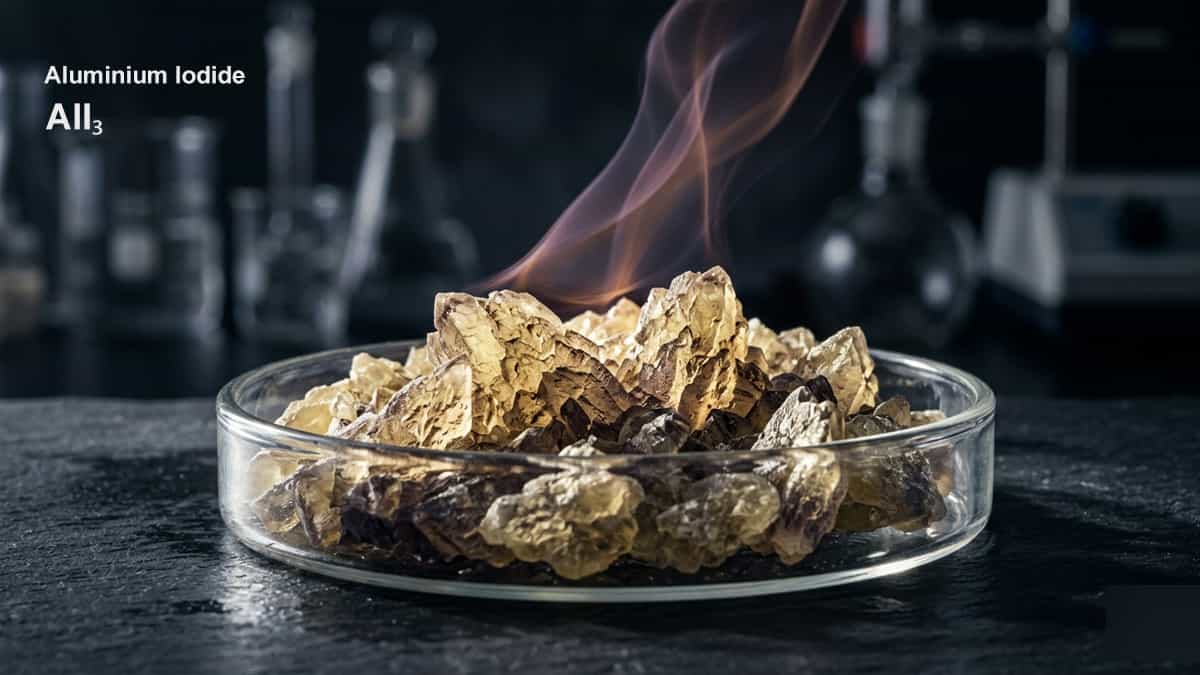
Aluminium iodide is a highly reactive chemical compound comprising aluminium and iodine. Appearing as a white to pale yellow‑brown crystalline powder, it is characterized by its powerful electron‑accepting nature. Much like aluminium chloride and bromide, it is a strong Lewis acid. While its commercial use is vastly eclipsed by other halides, it holds a highly specialized niche in organic synthesis, particularly in ether cleavage and redox reactions.
1. Basic Identification
Chemical Formula: AlI₃ (monomer); normally exists as the dimer Al₂I₆ in its solid and liquid states.
Alternative Names: Aluminium triiodide.
Molecular Weight: 407.69 g/mol (anhydrous).
CAS Number: 7784-23-8 (anhydrous).
Appearance: Unadulterated AlI₃ is a white crystalline powder. However, samples are frequently contaminated with free iodine, lending them a yellowish‑brown or even dark violet tint.
2. Physical Properties
The physical profile of aluminum iodide resembles aluminum bromide in its low melting point, tendency to form dimers, and extreme hygroscopic properties.
2.1 Key Data Table
| Property | Anhydrous AlI₃ |
|---|---|
| Melting Point | 189.4 °C (372.9 °F) |
| Boiling Point | 382 °C (719.6 °F) – sublimes rapidly |
| Density | 3.98 g/cm³ |
| Vapor Pressure | 1 mmHg at ~155 °C |
| Solubility | Reacts violently with water. Soluble in carbon disulfide, ethanol, ether, and diethyl ether. |
2.2 Physical Description
In its anhydrous state, it consists of dense crystalline plates or powder. It is acutely hygroscopic. When left in open air, it pulls moisture, degrades rapidly, and releases plumes of corrosive hydrogen iodide (HI) gas.
3. Chemical Behavior and Reactions
Aluminum iodide is an aggressive Lewis acid. It forces reactions by accepting electron pairs from other compounds, making it a very capable catalyst and reagent.
3.1 Reaction with Water
Contact with water induces violent hydrolysis.
AlI₃ + 3H₂O → Al(OH)₃ + 3HI ↑
Observation: This reaction is fiercely exothermic, producing dangerous spurts and a heavy cloud of highly acidic hydrogen iodide gas.
Result: It is impossible to form an aqueous solution of pure, unreacted aluminum iodide.
3.2 Synthesis (How It Is Made)
It can be formulated safely inside a protected laboratory setting.
2Al + 3I₂ → 2AlI₃
Process: The classic method involves reacting elemental aluminum shavings directly with solid iodine. Because it requires heat to initiate but is intensely exothermic, the synthesis must be carefully controlled, often using a solvent like ether or carbon disulfide as a heat sink.
3.3 Cleavage of Ethers
A signature reaction of AlI₃ is splitting ether bonds. It can effectively sever the carbon‑oxygen bond in ethers (C–O–C), a valuable technique in complex organic chemistry to uncover reactive functional groups.
4. Industrial and Laboratory Applications
Unlike aluminum chloride, aluminium iodide is rarely utilized on a massive industrial scale due to the high cost of iodine and its instability. It is strictly a specialized laboratory agent.
4.1 Ether Cleavage
This reagent is excellent for breaking apart specific ether linkages to form corresponding alcohols or alkyl iodides. This reaction is extremely useful when chemists are synthesizing elaborate pharmaceutical molecules and need to “unmask” a hidden alcohol group.
4.2 Reducing Agent
In selective environments, it behaves as a strong reductant, capable of reducing some aromatic compounds and ketones back to their respective starting alcohols or hydrocarbons.
4.3 Specialized Friedel‑Crafts Reactions
While AlCl₃ is cheaper and predominantly used for typical Friedel‑Crafts reactions, AlI₃ can be selected for highly specialized cases where its specific steric bulk or reactivity profile yields a better distribution of isomers.
5. Safety and Hazard Management
⚠️
GHS05
Corrosive
Critical Warning: Aluminum iodide reacts viciously with water, resulting in corrosive gas clouds. Furthermore, breakdown products include free iodine, which is highly irritating to the eyes and lungs.
5.1 Health Effects
| Route of Exposure | Effect |
|---|---|
| Inhalation | Immediate coughing and burning of the throat. Inhaled hydrogen iodide can lead to pulmonary complications and chemical pneumonia. |
| Skin Contact | Instantly causes painful chemical burns. The iodine present will heavily stain the skin dark brown/violet. |
| Eye Contact | High risk of irreversible corneal damage and blindness from acid burns. |
| Ingestion | Causes massive burns across the gastrointestinal tract; potentially fatal. |
5.2 Personal Protective Equipment (PPE)
Proper PPE is mandatory to defend against both the acidic powder and the emitted gases.
- Respiratory: Powered Air Purifying Respirator (PAPR) or supplied‑air system is highly recommended.
- Hands: Heavy neoprene or butyl rubber gloves.
- Eyes: Tight‑sealing chemical safety goggles.
- Body: Acid‑resistant lab coat, apron, or Tychem suit.
5.3 First Aid Measures
- Skin: If dry powder is present, carefully brush off the excess without generating dust. Then immediately flush with massive flows of water for at least 15 minutes. Seek medical help.
- Eyes: Rinse vigorously with water for 15–20 minutes, keeping eyelids forcibly opened. Get emergency ophthalmic intervention.
- Inhalation: Evacuate to fresh air. Provide oxygen. Alert emergency services immediately.
5.4 Firefighting Information
- Suitable Extinguishers: Dry powder, dry sand, or Class D extinguishers.
- DO NOT USE: Water or water‑based foams. Water triggers explosive boiling and toxic gas release.
6. Storage and Handling Guidelines
6.1 Storage Conditions
- Container: Protect firmly against moisture and light. Glass bottles wrapped in foil or opaque, thick‑walled HDPE containers.
- Atmosphere: Store beneath a blanket of completely dry inert gas (argon).
- Temperature: Keep cool and away from all heat sources.
- Incompatibles: Strictly isolate from water, oxygen, bases, strong oxidizers, and combustible materials.
6.2 Disposal Considerations
Disposal must be rigorously controlled.
- Suspend carefully in a non‑polar, dry organic solvent within a certified fume hood.
- Add this suspension dropwise into a massive volume of ice water while stirring constantly.
- Neutralize the resulting heavily acidic slurry with a sodium bicarbonate solution until pH neutral.
- Discard the liquid via certified hazardous waste management services.
7. Environmental Impact
Due to its intense reaction with ambient moisture to form hydroiodic acid and aluminium hydroxide, it exhibits poor environmental persistence. However, heavy iodine components can be toxic to local aquatic fauna and flora, inducing acidification of water sources and heavy halogen disruption in local biomes. Spills must be physically managed and kept completely out of the water table.
8. Comparison with Other Aluminium Halides
| Compound | Formula | Melting Point | Lewis Acidity | Industrial Note |
|---|---|---|---|---|
| Aluminium Fluoride | AlF₃ | 1291 °C | Weak | Used for high‑temperature metal smelting. |
| Aluminium Chloride | AlCl₃ | 192.4 °C | Very Strong | Massively produced catalyst for petrochemicals. |
| Aluminium Bromide | AlBr₃ | 97.5 °C | Very Strong | Primary versatile lab catalyst. |
| Aluminium Iodide | AlI₃ | 189.4 °C | Strong | Niche utility primarily reserved for ether cleavage. |
9. Frequently Asked Questions
Q: Why does my aluminum iodide look brown instead of white?
A: Aluminum iodide is inherently unstable over time. It easily sheds some of its bonded iodine, leaving behind free, elemental iodine (I₂), which carries a dark brown‑violet color. Pure fresh AlI₃ is white.
Q: Does it glow in the dark?
A: No, aluminum iodide is not luminescent or radioactive.
Q: Can I extinguish an aluminum iodide fire with a normal fire extinguisher?
A: Absolutely not. A standard Class A (water) or A/B/C extinguisher might cause disaster. You must use dry sand or a Class D extinguisher.
Q: How do you separate the aluminum from the iodine?
A: It is rarely necessary to split them back into raw elements. Industrially, it is far cheaper to mine new aluminum and extract new iodine than to revert an AlI₃ compound.
10. Summary Data Sheet
| Chemical Name | Aluminum Iodide (Anhydrous) |
|---|---|
| Formula | AlI₃ / Al₂I₆ |
| Appearance | White to yellow‑brown crystalline solid |
| Melting Point | 189.4 °C |
| Hazards | Corrosive; Water‑Reactive; Emits toxic HI gas |
| Primary Utility | Laboratory reagent for ether cleavage and reductions |
| Storage Needs | Store sealed under argon gas in darkness |
Related Articles

Featured

You May Also Like

Aluminum Bathroom Windows That Work in Every U.S. Climate Zo…

Top 12 RAL Colour for Aluminium Doors & Windows

When Powder Coating Fails on Aluminium (And How to Fix It)

Curtain Wall System Components: Mullions, Transoms, Anchors,…

20ft Aluminium Ladder vs. Extension: Finding Your Ideal Ladd…