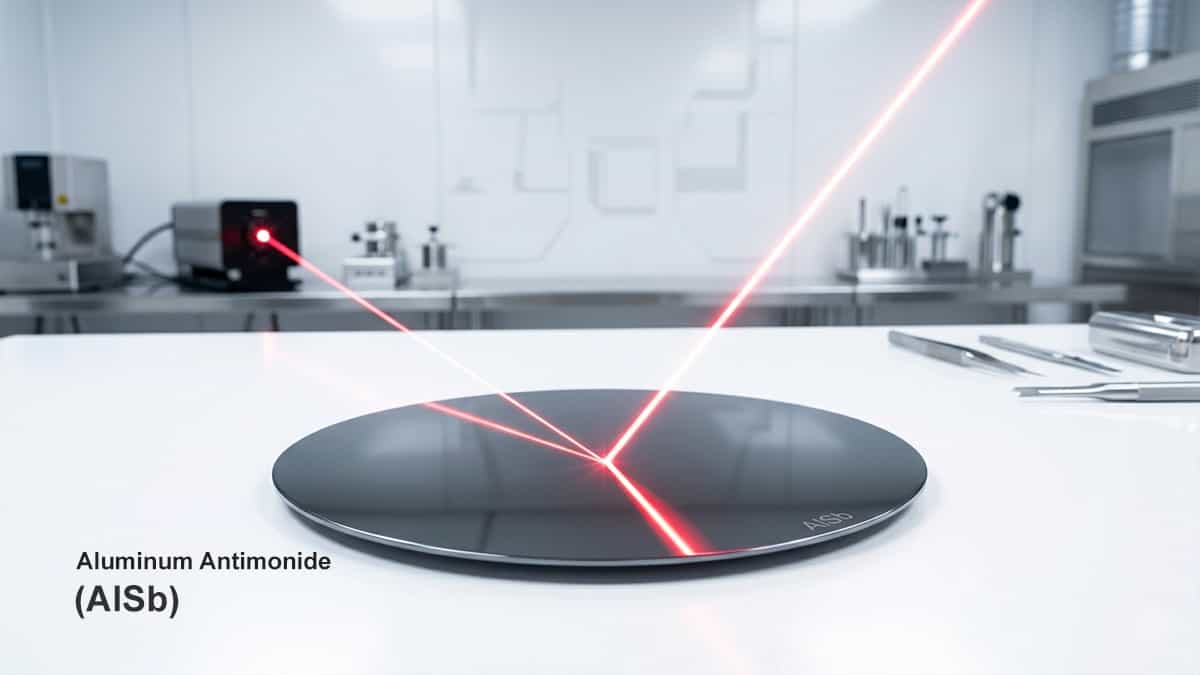
Aluminium antimonide belongs to a highly exclusive subset of chemicals recognized as III-V group semiconductors. It exists far outside the realms of traditional metallurgy, medicine, or catalysis, instead carving its niche at the cutting edge of optoelectronics. Appearing as a dark, crystalline semi-metallic solid, its ability to guide electrons and interact precisely with infrared light places it inside advanced radiation detectors, high-speed transistors, and specialized infrared sensors.
1. Basic Identification
Chemical Formula: AlSb
Alternative Names: Aluminium(III) antimonide.
Molecular Weight: 148.74 g/mol.
CAS Number: 25152-52-7.
Appearance: Dark grey or black, lustrous crystalline solid resembling metallic ores.
2. Physical Properties
The value of aluminium antimonide is linked directly to its semiconductor bandgap and crystalline atomic geometry.
2.1 Key Data Table
| Property | Aluminium Antimonide |
|---|---|
| Melting Point | 1060 °C (1940 °F) |
| Density | 4.26 g/cm³ |
| Crystal Structure | Zincblende lattice |
| Bandgap Energy | 1.62 eV (indirect at room temperature) |
| Solubility | Insoluble in water. Decomposes slowly in humid air. |
2.2 Physical Description
Visually, pure AlSb looks like heavy, sharp chunks of silicon or gray metal ore. However, its microscopic lattice is arranged like diamond. Over time, if exposed to open, humid air, the dark crystals slowly break down, coating themselves in a dull, gritty white powder composed of aluminium oxide and antimony compounds.
3. Chemical Behaviour and Reactions
For a semiconductor, stability is critical. AlSb is known for incomplete chemical immutability, making its industrial fabrication more difficult than that of silicon.
3.1 Atmospheric Degradation (Hydrolysis)
AlSb has an “Achilles heel”—it reacts with moisture, even if slowly.
Observation: If a polished wafer of AlSb is left in a humid environment, moisture in the air will gradually degrade the crystal. Over days or weeks, it releases trace amounts of highly toxic stibine gas (SbH₃) and forms a white oxidized crust on its surface, ruining its electrical properties. Proper storage in dry, inert atmospheres completely prevents this.
3.2 Synthesis (How It Is Made)
You cannot create a semiconductor chip by mixing powders in a beaker. You must grow a flawless crystal via deposition or extreme melting.
Al + Sb + Extreme Heat/Pressure → AlSb
Process: The elements are loaded into specialized quartz ampoules and heated past 1100 °C in a vacuum or purified argon atmosphere. Alternatively, for thin-film electronics, it is grown via Molecular Beam Epitaxy (MBE)—essentially “spray-painting” individual atoms of aluminum and antimony onto a base wafer inside a multi-million-dollar vacuum chamber.
4. Industrial and Laboratory Applications
Aluminum antimonide is more difficult to manufacture than its rival, gallium arsenide. Therefore, it is used only when its exact 1.62 eV bandgap is required.
4.1 High-Speed Transistors (HEMTs)
Because electrons travel across AlSb with high velocity, it forms the foundation of experimental High Electron Mobility Transistors. These chips can process data faster than silicon, making them attractive for deep-space communications and military radar.
4.2 Advanced Radiation Detectors
Its atomic density and bandgap allow it to act as an effective solid-state detector for X-rays and gamma radiation. Unlike traditional gas-filled tubes, a small solid block of AlSb can accurately quantify radiation, making it valuable for next-generation dosimeters and medical imaging.
4.3 Tunable Infrared Alloys
Engineers rarely use pure AlSb. By creating alloys such as gallium aluminium antimonide (GaAlSb), researchers can tune the semiconductor to absorb or emit specific near-infrared wavelengths. This is essential for fiber-optic communication lasers and night vision hardware.
5. Safety and Hazard Management
☠️
GHS06
Toxic (dust & decomposition products)
❗
GHS07
Harmful
Critical Warning: A solid chunk of AlSb is minimally hazardous when handled properly. The extreme danger arises when machining the crystal into wafers (creating inhalable, toxic dust containing antimony) or allowing it to sit in humid air, slowly releasing poisonous stibine gas.
5.1 Health Effects
| Route of Exposure | Effect |
|---|---|
| Inhalation | Primary risk. Breathing dust introduces toxic antimony to the lungs. If the crystal decomposes into stibine gas, inhalation can damage red blood cells (hemolysis) and cause kidney injury. |
| Skin Contact | Prolonged contact may cause localized dermatitis (“antimony spots”) – a painful rash resembling small ulcers. |
| Eye Contact | Mechanical irritation and chemical reddening. |
| Ingestion | Toxic, causing gastric pain, vomiting, and systemic heavy metal poisoning. |
5.2 Personal Protective Equipment (PPE)
Protection focuses on suppressing toxic dust.
- Respiratory: HEPA full-face respirators mandatory when grinding or polishing wafers.
- Hands: Thick nitrile gloves.
- Eyes: Tight-sealing splash and dust goggles.
- Body: Full clean-room “bunny suits.”
5.3 First Aid Measures
- Inhalation: If stibine or dust causes dizziness, move to fresh air immediately, administer oxygen if available, and seek emergency medical evaluation.
- Skin: Wash thoroughly with soap and water to remove heavy-metal dust.
6. Storage and Handling Guidelines
6.1 Storage Conditions
- Container: Vacuum-sealed jewel cases or heavy barrier pouches.
- Atmosphere: Hyper-dry storage (desiccator) with vacuum or argon backfill to prevent moisture contact.
- Location: Semiconductor clean rooms or restricted hazardous chemical lockers.
- Incompatibles: Water, humidity, strong acids (which accelerate stibine release).
6.2 Disposal Considerations
Do not dispose of AlSb in standard waste due to its antimony content.
- Segregate cracked wafers, dust, or shattered ampoules.
- Ship to licensed heavy-metal reclamation facilities, where the compound is chemically dissolved and antimony is extracted via electrolysis.
7. Environmental Impact
If dumped in a landfill, rainwater attacks AlSb, releasing soluble antimony into groundwater. Antimony is toxic to soil microbes, can contaminate drinking water, and harms aquatic life. Strict environmental compliance governs III-V semiconductor manufacturing.
8. Comparison with Other Aluminium Semiconductors
| Compound | Formula | Primary Nature | Degradation Consequence |
|---|---|---|---|
| Aluminium Antimonide | AlSb | Mid-bandgap semiconductor (1.62 eV) | Releases toxic stibine (SbH₃) gas and heavy metals. |
| Aluminium Arsenide | AlAs | Wide-bandgap semiconductor | Releases lethal arsine (AsH₃) gas. |
| Aluminium Phosphide | AlP | Wide-bandgap semiconductor (fumigant) | Releases lethal phosphine (PH₃) gas. |
9. Frequently Asked Questions
Q: Why doesn’t Apple use Aluminum Antimonide in iPhones if it’s faster than silicon?
A: Silicon is stable, non-toxic, and thrives in humidity. AlSb degrades in air and releases toxic compounds. The cost to encapsulate and stabilize AlSb restricts it to high-budget military, aerospace, and medical prototypes.
Q: Does it look like metal?
A: Yes. A polished wafer of AlSb looks like a dark, highly reflective black mirror.
Q: I found an old jar labeled AlSb from the 1980s, but it’s full of white chalky powder. What happened?
A: The jar was not properly sealed. Over decades, moisture leaked in and attacked the crystal, converting it into a mixture of aluminum oxide and antimony oxide—no longer a semiconductor.
10. Summary Data Sheet
| Chemical Name | Aluminum Antimonide |
|---|---|
| Formula | AlSb |
| Appearance | Dark gray to black, lustrous crystalline wafers |
| Bandgap | 1.62 eV (indirect) |
| Hazard Note | Decomposes in humidity, releasing toxic stibine gas. Dust is a heavy-metal poison. |
| Primary Utility | Infrared sensors, gamma detectors, high-speed transistors |
| Disposal | Strict heavy-metal reclamation only |