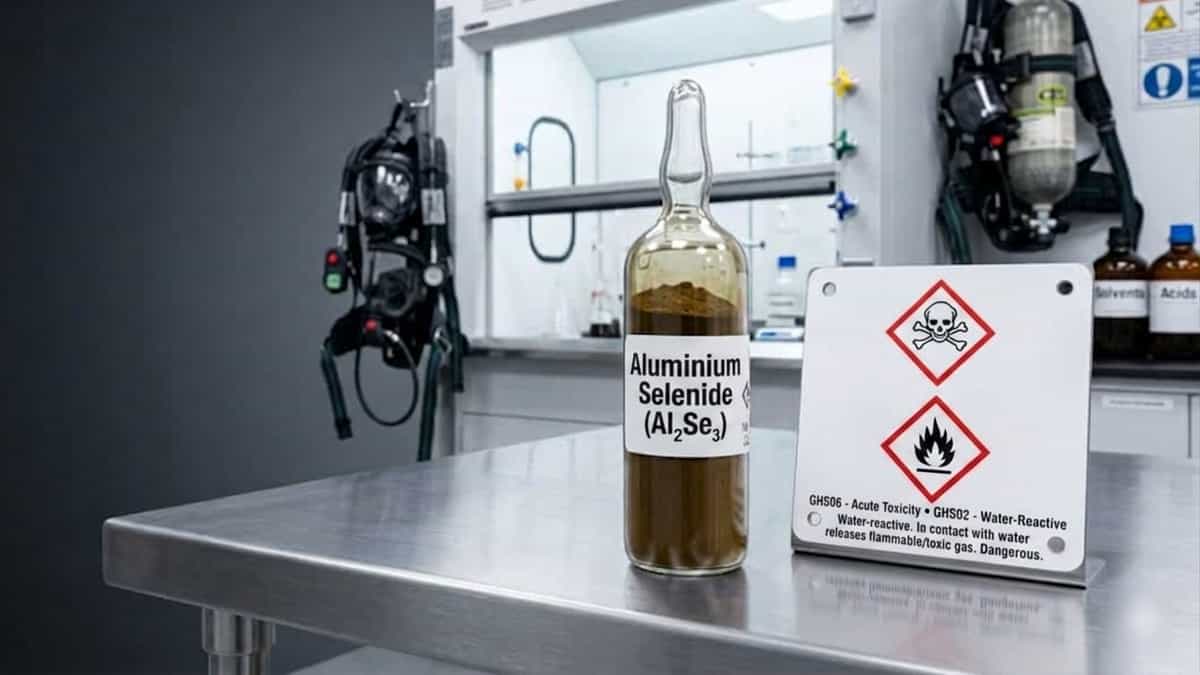
Aluminium selenide is a binary compound of aluminium and selenium. It is a highly reactive, moisture‑sensitive material that decomposes violently in water to release hydrogen selenide (H₂Se) – an extremely toxic, foul‑smelling gas. Due to its instability and toxicity, it is not a consumer product but is used in specialized laboratory and semiconductor applications as a source of selenium or H₂Se.
1. Basic Identification
- Chemical Formula: Al₂Se₃
- Alternative Names: Aluminium(III) selenide, dialuminum triselenide
- Molecular Weight: 290.84 g/mol
- CAS Number: 1302-82-5
- Appearance: Yellowish‑brown to dark brown/black powder or brittle, rock‑like fragments
2. Physical Properties
| Property | Aluminum Selenide |
|---|---|
| Melting Point | 960 °C (1760 °F) (under inert atmosphere) |
| Density | 3.43 g/cm³ |
| Crystal Structure | Defect zincblende (or wurtzite variations) |
| Solubility | Reacts violently with water; insoluble in organic solvents |
Aluminum selenide is a heavy, brittle solid. In dry, inert conditions, it is stable. However, exposure to even trace moisture triggers rapid decomposition.
3. Chemical Behavior & Synthesis
3.1 Reaction with Water – Hydrogen Selenide Generation
This is the defining chemical reaction of Al₂Se₃:
Al₂Se₃ + 6 H₂O → 2 Al(OH)₃ + 3 H₂Se ↑
Observations:
- The solid fizzes, warms, and releases hydrogen selenide (H₂Se) gas.
- H₂Se is extremely toxic (comparable to hydrogen cyanide), has a characteristic rotten‑egg/garlic‑like odor at low concentrations, and at higher concentrations can cause rapid respiratory failure.
- The gas is also flammable and can form explosive mixtures with air.
3.2 Synthesis
Prepared by direct combination of the elements under high heat in an inert, moisture‑free atmosphere:
2 Al + 3 Se + Heat → Al₂Se₃
The reaction is exothermic and must be controlled. It is typically performed in sealed quartz ampoules or under flowing argon.
4. Applications
Aluminum selenide has no consumer or large‑scale industrial applications due to its extreme moisture sensitivity and toxicity. Its uses are limited to specialized research:
4.1 Hydrogen Selenide Generator
In the laboratory, Al₂Se₃ can be used to generate small, controlled amounts of H₂Se by the slow addition of water. H₂Se is used in:
- Semiconductor doping – introducing selenium into II‑VI or III‑V materials
- Synthesis of other selenium compounds
4.2 Selenium Source for Materials Science
Researchers use Al₂Se₃ as a precursor to incorporate selenium into thin films or nanoparticles under vacuum conditions.
Note: Most modern semiconductor processes use safer selenium precursors (e.g., H₂Se gas cylinders with strict controls) rather than handling Al₂Se₃ directly.
5. Safety & Hazard Management
| GHS Symbol | Meaning |
|---|---|
| ☠️ GHS06 | Acute toxicity (fatal if inhaled) |
| 🔥 GHS02 | Flammable gas (H₂Se) |
| ❗ GHS05 | Corrosive (H₂Se) |
Critical Warning: Aluminum selenide itself is hazardous, but the real danger is the hydrogen selenide gas it releases upon contact with water or humid air. H₂Se is fatal if inhaled – it causes pulmonary edema and systemic poisoning.
5.1 Health Effects
| Route of Exposure | Effect |
|---|---|
| Inhalation (H₂Se gas) | Pulmonary edema, chemical pneumonia, headache, dizziness, nausea. High concentrations cause rapid collapse and death. |
| Skin Contact | Solid may cause mild irritation. H₂Se gas is corrosive to moist skin. |
| Eye Contact | Solid dust is abrasive; H₂Se gas causes severe irritation and burns. |
| Ingestion | Highly toxic – decomposes in stomach to release H₂Se gas internally. |
5.2 Personal Protective Equipment (PPE)
- Respiratory: SCBA (Self‑Contained Breathing Apparatus) – mandatory if there is any risk of moisture contact. N95 masks do NOT protect against H₂Se gas.
- Hands: Heavy nitrile or butyl rubber gloves
- Eyes: Tight‑sealing chemical splash goggles + face shield
- Body: Fully encapsulating chemical‑resistant suit
5.3 First Aid Measures
- Inhalation: Remove victim to fresh air immediately. Administer oxygen if available. Do not perform mouth‑to‑mouth (risk to rescuer). Seek emergency medical attention.
- Skin: Brush off dry chemical, then wash with copious water.
- Eyes: Flush with water for 15+ minutes; seek ophthalmologist.
- Ingestion: Do not induce vomiting. Seek immediate medical help.
5.4 Firefighting Information
- H₂Se gas is flammable and can explode in confined spaces.
- Use: Dry sand, Class D powder, or CO₂ for small fires. For large fires, evacuate area.
- Do NOT use: Water – this will generate more H₂Se gas.
6. Storage & Handling
- Container: Sealed glass ampoules or metal containers under inert gas (argon or nitrogen)
- Atmosphere: Strictly dry, inert – never open in humid air
- Location: Cool, dry, well‑ventilated, locked hazardous materials storage
- Incompatibles: Water, moisture, acids, oxidizing agents
6.1 Disposal
Do not discard in trash or down drains. Small quantities can be slowly hydrolyzed in a fume hood by carefully adding to a large excess of dilute sodium hydroxide solution (to trap H₂Se as sodium selenide), then treated with an oxidizer (e.g., bleach) to convert to non‑volatile selenite/selenate. This must be done by trained professionals.
7. Environmental Impact
Hydrogen selenide is highly toxic to aquatic life. Aluminum selenide itself, if released into the environment, will rapidly hydrolyze to H₂Se gas (which disperses or oxidizes to elemental selenium) and aluminum hydroxide (inert). Selenium can bioaccumulate but is also an essential trace element at low concentrations. Large spills require hazmat response.
8. Comparison with Other Reactive Aluminum Compounds
| Compound | Formula | Gas Released in Water | Toxicity of Gas |
|---|---|---|---|
| Aluminium Selenide | Al₂Se₃ | Hydrogen selenide (H₂Se) | Extremely toxic (fatal) |
| Aluminium Sulfide | Al₂S₃ | Hydrogen sulfide (H₂S) | Highly toxic |
| Aluminium Carbide | Al₄C₃ | Methane (CH₄) | Flammable, low toxicity |
| Aluminium Phosphide | AlP | Phosphine (PH₃) | Extremely toxic |
9. Frequently Asked Questions
Q: Does aluminum selenide smell like garlic?
A: The solid itself has a faint, unpleasant odor, but the real smell comes from hydrogen selenide gas (released upon contact with moisture), which at low concentrations smells like rotten eggs or garlic. At high concentrations, it can paralyze the sense of smell – making it even more dangerous.
Q: Is this used in consumer products?
A: Absolutely not. It is a specialist laboratory chemical, restricted to trained researchers. It has no household, medical, or agricultural use.
Q: What should I do if I suspect a spill?
A: Evacuate the area immediately, ventilate if possible, and call professional hazmat responders. Do not attempt to clean up without proper training and equipment (SCBA, full suit).
10. Summary Data Sheet
| Property | Value |
|---|---|
| Chemical Name | Aluminum Selenide |
| Formula | Al₂Se₃ |
| Appearance | Yellowish‑brown to dark brown powder/chunks |
| Melting Point | 960 °C |
| Density | 3.43 g/cm³ |
| Defining Trait | Releases lethal H₂Se gas on contact with water |
| Primary Utility | Laboratory source of H₂Se or selenium |
| Storage | Sealed, dry, inert atmosphere; strict hazard protocols |
Related Articles

Featured


You May Also Like

Beat the Heat: Premium vs. Budget Aluminum Window Options fo…

Aluminium Sliding Windows for QLD’s Heat & Humidity: Sta…

Solar BIPV Systems: Why Aluminium Is the Backbone of the Gre…

Best Storm Doors for Harsh Winters: Heavy-Duty Options for W…

Thinking of Installing Aluminium Sliding Windows? Check Thes…