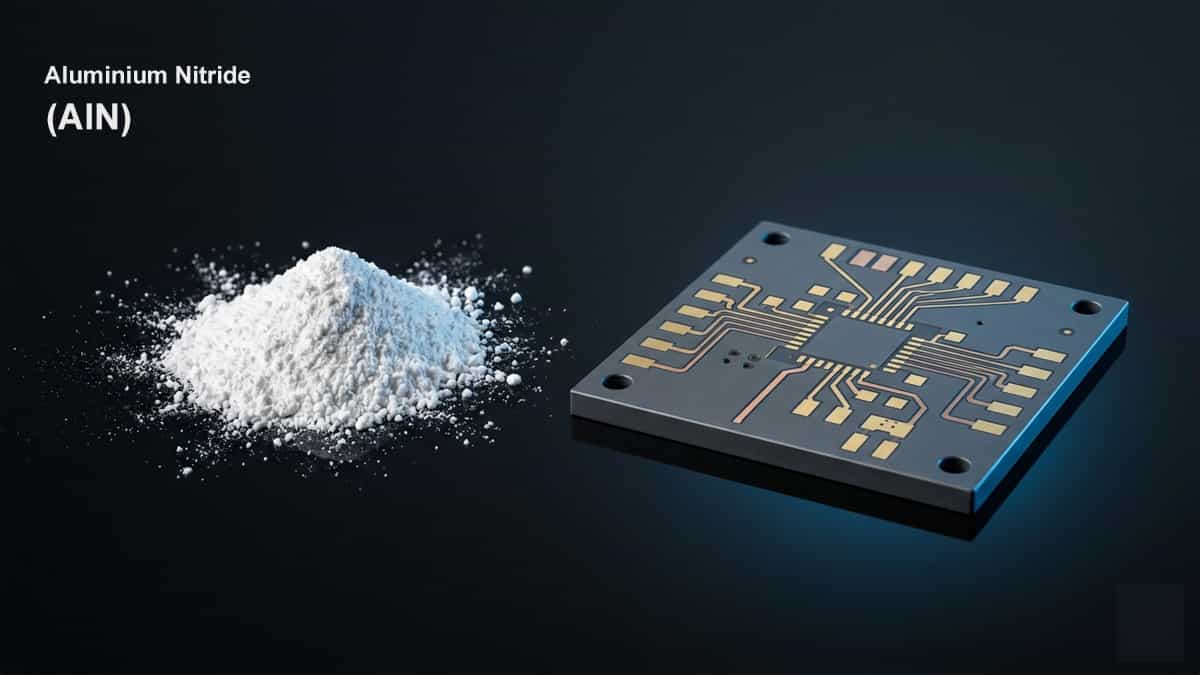
Aluminium nitride is a highly advanced technical ceramic distinct from typical aluminium halide salts. It appears as a white or pale yellow powder in its raw form and is engineered for its remarkable ability to conduct heat extremely well while acting as an effective electrical insulator. This rare combination makes it a cornerstone in optoelectronics, semiconductor manufacturing, and high‑performance LED technology.
1. Basic Identification
- Chemical Formula: AlN
- Alternative Names: Aluminium nitride
- Molecular Weight: 40.99 g/mol
- CAS Number: 24304-00-5
- Appearance: White to pale yellow powder; sintered parts are gray or off‑white
2. Physical Properties
| Property | Aluminium Nitride |
|---|---|
| Melting Point | ~2200 °C (3992 °F) under N₂ pressure |
| Boiling Point | Sublimes/decomposes ~2000 °C at normal pressure |
| Density | 3.26 g/cm³ |
| Thermal Conductivity | 140 – 320 W/m·K (purity dependent) |
| Electrical Resistance | >10¹³ Ohm·cm (excellent insulator) |
| Solubility | Insoluble in water; slowly hydrolyzes in moist air |
AlN is a covalently bonded material. As a powder, it is fine and slightly moisture‑sensitive. Sintered components are hard, heat‑resistant ceramics.
3. Chemical Behavior & Synthesis
3.1 Slow Hydrolysis
Fine AlN powder slowly degrades in high humidity:
AlN + 3 H₂O → Al(OH)₃ + NH₃ ↑
This is a slow, non‑violent reaction that releases ammonia gas (detectable by its sharp smell in humid storage).
3.2 Synthesis – Carbothermal Reduction
Al₂O₃ + 3 C + N₂ → 2 AlN + 3 CO
Alumina is heated with carbon in pure nitrogen at >1600 °C. Alternatively, pure aluminum powder can be directly nitrided at high temperatures.
3.3 Reaction with Alkalis
AlN is attacked by hot concentrated alkaline solutions, completely dissolving and releasing ammonia.
4. Industrial Applications
4.1 High‑Power Microelectronics
AlN ceramic substrates pull heat away from silicon chips faster than most metals while remaining electrically insulating – essential for:
- High‑power LED arrays
- Electric vehicle motor controllers
- Military and aerospace radar systems
4.2 Deep‑UV LEDs
With a wide bandgap (6.01 eV), AlN alloys with gallium nitride (AlGaN) to produce deep ultraviolet LEDs for water sterilization and biomedical sanitization.
4.3 Telecommunications (RF Filters)
AlN is piezoelectric, used in surface acoustic wave (SAW) sensors and RF filters in mobile phones.
5. Safety & Hazard Management
| GHS Symbol | Meaning |
|---|---|
| ❗ GHS07 | Irritant |
Critical Warning: Sintered solid pieces are harmless unless cut (dust hazard). Raw powder is irritating and releases ammonia when wet.
5.1 Health Effects
| Route of Exposure | Effect |
|---|---|
| Inhalation | Powder causes throat/lung irritation; ammonia from hydrolysis damages respiratory tract. |
| Skin Contact | Slightly irritating; ammonia may cause redness if trapped against sweat. |
| Eye Contact | Mechanical irritation, redness, pain. |
| Ingestion | Possible digestive distress; less toxic than aluminum halides. |
5.2 PPE
- Respiratory: N95 or P100 for powder or machining
- Hands: Standard lab gloves
- Eyes: Safety glasses with side shields
- Body: Lab coat
5.3 First Aid
- Skin: Wash with soap and water
- Eyes: Flush 15 minutes; ensure no abrasive particles remain
- Inhalation: Move to fresh air if ammonia fumes cause distress
6. Storage & Handling
- Container: Sealed, moisture‑proof
- Atmosphere: Dry storage critical
- Location: Cool, dry shelf
- Incompatibles: Strong acids, strong bases, water/humidity
6.1 Disposal
- Solid ceramic waste → standard industrial waste
- Bulk powder → slow hydrolysis outdoors (vent ammonia), then discard inert Al(OH)₃ sludge
7. Environmental Impact
AlN slowly hydrolyzes to aluminum hydroxide (common soil component) and ammonia (disperses or acts as nitrogen source). No significant bioaccumulation or water toxicity.
8. Comparison with Other Aluminium Compounds
| Compound | Formula | Primary Nature | Primary Use |
|---|---|---|---|
| Aluminium Oxide | Al₂O₃ | Ceramic / abrasive | Smelting ore, sandpaper, generic insulators |
| Aluminium Nitride | AlN | Advanced ceramic | Thermal management, RF filters, LEDs |
| Aluminium Chloride | AlCl₃ | Reactive acid catalyst | Plastics, petrochemical refining |
| Aluminium Phosphide | AlP | Reactive solid | Agricultural fumigant |
9. Frequently Asked Questions
Q: Why use AlN instead of cheaper aluminium oxide (alumina) for electronics?
A: AlN conducts heat nearly ten times better than alumina, preventing chips from overheating while remaining electrically insulating.
Q: Is aluminium nitride the same as aluminium metal?
A: No. Aluminium metal is silvery and conductive. AlN is a ceramic compound that looks and behaves like crushed stone or a ceramic dish.
Q: Can I smell it?
A: Dry AlN is odorless. But if powder is left open, it reacts with humidity to produce ammonia, giving a sharp “window cleaner” smell.
10. Summary Data Sheet
| Property | Value |
|---|---|
| Chemical Name | Aluminium Nitride |
| Formula | AlN |
| Appearance | White/yellow powder or gray ceramic |
| Density | 3.26 g/cm³ |
| Key Attribute | High thermal conductivity + electrical insulation |
| Primary Hazard | Dust inhalation; ammonia release when wet |
| Storage | Dry, sealed environment |
Related Articles

Featured


You May Also Like
Aluminium 5454 (Aluminum 5454): The Elevated Marine Alloy fo…

Aluminium-Clad Wood Thermal-Break Systems, Before Buying Tip…
What Is a Thermal Break Strip in Aluminum Windows?

Aluminum Summit Grapples with Supply, Sanctions, and Sustain…
The Dirty Truth Behind Early Beverage Cans (And Why Aluminiu…