
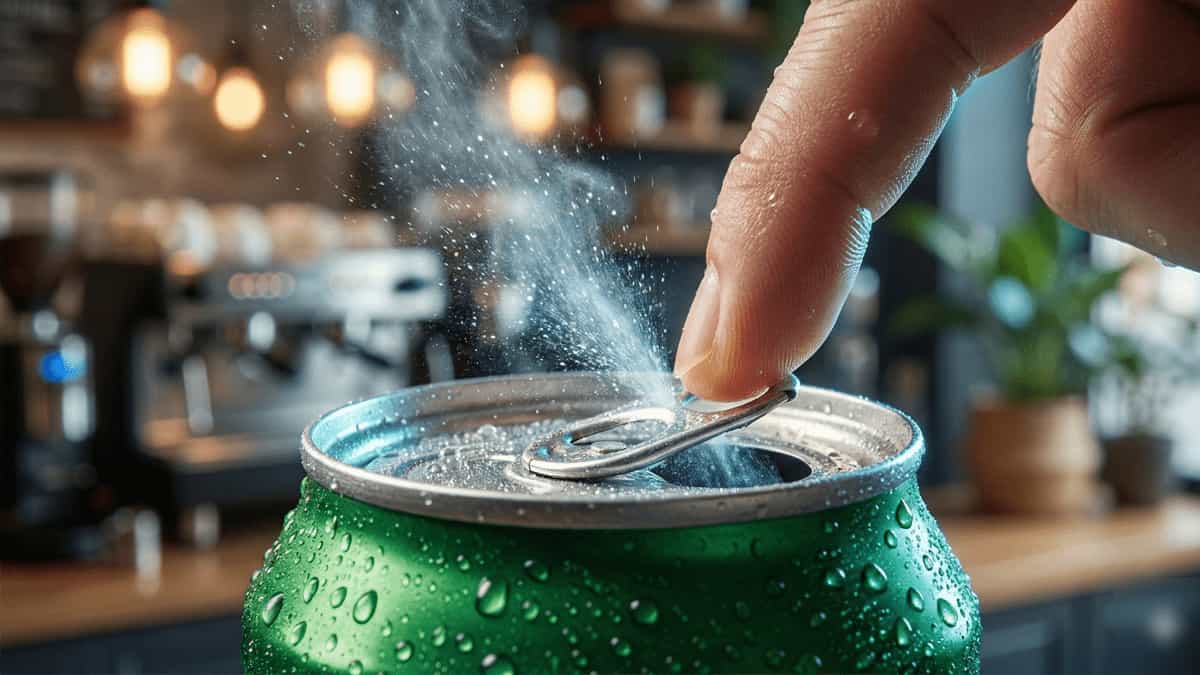
That crisp, fizzy “pssst” when you open a soda or beer can isn’t just satisfying—it’s a miniature physics and engineering lesson. Here’s the high-stakes science happening in your hand.
The Pressure Cooker in Your Palm
Every unopened beverage can is a sealed pressure vessel. Carbonated drinks contain dissolved CO₂, which exists in equilibrium between the liquid and the headspace (the small area above the drink). When sealed, pressure inside builds—typically to 2–3 times atmospheric pressure (roughly 30–50 PSI).
The iconic “pssst” isn’t just air escaping; it is the sound of Adiabatic Expansion. As the high-pressure gas rushes out to equalize with the outside air in a millisecond, it cools rapidly, often creating a tiny mist. It’s a controlled explosion, engineered to happen safely in your hand.
The Genius of the Dome-Bottom
Look at the bottom of any aluminium can: it’s concave, like a shallow dome. This isn’t a design quirk; it’s a critical structural necessity.
Think of it like a Roman Arch. If the bottom were flat, the 90 PSI of internal pressure would make it bulge outward, turning the can into a sphere that couldn’t stand up. The dome shape directs the internal force outward toward the thickest part of the can (the rim), allowing a paper-thin aluminium sheet to hold immense pressure without buckling. It is a masterclass in “Geometry over Mass.”
Why This Matters: Without this dome, cans would need to be made of much thicker, heavier metal to stop the bottom from popping out. The dome allows the can to remain lightweight and sustainable.
The Trigger: The “Score Line” Mechanism
The sound doesn’t just happen; it is triggered by a precision mechanism on the lid. The Stay-On Tab is a Class 2 Lever. When you lift it, it drives the nose of the tab down into the Score Line—a perimeter where the aluminium has been thinned to exactly ~0.004 inches.
The “Pop” is the sound of that metal shearing (breaking) instantaneously, followed by the “Hiss” of the gas escaping. If the score line were a few microns too thick, the tab would bend. Too thin, and the can would explode in transit.
Safety by Design: The Buckle Test
Before any can design hits the market, it undergoes rigorous safety testing. Engineers perform “buckle tests” to ensure the dome bottom can withstand pressures far higher than your drink will ever reach (often up to 90 PSI). The goal? Ensure the can fails safely (by the dome popping out) rather than the sidewall exploding (shrapnel).
The Perfect “Pssst“: A Sign of Quality
That sound is an auditory quality check. A strong, crisp “pssst” indicates:
- Good carbonation: The drink is fresh and fizzy.
- Intact seal: The can hasn’t been compromised.
- Correct pressure: The contents have been stored properly.
A weak or absent “pssst” can signal flatness, a slow leak, or temperature abuse. Your ears are conducting a tiny, instant quality assurance test.
💡 Fun Facts: The Evolution of the Can
- The “Church Key” Era: Before 1963, cans had flat tops. You needed a pointed tool called a “church key” to punch two holes—one for drinking, one for airflow.
- The “Blood” Tab: The first pull-tabs (1960s) came completely off the can. People threw them on the ground, cutting feet at beaches. This litter problem led to the invention of the modern Stay-On Tab in 1975.
- The Cold Factor: Aluminium chills a drink significantly faster than glass or plastic because metal has higher thermal conductivity. It’s the fastest way to get a cold drink on a hot day.
- The Stack Hack: That dome bottom isn’t just for pressure—it also fits perfectly over the tab of the can below it, allowing cans to stack securely in transport.
In essence, that humble “pssst” is the triumphant shout of precision engineering, materials science, and safety design—all contained within a fraction of a second and a few grams of aluminium.
-Ads-
Dive Deeper into Aluminium Innovation:
Want to understand more about the material and engineering behind everyday wonders? Explore these related reads:
- The Aluminium Can: A Journey from Concept to Everyday Marvel – Trace the evolution of the iconic container.
- Advanced Metal Forming: How Aluminium Gets Its Shape – Explore the processes that create complex shapes like the dome-bottom.
- Material Science: Why Aluminium Reigns Supreme in Packaging – Understand the unique properties of this versatile metal.
- Sustainability in a Seam: The Environmental Story of the Aluminium Can – Discover how this design champions recycling.
Related Articles



Featured


You May Also Like

How to Choose the Best Used Aluminum Fishing Boats

Why Cheap Telescopic Ladders Feel Unsafe

Energy Efficient Thermal-Break Aluminium Windows: The Ultima…

From ‘My Coke Can Went to Space’ to 5-Cent Deposits — The Tr…

Why Most Modern Bicycles Use Aluminum Frames
