
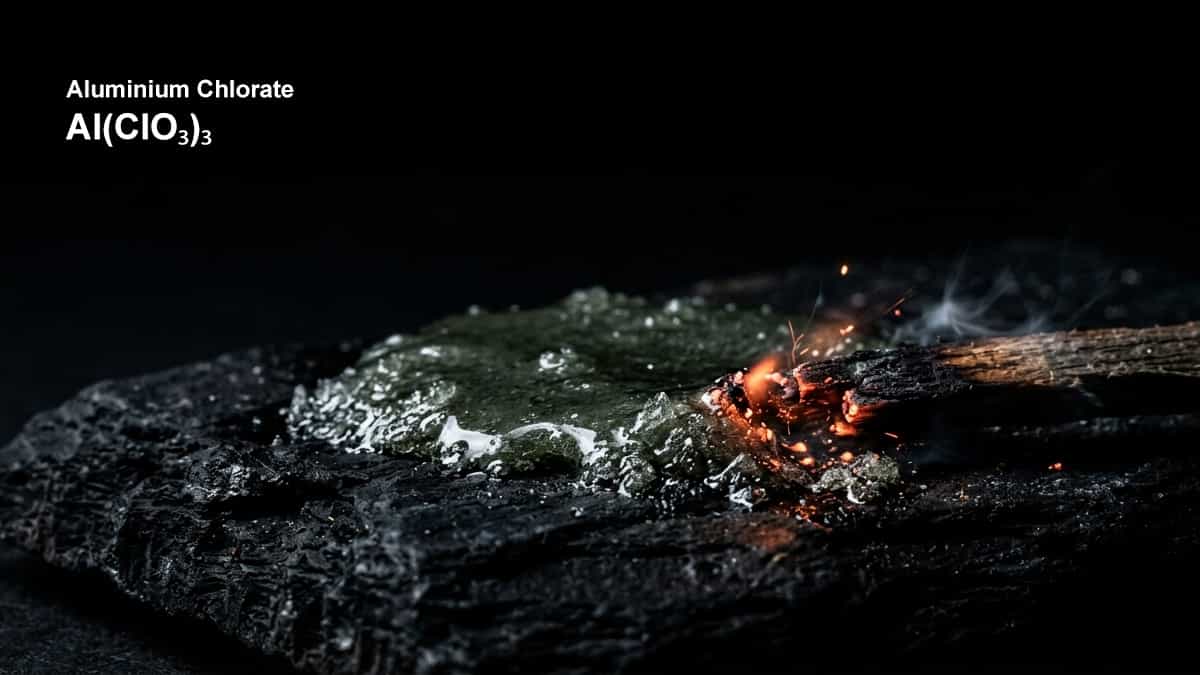
Aluminium chlorate is a highly obscure, unstable, and intensely powerful oxidizing agent. Combining the aluminium cation with three volatile, oxygen‑rich chlorate anions produces a compound that is simply too dangerous to store or transport easily. It typically appears as heavily hydrated, deliquescent crystals, and its only uses are tightly constrained within specialized explosives research and high‑risk energetic pyrotechnics.
1. Basic Identification
Chemical Formula: Al(ClO₃)₃ (usually hydrated as Al(ClO₃)₃·6H₂O or 9H₂O)
Alternative Names: Aluminium chlorate.
Molecular Weight: 277.34 g/mol (anhydrous).
CAS Number: 15477-33-5.
Appearance: Unstable, colorless to pale yellow, highly deliquescent crystals.
2. Physical Properties
Aluminium chlorate practically refuses to exist in a dry, stable state. The internal energy trapped inside the chlorate groups dictates its erratic physical behavior.
2.1 Key Data Table
| Property | Aluminum Chlorate |
|---|---|
| Melting Point | Unknown / Variable. Explosively decomposes upon heating before establishing a true melt phase. |
| Density | Variable based on hydration state. |
| Stability | Exceptionally poor. Breaks down under friction, heat, or organic contamination. |
| Solubility | Intensely soluble in water. |
2.2 Physical Description
In a laboratory, it appears as damp, slushy, ice‑like crystals. The material is intensely deliquescent. If left exposed, it draws humidity from the air until it dissolves into a highly concentrated, oxygen‑rich liquid puddle. Pure anhydrous aluminum chlorate cannot be effectively isolated because attempting to remove the water of hydration risks detonation.
3. Chemical Behavior and Reactions
The defining trait of aluminium chlorate is its ability to release large amounts of oxygen when mechanically shocked or heated, vigorously supporting combustion.
3.1 High‑Energy Oxidation / Fire Hazard
Chlorates are powerful oxidizers, and pairing them with aluminium creates significant instability.
Observation: If a droplet of concentrated aluminium chlorate solution contacts wood, paper, or cotton, it supplies oxygen to the organic material. With minimal friction or heat, this can ignite a hot, intense flame.
3.2 Synthesis (How It Is Made)
Because it cannot withstand heating or evaporation, it is produced in solution through double decomposition.
Al₂(SO₄)₃ + 3Ba(ClO₃)₂ → 2Al(ClO₃)₃ + 3BaSO₄ ↓
Process: Aluminum sulfate reacts with barium chlorate in chilled water. Barium sulfate precipitates as an insoluble white solid, leaving a clear solution of aluminum chlorate. Attempting to boil this solution to obtain dry crystals is extremely dangerous.
4. Industrial and Laboratory Applications
No major industry manufactures or buys pure aluminium chlorate in bulk. Potassium chlorate and sodium chlorate accomplish similar oxidizing tasks with much lower risk.
4.1 Experimental Energetics and Pyrotechnics
In specialized pyrotechnic research, liquid aluminium chlorate solutions are used to create fast‑burning, oxygen‑rich mixtures. The aluminum provides fuel, while the chlorate provides oxygen.
4.2 Historical Astringent (Discontinued)
Briefly, nearly a century ago, very dilute solutions were tested as astringent nasal drops and mouthwashes. The oxidizing effect acted as an antiseptic. This application was abandoned due to toxicity and the fire hazard when residues dried on shelves.
5. Safety and Hazard Management
💥
GHS01
Explosive
🔥
GHS03
Oxidizer
Critical Warning: Aluminium chlorate is both an explosive compound under friction and a powerful oxidizer. Dropping a dried crust or rubbing it against a carbon‑based surface can initiate a violent reaction.
5.1 Health Effects
| Route of Exposure | Effect |
|---|---|
| Inhalation | Vapors from decomposing solution cause severe respiratory irritation and burns. |
| Skin Contact | Astringent. Liquid penetrates skin and causes prolonged irritation. Can ignite if allowed to dry on clothing. |
| Eye Contact | Severe eye damage. Extreme burning. |
| Ingestion | Highly toxic. Chlorates bind to hemoglobin, preventing oxygen transport, leading to kidney failure and asphyxiation. |
5.2 Personal Protective Equipment (PPE)
- Respiratory: SCBA required for large spills or decomposition scenarios.
- Hands: Thick synthetic nitrile gloves. Never use cotton or leather gloves – they can ignite if contaminated.
- Eyes: Heavy face shield over chemical goggles.
- Body: Fire‑resistant, non‑organic lab apron.
5.3 Firefighting Information
- Suitable Extinguishers: Large quantities of water (to cool and dilute).
- DO NOT RELY ON: Fire blankets, dry powder, foam, or CO₂ alone – the compound provides its own oxygen. Water is the most effective method.
6. Storage and Handling Guidelines
6.1 Storage Conditions
- Container: Heavy glass. Keep bottle threads clean – dried residue in threads can react when the cap is twisted.
- Atmosphere: Keep chilled and securely locked.
- Location: Purpose‑built explosive/oxidizer magazine (metal or concrete).
- Incompatibles: All organic materials: wood, paper, skin, oils, greases, sulfur, phosphorus, powdered metals.
6.2 Disposal Considerations
- Dilute heavily in a large volume of water.
- Treat with a mild reducing agent (e.g., sodium bisulfite) in a fume hood.
- This reduces chlorate to harmless chloride ions, which can be safely flushed.
7. Environmental Impact
Spills are dangerous. If solution is poured onto soil, water evaporates, leaving dry crystals mixed with vegetation. Sunlight or physical disturbance can then ignite the material, creating a fire hazard. High concentrations are toxic to aquatic life.
8. Comparison with Other Reactive Aluminum Compounds
| Compound | Formula | Primary Nature | Primary Threat |
|---|---|---|---|
| Aluminium Chlorate | Al(ClO₃)₃ | Energetic Oxidizer | Spontaneous ignition risk; aggressively feeds fires. |
| Aluminium Nitrate | Al(NO₃)₃ | Strong Oxidizer | Feeds fires but less sensitive to shock. |
| Aluminium Phosphide | AlP | Toxic Gas Releaser | Releases lethal phosphine gas. |
9. Frequently Asked Questions
Q: Why use potassium chlorate in fireworks instead of aluminium chlorate?
A: Potassium and sodium chlorates are stabilized by their cations. They sit calmly until intentionally ignited. Aluminium chlorate is too sensitive – even pouring it could trigger a reaction.
Q: Can I use this to clean my pool?
A: Absolutely not. Pool shock uses calcium hypochlorite. Aluminium chlorate would create a fire hazard and poison the water.
Q: What happens if it dries on my cotton jeans?
A: The concentrated solution soaks into the fibers. When dry, the residue can ignite from the friction of movement, causing a dangerous fire.
10. Summary Data Sheet
| Chemical Name | Aluminum Chlorate |
|---|---|
| Formula | Al(ClO₃)₃ |
| Appearance | Damp, slushy, ice‑like crystals |
| Thermal Stability | Erratic; decomposes explosively on heating |
| Defining Hazard | Violent oxidizer; reacts with organics |
| Primary Utility | Restricted to energetic pyrotechnics research |
| Extinguishing | Large volumes of water only |
Related Articles

Featured

You May Also Like

Why Aluminium is the Optimal Choice for Roofing Sheets

Anodized Aluminum Bolts: Strength, Durability, and Applicati…

Why Advertise on Aluminium Magazine?

Why the Aluminum Industry is Essential for Modern Infrastruc…

Perfluorooctanoic Acid – PFOA-free
