Aluminum capacitors dominate power electronics by offering unmatched capacitance density and cost-performance, thanks to a unique self-forming oxide layer that other materials can’t replicate.
- Core Principle: A nanometer-thin aluminum oxide (Al₂O₃) layer serves as the dielectric, enabling extremely high capacitance in a remarkably small volume.
- Market Dominance: A global market valued at over USD 5 billion, driven by surging demand in EVs, renewable energy, and consumer electronics.
- Key Weakness: Traditional liquid types are susceptible to electrolyte dry-out, a challenge that next-gen Solid Polymer and Hybrid designs are solving.
Why the Humble Capacitor Deserves More Respect
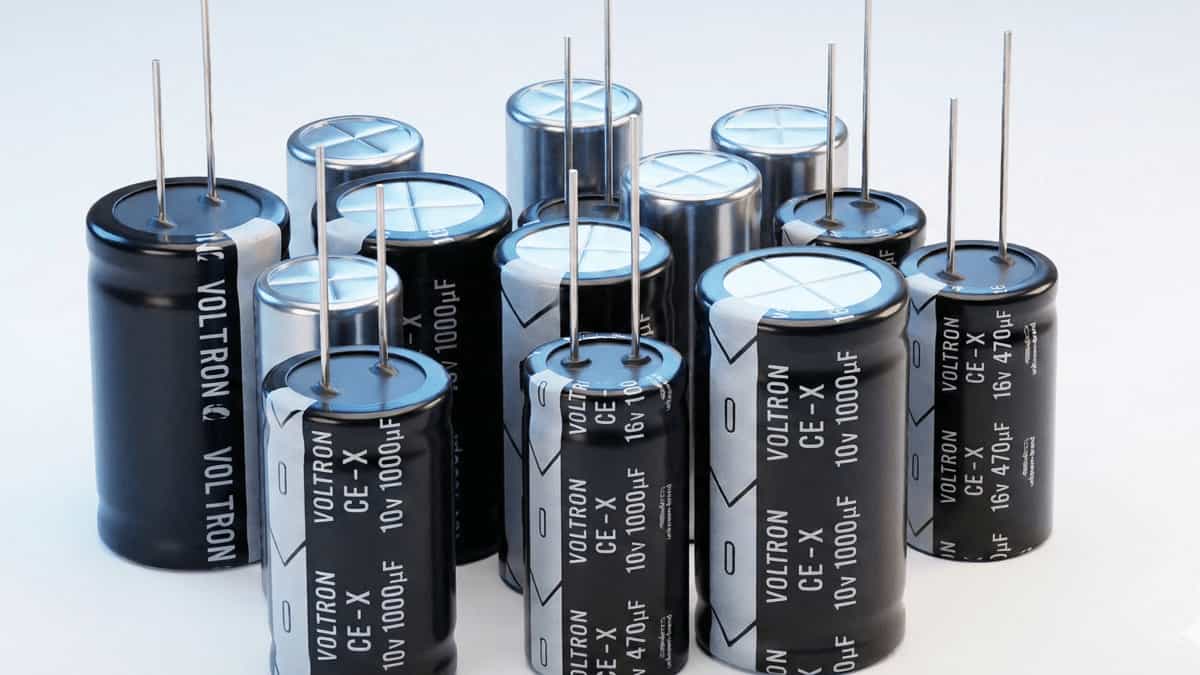
Look inside a UPS (Uninterruptible Power Supply), a computer power supply (SMPS), an EV inverter, a solar micro-inverter, or the industrial motor drive powering a factory floor, and you’ll find it: the iconic aluminum “can” capacitor. They might look like simple components, but they are the silent, high-capacity reservoirs that smooth out power, filter noise, and store energy in virtually every electronic device we depend on.
The reason they are ubiquitous—from gaming motherboards to industrial motor drives—isn’t an accident. It’s the result of unique physical and engineering advantages that plastic film, ceramic, or tantalum capacitors simply cannot match. To understand why this metal is so fundamental to electronics, we first need to look at what aluminum is and how it is made, laying the groundwork for its role in high-performance energy storage.
Where Aluminum Sits in the World of Capacitors (Quick Overview)
The capacitor family is diverse, with each member suited for specific tasks:
- Ceramic Capacitors (MLCC): Excellent for high-frequency decoupling but suffer from capacitance loss under voltage (DC bias) and can be acoustically noisy (“singing” capacitors).
- Film Capacitors: Robust and self-healing, but their lower dielectric constant makes them too bulky for high-capacitance needs.
- Tantalum Capacitors: Offer good volumetric efficiency but are costly, have supply chain concerns (conflict minerals), and carry a risk of thermal runaway failure.
- Aluminum Electrolytic Capacitors: They own the high-capacitance, high-ripple-current zone. They are the go-to solution for energy storage and smoothing in power supplies, balancing performance, size, and cost like no other.
The Physics Superpower: Aluminum’s Self-Forming Oxide Layer
This is the technical heart of its dominance. Aluminum is a “valve metal.” When an electrochemical process forms it as an anode, it naturally grows an insulating oxide layer on its surface.
- The Ultimate Thin Dielectric: This oxide layer is the capacitor’s dielectric. Engineers can form it to be incredibly thin—just nanometers thick. Since capacitance is inversely proportional to dielectric thickness, this ultra-thin layer is the secret to achieving massive capacitance values. For a deeper dive into the chemistry involved, it is worth understanding the differences between aluminum hydroxide and aluminum oxide, as the stability of this oxide layer is critical for performance.
- The Plastic Film Limitation: In contrast, plastic film capacitors use a pre-manufactured dielectric sheet (like polypropylene). It’s impossible to make these sheets as thin and defect-free as a naturally grown oxide layer, limiting their maximum capacitance density.
This self-forming, ultra-thin dielectric is the fundamental “mic-drop” reason aluminum reigns supreme for high-capacitance tasks.
Engineering Reason #1: High Capacitance in a Small Package
The physics translates directly into compact engineering. The etched aluminum foil provides a massive surface area. This foil—conceptually similar to widely used aluminum foil but processed for high purity and surface roughness—is rolled into a cylinder with the nanometer-thin oxide layer acting as the dielectric3. The result is tens to thousands of microfarads of capacitance fitting into a compact cylindrical package.
This miniaturization is non-negotiable. An audio amplifier needs large capacitors to deliver stable bass notes; a server’s power supply needs them to buffer energy for peak CPU demands. Using film capacitors for these same tasks could take up 10 to 100 times more space, which is simply impractical in modern electronics.
Engineering Reason #2: Excellent Heat Tolerance & Dissipation
Aluminum is a fantastic conductor of heat. The metal casing of a radial or snap-in capacitor acts as an integrated mini heat sink, helping to dissipate the internal heat generated by ripple current.
This is critical for reliability. The lifetime of an aluminum electrolytic capacitor is famously governed by the “10°C rule”—for every 10°C increase in core temperature, its operational life is roughly halved. The aluminum body helps manage this thermal stress, a passive benefit that aligns with why aluminum is used in electrical cables and other high-current applications: it handles energy and heat efficiently4.
Engineering Reason #3: The Cost–Performance Sweet Spot
When balancing performance, size, and cost, aluminum is unbeatable.
- Vs. Tantalum: Tantalum offers similar volumetric efficiency but at a significantly higher raw material cost and with greater supply chain volatility.
- Vs. Film: For the same capacitance and voltage, a film capacitor can be 20 times larger and more expensive.
- Scalability: Aluminum is abundant, and the manufacturing process is highly refined, allowing for mass production at low cost. This scalability is why the US market continues to rely on them for everything from consumer tech to automotive applications.
Engineering Reason #4: Self-Healing Behavior Under Stress
While not as robust as the self-healing of film capacitors, aluminum electrolytics have a form of damage control. Minor imperfections in the oxide layer can be “re-formed” during operation. The electrolyte allows for a small leakage current that can help repair localized weak spots in the Al₂O₃ dielectric. This inherent forgiveness contributes to a longer operational life in the variable, stressful environment of power electronics.
Where Alternative Materials Fail (A Quick Comparison)
| Material/Type | Key Advantage | Critical Limitation for Power Applications |
| Plastic Film | Excellent self-healing, robust | Low capacitance density; bulky for high-C applications. |
| Copper | High conductivity | No useful oxide dielectric; cannot form a capacitor anode. |
| Tantalum | High density, stable | Costly, supply issues, risk of explosive failure (thermal runaway). |
| Ceramic (MLCC) | Small, high-frequency | Capacitance drops under bias; brittle and prone to micro-cracking. |
| Aluminum | High-C, compact, cost-effective | Limited lifetime at high temps (traditional liquid type). |
Real-World Applications: Aluminum Capacitors in Every Device You Touch
This is where theory meets the road. You’ll find aluminum capacitors as the energy backbone in:
- Power Conversion: SMPS, AC/DC adapters, DC/DC converters (>500W), inverters (solar, EV), UPS buffering.
- Consumer & Industrial: Motherboard VRMs, high-end audio amplifiers, lighting ballasts, motor drives, Power Factor Correction (PFC) circuits.
- Next-Generation Tech: As the auto industry shifts gears, these capacitors are playing a key role in the electric vehicle revolution, powering EV chargers, Battery Management Systems (BMS), and renewable energy inverters5.
Why Aluminum Capacitors Fail (and What It Teaches You)
Nothing lasts forever, and understanding failure teaches good design. The primary enemy of traditional aluminum electrolytics is heat, which accelerates a process called “dry-out.”
- Electrolyte Dry-Out: High core temperature causes the liquid electrolyte to slowly evaporate or degrade chemically.
- Increased ESR (Equivalent Series Resistance): The capacitor becomes less effective at its job, wasting power as heat.
- Capacitance Drop & Ultimate Failure: Loss of electrolyte means loss of capacitance. The capacitor may bulge, its vent may rupture, or it may simply stop working (open circuit).
The Lesson: Derate your capacitors! Use a component with a voltage and temperature rating well above your application’s maximum. Ensuring good airflow and keeping capacitors away from other heat sources can multiply their operational lifespan.
Future Innovations: The Rise of Polymer and Hybrid Technologies
The future is about solving the traditional capacitor’s weaknesses while keeping its strengths. This has led to two major evolutions: Solid Polymer and Hybrid Aluminum capacitors.
Solid Polymer Aluminum Capacitors
Instead of a liquid electrolyte, these use a solid conductive polymer.
- Benefit: Massively lower ESR (higher ripple current) and no dry-out mechanism, leading to a dramatically longer lifespan.
The “Hybrid” Solution (The Best of Both Worlds)
Hybrid Aluminum Polymer Capacitors combine a liquid electrolyte and a solid polymer.
- Why it matters: You get the high reliability and low ESR of the polymer, plus the self-healing properties of the liquid electrolyte.
- Market Impact: These are becoming the new standard in demanding US automotive and industrial sectors, ensuring aluminum’s dominance continues into the era of AI servers and electric vehicles.
Final Wrap: Aluminum Isn’t Just a Metal — It’s the Backbone
From the physics of its self-forming oxide layer to the economics of mass production, the aluminum capacitor is a masterpiece of practical engineering. While alternatives have their niche, none compete with its winning combination of high capacitance density, effective heat dissipation, cost-effectiveness, and proven reliability.
As technology pushes toward higher efficiency and power density, the innovation continues with hybrid and solid polymer technology. The humble aluminum capacitor has been the backbone of the 20th-century electronics revolution and is now evolving to power the 21st-century transitions in energy, transportation, and computing. It’s a component that truly deserves our respect.
SEO Metadata
Meta Title: Why Aluminum Capacitors Dominate Electronics: Physics & Applications
Meta Description: Discover why aluminum capacitors are irreplaceable in power electronics. Explore the physics, advantages over plastic/ceramic, and the rise of Hybrid Aluminum technology in EVs and solar.
SEO URL Slug: aluminum-capacitors-dominate-electronics-guide
Related Articles

Featured



You May Also Like
Aluminum Arsenide (AlAs): The Complete Guide
Aluminium Molybdate (Al₂(MoO₄)₃): The Complete Guide
Aluminium 6005 & 6005A: The Extrusion-Focused Twin Alloy…

Why Aluminium Is Used in Telescopic Ladders
Why Aluminium Cans Are Only 0.1 mm Thick — Yet Strong Enough…