Aluminium (symbol Al, atomic number 13) might be hiding in your kitchen foil, your laptop casing, or the body of your car — but it’s far more important than most people realize.
It’s the most abundant metal in Earth’s crust and one of the most versatile materials in modern life — lightweight, corrosion-resistant, and endlessly recyclable.
In the periodic table, aluminium sits in the post-transition metal category, playing the role of the smart, agile lightweight among heavy industry metals.
Quick Reference Table – Aluminium Element
| Property | Details |
|---|---|
| Symbol | Al |
| Atomic Number | 13 |
| Atomic Mass | 26.98 u |
| Category | Post-transition metal |
| Density | 2.70 g/cm³ |
| Melting Point | 660.3 °C |
| Boiling Point | 2470 °C |
| Oxidation State | +3 |
| Abundance | ~8.1% of Earth’s crust |
💡 Fun Fact: The name comes from the Latin Alumen, meaning alum — a naturally occurring mineral salt.
For an interactive view of the full periodic table, check out this detailed periodic chart.
Is Aluminium an Element?
Yes. Aluminium is a pure chemical element, not a compound or mixture.
Its atoms all have 13 protons in their nuclei.
Naturally, it’s found in minerals like bauxite ore. Once refined, aluminium becomes strong, lightweight, and resistant to corrosion — reasons why it’s so heavily used across industries.
Aluminium Element Symbol
Its chemical symbol is Al.
This two-letter abbreviation is used in chemical equations and lab work for quick identification.
Example:
4Al + 3O₂ → 2Al₂O₃
(Aluminium reacts with oxygen to form aluminium oxide.)
Interesting Facts About Aluminium
- Light but Strong – About one-third the weight of steel but can be equally strong in alloy form.
- Infinitely Recyclable – Can be melted down and reused forever without losing quality. See our aluminium recycling process guide.
- Excellent Conductor – Second only to copper for electrical conductivity among common metals.
- Self-Protective – Forms a thin oxide layer instantly when exposed to air, preventing rust.
- Aerospace Favorite – Used extensively in airplanes, satellites, and rockets due to its strength-to-weight ratio.
Is Aluminium Foil an Element or Compound?
Aluminium foil is almost pure aluminium (usually 99% or more).
During manufacturing, a very thin oxide layer forms naturally on the surface, which actually protects it from further corrosion. Chemically, it’s still an element.
Is Aluminium a Semiconductor?
No — aluminium is a metal and a good electrical conductor.
Semiconductors include elements like Germanium (Ge) and Silicon (Si), whose conductivity can be precisely controlled. Aluminium conducts electricity freely, which is why it’s used in power lines.
Atoms of Which Element Contain 25 Protons?
An atom’s proton count = its atomic number.
- 25 protons = Manganese (Mn)
- Aluminium has 13 protons.
Gold, Silver, Sodium, and Aluminium – What Type of Element Are They?
They’re all metals, but in different categories:
- Gold (Au) – Precious metal
- Silver (Ag) – Precious metal
- Sodium (Na) – Alkali metal
- Aluminium (Al) – Post-transition metal
Common Uses of the Aluminium Element
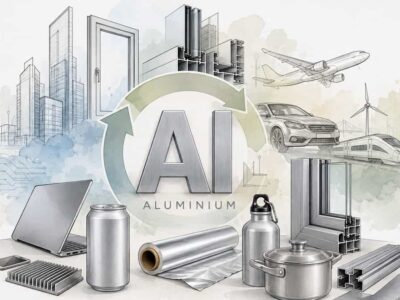
- Kitchen: Foil wrap, cookware, beverage cans
- Construction: Window frames, roofing sheets, wall cladding
- Transport: Car parts, aircraft bodies, ship superstructures
- Packaging: Food containers, blister packs
- Technology: Laptop chassis, smartphone frames, hard drive enclosures
Frequently Asked Questions (FAQs)
Q1: Is aluminium an element or a compound?
A: An element. It’s made of only one type of atom with 13 protons.
Q2: Which element is a semiconductor – germanium, aluminium, tin, or iodine?
A: Germanium is a semiconductor. The rest are not.
Q3: Is aluminium foil pure aluminium?
A: Yes, usually over 99% pure, with a thin protective oxide layer.
Q4: Which element has 25 protons?
A: Manganese (Mn).
Q5: What type of element is aluminium?
A: A metal (post-transition metal).
Q6: Can aluminium rust like iron?
A: No. It oxidizes, but the oxide layer acts as a protective shield instead of flaking away like rust.