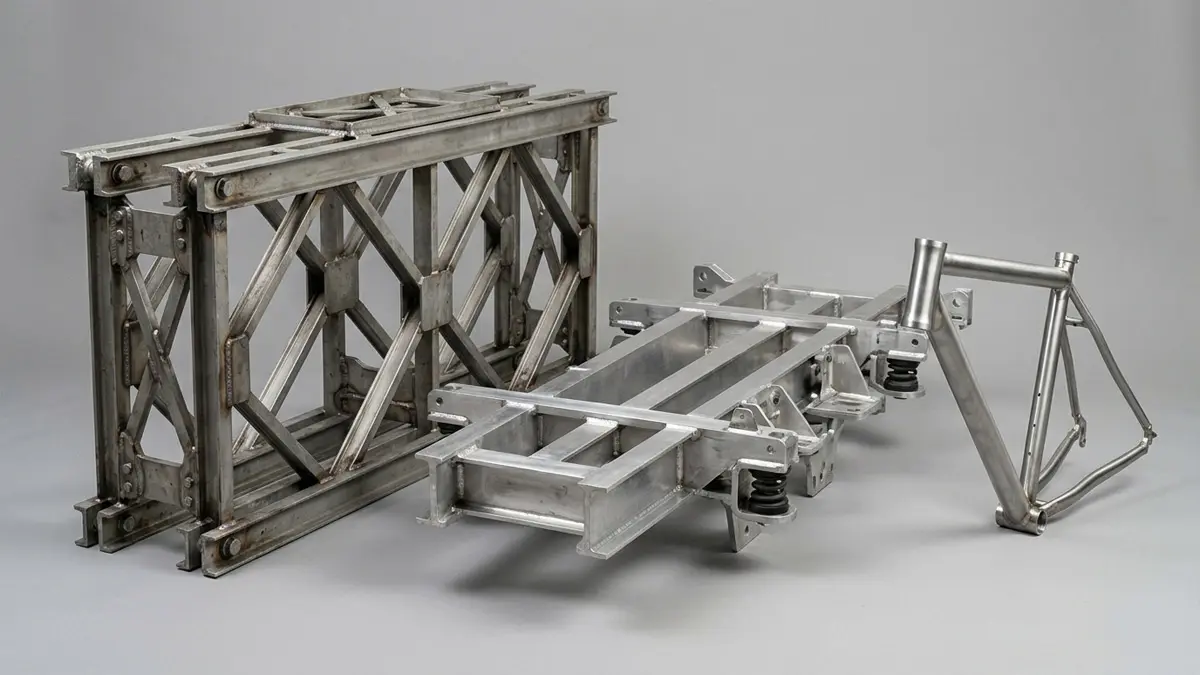
Aluminium 7020 is a high-strength, heat-treatable alloy belonging to the Al-Zn-Mg (7000) series. Unlike many other 7000-series alloys that contain copper, 7020 is copper-free, which gives it exceptional weldability and stress corrosion cracking resistance. This makes it a preferred material for structural applications in military, transportation, and general engineering where welding is required.
Chemical Composition of Aluminium 7020
The table below shows the typical composition limits for Aluminum 7020 (according to EN 573-3 standard).
| Element | Weight % |
|---|---|
| Aluminium (Al) | Balance |
| Zinc (Zn) | 4.0 – 5.0 |
| Magnesium (Mg) | 1.0 – 1.4 |
| Manganese (Mn) | 0.05 – 0.50 |
| Chromium (Cr) | 0.10 – 0.20 |
| Zirconium (Zr) | 0.08 – 0.20 |
| Titanium (Ti) | 0.01 – 0.10 |
| Silicon (Si) | ≤ 0.35 |
| Iron (Fe) | ≤ 0.40 |
| Copper (Cu) | ≤ 0.10 |
| Others (each) | ≤ 0.05 |
The absence of copper is the key differentiator from alloys like Aluminium 7075 – it dramatically improves weldability and corrosion resistance in welded conditions.
-Ads-
Mechanical & Physical Properties
Aluminium 7020 is typically supplied in the T6 or T651 temper (solution heat-treated and artificially aged). Its properties strike an excellent balance between strength and ductility.
| Property | Value (T6 Temper) |
|---|---|
| Tensile Strength (Ultimate) | 350 – 410 MPa |
| Yield Strength (0.2% offset) | 280 – 350 MPa |
| Elongation at Break | 8 – 12% |
| Hardness (Brinell) | ~100 HB |
| Fatigue Strength | 140 – 160 MPa |
| Elastic Modulus | 70 GPa |
| Density | 2.78 g/cm³ |
| Thermal Conductivity | 130 – 150 W/m·K |
| Electrical Resistivity | 0.045 – 0.055 μΩ·m |
Heat Treatment and Weldability
Heat Treatment
- Solution Heat Treatment: 450 – 480°C
- Quenching: Water or forced air
- Artificial Aging: 120 – 140°C for 12 – 24 hours (T6 temper)
- Natural Aging: 7020 can also naturally age to a stable condition over several weeks.
Weldability – The Standout Feature
Aluminium 7020 has excellent weldability using MIG, TIG, and resistance welding. Because it contains no copper, the heat-affected zone (HAZ) does not suffer from severe strength loss or cracking.
- Filler wire: ER5356 or ER5183 are recommended.
- Preheating: Not required for sections under 12 mm; for thicker plates, preheat to 100–150°C.
- Post-weld aging: A low-temperature aging treatment (100–120°C for 8–16 hours) can restore up to 90% of the original strength.
For a comparison of weldability across different 7000-series alloys, see our guide on Aluminium 7005, which also offers excellent welding characteristics for structural applications.
Applications of Aluminum 7020
Thanks to its high strength, weldability, and corrosion resistance, 7020 is used in demanding structural applications.
1. Military and Defence
- Military bridges (e.g., portable assault bridges)
- Armoured vehicle components (non-ballistic structural parts)
- Helicopter landing platforms
2. Railway and Transport
- Railcar bodies and underframes
- Truck and trailer chassis components
- Bus superstructures
3. Bicycle Frames
Aluminium 7020 is a popular choice for mountain bike and touring bike frames. It offers a slightly higher strength-to-weight ratio than 7005 and is often welded without post-weld heat treatment.
Learn more about aluminium’s role in modern bicycle frames and why it dominates the cycling industry.
-Ads-
4. General Structural Engineering
- Crane components
- Scaffolding and access towers
- Offshore platforms (where weldability and corrosion resistance are critical)
5. Marine Applications
7020 shows good resistance to seawater corrosion, especially in welded conditions, making it suitable for boat hull reinforcements and superstructures.
Comparison with Other Aluminium Alloys
| Alloy | Strength | Weldability | Corrosion Resistance | Typical Applications |
|---|---|---|---|---|
| 7020 | High (350–410 MPa) | Excellent | Good (SCC resistant) | Military bridges, railcars, bikes |
| 7005 | Medium-High (350–450 MPa) | Excellent | Very Good | Bicycle frames, scaffolding |
| 7050 | Very High (490–550 MPa) | Poor (not recommended) | Excellent (thick sections) | Aerospace wing skins, fuselage |
| 7075 | Highest (570 MPa+) | Very Poor | Moderate | Aircraft fittings, rock climbing gear |
| 6061 | Medium (310 MPa) | Excellent | Good | General purpose, marine, pipes |
Key takeaway: Choose 7020 when you need high strength and reliable weldability for structural components. Choose 7075 only for machined parts that will not be welded. Choose 6061 for lower-cost, general-purpose applications.
-Ads-
For a deep dive into another highly weldable alloy, read our complete guide on Aluminium 7005 – properties, applications, and weldability.
Machining and Forming
- Machinability: Fair to good. Use sharp carbide tools, moderate speeds, and plenty of coolant to avoid built-up edge. Stress-relieving after rough machining is recommended for tight tolerances.
- Forming: 7020 has lower formability than 6061. Cold bending of thin sections is possible; thicker sections require hot forming (250–350°C).
- Corrosion protection: Anodizing or powder coating is recommended for outdoor exposure, especially in coastal or industrial environments.
See our article on powder coating vs. anodizing to choose the right finish for your 7020 components.
Standards and Equivalents
| Standard | Designation |
|---|---|
| EN 573-3 | EN AW‑7020 |
| UNS | A97020 |
| DIN | 3.4345 |
| Former USSR | D16 (similar, not identical) |
Advantages and Limitations
✅ Advantages
- High strength-to-weight ratio
- Excellent weldability (no copper)
- Good stress corrosion cracking resistance
- Naturally aging possible
- Suitable for welded military and transport structures
❌ Limitations
- Lower strength than 7050 or 7075
- Not suitable for high-temperature service (>150°C)
- Requires protective coating for long-term marine exposure
- More expensive than 6xxx series alloys
Aluminum 7020 is a specialist alloy that shines where others fail – in welded, high-strength structural applications. Its copper-free composition gives it a unique place in the 7000 series, making it the go-to material for military bridges, railway carriages, bicycle frames, and heavy-duty transport equipment. While it does not reach the extreme strength of 7075, its combination of weldability, corrosion resistance, and strength is unmatched among heat-treatable aluminium alloys.
For engineers and fabricators looking for a reliable, weldable, high-strength aluminium, 7020 is an outstanding choice.