
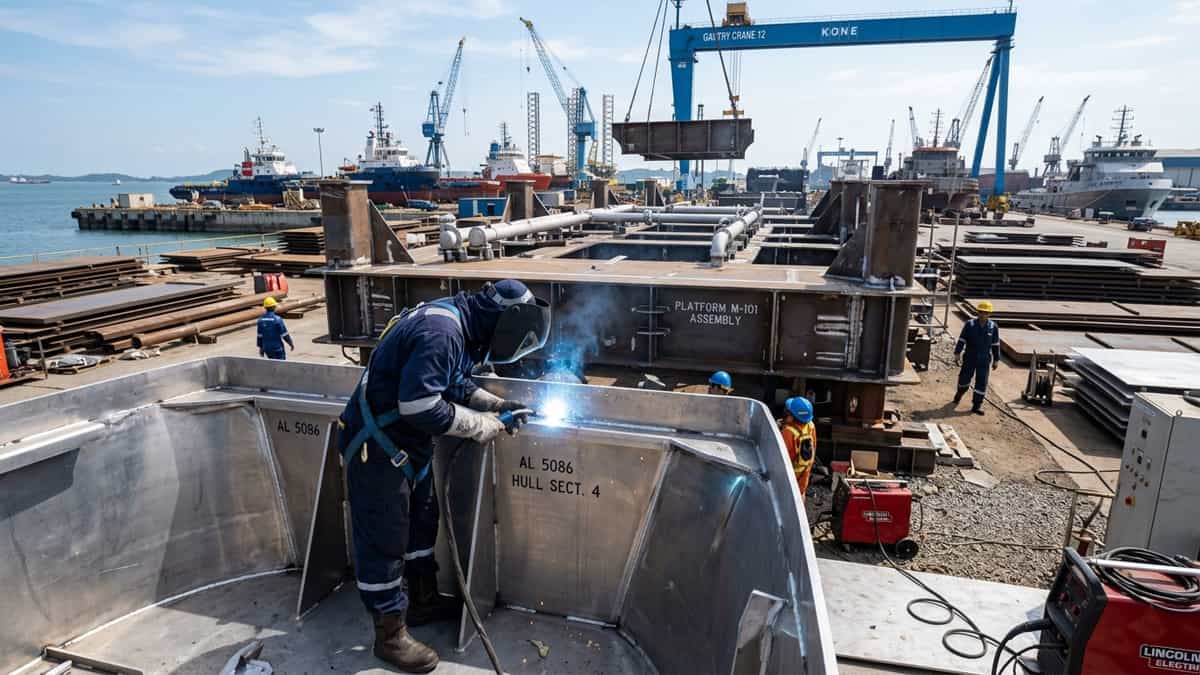
Aluminium 5086 – also known as Aluminum 5086 – is a non‑heat treatable aluminium‑magnesium alloy that occupies the sweet spot of the 5000 series. With a magnesium content of 3.5–4.5%, 5086 aluminium offers an exceptional balance of seawater corrosion resistance, weldability, and moderate‑to‑high strength. It is the material of choice for boat and yacht hulls, vessel gangways, cryogenic tanks, offshore platforms, and any application where weld integrity and long‑term durability in saltwater are paramount – bridging the gap between the formability of 5052 and the extreme strength of 5083.
What is Aluminium 5086?
Aluminium alloy 5086 is a member of the 5xxx series (aluminium‑magnesium), registered with the US Aluminium Association in 1954 as part of the post‑war expansion of marine‑grade alloys. Like 5052, 5754, 5454, and 5083, 5086 is a non‑heat treatable alloy; its strength comes from solid solution strengthening (magnesium dissolved in aluminium) and cold working (strain hardening), not from heat treatment.
Within the 5000 series, 5086 occupies a distinct middle ground. It is stronger than 5052 but not as strong as 5083; it is more weldable than 5083 in certain respects, particularly regarding stress‑corrosion cracking resistance at weld seams, while offering better formability than its higher‑strength cousin. This balanced profile – combined with the US Navy’s adoption of 5086 sheet (H32) and extrusions (H111) in the 1960s – has made 5086 a mainstay of shipbuilding, offshore engineering, and cryogenic equipment.
Key Characteristics at a Glance:
| Property | Value |
|---|---|
| Density | 2.66 g/cm³ |
| Melting Range | 574 – 590 °C |
| Thermal Conductivity | 125 – 127 W/m·K |
| Modulus of Elasticity | 70 – 71 GPa |
| Electrical Resistivity | 29 – 34% IACS |
Data compiled from industry specifications
Chemical Composition of Aluminium 5086
Aluminium 5086 derives its balanced properties from a composition that sits between 5052 and 5083. The magnesium content (3.5–4.5%) provides solid‑solution strengthening and excellent corrosion resistance. The manganese (0.2–0.7%) and chromium (0.05–0.25%) work together to control grain size and limit brittle intermetallic phases, improving strength and resistance to intergranular corrosion. The low copper (≤0.10%) and low iron (≤0.50%) ensure that the protective oxide film remains stable in saltwater.
| Element | Percentage (%) |
|---|---|
| Aluminum (Al) | Balance |
| Magnesium (Mg) | 3.50 – 4.50 |
| Manganese (Mn) | 0.20 – 0.70 |
| Chromium (Cr) | 0.05 – 0.25 |
| Iron (Fe) | ≤0.50 |
| Silicon (Si) | ≤0.40 |
| Zinc (Zn) | ≤0.25 |
| Titanium (Ti) | ≤0.15 |
| Copper (Cu) | ≤0.10 |
| Others (Each) | ≤0.05 |
| Others (Total) | ≤0.15 |
Source: ASTM B209 / EN 573‑3 / Wikipedia
Key Properties of Aluminium 5086
🌊 Excellent Seawater Corrosion Resistance
Aluminium 5086 offers very good corrosion resistance in marine atmospheres and seawater – a defining characteristic of the 5000 series. The magnesium‑rich solid solution promotes a stable, self‑healing oxide film that protects against pitting, crevice corrosion, and general attack. In standardised salt spray testing, 5086 achieves approximately 6,000 hours without perforation – falling between 5052 (5,000 hours) and 5083 (8,000 hours).
“The good results with welding and good corrosion properties in seawater make 5086 extremely popular for vessel gangways, building boat and yacht hulls.” – Wikipedia
⚡ Superior Weldability – With Exceptional Weld Seam Integrity
This is where Aluminium 5086 truly excels. While both 5086 and 5083 offer excellent weldability, 5086 outperforms in stress‑corrosion cracking resistance at weld seams. This is a critical advantage for large welded structures such as ship hulls, offshore platforms, and pressure vessels, where weld integrity directly determines service life.
Because 5086 is not heat treatable, welding does not cause the dramatic strength losses seen in heat‑treatable alloys. The alloy can be welded using all standard methods:
- MIG (GMAW) – most common for shipbuilding and heavy fabrication
- TIG (GTAW) – for precision work and thinner sections
- Resistance welding
The recommended filler alloy is 5356 or 5183, both of which produce weld metal with good strength and corrosion resistance matching the parent material.
🧊 Cryogenic Performance – Maintaining Toughness at Low Temperatures
Like other 5xxx series alloys, 5086 performs exceptionally well at cryogenic temperatures. Unlike many structural materials that become brittle when cold, 5086 actually becomes stronger as temperature decreases while retaining excellent ductility.
| Temperature | Yield Strength (MPa) | Ultimate Tensile Strength (MPa) |
|---|---|---|
| −28 to 100°C | ~120 | ~260 |
| −196°C (cryogenic) | ~130 | ~380 |
Data from Wikipedia
This property makes 5086 the material of choice for LNG carrier cryogenic tanks and piping systems (service temperature around −162°C), as well as liquid hydrogen applications, aerospace cryogenic tankage, and marine cryogenic storage. Above 100°C, however, its strength begins to degrade.
💪 Moderate‑to‑High Strength
Aluminium 5086 delivers solid mechanical strength across its available tempers, offering a practical balance between structural capability and workability.
Typical Mechanical Properties by Temper:
| Temper | Condition | Yield Strength (Rp0.2) | Ultimate Tensile Strength (Rm) | Elongation |
|---|---|---|---|---|
| O | Annealed | ≈120 MPa | ≈270–290 MPa | ≈12–20% |
| H32 / H116 | Strain‑hardened, stabilised | ≈210–215 MPa | ≈300–305 MPa | ≈11–12% |
| H36 | Half hard (higher strength) | — | ≈335 MPa (max) | — |
| H38 | Full hard | ≈320 MPa | ≈390 MPa | ≈2–3% |
Data from multiple industry sources
The H116 temper is particularly important for marine applications. Introduced after the 1960s, H116 is specifically controlled to limit harmful intergranular precipitation and exfoliation risks, with corrosion requirements verified through dedicated tests.
🔨 Good Formability
5086 offers good formability, particularly in the annealed (O) temper. Its formability is generally better than 5083 but not as good as 5052, which remains the easiest alloy in the 5000 series to bend into tight curves. Minimum bend radii for 5086 in H32/H116 are approximately 1.2× material thickness, compared to 2.0× for 5083.
⚙️ Machinability
Like most 5xxx series alloys, 5086 has fair machinability (approximately 30% on the 0–100 scale where 100% represents free‑machining alloy 2011). Machinability improves in the strain‑hardened tempers (H36, H38). For extensive machining, consider using the O temper and then cold working, or select a different alloy such as 6061.
🔄 Common Tempers
| Temper | Description | Typical Application |
|---|---|---|
| O | Annealed – maximum formability | Complex formed parts, subsequent cold working |
| H111 | Slightly work‑hardened (less than H11) | Moderate forming, extrusions |
| H116 | Special marine temper – strain‑hardened and stabilised for intergranular corrosion resistance | Ship hulls, offshore structures, pressure vessels – the most common marine temper |
| H321 | Strain‑hardened – similar to H116 | Heavy plate applications |
| H32 | Quarter hard – strain‑hardened and stabilised | General fabrication, sheet metal work |
| H34 | Half hard – higher strength, reduced formability | Structural components |
| H36 | Three‑quarter hard | Higher‑strength applications |
| H38 | Full hard – maximum strength, minimum formability | High‑strength, flat applications |
Applications of Aluminium 5086
Aluminium 5086 is a versatile marine‑grade alloy whose balanced combination of properties makes it suitable for a wide range of demanding applications, from civilian vessels to specialised cryogenic equipment.
⚓ Marine & Shipbuilding – The #1 Application
5086 is widely used in marine construction, particularly where excellent weldability and corrosion resistance are required:
- Boat and yacht hulls – the preferred hull material for small aluminium boats and larger yachts
- Vessel gangways, decks, and superstructures – where foot traffic and corrosion demand durability
- Offshore platform structures – particularly for long‑term submerged areas such as platform supports and hull bottoms
- High‑speed patrol boats and workboats – where lightweight construction improves speed and fuel efficiency
- Ship hull bottoms – where continuous saltwater exposure demands the highest corrosion resistance
🧊 Cryogenic & LNG – The Specialist Application
The cryogenic toughness of 5086 makes it a standard material for low‑temperature service:
- LNG carrier cryogenic tanks and piping systems – operating at approximately −162°C
- Liquid hydrogen and liquid oxygen storage vessels
- Cryogenic transport vessels – for road, rail, and marine shipment of liquefied gases
- Aerospace cryogenic tankage – including rocket propellant tanks
- Heat exchangers and vaporisers for cryogenic plants
🏭 Pressure Vessels & Chemical Storage
- Low‑to‑medium pressure vessels – for compressed air, industrial gases, and chemical storage
- Storage tanks for water, chemicals, and petroleum products
- Gas and oil piping systems – where both corrosion resistance and weldability are required
🚛 Transport & Heavy Vehicles
- Truck and trailer fuel tanks – lightweight and corrosion‑resistant
- Cargo vehicle bodies – requiring good strength and weldability
- Railway tank cars – for bulk liquid transport
- Refrigerated container linings – where low‑temperature performance is needed
🎯 Defence & Ordnance
- Missile components – where weight reduction and structural integrity are critical
- Armour plate – for military vehicles and naval applications
- Ordnance components – where consistent performance under extreme conditions is required
🏗️ General Fabrication & Structural
- Towers and drilling rigs – including radio towers, television towers, and oil drilling platforms
- Storage tanks – for a wide range of industrial applications
- General sheet metal work – where marine‑grade corrosion resistance is required
Aluminium 5086 vs. Other 5000 Series Alloys
Rather than presenting a dense table, here is a practical guide to understanding where 5086 fits within the 5000 series family:
| Alloy | Mg (%) | Key Strengths | Formability | Weld Seam SCC Resistance | Best Applications |
|---|---|---|---|---|---|
| 5052 | 2.2–2.8 | Excellent formability, good corrosion resistance | Excellent (tightest bends) | Good | Fuel tanks, complex curves, general fabrication |
| 5086 | 3.5–4.5 | Excellent weldability with superior weld seam SCC resistance, good formability | Good | Superior | Boat hulls, vessel gangways, offshore structures, cryogenic tanks |
| 5083 | 4.0–4.9 | Highest strength, excellent deep‑drawing formability | Moderate | Good | Heavy‑duty marine hulls, decks, bulkheads, naval armour |
| 5454 | 2.4–3.0 | Elevated‑temperature strength (65–170°C) | Good | Good | Chemical storage, pressure vessels, wheels |
Pro Tip: Choose 5086 when you need excellent weldability with superior weld seam stress‑corrosion cracking resistance – for boat hulls, vessel gangways, offshore platforms, and cryogenic tanks. Choose 5052 for complex forming and tight bends. Choose 5083 for maximum strength in heavy‑duty marine structures such as large ship decks and naval armour.
For a detailed, interactive side‑by‑side comparison of 5086 with any other aluminium alloy – including 5052, 5083, 5454, 6061, or 7075 – visit the Aluminium Alloy Comparison Tool. This tool allows you to compare over 40 alloy types across properties including strength, corrosion resistance, weldability, and thermal conductivity.
Fabrication & Workability Guide
🔨 Forming
5086 has good forming characteristics, particularly in the O (annealed) temper. In H32/H116, the alloy can be bent and moderately formed. Minimum bend radii for H32/H116 are approximately 1.2× material thickness – better than 5083 (2.0×) but not as good as 5052 (1.5×). For complex forming operations, the O temper is recommended.
🔥 Welding – The Standout Feature
5086 offers excellent weldability with all standard methods:
- MIG (GMAW) – most common for marine fabrication
- TIG (GTAW) – for precision work and thin sections
- Resistance welding
The recommended filler alloys are 5356 (most common) and 5183. The alloy is highly resistant to stress‑corrosion cracking at weld seams, which is a key differentiator from 5083 in certain applications. Pre‑heating is generally not required for thinner sections.
⚙️ Machining
5086 has fair machinability – approximately 30% on the 0–100 scale. Best practices:
- Use carbide‑tipped tools with sharp cutting edges
- Apply ample coolant to prevent work hardening
- Employ high cutting speeds with positive rake angles
- Machinability improves in the strain‑hardened tempers (H36, H38)
🌡️ Heat Treatment
Not heat treatable – strength is achieved only through cold work and solid‑solution hardening. The only thermal process available is annealing:
- Annealing temperature: approximately 343°C (650°F)
- Hold for sufficient time, then cool in air
❄️ Cold Working
5086 has excellent cold working characteristics in the O temper, allowing significant strain hardening to achieve higher tempers. Cold working is less effective in the H38 and H36 tempers due to prior work hardening.
🎨 Anodising
5086 responds well to anodising using all traditional techniques. The alloy’s high magnesium content produces a uniform anodic film, though the finish may be slightly different from lower‑magnesium alloys such as 5005.
Why Choose Aluminium 5086?
✅ Advantages
- Excellent seawater corrosion resistance – proven in decades of marine service
- Outstanding weldability with superior weld seam SCC resistance – the key differentiator from 5083
- Good formability – better than 5083 for moderate bending operations
- Good cryogenic performance – becomes stronger at low temperatures; ideal for LNG and cryogenic service
- Moderate‑to‑high strength – stronger than 5052, comparable to many structural alloys
- Non‑heat treatable – no risk of improper heat treatment; welding does not cause dramatic strength loss
- Good machinability in strain‑hardened tempers
- Non‑magnetic – suitable for sensitive electronic and naval applications
- Fully recyclable – sustainable choice for large marine structures
❌ Limitations
- Lower strength than 5083 – not suitable for the highest‑load marine structures such as heavy‑duty decks and bulkheads
- Strength degrades above 100°C – not suitable for elevated‑temperature service; use 5454 for hot environments
- Formability only good, not excellent – not as formable as 5052 for complex curves and tight bends
- Machinability only fair – not suitable for precision machining without care
- Susceptible to intergranular corrosion if improperly processed – always specify H116 for marine service
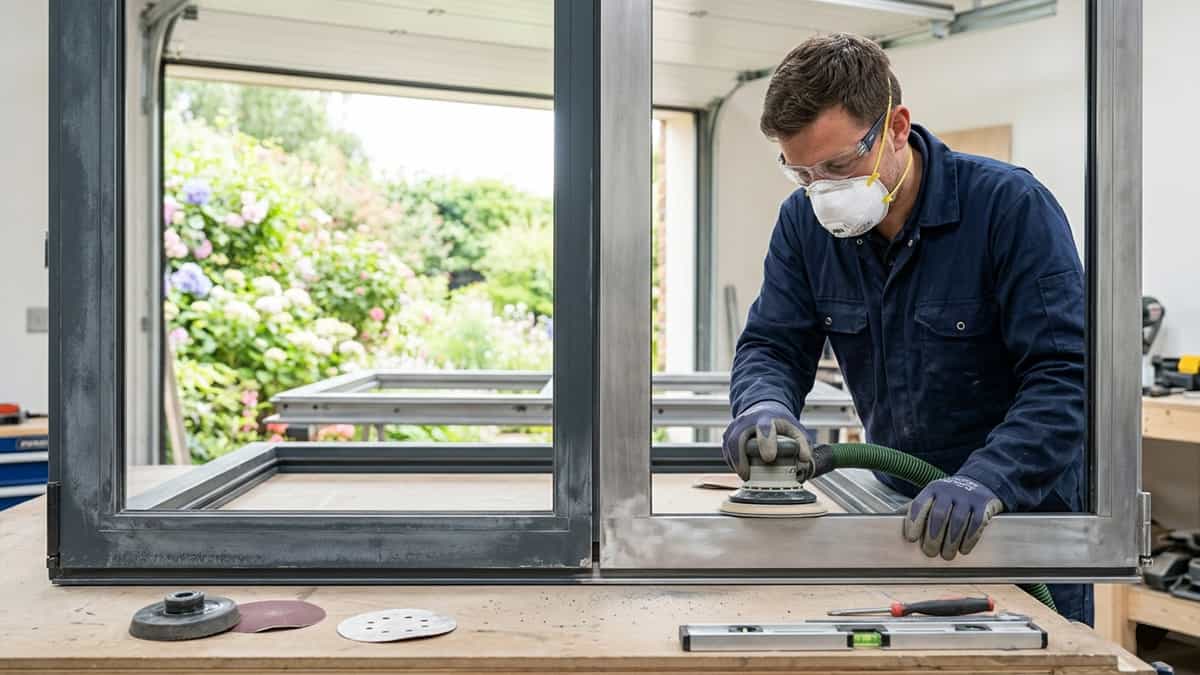
- Soft material (70 HB) – requires careful preparation during grinding and polishing to avoid smearing and orange peel
Final Wrap
Aluminium 5086 (Aluminum 5086) is the balanced marine alloy of the 5000 series – offering an exceptional combination of seawater corrosion resistance, weldability, formability, and moderate‑to‑high strength. It occupies the middle ground between the formability of 5052 and the extreme strength of 5083, while offering superior weld seam stress‑corrosion cracking resistance that makes it the preferred choice for large welded structures such as ship hulls, vessel gangways, offshore platforms, and cryogenic tanks.
From the hull of a patrol boat to the gangways of a luxury yacht, from the cryogenic tanks of an LNG carrier to the offshore platforms of the oil and gas industry, Aluminium 5086 delivers reliable, weldable, corrosion‑resistant performance in the most demanding environments.
For engineers and fabricators working in marine, offshore, cryogenic, or pressure vessel applications, 5086 aluminium is the trusted, proven choice. Explore its properties relative to other alloys using the Aluminium Alloy Comparison Tool.
📚 Related Articles
Deepen your understanding of aluminium alloys with these curated guides:
- Aluminium Alloy Comparison Tool – Compare 40+ aluminium alloys side by side to find the perfect material for your project
- Aluminium 5083: The High‑Strength Marine Alloy for Extreme Environments – The higher‑strength alternative for heavy‑duty marine structures
- Aluminium 5052: The Marine‑Grade Alloy for Superior Corrosion Resistance – The formable, general‑purpose marine alloy
- Aluminium 5454: The Elevated‑Temperature Marine Alloy – The specialist for pressure vessels and chemical storage up to 170°C
- Why Is Aluminum Used for Aircraft Bodies? – Understanding aluminium’s role in extreme environments
Related Articles


Featured


You May Also Like

Aluminum Bay Windows: Types, Ideas & Replacement Guide

From Raw Metal to Real-World Shapes: The Essential Role of E…

Solar Projects: Why Aluminium is the Strategic Backbone for …
Sodium Aluminium Fluoride (Na₃AlF₆): Technical Guide to Cryo…
Can Powder Coated Aluminium Be Repainted or Recoated?
