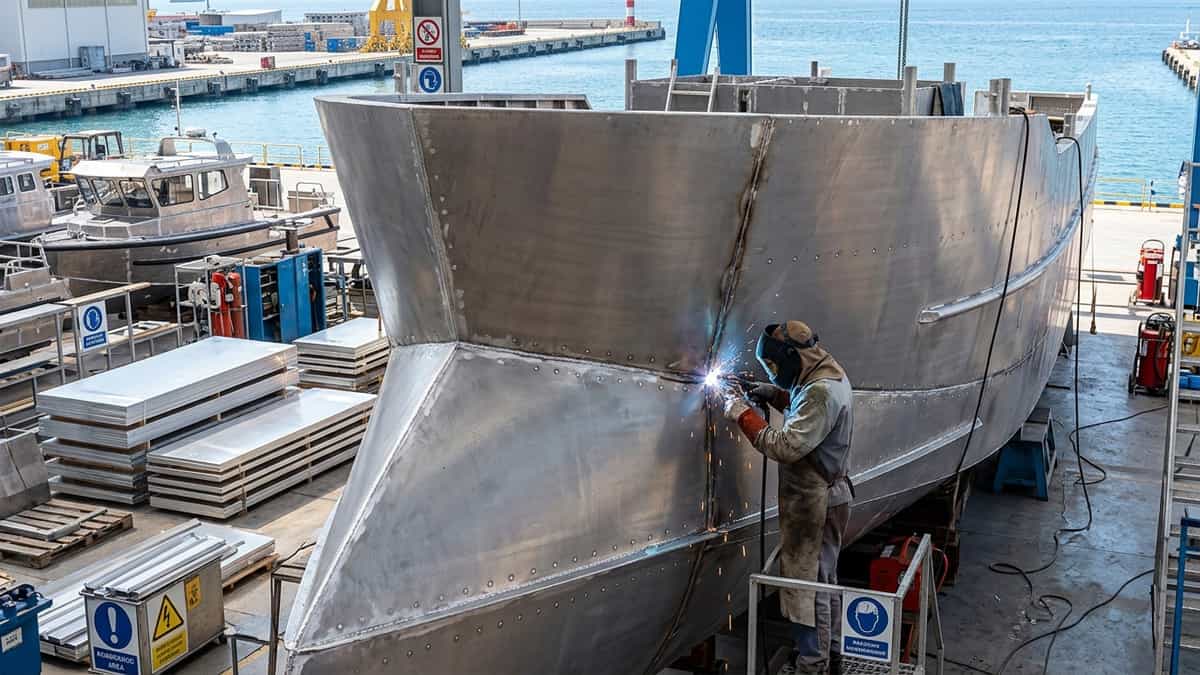
Aluminium 5052 – also known as Aluminum 5052 – is a non-heat treatable aluminium-magnesium alloy that stands as the industry benchmark for marine environments. With outstanding corrosion resistance (especially to saltwater), high fatigue strength, and excellent formability, 5052 aluminum is the go-to alloy for boat hulls, fuel tanks, sheet metal work, and applications where durability meets ductility.
What is Aluminium 5052?
Aluminium alloy 5052 belongs to the 5xxx series of aluminum alloys, where magnesium (2.2–2.8%) is the principal alloying element. It is a non-heat treatable alloy, meaning its strength comes from cold working (strain hardening) rather than thermal processing. Among all non-heat treatable aluminum alloys, 5052 offers one of the highest fatigue strengths and exceptional corrosion resistance – particularly in marine and industrial atmospheres.
Key Characteristics at a Glance:
| Property | Value |
|---|---|
| Density | 2.68 g/cm³ |
| Melting Range | 607 – 649 °C |
| Thermal Conductivity | 138 W/m·K |
| Electrical Resistivity | 30% IACS |
| Modulus of Elasticity | 70.3 GPa |
Data compiled from industry specifications
Chemical Composition of Aluminium 5052
Aluminum 5052 derives its superior properties from a precise balance of alloying elements, with magnesium as the key contributor.
| Element | Percentage (%) |
|---|---|
| Aluminum (Al) | Balance |
| Magnesium (Mg) | 2.20 – 2.80 |
| Chromium (Cr) | 0.15 – 0.35 |
| Silicon (Si) | 0.00 – 0.25 |
| Iron (Fe) | 0.00 – 0.40 |
| Copper (Cu) | 0.00 – 0.10 |
| Manganese (Mn) | 0.00 – 0.10 |
| Zinc (Zn) | 0.00 – 0.10 |
| Others (Each) | 0.00 – 0.05 |
| Others (Total) | 0.00 – 0.15 |
Source: ASTM B209 / EN 573-3 standards
The 2.2–2.8% magnesium content provides solid solution strengthening without compromising ductility. The addition of chromium (0.15–0.35%) significantly improves stress-corrosion cracking resistance – a critical feature for marine and high-humidity environments. Low copper and iron ensure consistent corrosion performance.
Key Properties of Aluminum 5052
🔹 Outstanding Corrosion Resistance – Especially Marine
Aluminium 5052 offers excellent resistance to atmospheric corrosion and is widely regarded as the best among non-heat treatable alloys for resistance to saltwater and marine atmospheres. It also performs exceptionally well in industrial and chemical environments.
“5052 has excellent resistance to marine atmosphere and salt water corrosion, and is widely used in marine applications.”
The protective oxide film is stable in neutral and alkaline pH ranges, but the alloy should not be used in strong acidic or caustic environments (pH < 4 or > 9). For galvanic corrosion, avoid direct electrical contact with more noble metals like copper, brass, or steel in wet conditions.
🔹 High Fatigue Strength
Among non-heat treatable aluminum alloys, 5052 exhibits the highest fatigue strength – superior even to some heat-treatable alloys like 6061-T6 in certain loading conditions. This makes it ideal for components subject to repeated stress, such as boat hulls, vehicle panels, and vibrating equipment.
🔹 Excellent Formability & Workability
Aluminium 5052 is highly formable, especially in the annealed (O) temper. It can be bent, stretched, drawn, and spun using conventional methods. Its ductility allows for severe forming operations without cracking.
Formability by Temper:
- O temper: Excellent – deep drawing, complex shapes
- H32/H34: Good – moderate bending and forming
- H36/H38: Fair – limited forming, primarily for flat applications
🔹 Good Weldability
Aluminium 5052 offers good weldability using all standard methods (GMAW/MIG, GTAW/TIG, resistance welding). The most common filler alloys are:
- 5356 – preferred for maximum strength and corrosion resistance
- 5183 – excellent for marine applications
- 4043 – acceptable for less critical applications
Note: Welding reduces the strength of 5052 in the heat-affected zone (HAZ). Post-weld strength typically approaches the annealed (O) temper values.
🔹 Moderate-to-High Strength
As a work-hardened alloy, 5052 aluminum provides significantly higher strength than 3003 or 5005, making it suitable for structural applications where heat-treatable alloys might be overkill.
Typical Mechanical Properties by Temper:
| Temper | 0.2% Proof Stress (MPa min) | Tensile Strength (MPa) | Elongation (% min) |
|---|---|---|---|
| O (annealed) | 65 – 95 | 170 – 215 | 12 – 25 |
| H32 | 160 | 215 – 250 | 7 – 12 |
| H34 | 180 | 230 – 265 | 6 – 10 |
| H36 | 200 | 245 – 275 | 5 – 8 |
| H38 | 215 | 260 – 290 | 4 – 7 |
Data from ASTM B209 specifications
🔹 Machinability
Aluminium 5052 has fair to poor machinability in soft tempers (O, H32). In harder tempers (H36, H38), machinability improves but still requires sharp tools, high cutting speeds, and adequate lubrication. For extensive machining, alloys like 2011 or 6061 are preferred.
🔹 Thermal & Electrical Properties
- Thermal conductivity: ~138 W/m·K (moderate – less than pure aluminum but adequate for heat exchangers)
- Electrical conductivity: ~30% IACS (suitable for low-current applications but not for primary electrical conductors)
Applications of Aluminium 5052
Thanks to its unique combination of saltwater corrosion resistance, high fatigue strength, and formability, Aluminium 5052 is used across demanding industries.
⚓ Marine & Offshore – The #1 Application
- Boat hulls and decks
- Fuel and water tanks
- Marine piping and handrails
- Dock components and ladders
- Fishing vessel superstructures
“5052 is the standard alloy for marine sheet applications – from small dinghies to commercial vessel interiors.”
🚛 Transportation & Automotive
- Fuel tanks (gasoline, diesel)
- Truck and trailer panels
- Bus body panels
- Automotive interior trim
- Engine shrouds and heat shields
- License plates
🏗️ Architectural & Building
- Building facades and cladding (especially coastal areas)
- Signage and highway signs
- Roofing and gutters
- HVAC ductwork and equipment
- Mobile homes and RVs
🏭 General Fabrication & Industrial
- Pressure vessels (low-pressure)
- Chemical equipment (non-strong acid service)
- Hydraulic tubing
- Electrical enclosures
- Electronic chassis (non-magnetic)
- Toolboxes and storage boxes
- Household appliances (washing machine drums, refrigerator liners)
🥤 Consumer Goods
- Cooking utensils
- Bottle caps (non-crown type)
- Medical equipment (non-toxic)
Fabrication & Workability Guide
Forming
Aluminium 5052 is one of the most formable 5000-series alloys. It can be deep drawn, stamped, bent, and spun. For severe forming, use O temper; for moderate forming, H32/H34 are acceptable. Minimum bend radii vary by temper – typically 0–1T for O, 1–2T for H32, and 3–4T for H38.
Welding
- Excellent weldability with MIG/TIG
- Recommended filler: 5356 (highest strength and corrosion resistance)
- Post-weld strength: approximately 125–170 MPa tensile (O temper equivalent)
- For anodized applications post-weld, filler 5556 may be preferred
Machining
- Poor to fair in O and H32 tempers
- Better in H36/H38, but still inferior to 2011 or 6061
- Use carbide tools, positive rake, high speeds, and coolant
Heat Treatment
- Not heat treatable – annealing is the only thermal process
- Annealing temperature: 343°C (650°F) for 2–3 hours, then air cool
- Stress relief: 200–250°C for 1–2 hours to reduce residual stresses
Cold Working
- Excellent – the alloy strengthens significantly with cold work
- Strain hardening tempers (H32 through H38) are achieved by cold rolling after annealing
Comparison with Other Aluminium Alloys
🔸 5052 vs. 5005
This is a critical comparison for architects and fabricators. 5052 is stronger and more fatigue-resistant but 5005 anodizes better and has a clearer finish.
| Property | 5052 | 5005 |
|---|---|---|
| Magnesium Content | 2.2–2.8% | 0.5–1.1% |
| Tensile Strength (H32) | ~215–250 MPa | ~115–160 MPa |
| Corrosion Resistance (Marine) | Excellent | Good |
| Anodizing Quality | Good (slightly bluish) | Excellent (clear, uniform) |
| Fatigue Strength | Highest among 5xxx | Moderate |
| Typical Use | Marine, tanks, structural | Architecture, signage |
Pro Tip: Choose 5052 for saltwater or high-stress applications. Choose 5005 when you need a perfect anodized match with 6063 extrusions.
🔸 5052 vs. 6061
6061 is heat treatable and stronger in T6 temper (~310 MPa tensile). However, 5052 offers better formability, higher fatigue strength (in some conditions), and superior corrosion resistance – especially in marine environments.
| Property | 5052-H32 | 6061-T6 |
|---|---|---|
| Tensile Strength | 215–250 MPa | 290–310 MPa |
| Yield Strength | ~160 MPa | ~240 MPa |
| Corrosion Resistance (Saltwater) | Excellent | Good |
| Formability | Excellent | Fair |
| Weldability | Good | Good |
| Cost | Lower | Moderate |
| Best Use | Marine, forming, tanks | Structural frames, heavy load |
🔸 5052 vs. 3003
3003 is a general-purpose alloy with lower strength but excellent formability. 5052 is the upgrade when corrosion resistance and strength matter.
| Property | 5052-H32 | 3003-H14 |
|---|---|---|
| Tensile Strength | 215–250 MPa | 145–185 MPa |
| Corrosion Resistance (Marine) | Excellent | Good |
| Fatigue Strength | High | Low |
| Anodizing | Good | Fair (can be hazy) |
| Cost | Slightly higher | Lower |
Why Choose Aluminium 5052?
✅ Advantages
- Best-in-class saltwater corrosion resistance among non-heat treatable alloys
- Highest fatigue strength in the 5xxx series
- Excellent formability – can be deep drawn and bent
- Good weldability with 5356 filler
- Non-heat treatable – no loss of strength from improper thermal cycles
- Non-magnetic – ideal for electronic and medical applications
- FDA compliant for food contact
- Fully recyclable – sustainable material choice
❌ Limitations
- Cannot be heat treated – strength limited to cold work
- Poor machinability in soft tempers
- Not suitable for strong acids or caustics (pH <4 or >9)
- Strength lower than 6061-T6 for structural beams
- Anodized finish less clear than 5005 – slight bluish tint
Final Wrap
Aluminium 5052 (Aluminum 5052) is the marine-grade workhorse of the aluminum world. Its outstanding resistance to saltwater corrosion, combined with high fatigue strength and excellent formability, makes it the preferred choice for boat hulls, fuel tanks, coastal architecture, and demanding sheet metal applications.
While it cannot match the ultimate tensile strength of heat-treatable alloys like 6061-T6, 5052 aluminum offers a compelling balance of durability, workability, and corrosion protection – especially in wet, salty, or vibration-prone environments. For any project that lives near water or needs to withstand repeated stress, Aluminium 5052 is the proven performer.
📚 Related Articles
Deepen your understanding of aluminum alloys with these curated guides:
- Aluminium 5005: The Architect’s Alloy for Superior Anodized Finish – Compare 5005 vs 5052 for architectural applications
- Aluminum 6063 Alloy: The Extrusion Standard for Windows & Doors – Heat-treatable alloy for architectural profiles
- Aluminum 3003: The Most Widely Used General-Purpose Alloy – Lower-strength alternative for non-marine forming
- Aluminium 6060 Alloy: Cost-Effective Extrusion for Complex Profiles – Another 6xxx series option
- Why Aluminum is Used for Aircraft Bodies (Fatigue & Strength Insights) – Explore fatigue resistance in aerospace applications
Related Articles

Featured
You May Also Like

The Beauty and Strength of Aluminium-Clad Wood Windows

Cheap Aluminium Windows in Cape Town: Real Prices, Buying Ti…

Why Is Aluminum Used for Aircraft Bodies? Which Alloys Are U…
Aluminum Bathroom Windows That Work in Every U.S. Climate Zo…
Why Aluminium Cans Have a Curved Bottom