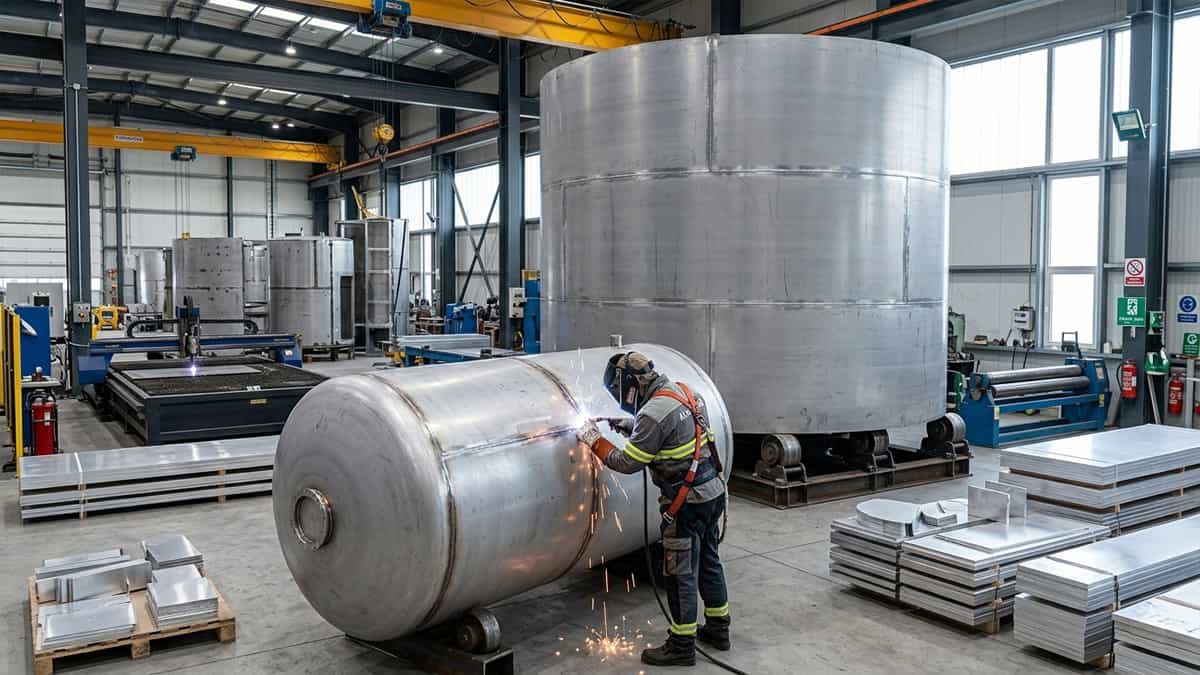
Aluminium 5454 – also known as Aluminum 5454 – is a non-heat treatable aluminium-magnesium alloy that serves as the elevated-temperature specialist of the 5000 series. With outstanding resistance to seawater corrosion, medium-to-high strength that persists at elevated temperatures (65–170°C), and good weldability, 5454 aluminum is the preferred choice for pressure vessels, chemical storage tanks, marine pipelines, and automotive wheels where operating conditions exceed the comfort zone of standard alloys.
What is Aluminium 5454?
Aluminium alloy 5454 belongs to the 5xxx series of aluminum alloys, where magnesium (2.4–3.0%) serves as the primary alloying element, with manganese (0.5–1.0%) as a secondary strengthener. It is a non-heat treatable alloy, meaning its strength comes from cold working (strain hardening) rather than thermal processing.
What truly distinguishes 5454 aluminum from its 5xxx series cousins – such as 5052, 5083, and 5754 – is its superior performance at elevated temperatures. While most aluminum alloys experience significant strength loss above 65°C, 5454 maintains good mechanical properties all the way up to 170°C, making it the go-to alloy for applications involving heat, pressure, and corrosive environments simultaneously.
Key Characteristics at a Glance:
| Property | Value |
|---|---|
| Density | 2.68–2.69 g/cm³ |
| Melting Range | 645 °C |
| Thermal Conductivity | 130–135 W/m·K |
| Electrical Resistivity | 34% IACS |
| Modulus of Elasticity | 70–70.5 GPa |
Data compiled from industry specifications
Chemical Composition of Aluminium 5454
Aluminium 5454 derives its distinctive properties from a carefully balanced composition that sets it apart from other 5xxx series alloys. The magnesium content provides solid solution strengthening and corrosion resistance, while the manganese addition further enhances strength without compromising ductility. The controlled addition of chromium (0.05–0.20%) improves stress-corrosion cracking resistance – a critical feature for welded structures.
| Element | Percentage (%) |
|---|---|
| Aluminum (Al) | Balance |
| Magnesium (Mg) | 2.40 – 3.00 |
| Manganese (Mn) | 0.50 – 1.00 |
| Chromium (Cr) | 0.05 – 0.20 |
| Iron (Fe) | 0.00 – 0.40 |
| Silicon (Si) | 0.00 – 0.25 |
| Zinc (Zn) | 0.00 – 0.25 |
| Titanium (Ti) | 0.00 – 0.20 |
| Copper (Cu) | 0.00 – 0.10 |
| Others (Each) | 0.00 – 0.05 |
| Others (Total) | 0.00 – 0.15 |
Source: BS EN 573-3:2009 standards
Key Properties of Aluminium 5454
🔥 Elevated Temperature Performance – The Defining Feature
This is where Aluminium 5454 truly distinguishes itself. While most aluminum alloys begin to lose strength above approximately 65°C, 5454 maintains good mechanical properties in the temperature range of 65°C to 170°C. This makes it invaluable for applications involving:
- Chemical storage tanks containing heated contents
- Automotive wheels exposed to braking heat
- Pressure vessels operating at elevated temperatures
- Exhaust systems and heat-affected components
“Strength is medium to high and similar to alloy 5754 with good strength in the temperature range 65 to 170 degrees centigrade.”
🌊 Outstanding Corrosion Resistance – Especially Seawater
Aluminium 5454 offers very good corrosion resistance, with particular excellence in seawater and general environmental conditions. Like other 5xxx series alloys, it forms a protective self-healing oxide layer that provides:
- Marine atmosphere resistance – ideal for offshore platforms and vessels
- Saltwater immersion resistance – suitable for continuous seawater exposure
- Industrial atmosphere resistance – tolerates acid rain and industrial wastewater
- Chemical environment resistance – performs well in many process industry settings
⚙️ Medium-to-High Strength
Aluminium 5454 provides medium-to-high strength comparable to alloy 5754, with excellent fatigue strength. Its strength is approximately 20% higher than 5052 aluminum, making it suitable for structural applications where 5052 would be insufficient.
Typical Mechanical Properties (Sheet – H22/H32 Temper):
| Property | Value |
|---|---|
| Proof Stress (0.2%) | 180 MPa (min) |
| Tensile Strength | 250 – 305 MPa |
| Hardness (Brinell) | 74 HB |
Data from Aalco / thyssenkrupp datasheets
Typical Mechanical Properties (O Temper):
| Property | Value |
|---|---|
| Tensile Strength | 215 – 285 MPa |
| Yield Strength | ~80 MPa |
| Elongation | 12–18% |
Data from aircraftmaterials.com
🔧 Good Weldability
Aluminium 5454 offers good weldability using common methods like MIG (Metal Inert Gas) welding. However, soldering and brazing are not recommended. The alloy 5554 was specifically developed as a filler alloy for welding 5454, ensuring optimal joint performance.
📐 Formability and Fabrication
- Formability is good in the softer tempers, allowing for moderate bending and shaping.
- Extrusion is possible, but 5454 is not suitable for complex or fine extrusions.
- Machinability is similar to other 5xxx series alloys – best performed in harder tempers with sharp tools and adequate lubrication.
🔄 Tempers Available
The most common tempers for Aluminium 5454 are:
| Temper | Description |
|---|---|
| O | Soft / annealed – maximum formability |
| H111 | Some work hardening from shaping processes (less than H11) |
| H22 | Work hardened by rolling, then annealed to quarter hard |
| H32 | Work hardened by rolling, then stabilized by low-temperature heat treatment to quarter hard |
| H24 | Work hardened to half hard |
| H34 | Work hardened to three-quarter hard |
| H38 | Full hard |
Applications of Aluminium 5454
Thanks to its unique combination of elevated-temperature strength, seawater corrosion resistance, and good weldability, Aluminium 5454 is used across demanding industries where operating conditions exceed the capabilities of standard 5xxx alloys.
🏭 Pressure Vessels & Chemical Storage – The #1 Application
5454 aluminum is widely used in the manufacture of chemical storage tanks, pressure vessels, containers, and boilers. Its ability to maintain strength at elevated temperatures makes it particularly suitable for:
- Pressurized storage tanks containing heated or reactive chemicals
- Low-pressure vessels operating at up to 6.4 MPa
- Cryogenic equipment – excellent performance at low temperatures as well
⚓ Marine & Offshore
As a marine-grade aluminum alloy, 5454 is commonly used in welded marine structures:
- Marine pipelines and piping systems
- Offshore platform components
- Ship hull structures (alongside 5083, 5086, and 5456)
- Masts, pylons, and poles
“5454 aluminum alloy… mainly used in welded structures for marine facilities, pressure vessels, pipelines, etc.”
🚛 Road Transport & Automotive
The combination of elevated-temperature strength and corrosion resistance makes 5454 ideal for:
- Automotive wheels – one of the most significant applications, particularly for wheels that may be subject to temperatures exceeding 65°C
- Road transport body building
- Fuel and oil lines – where heat from the engine compartment is a factor
- Truck and trailer panels – especially for transporting heated or chemical cargo
🧪 Chemical & Process Plant
5454 aluminum is extensively used in:
- Chemical process equipment
- Cryogenic plant – maintaining properties at very low temperatures
- General fabrication for corrosive environments
🏗️ Structural & General Engineering
- Pylons, poles, and masts – where long-term outdoor exposure demands corrosion resistance
- Welded structures requiring consistent performance across temperature ranges
- Railway vehicle components – contributing to weight reduction (up to 1.2 tons per vehicle in some applications)
Why Choose Aluminium 5454?
✅ Advantages
- Elevated-temperature strength – maintains good mechanical properties from 65°C to 170°C, unlike most aluminum alloys
- Outstanding seawater corrosion resistance – performs exceptionally well in marine and coastal environments
- Medium-to-high strength – approximately 20% stronger than 5052 aluminum
- Good weldability – with dedicated 5554 filler alloy for optimal joint performance
- Good formability in softer tempers
- Excellent fatigue strength – suitable for cyclic loading applications
- Lightweight – density of just 2.68–2.69 g/cm³
- Fully recyclable – sustainable material choice
❌ Limitations
- Not suitable for complex or fine extrusions
- Cannot be heat treated – strength limited to cold work
- Soldering and brazing not recommended
- Lower strength than 5083 for maximum-strength marine applications
- Machinability requires sharp tools and proper lubrication
Aluminium 5454 vs. Other 5000 Series Alloys
Rather than presenting an exhaustive table, here is a practical guide to understanding where 5454 fits within the 5xxx series family:
| Alloy | Magnesium (%) | Key Strengths | Best Applications |
|---|---|---|---|
| 5052 | 2.2–2.8 | Good formability, good corrosion resistance | Fuel tanks, sheet metal, general fabrication |
| 5454 | 2.4–3.0 | Elevated-temperature strength, seawater resistance | Pressure vessels, chemical tanks, wheels |
| 5754 | 2.6–3.6 | Good formability, medium strength | Automotive panels, general fabrication |
| 5083 | 4.0–4.9 | Highest strength among non-heat treatable alloys | Hull structures, heavy-duty marine |
| 5086 | 3.5–4.5 | Good weldability, seawater resistance | Marine construction, pressure vessels |
Pro Tip: Choose 5454 when your application involves elevated temperatures (65–170°C) or chemical storage. Choose 5052 for general marine fabrication where temperatures are moderate. Choose 5083 when maximum strength in a non-heat treatable alloy is required.
-Ads-
For a detailed, side-by-side comparison of 5454 with any other aluminum alloy – including 5052, 5083, 6061, or 7075 – visit the Aluminium Alloy Comparison Tool. This interactive tool allows you to compare over 40 alloy types across multiple properties including strength, corrosion resistance, weldability, and thermal conductivity, helping you make the right material selection for your project.
Fabrication & Workability Guide
🔨 Forming
Formability of Aluminium 5454 is good in the softer tempers (O, H111). For complex forming operations, the annealed (O) temper is recommended. Harder tempers (H22, H32) can be formed with moderate bending but are better suited for applications requiring minimal forming.
🔥 Welding
Aluminium 5454 offers good weldability using MIG (GMAW) and TIG (GTAW) processes. The filler alloy 5554 was specifically developed for welding 5454 to ensure optimal joint strength and corrosion resistance.
- Do NOT use soldering or brazing – these are not recommended
- Pre-heating is generally not required for thinner sections
- Post-weld strength typically approaches the annealed (O) temper values
⚙️ Machining
Like most 5xxx series alloys, 5454 has moderate machinability. For best results:
- Use sharp, carbide-tipped tools
- Apply adequate lubrication
- Employ high cutting speeds with positive rake angles
- Consider harder tempers (H32, H34) for machining operations
🌡️ Heat Treatment
Aluminium 5454 cannot be heat treated to increase strength. The only thermal process available is annealing to soften the material:
- Annealing temperature: approximately 343°C (650°F)
- Hold for sufficient time, then air cool
- Hot working temperature range: 260–510°C
❄️ Cold Working
The alloy has excellent cold working capacity and can be strain hardened to achieve higher tempers (H22 through H38). This is the primary method of strengthening 5454 aluminum.
Final Wrap
Aluminium 5454 (Aluminum 5454) is the elevated-temperature specialist of the 5000 series. While it shares the excellent corrosion resistance and good weldability common to aluminium-magnesium alloys, 5454’s ability to maintain strength at temperatures up to 170°C sets it apart from alternatives like 5052 and 5754.
From chemical storage tanks and pressure vessels to automotive wheels and marine pipelines, Aluminium 5454 delivers reliable performance where heat, pressure, and corrosive environments intersect. It is stronger than 5052, more formable than 5083, and uniquely capable of handling elevated service temperatures that would compromise other non-heat treatable alloys.
When your application demands medium-to-high strength, seawater corrosion resistance, and sustained performance at elevated temperatures, Aluminium 5454 is the proven, cost-effective choice.
📚 Related Articles
Expand your knowledge of aluminium alloys with these curated guides:
- Aluminium Alloy Comparison Tool – Compare 40+ aluminum alloys side by side to find the perfect material for your project
- Aluminium 5052: The Marine-Grade Alloy for Superior Corrosion Resistance – The standard 5xxx alloy for marine fuel tanks and general fabrication
- Aluminium 5005: The Architect’s Alloy for Superior Anodized Finish – The architectural choice for anodized finishes that match 6063 extrusions
- Why Is Aluminum Used for Aircraft Bodies? – Understanding the role of 5000 series alloys in aerospace applications
- Aluminum 6063: The Extrusion Standard for Windows & Doors – The heat-treatable architectural alloy for complex profiles
Related Articles


Featured


You May Also Like

Modern Shade Goals? Why Aluminum Patio Umbrellas Are the New…
NTPC REL Floats 300 MW Solar Project Tender in Goa, Aluminiu…

Understanding the Basics of Aluminium Fabrication Processes

Thermal Break Material for Aluminium Windows

Why Modern Aluminium Hinged Doors Are Replacing Wood, Steel …