
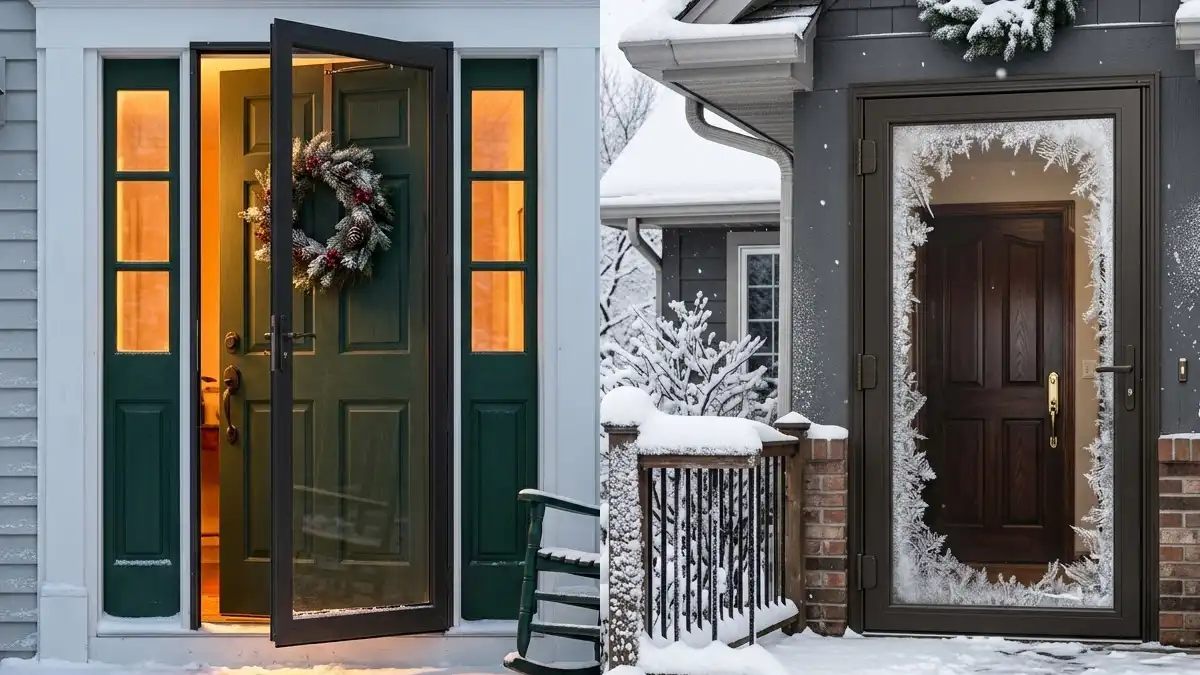
Winter doesn’t just knock on your front door—it tries to push right through it. Subzero temperatures, howling winds, ice accumulation, and snowdrifts turn an unprotected entry into a major heat leak.
A standard storm door helps. But for homes in Minnesota, Wisconsin, New York, Vermont, North Dakota, and other harsh-winter states, you need more than basic protection. You need heavy-duty engineering: thermal breaks, Low-E glass, reinforced frames, and weatherstripping that won’t freeze solid.
This guide covers exactly what to look for in a winter-grade aluminum storm door and which features separate seasonal helpers from true cold-climate performers.
Why Standard Storm Doors Fail in Extreme Cold
Walk up to a cheap storm door on a 10°F morning. Touch the frame. If it’s non-thermal break aluminum, it’ll feel like ice. That cold conducts directly through the metal, creating condensation and frost on the interior side.
Now check the weatherstripping. Budget doors use a single vinyl bulb that hardens and compresses unevenly in subzero temps. Gaps open. Wind whistles through.
The glass? Clear single-pane offers almost no insulation. Interior heat radiates outward, and the glass surface stays cold enough to form frost.
Bottom line: economy storm doors turn your entry into a thermal weak point rather than fixing it.
The Winter-Grade Aluminum Storm Door: Required Features
1. Thermal Break in the Frame – Non-Negotiable
A thermal break is a polyamide strip inserted between the interior and exterior aluminum sections. It stops conductive heat transfer cold.
Without a thermal break, the exterior cold travels straight through the frame to the inside. Your storm door becomes a radiator of cold. With a thermal break, the interior frame surface stays 20–30°F warmer, eliminating condensation and frost.
| Condition | No Thermal Break | With Thermal Break |
|---|---|---|
| Frame temp (20°F outside) | 25–30°F | 45–55°F |
| Frost on interior frame | Common | Rare |
| Condensation between doors | Frequent | Minimal |
| Winter comfort | Cold to touch | Neutral |
For a deeper explanation of how thermal breaks work in aluminum systems, see our energy-saving thermal break aluminum windows guide—the same principles apply to storm doors.
2. Low-E Glass, Not Clear
Low-E (low-emissivity) glass has a microscopic metallic coating that reflects long-wave infrared heat while allowing visible light to pass through.
In winter: Interior heat radiates toward the cold glass. Low-E reflects that heat back into your home. It also allows solar gain (short-wave energy) to pass through and warm the dead-air space between doors.
A Low-E coated storm door cuts heat loss through the glass by 30–50% compared to clear single-pane.
Double-pane Low-E glass exists but is rare in storm doors due to weight. Single-pane Low-E is the practical sweet spot for winter performance.
3. Heavy-Duty Extruded Aluminum Frame (0.080″ Minimum Wall Thickness)
Winter winds place constant pressure on the door. Ice buildup adds weight. A thin-gauge frame (0.040–0.050″) flexes, breaking weather seals and accelerating wear.
Premium winter doors use 6063-T5 extruded aluminum with minimum wall thickness of 0.080 inches or more. Profile depths often reach 65mm. This rigidity keeps the door square through freeze-thaw cycles and wind loads up to 93 mph.
4. Dual-Fin or Closed-Cell Weatherstripping
Single vinyl bulbs harden below freezing. They lose compliance and allow air infiltration.
Look for:
- Dual-fin bulb vinyl – Two contact points create redundant seals
- Closed-cell foam – Compresses evenly and doesn’t absorb moisture
- Adjustable bottom sweep – Rubber or vinyl that maintains contact with the threshold even as the ground heaves
Replace weatherstripping every 5–7 years. Compression set and UV degradation are inevitable.
5. Three Hinges with Stainless Steel Pins
A 50-pound storm door with glass needs support. Two hinges allow the door to sag over time, especially in cold climates where contraction cycles loosen fasteners.
Premium winter doors include a third center hinge. Stainless steel pins resist rust from road salt and melting snow tracked onto the threshold.
6. Deadbolt – Not Optional
A latch alone doesn’t secure your home. Winter storms bring power outages—you want a deadbolt that requires forced entry to defeat. Look for steel bolts that throw at least 1 inch into the frame.
Best Configuration for Windy & Snowy States (ND, SD, MN, WI, MI, NY, VT, NH, ME, CO, WY)
Recommended setup:
- Full-view glass (maximize solar gain)
- Low-E coating
- Thermal break in frame
- Heavy-duty extruded aluminum (0.080″ wall)
- Three stainless steel hinges
- Integrated deadbolt
- Dual-fin weatherstripping
- Retractable or interchangeable screen (winter = glass, summer = screen)
Color recommendation: Dark bronze, black, or forest green—these absorb solar heat during winter days, helping melt frost off the glass surface.
Finish: Powder-coated or anodized both work in cold climates (salt air is not a concern). Powder coating offers more color options.
For homeowners who also want year-round ventilation, models with interchangeable glass/screen panels allow summer conversion. See our best storm doors with screens guide (coming in this series) for more details.
What About Wind-Driven Snow and Ice?
In open plains and lake-effect regions, wind-driven snow packs against the door. Some premium storm doors include:
- Raised bottom sweep – Prevents snow from sealing the door shut
- Drip cap with ice break – Sheds water away from the frame to prevent ice dams
- Sweep with anti-friction coating – Slides freely even when frost forms on the threshold
If you live in a known snow belt (Erie, PA; Buffalo, NY; Marquette, MI), ask your supplier about winter-specific sweep options.
Installation Considerations for Cold Climates
Even the best storm door performs poorly if installed wrong in freezing conditions.
- Use stainless steel screws – Galvanized screws rust and snap during spring thaw
- Add foam filler in frame cavities – Prevents convective loops that bypass the thermal break
- Seal the drip cap with exterior caulk – Water that gets behind the frame freezes, expands, and pushes the door out of square
- Leave 1/8″ gap for expansion – Aluminum contracts in extreme cold; no gap = binding
Professional installation is strongly recommended for winter-grade doors. The extra $100–150 ensures the frame stays square through multiple freeze-thaw cycles.
Energy Savings Expectation
The U.S. Department of Energy estimates a properly fitted storm door with Low-E glass and thermal break can reduce heat loss through an entry by 40–50% compared to no storm door. For a typical home in Minneapolis or Buffalo spending $2,500+ annually on heating, that’s $100–$200 saved per winter.
The payback period for a premium $500–700 storm door versus a $150 economy model is 2–3 winters when you factor in avoided heat loss and longer primary door life.
The Bottom Line
For harsh winter states, don’t compromise. Skip the thin-gauge, non-thermal break doors found at big-box stores. Invest in a heavy-duty extruded aluminum storm door with:
- Thermal break (mandatory)
- Low-E glass (mandatory)
- Three hinges with stainless pins
- Dual-fin or closed-cell weatherstripping
- Deadbolt
Your front door, your heating bill, and your comfort will thank you for 25+ winters.
For a complete starting point, review our best aluminum storm doors for front entrances buyer’s guide, then filter for the winter-specific features listed above.
Related Articles
Featured

You May Also Like

Aluminium Foil: GST Rates & HSN Codes

Aluminium Titanate (Al₂TiO₅): Technical Guide to Zero‑Expans…

Why Arched Windows Are Called Curved Windows: Pros, Cons &am…

Aluminum Chlorohydrate (Al₂(OH)₅Cl): The Complete Guide
What Is Aluminium? 36 Types, Smelting Process & How Alum…
