Aluminium bifold windows (often referred to as aluminum bi-fold windows in North America) have quickly become a favorite in modern residential architecture worldwide. They provide an eye-catching design solution while offering practical benefits that make daily living more comfortable. Whether you are renovating a heritage property in Melbourne, adding a kitchen extension in London, or building a new contemporary custom home in California or Toronto, understanding the ins and outs of these high-performance glass systems will help you make an informed choice that brings value for years to come.
What Are Aluminium Bifold Windows?
Aluminium bifold windows are multi-panel glazing systems made from strong, slim profile frames that fold back on themselves like an accordion or concertina when opened. Unlike traditional casement or double-hung windows that swing or slide open partially, bifolds collapse into a compact stack on one or both sides of the opening, allowing almost the entire architectural aperture to become completely unobstructed.
Bifolds are most frequently specified in ground-floor extensions, indoor-outdoor living areas, and garden-facing spaces where homeowners want to blur the boundary between the interior floor plan and the landscape. The material aluminum is particularly valued in the architectural glazing segment because it is incredibly lightweight yet robust, allowing it to hold large expanses of heavy insulated glass units (IGUs) without bulky framing. It demands very little upkeep and naturally resists the elements—it does not rot, warp, rust, or discolor under harsh environmental conditions.
How Aluminium Bifold Windows Work
The working principle of a bifold window system is simple but clever. Panels are connected by heavy-duty hinges at their vertical edges. The entire system runs along a precision-engineered track, typically a top-hung setup, which keeps operation smooth and takes structural weight off the bottom track.
When you open the window, the first panel (often called the master panel or lead stile) is pulled sideways, and all subsequent panels follow and fold against each other in a controlled accordion motion. By the time the window is fully open, the glass panels are neatly stacked out of the way, leaving only the slim frame profiles in view. Leading systems allow openings of up to 90% of the total rough opening width, transforming how a room interacts with its immediate environment.
Main Components of a Bifold Window System
A quality bifold system is only as good as the components that make it work. Paying attention to the quality of each element ensures smooth daily operation, long-term structural reliability, and security.
- Panels: The individual glazed frames that make up the system. They consist of an aluminum profile that holds insulated glass units (IGUs). Panel widths typically range from 600 mm to 1,200 mm (roughly 24 to 48 inches), depending on wind load requirements and engineering specs.
- Hinges: Hinges connect the panels and enable smooth folding. For external installations, marine-grade stainless-steel hinges offer superior corrosion resistance, handling constant exposure to rain, coastal salt air, and humidity without seizing up.
- Track: Tracks act as the structural pathway along which the panels travel. A top-hung track system suspends the window from above, reducing wear on the bottom mechanism. (Note: while top-hung systems collect less debris, the bottom guide track still needs a quick vacuum occasionally to prevent the rollers from jumping.)
- Rollers: Rollers ensure that panels glide effortlessly along the track. Precision-engineered, sealed ball-bearing rollers reduce friction and noise and are typically adjustable so installers can fine-tune height and lateral alignment for a airtight fit.
- Handles & Locks: Most modern bifold systems use multi-point locking mechanisms that secure the sash at several points along the perimeter frame, offering far better protection than a simple single-point latch.
Common Aluminium Bifold Window Configurations
Bifold systems are highly customizable. The number of panels and the way they fold can be adapted to almost any structural opening. The first number indicates the total quantity of folding panels, followed by how many stack on each side.
- 2-2-0 – A two-panel configuration where both panels fold to one side. Ideal for small to medium openings with limited stack space on one side of the aperture.
- 3-3-0 – Three panels folding to one side. The uneven panel count allows one panel to be used as a “traffic door” or daily access panel, opening like a standard hinged window without unfolding the whole system.
- 4-2-2 – Four panels, with two folding left and two right. Perfect for symmetrical architectural layouts or central access points.
- 4-4-0 – All four panels fold to one side. Creates a single, neat stack, leaving the rest of the opening completely clear.
- 5-2-3 – Five panels, with two stacking on one side and three on the other. This asymmetrical layout works well for irregular openings or off-centre interior traffic flow.
Design ideas for every space – For more inspiration on how to style your bifold windows, explore our dedicated guide: bifold windows design ideas. You’ll find real‑world layouts, colour combinations, and handle finishes to match your project.
-Ads-
Regional Architectural Profiles: US, UK, AU, & CA
While the core mechanics of aluminum bifold windows remain consistent globally, structural requirements, climate considerations, and building codes vary significantly by region.
🇬🇧 United Kingdom
In the UK market, aluminium bifold windows are heavily driven by thermal performance standards and security compliance.
- Regulations & Codes: Systems must comply with Document L of the Building Regulations, which enforces strict maximum U-values for windows (typically requiring 1.4 W/m²K or lower for replacement glazing). Security is governed by the PAS24 certification, a testing standard for enhanced security performance that is highly scrutinized by home insurance providers.
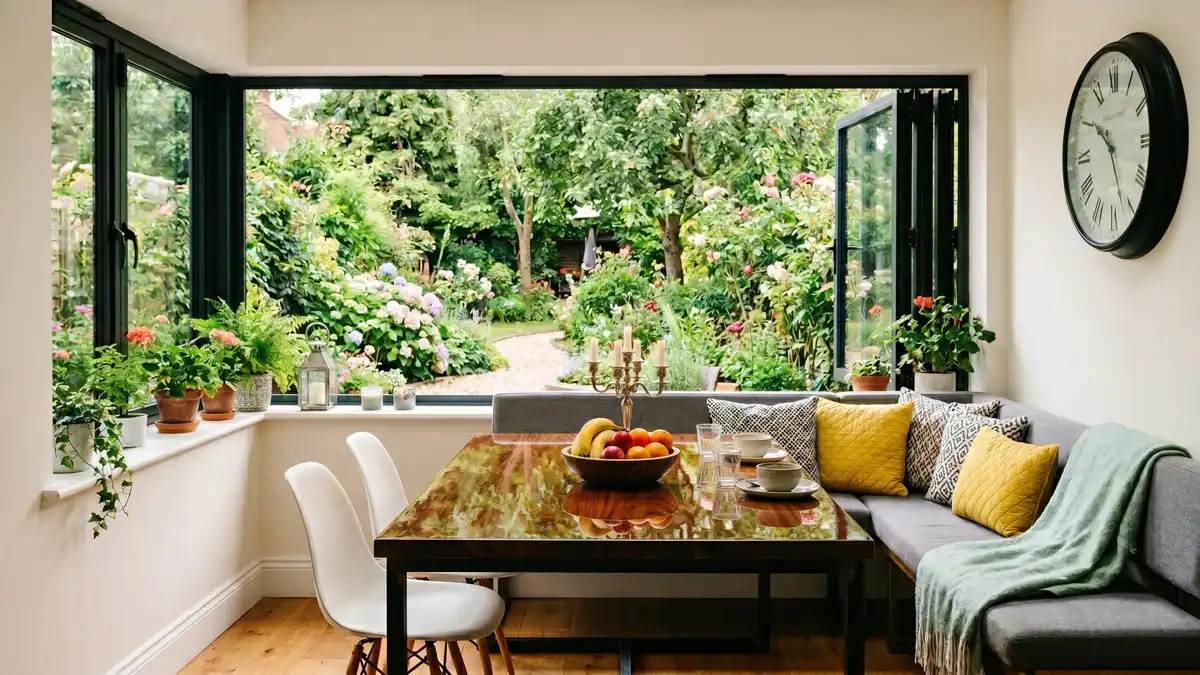
- Architectural Fit: Most commonly featured in modern kitchen-diner extensions, looking out onto rear patios or courtyard gardens. Powder-coated Anthracite Grey (RAL 7016) remains the dominant color choice.
🇺🇸 United States
In the US, aluminum bi-fold windows are popular in high-end custom home builds, particularly in sunbelt states and coastal areas.
- Regulations & Codes: Products are typically rated by the National Fenestration Rating Council (NFRC) for U-factor and Solar Heat Gain Coefficient (SHGC). In coastal markets like Florida or the Northeast, systems must pass rigid Impact Rating standards and structural wind-load testing to comply with local International Residential Code (IRC) updates.
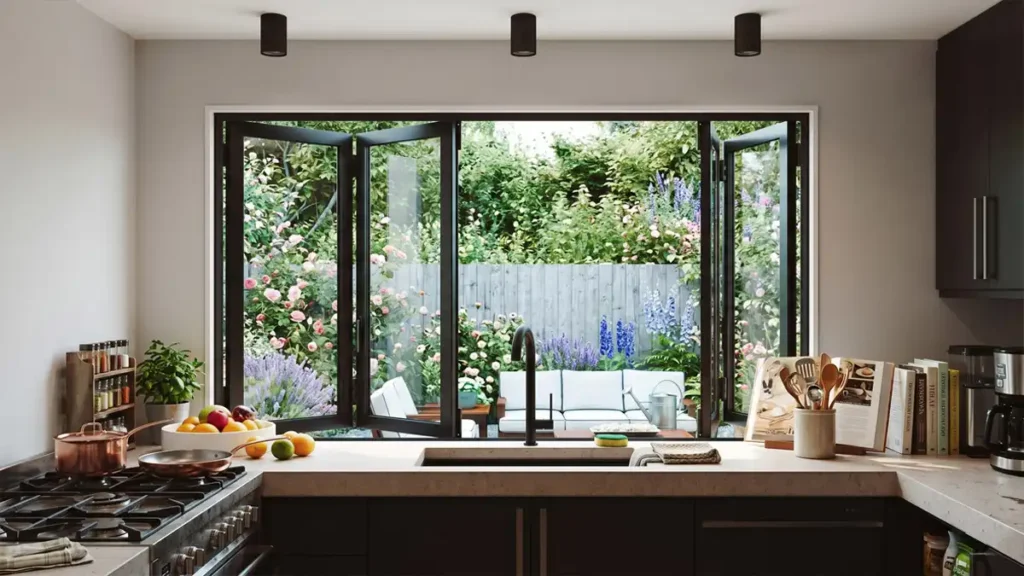
- Architectural Fit: Frequently designated as “pass-through” or “servery” windows over outdoor bars, BBQ islands, and lanai spaces in California, Florida, and the Pacific Northwest. Dark bronze anodized and matte black finishes dominate the luxury market.
🇦🇺 Australia
Australian architecture prioritizes expansive indoor-outdoor transitions, making aluminium bifold windows a staple of modern residential design.
- Regulations & Codes: Systems must be tested and manufactured to comply with AS 2047 (Windows and External Glazing in Buildings) and AS 1288 (Glass in Buildings). Thermal compliance is measured via the Window Energy Rating Scheme (WERS). In bushfire-prone areas, systems must meet specific Bushfire Attack Level (BAL) ratings, which may mandate specialized glass and integrated metal mesh screening.
- Architectural Fit: Used extensively as kitchen servery windows opening onto alfresco decks, outdoor kitchens, and swimming pool enclosures. Clear anodized finishes and coastal-grade powder coatings are highly specified to combat UV degradation and marine environments.
🇨🇦 Canada
In Canada, the extreme thermal variance between seasons means that aluminum bi-fold window systems must feature cutting-edge insulating technology.
- Regulations & Codes: Systems must comply with the National Building Code of Canada (NBC) and are evaluated based on their ER (Energy Rating) or U-factor. Due to severe winters, deep, multi-cavity thermal breaks and argon-filled triple-pane glazing are standard specifications to combat condensation and heat loss.
- Architectural Fit: Popular in four-season sunrooms, lakeside cottages, and urban residential designs across British Columbia, Ontario, and Quebec, allowing homeowners to maximize short summer seasons while staying completely insulated during sub-zero winters.
Benefits of Aluminium Bifold Windows
1. Maximised indoor-outdoor connection
Because the panels fold completely out of the way, bifold windows allow up to 90% of the opening to be completely unobstructed. This creates a truly seamless transition between a kitchen workspace and an outdoor entertainment deck or patio.
2. Abundant natural light
Aluminium frames are structurally strong but very slim. Narrow sightlines mean the total glass surface area is maximized, making interior rooms feel brighter, larger, and more inviting even when the windows are fully closed.
3. Space-saving operation
Unlike traditional French or casement windows that swing outward or inward across a wide radius, bifolds stack compactly together. They do not intrude heavily into the interior room footprint or block narrow outdoor pathways, balconies, or patios.
4. Low maintenance
High-quality aluminum frames are finished with an architectural powder coating or anodized layer, meaning they never require painting, staining, or sealing. A simple wipe-down with mild soapy water and an occasional drop of silicone lubricant on the moving tracks is all that is required.
5. Advanced thermal insulation
Modern architectural aluminum windows incorporate advanced thermal breaks—insulating polyamide strips inserted between the inner and outer aluminum profiles. This prevents thermal bridging, locking heat inside during the winter and keeping humidity or extreme heat outside during the summer.
Some Drawbacks of Bifold Windows
Higher initial cost
Aluminium bifold systems sit at the premium end of the fenestration market. The precision engineering required for the multi-point locking tracks, heavy-duty rollers, and reinforced corner joins carries an upfront cost premium over standard sliding or fixed windows. However, their 20- to 30-year operational lifespan and low maintenance requirements offer a strong long-term return on investment.
Structural stack space requirements
While bifold windows save space along their opening trajectory, the folded panel stack must sit somewhere when opened. If your opening sits flush against a tight corner or structural column with no clearance on either side, a bifold may not be physically feasible. In those specific layouts, an inline sliding window might be a more efficient alternative.
Multiple vertical sightlines
When completely closed, a bifold window system will naturally introduce multiple vertical frame profiles across your field of view. If your absolute top architectural priority is an entirely uninterrupted panoramic view of a landscape, a large-format minimalist sliding window with ultra-slim stiles may be more appropriate.
4 Best Locations for Aluminium Bifold Windows
Thanks to their architectural versatility, bifold windows work exceptionally well across several residential and commercial floor plans:
1. Kitchen Servery Windows
Positioning a bifold window directly above an extended kitchen countertop or sink creates an instant serving hatch to an outdoor bar or patio dining area. It allows food and drinks to be passed back and forth effortlessly while keeping cooking aromas from being trapped indoors.
2. Patio & Courtyard Openings
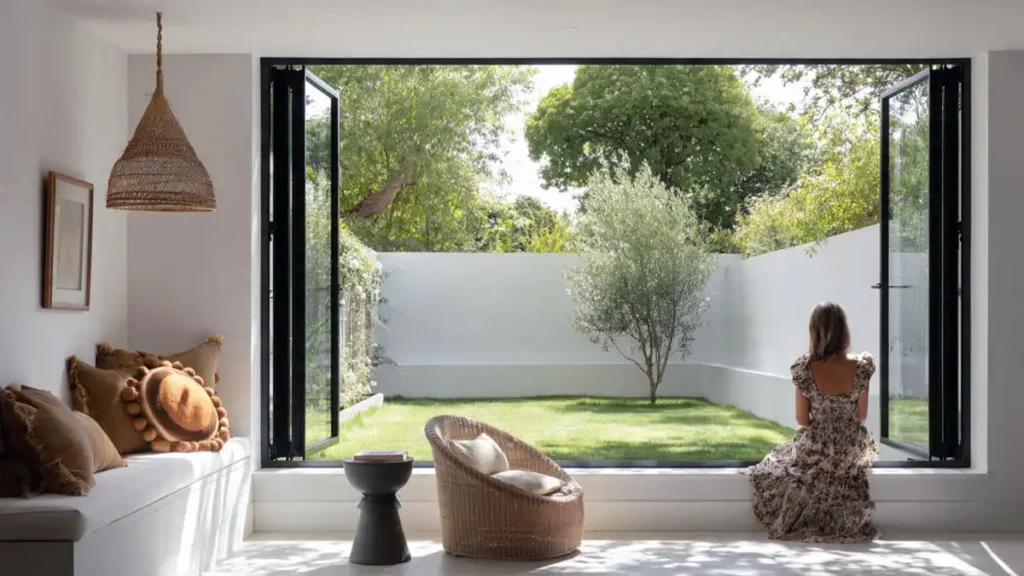
Perfect for ground-floor living areas, home bars, or dining rooms facing a backyard, allowing the main living zone to spill outdoors during social gatherings.
3. Balconies & High-Rise Apartments
In tight urban settings where external projection space is restricted, bifolding windows open smoothly without clashing with balcony railings or exterior structural columns.
4. Commercial Cafés & Hospitality Venues
Restaurants and storefronts utilize commercial-grade bifold window walls to establish open-air dining options on demand, instantly increasing foot traffic and curb appeal during pleasant weather.
Maintenance & Performance
To keep an aluminum bifold window operating smoothly over a multi-decade lifespan, implement a basic seasonal maintenance routine:
Track Clearance: Vacuum out the lower guide track every few months. Small pebbles, pet hair, or windblown dirt can lodge in the tracking system, causing friction against the rollers and putting undue stress on the hinges.
Hardware Lubrication: Apply a light spray of dry silicone lubricant to the stainless-steel rollers, hinges, and multi-point locking cylinders once or twice a year. Avoid heavy oils or grease, which can attract abrasive dirt and dust.
Frame Cleaning: Wipe down the powder-coated exterior profiles using a soft cloth and a mild pH-neutral detergent. Avoid harsh abrasive pads or chemical solvents, which can degrade the integrity of the factory finish.
FAQs
Do aluminum bifold windows offer good energy efficiency?
Yes. When specified with structural thermal breaks and high-performance Low-E double or triple glazing, modern bifold windows comfortably meet and exceed rigid energy codes globally, including Title 24 in the US, Document L in the UK, and NBC mandates in Canada.
Can bifold windows be fitted with insect screens?
Absolutely. Many premium systems can be integrated with heavy-duty retractable insect screens, pleated mesh nets, or blind systems that roll away completely out of sight into the perimeter frame jamb when not in use.
Are they secure against break-ins?
Yes, provided you choose a reputable architectural system. High-quality bifold windows feature robust multi-point locking mechanisms that secure the window panels firmly into the head and sill tracks simultaneously, alongside anti-lift engineering that prevents panels from being forced off their tracks.
Technical Notes
All structural measurements, thermal performance ratings (U-values/U-factors), and code compliances cited in this global guide represent general industry benchmarks. Always consult a certified fenestration engineer, local architect, or factory-certified installer to verify wind-load engineering, local structural regulations, and thermal performance requirements specific to your project’s geographic coordinates.
For more insights into premium architectural glazing solutions and material sciences, visit the Aluminium Magazine homepage.