You need to work safely at a height of 20 feet. The big question is: do you buy a single-piece 20ft aluminium straight ladder or the more common 20ft aluminium extension ladder?
This isn’t just about features. It’s about real-world practicality, storage headaches, and, most importantly, your safety. Let’s cut through the marketing and find the right tool for your job.
⚠️ The Critical Safety Rule Everyone Misses
A “20ft Ladder” Does Not Give You a 20ft Working Height.

You must NEVER stand on the top three rungs of any ladder. The highest safe standing level on a 20ft ladder is approximately 17 feet.
- Your Maximum Safe Working Reach: ≈19-21 feet (17ft ladder +arm extension).
- The Real Question: For this ≈19ft reach, which ladder is safer and more practical?
The Core Question: Is a Fixed 20ft Ladder Even Practical?
A manufacturer can build a single-section, 20ft straight ladder, but the real issue is handling and storage.
| Problem | Reality Check |
| Maneuverability | A 20ft fixed ladder is over 6 meters long. Moving it through a standard hallway or around a corner is extremely difficult. Try moving a 20ft straight ladder through your hallway — it’s like wrestling with a telephone pole indoors. |
| Storage | It demands dedicated, long vertical storage space (a tall, empty wall). Impossible for most homeowners. |
| Transport | Requires a long-bed truck or large van—not a regular car. |
Verdict: The fixed 20ft ladder is a specialist tool for operations where it rarely moves (e.g., industrial warehouse). For the average user, its sheer size makes it prohibitively impractical.
-Ads-
⚖️ The Core Comparison: Stability vs. Versatility
Let’s compare them based on what actually matters when you need to work at a ≈19ft reach.
| Factor | 20ft Straight Ladder | 20ft Extension Ladder | Practical Implication |
| Stability at Height | Superior. Rigid, one-piece design offers minimal flex. | Adequate but Flexible. Has a natural “bounce.” Stability depends on correct setup/lock engagement. | For pure, unwavering confidence and stability, the Straight Ladder wins. |
| Versatility & Storage | Poor. Fixed ≈19ft tasks only. Requires massive vertical storage. | Excellent. Adjustable for various jobs. Collapses to compact length (≈10-11ft) for easy storage. | This is the Extension Ladder’s killer feature for 95% of users. |
| Setup & Portability | Simple to set up, hard to move. “Lean and go,” but a 20ft object is awkward to transport. | Takes more time to set up, easy to move. Must extend and lock sections, but is far more manageable to carry and transport. | The Extension Ladder wins on overall practicality and portability. |
The extension ladder is basically the Swiss Army knife of ladders — one tool, many jobs.
💡 Pro Tip: Always check rubber feet quality — poor grip can make even the most stable ladder unsafe.
Related: Before any purchase, it’s crucial to Understand Aluminium Ladder Strength1.
🧱 Load Capacity: The Critical Safety Check
If you weigh 100kg (220lbs), the load capacity (Duty Rating) is your most important safety concern.
💡 Pro Tip: Buy a rope & pulley system extension ladder — smoother to extend, less bounce at full height.
| Duty Rating | Weight Capacity | User Type |
| Type I (Heavy Duty) | 250 lbs (113 kg) | Minimum for a 100kg user. |
| Type IA (Extra Heavy Duty) | 300 lbs (136 kg) | Recommended. Provides a safety margin for tools and movement. |
Recommendation: For a 100kg user, a Type IA ladder is strongly recommended.
-Ads-
Load Capacity at Height: The Physics Reality
A ladder’s effective load capacity feels different as you go higher due to leverage.
- Extension Ladder: The connection points (locks) and overlapping sections are under more stress. Never exceed the duty rating, especially when fully extended.
Related: For a different perspective on ladder choices, see our comparison of 20ft Aluminium Ladder: Straight vs. Extension Ladders2.
Final Verdict: Which One Should YOU Buy?
Think of the straight ladder as a tank — powerful but bulky. The extension ladder? More like an SUV — versatile and practical for everyday life.”
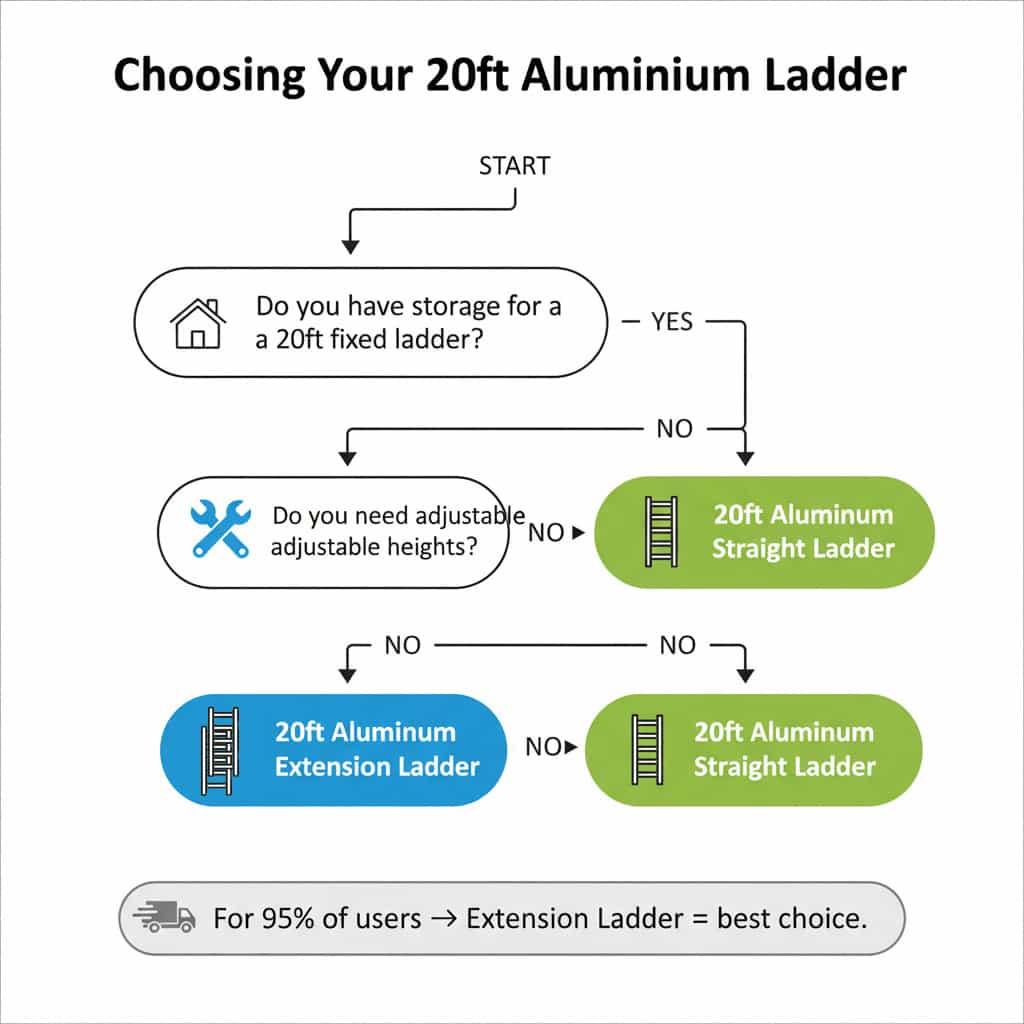
Choose the Single-Piece 20ft Straight Ladder ONLY if:
- You have a dedicated, repetitive task that always requires the same ≈19ft reach.
- You have industrial-grade storage for a 20ft object.
- Maximum stability and rigidity are non-negotiable top priorities.
Choose the 20ft Extension Aluminium Ladder if:
- You are a homeowner, contractor, or handyman (this covers most users).
- Storage space is limited in your garage, shed, or vehicle.
- You need one ladder that can do it all, from low-level repairs to high gutter cleaning.
- You purchase a Type IA rated model and commit to correct setup.
This is the practical, versatile, and recommended choice for almost everyone.
-Ads-
🛑 Non-Negotiable Safety Checklist
- CHECK THE STICKER: Confirm the Duty Rating is Type I or Type IA before you buy or climb.
- RESPECT THE ANGLE: Use the “1-in-4” rule: for every 4 feet of height, the base should be 1 foot out from the wall (≈75 degrees).
- INSPECT AT HEIGHT (Extension): Before climbing, ensure all rung locks are fully engaged and the sections have sufficient overlap (3-4 feet).
- NO OVERREACHING: Keep your belt buckle between the ladder rails at all times.
- ELECTRICAL WORK: NEVER use an aluminium ladder for electrical work. Use fiberglass.
❓ Frequently Asked Questions (FAQs)
Q1: The extension ladder feels “bouncy” at full length. Is it safe?
A1: A slight, controlled flex is normal. A pronounced bounce is a danger sign. Stop immediately, descend, and check the angle, locks, and overlap.
Q2: Are aluminium ladders safe for electrical work?
A2: NO. Aluminium conducts electricity. For any electrical work, you must use a fiberglass ladder.
Q3: What is the realistic lifespan of an aluminium ladder?
A3: With proper care and storage, a quality aluminium ladder can easily last over a decade. Inspect it regularly for damage.
Related: Exploring business opportunities? Learn about the potential in the
-Ads-
Related Articles
Featured


You May Also Like

The Lightweighting Imperative: How Aluminium Extrusion is Wi…
Why Aluminium Cans Are Only 0.1 mm Thick — Yet Strong Enough…
Why Aluminium is the Best Material for Skylights in Australi…

Aluminium Arched Windows: Pros & Cons of Aluminum Frames

Aluminium Sheet Metal and Where it use