The glass in your storm door does more than let you see outside. It determines energy performance, safety, UV protection, and even privacy.
Walk through any home improvement store, and you’ll see storm doors with clear glass, tinted glass, Low-E coatings, frosted patterns, and tempered safety ratings. Each type serves a different purpose. Choose wrong, and you’ll have a door that fades your flooring, traps heat, or shatters dangerously.
This guide cuts through the confusion. You’ll learn exactly what each glass type does, which combinations work for your climate, and how glass interacts with your aluminum storm door frame.
The Four Glass Types You Need to Know
1. Clear Annealed Glass
Standard, untreated glass. It’s what you get on the cheapest storm doors.
Pros: Maximum visible light (90%+), least expensive, no color distortion.
Cons: No UV protection (UV-A passes through), poor insulation, shatters into sharp shards, no privacy.
Best for: Mild climates, budget rentals, north-facing entries with zero direct sun.
Avoid if: You have south/west exposure, valuable flooring or art, children near the door (shatter risk).
2. Tempered Glass
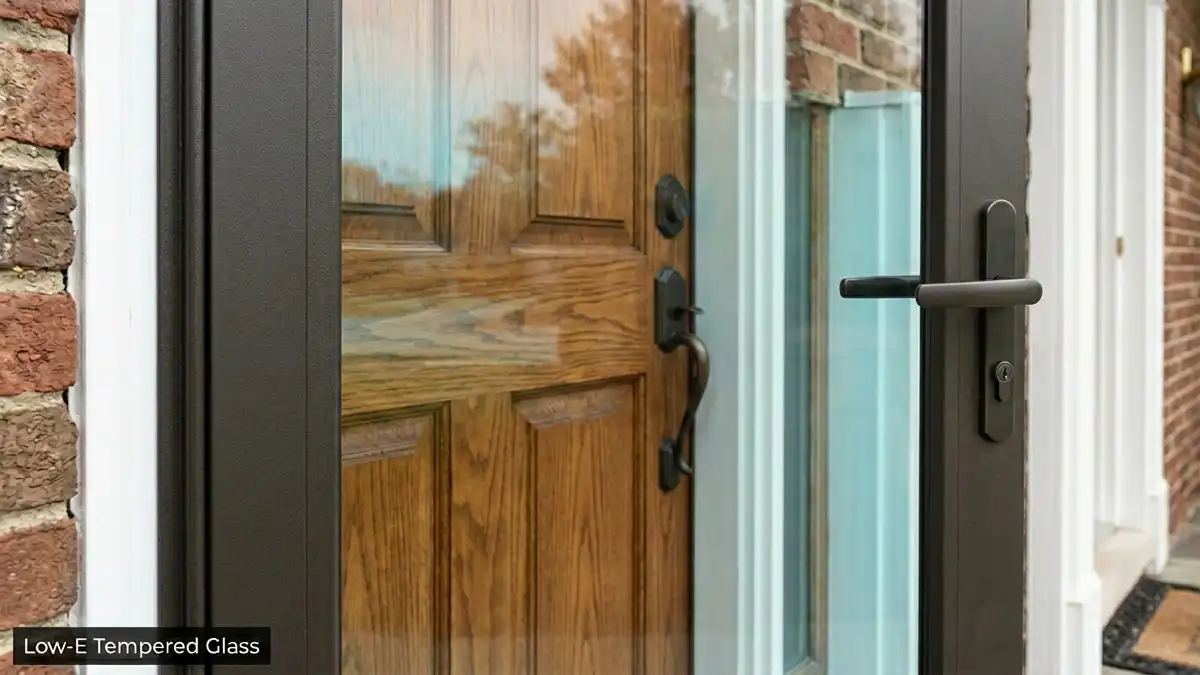
Annealed glass that has been heat-treated and rapidly cooled. It’s four to five times stronger than annealed glass.
Pros: Safety glass—shatters into small, dull cubes (not sharp shards), meets building codes for doors, good impact resistance.
Cons: Slightly more expensive than annealed, same insulation and UV performance as clear glass.
Best for: Any storm door in a home with children, pets, or high-traffic entries. Often required by code.
Important: Most quality storm doors use tempered glass as the base. The upgrade is not annealed vs. tempered—it’s adding Low-E coating to tempered glass.
3. Low-E (Low-Emissivity) Glass
Tempered glass with a microscopic metallic oxide coating. The coating reflects infrared heat while passing visible light.
Pros:
- Reflects interior heat back inside (winter)
- Reflects exterior heat away (summer)
- Blocks 30–50% more UV than clear glass
- Nearly invisible coating—doesn’t change appearance
Cons: Costs $50–150 more per door, slightly cooler color temperature (barely noticeable).
Best for: Any climate with heating or cooling seasons. The single most valuable glass upgrade.
For a deeper dive into energy performance, see our storm door insulation and energy efficiency guide.
4. Tinted Glass (Bronze, Gray, Green)
Glass with colorants added during manufacturing. Reduces visible light transmission and solar heat gain.
Pros: Reduces glare, lowers cooling load in hot climates, adds daytime privacy (harder to see in from outside).
Cons: Darkens interior, makes entry feel smaller, absorbs heat (can transfer to frame), looks dated on modern homes.
Best for: West or south-facing entries in desert climates (AZ, NV, NM) where reducing solar gain is the priority.
Not recommended for: Cold climates (blocks valuable solar heat), modern minimalist homes, north-facing entries.
Privacy Glass Options (Frosted, Obscure, Patterned)
Sometimes you want light without a clear view. Bathroom entries, side doors, or homes on busy streets benefit from privacy glass.
| Type | Appearance | Best Use |
|---|---|---|
| Acid-etched | Smooth, milky white, uniform | Full privacy, modern look |
| Sandblasted | Textured, slightly translucent | Partial privacy, softer light |
| Patterned (rain, glue-chip) | Distinct textures (waves, ice patterns) | Decorative privacy, traditional homes |
| Translucent film | Applied to existing glass | Cheap retrofit, temporary |
Trade-offs: Privacy glass blocks visibility but also reduces natural light by 30–60%. It does not improve energy performance unless combined with Low-E coating.
Recommendation: Use privacy glass only on doors where you genuinely need obscurity (bathroom, side entry). For front doors, clear Low-E glass with a retractable screen offers privacy when needed (screen down) and full view when desired.
For more on glass types in aluminum systems, see our types of glass for aluminum doors and windows guide.
Low-E vs. Tinted: Which Is Better for Hot Climates?
Homeowners in Texas, Florida, and Arizona often assume tinted glass is the best choice for heat rejection. That’s not always correct.
| Feature | Tinted Glass | Low-E Glass |
|---|---|---|
| Visible light transmission | 50–70% | 75–80% |
| Solar heat gain coefficient (SHGC) | 0.40–0.60 | 0.25–0.40 |
| UV block | Moderate (30–50%) | High (50–70%) |
| Winter heat retention | Poor (blocks solar gain) | Good (reflects interior heat) |
| Appearance | Dark, colored cast | Clear, barely noticeable |
Verdict: Low-E glass outperforms tinted in every metric except glare reduction. For extreme sun, combine Low-E with a slight tint (available from some manufacturers). For most homes, Low-E alone is the better year-round choice.
Glass and Frame Interaction: The Aluminum Connection
Your glass choice doesn’t exist in isolation. It interacts with the aluminum frame in three important ways:
1. Thermal break necessity
Low-E glass reduces radiant heat transfer, but the aluminum frame still conducts heat. A thermal break in the frame is required to realize the full energy benefit. Non-thermal break frames negate much of Low-E’s advantage.
2. Condensation management
In cold climates, warm interior air hits cold glass. Condensation forms. Low-E glass stays slightly warmer than clear glass, reducing but not eliminating condensation. A thermally broken frame further reduces cold transfer to the glass edge.
3. Weight and hinge stress
Double-pane insulated glass (rare in storm doors but available) weighs significantly more than single-pane. Heavy glass requires three hinges and reinforced frame attachment points.
For a full explanation of thermal breaks, see our energy-saving thermal break aluminum windows guide.
What About Double-Pane Storm Door Glass?
Some premium storm doors offer double-pane insulated glass units (IGUs). Two glass panes with argon gas between them.
Pros: R-value of 2–3 (single-pane is R-0.9), excellent condensation resistance, superior noise reduction.
Cons: Heavy (adds 10–15 lbs), expensive, reduces visible light slightly, overkill for most climates.
Who needs double-pane:
- Extreme cold climates (Zone 6+, e.g., International Falls, MN)
- Homes with no other entry insulation
- Noise-sensitive locations (near airports, highways)
Who doesn’t: Most US homes. Single-pane Low-E with a thermal break frame provides 90% of the benefit at half the cost and weight.
UV Protection: What the Numbers Mean
UV radiation causes fading. Standard clear glass blocks UV-B but allows most UV-A through. That UV-A penetrates deeper and causes most fading.
UV block by glass type:
- Clear single-pane: 25–35%
- Tinted: 40–60%
- Low-E single-pane: 50–70%
- Low-E double-pane: 70–85%
- Laminated glass: 99% (rare in storm doors)
For homes with expensive entryway rugs, hardwood floors, or artwork, Low-E glass is the minimum acceptable UV protection.
Glass Thickness: 1/8″ vs. 3/16″ vs. 1/4″
Most storm doors use 1/8-inch (3mm) tempered glass. That’s adequate for standard use.
Upgrade to 3/16″ (5mm) or 1/4″ (6mm) if:
- You live in a high-wind or hail-prone region
- The door faces south or west and will experience thermal stress
- You want additional impact resistance (though still less than security mesh)
Thicker glass adds weight (1/4″ weighs 50% more than 1/8″). Ensure the frame and hinges are rated for the extra load.
For security-focused applications, consider stainless steel mesh instead of glass. See our best security storm doors guide.
Glass by Climate: Quick Reference
| Climate Zone | Recommended Glass | Avoid |
|---|---|---|
| Cold (MN, WI, ND, ME) | Low-E (single-pane) | Clear, tinted |
| Hot-humid (FL, TX, LA, GA) | Low-E + ventilating door | Clear, full-glass (heat trap) |
| Hot-dry (AZ, NV, NM) | Low-E with light tint | Clear (too much solar gain) |
| Mixed (MO, OH, PA, VA) | Low-E (single-pane) | Tinted (reduces winter solar gain) |
| Marine (CA, WA, OR coast) | Low-E or clear with tempered safety | Tinted (reduces already low light) |
| Any climate with children/pets | Tempered (safety) | Annealed (shatter risk) |
For a complete climate-based analysis, see our storm doors necessary by climate guide.
Maintenance and Cleaning
Glass storm doors collect fingerprints, pollen, and water spots.
Do:
- Clean with mild soap and water
- Use a soft microfiber cloth or squeegee
- Clean both sides (the space between glass and screen collects debris)
Don’t:
- Use abrasive pads (scratch the Low-E coating)
- Use ammonia-based cleaners on tinted or Low-E glass
- Pressure-wash the glass (seal damage)
For Low-E glass specifically, the coating is on the interior surface of the exterior pane (in double-pane) or on one surface of single-pane. Scratching the coating ruins its performance. Soft cloths only.
For general care of aluminum frames and glass, see our how to maintain aluminum windows and doors guide.
The Bottom Line
Glass is not a commodity. The right glass transforms your storm door from a simple weather barrier into an energy-saving, UV-protecting, safety-enhanced home asset.
Your cheat sheet:
- Default choice for most US homes: Tempered Low-E single-pane glass. Maximum performance for the price.
- Safety priority: Tempered glass (non-negotiable if you have children).
- Privacy needs: Frosted or obscure glass only on side/bathroom entries.
- Hot climates: Low-E, not tinted. Tinted is outdated.
- Cold climates: Low-E. Double-pane only for extreme cold or noise.
- Avoid: Clear annealed glass on any door you actually care about.
Invest in Low-E tempered glass with a thermally broken aluminum frame. Skip the cheap clear glass doors. Your energy bill, your furniture, and your family’s safety will thank you.
For a complete starting point, see our best aluminum storm doors for front entrances buyer’s guide and filter for Low-E tempered glass.
Related Articles
Featured
You May Also Like

Aluminum vs. Vinyl vs uPVC Windows

From Raw Metal to Real-World Shapes: The Essential Role of E…
Water Leakage at Aluminium Window Frame-Wall Joints: A Step-…

Aluminium Sulfate (Al₂(SO₄)₃): The Complete Guide
Should I Repair or Replace My Old Windows? Here’s the Real A…