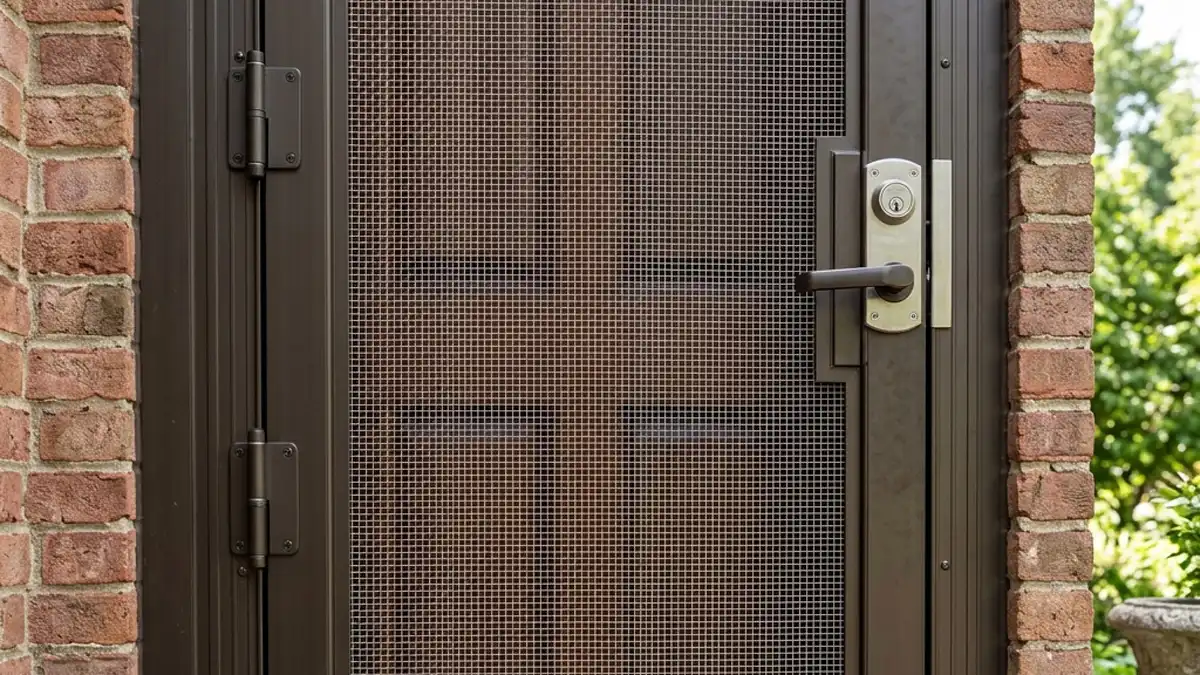
Your front door lock stops someone from turning the handle. But what stops someone from kicking the door in, prying the frame apart, or breaking a sidelight and reaching through?
A standard storm door adds a second barrier. But a true security storm door is engineered to resist forced entry—heavy-gauge extruded aluminum, reinforced strike plates, tamper-proof hinges, and high-tensile stainless steel mesh that stops a crowbar cold.
Many homeowners assume security means heavy steel. That’s outdated thinking. Modern aluminum security doors offer the same or better impact resistance without the rust, weight, and maintenance headaches.
This guide covers what actually makes a storm door secure, the steel vs. aluminum debate, and which features separate cosmetic doors from protective barriers.
The Misconception: Steel Is Always Stronger
Walk into any big-box store, and you’ll see “security doors” made of welded steel bars or expanded metal. They look tough. And they are—against a casual kick.
But steel rusts. A scratched powder coating in a coastal or humid environment leads to corrosion within months. Rust weakens welds and eats through tubes from the inside. Five years later, that “tough” steel door is structurally compromised.
Premium extruded aluminum, on the other hand, doesn’t rust. Ever. Marine-grade aluminum alloys (6061, 6063) are used in boat hulls and aircraft frames. They resist salt, humidity, and temperature swings.
The real comparison isn’t steel vs. aluminum. It’s heavy-gauge extruded aluminum vs. thin steel tubing. Quality aluminum wins.
What Makes a Storm Door “Security Grade”
Not every storm door qualifies as a security door. Look for these specific engineering features:
1. Heavy-Gauge Extruded Aluminum Frame (0.080″ Minimum)
Standard storm door frames use 0.040–0.050″ wall thickness. Security-grade doors start at 0.080″ and go up to 0.125″ (1/8 inch). The frame must resist prying and spreading—where a crowbar tries to widen the gap between door and jamb.
Ask for the exact wall thickness. “Heavy-duty” is marketing. “0.080-inch 6063-T5 aluminum” is a specification.
2. Reinforced Strike Plate and Deadbolt
The lock is only as strong as what it anchors into. Security doors include:
- Steel strike plate with 3-inch screws into the framing stud
- Deadbolt with 1-inch throw (minimum)
- Anti-drill and anti-pick cylinder
- Reinforced lock housing – not plastic
Cheap doors use a basic latch and a thin stamped strike plate. A firm shoulder push defeats it.
3. Stainless Steel Security Mesh (Not Standard Screen)
Standard fiberglass or aluminum insect screen tears with a utility knife. Security mesh is different:
- 304 or 316 stainless steel wire (marine grade for coastal)
- Wire diameter 0.027″ or thicker
- Aperture 3/32″ or smaller (fine enough to block insects too)
- Welded or woven construction – resists cutting, prying, and pushing through
Some premium meshes are rated to withstand 200+ foot-pounds of impact—equivalent to a grown man’s full-force kick.
4. Hinge Security Pins
Standard hinges have removable pins. Pull the pin, remove the door. Security hinges include:
- Non-removable pins (set screw locks pin in place)
- Hidden pivot hinges (no exposed pins at all)
- Three heavy-duty hinges minimum
5. Jamb Reinforcement
The door frame itself must resist spreading. Look for:
- Reinforced aluminum jamb with internal steel stiffener
- Multi-point locking (locks at top, middle, and bottom)
- Security studs that engage into the jamb when the door closes
For a foundation-level understanding of storm door protection, see our what do storm doors do for a home guide.
Steel vs. Aluminum Security Doors: The Showdown
| Factor | Steel Security Door | Aluminum Security Door |
|---|---|---|
| Weight | 80–120 lbs | 40–60 lbs |
| Rust resistance | Poor (needs painting) | Excellent (anodized or powder-coated) |
| Impact strength | Very high | High (thicker gauge needed) |
| Frame thickness needed | 0.050″ – 0.065″ | 0.080″ – 0.125″ |
| Hinge wear | Heavier door wears hinges faster | Lighter door, less stress |
| Marine/coastal suitability | No (rust within 2-3 years) | Yes (anodized) |
| Custom color options | Limited (baked enamel) | Unlimited (powder-coated) |
| Lifespan in humid climate | 5–10 years before rust | 20+ years |
| Cost | $300–600 | $500–1,000+ |
The verdict: Steel works in dry, inland areas if you religiously touch up scratches. Aluminum is better everywhere—and the only sensible choice within 10 miles of salt water.
Security Mesh: The Critical Component
Standard insect screen stops mosquitoes. It does not stop a knife, screwdriver, or fist.
Security mesh is made of stainless steel wire, often woven or welded into a rigid panel. To test quality:
- Wire gauge: 0.027″ or thicker (standard screen is 0.011″)
- Cut resistance: A utility knife should not penetrate with one pass
- Push-out resistance: Should not flex inward more than 1 inch with firm hand pressure
Some top-tier security meshes are rated ASTM F1233 (forced entry resistance) or CPTED (Crime Prevention Through Environmental Design) certified.
Stainless Steel Grade Matters
- 304 stainless steel – Standard, good corrosion resistance. Fine for most inland locations.
- 316 stainless steel – Marine grade. Contains molybdenum for superior salt resistance. Mandatory for coastal Florida, Texas, California.
Cheap “security doors” use 304 mesh painted black. Salt air will cause rust spots at the weld points within 12 months.
Best Applications for Security Storm Doors
High-Crime Urban Areas (Chicago, Detroit, Baltimore, Philadelphia, parts of LA/NYC)
Full-height stainless steel mesh, multi-point locking, reinforced jamb, non-removable hinge pins. The door should look substantial enough to deter casual attempts.
Coastal Florida, Texas, Georgia, South Carolina
316 marine-grade stainless steel mesh + anodized aluminum frame (not powder-coated). Powder coating peels if salt gets under a scratch. Anodizing is integral to the metal.
Homes with Glass Sidelights
A sidelight next to your front door is a vulnerability—break the glass, reach in, unlock the door. A security storm door that covers both the door and sidelight (or a separate security screen over the sidelight) closes that gap.
Rental Properties
Landlords install security doors to reduce liability and break-in claims. Durable, low-maintenance aluminum with security mesh lasts through multiple tenants.
Remote or Rural Properties
Not necessarily high crime, but response times are longer. A security door buys critical minutes.
For a comparison of security vs. basic storm door construction, see our storm doors vs. screen doors guide.
What Security Storm Doors Do NOT Do
- Stop a firearm – Security mesh is not bulletproof. Ballistic doors exist but cost thousands.
- Replace a deadbolt on your primary door – You still need a quality lock on your main entry.
- Prevent window entry – A security storm door protects only the door opening.
Installation for Security, Not Just Fit
A $1,000 security door installed with drywall screws fails instantly. Security installation requires:
- 3-inch screws through the strike plate into the stud
- Security screws (non-removable head) on hinges
- Reinforced framing behind the jamb (add backing if needed)
- No gaps wider than 1/8 inch between door and jamb
Professional installation is strongly recommended. The extra $150–200 ensures the door performs as engineered.
Top Security Features Cheat Sheet
| Feature | Must-Have | Nice-to-Have |
|---|---|---|
| Frame wall thickness | 0.080″ min | 0.125″ |
| Deadbolt throw | 1 inch | 1.5 inches |
| Strike plate screws | 3 inches into stud | 4 inches |
| Security mesh material | 304 stainless | 316 stainless (coastal) |
| Hinge pin security | Non-removable | Hidden pivot |
| Jamb reinforcement | Steel stiffener | Multi-point locking |
The Bottom Line
A security storm door is not a decorative accessory. It’s a functional barrier that can mean the difference between a deterred intruder and a successful break-in.
For most US homes, a heavy-gauge extruded aluminum frame with stainless steel security mesh, 1-inch deadbolt, reinforced strike plate, and non-removable hinge pins provides excellent protection without the rust and weight of steel.
Choose 304 stainless mesh for inland areas. Upgrade to 316 marine-grade within 10 miles of salt water. Specify anodized finish for coastal homes.
Install with proper screws into studs. Replace the cheap latch that comes with the door if necessary. And remember: the best security door in the world still needs a solid primary door and deadbolt behind it.
For a complete starting point, see our best aluminum storm doors for front entrances buyer’s guide, then filter for models with security mesh and reinforced frames.
Related Articles
Featured
You May Also Like
Curtain Wall Profiles: Types, Shapes, Materials & Applic…

Is the Aluminium Ladder Business Profitable?
Aluminium Windows: Improper Glass Installation Orientation –…
Aluminium Frame Deformation and Poor Rigidity: A Step‑by‑Ste…

Aluminum Phosphate (AlPO₄): The Complete Guide