
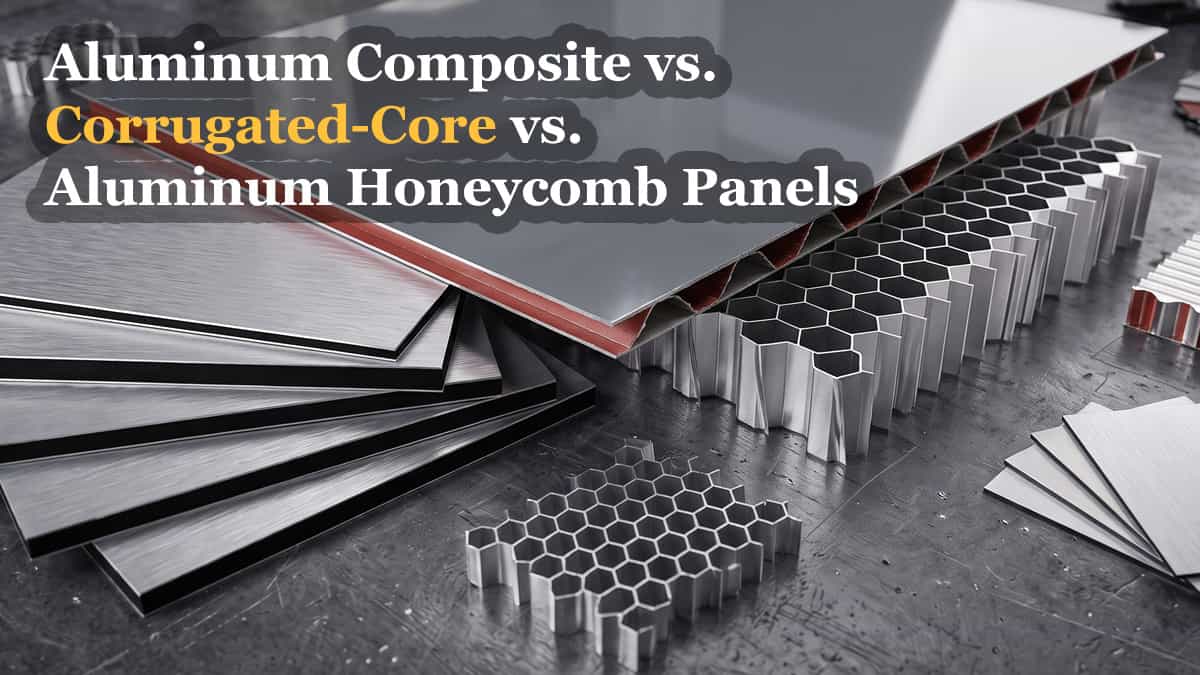
At first glance, an aluminum composite panel, an aluminum corrugated-core panel, and an aluminum honeycomb panel can look remarkably similar. All three may present a smooth aluminum surface, all can be used in architectural applications, and all rely on some form of sandwich construction.
But the important difference is hidden between the face sheets.
ACP uses a continuous core, which may be polyethylene-based or a mineral-filled polymer formulation, depending on the product. Corrugated-core panels replace that continuous core with formed aluminum. Honeycomb panels use a cellular aluminum honeycomb core.
That difference in core architecture affects weight, stiffness, panel thickness, fabrication, fire performance, cost and ultimately where a particular panel makes sense.
This also means there is no universal hierarchy in which ACP is simply “basic,” corrugated aluminum is “better,” and honeycomb is “best.”
The right question is:
What does the project require the panel to do?
Three Panels, Three Core Architectures
The simplest way to understand the difference is to look inside.
| Aluminum Composite Panel (ACP/ACM) | Aluminum Corrugated-Core Panel | Aluminum Honeycomb Panel | |
|---|---|---|---|
| Face material | Aluminum | Aluminum | Aluminum |
| Core concept | Continuous composite core | Corrugated aluminum core | Cellular aluminum honeycomb core |
| Core geometry | Solid/continuous | Repeating ribs or waves | Repeating honeycomb cells |
| Typical design objective | Thin, flat, readily fabricated architectural panel | Lightweight all-metal sandwich construction with increased section depth | High stiffness at relatively low weight and larger sandwich depths |
| Fire performance | Depends strongly on core formulation and tested product | Depends on complete tested product/system | Depends on complete tested product/system |
| Common positioning | Architectural cladding, signage and interiors | Architectural cladding and related applications | Architecture plus transport and other weight-sensitive applications |
These are general characteristics, not specifications.
Panel thickness, aluminum skin thickness, alloy, core geometry or density, adhesive, coating, fixing system and other variables can substantially change the performance of products within the same category.
Aluminum Composite Panel (ACP/ACM)
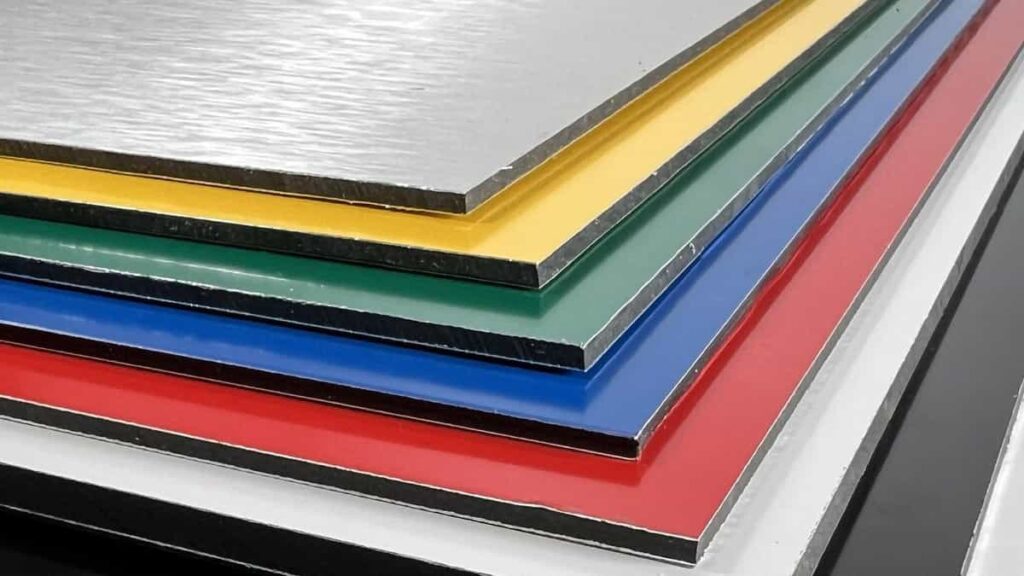
An aluminum composite panel generally consists of two relatively thin aluminum sheets bonded to a continuous core.
That core is one of the most important details on the specification sheet.
Traditional products may use polyethylene (PE), while other products use mineral-filled polymer cores engineered for improved reaction-to-fire performance. It is therefore misleading to treat every product sold as “ACP” as though it has the same core or fire behavior.
Why ACP Became So Common
ACP combines several useful characteristics in a relatively thin panel.
It can provide a flat architectural surface, is available in a huge range of colors and finishes (note: protective finishes such as PVDF, FEVE, and anodized coatings are available across all three panel types, meaning aesthetic choice rarely dictates core selection), and can often be cut, routed, folded and formed into cassette-type components using established fabrication methods.
That mature fabrication ecosystem is an important advantage.
For many projects, the engineering objective is not to obtain the stiffest possible panel. It is to obtain a panel that meets the project’s performance requirements while remaining economical and practical to fabricate.
In those situations, specifying a more elaborate core simply because it is technically capable of greater stiffness may provide little practical benefit.
The Important ACP Qualification: The Core Matters
The term ACP alone does not tell you its reaction-to-fire classification.
For example, products are commercially available with an A2-s1,d0 classification under EN 13501-1, while other composite-panel constructions use very different core formulations and achieve different classifications.
Therefore statements such as:
“ACP is combustible.”
or
“ACP is fire resistant.”
are both too broad to be useful specifications.
The actual product, core composition, classification report, applicable test standard, façade assembly and local building regulations matter.
Aluminum Corrugated-Core Panels
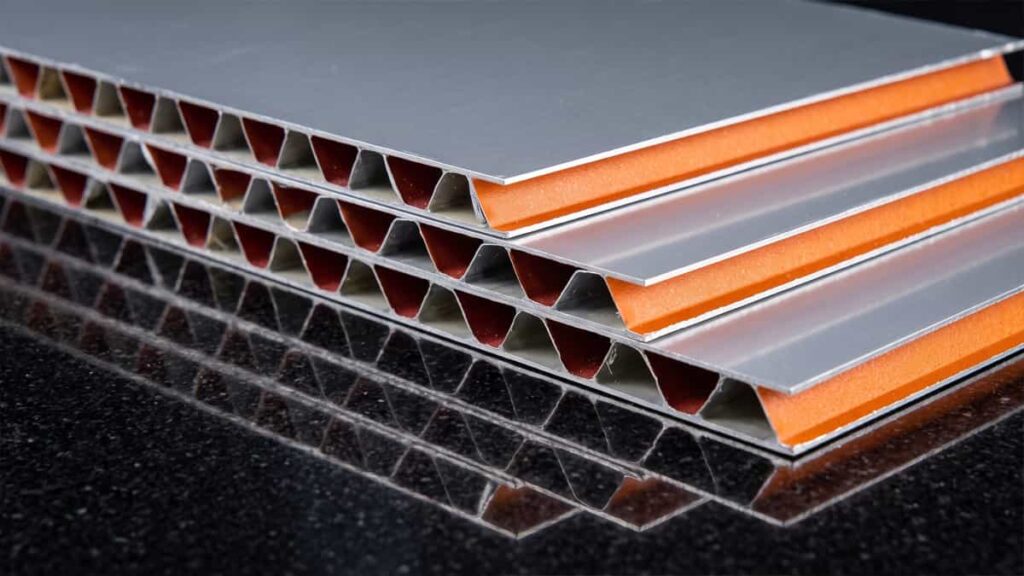
A corrugated-core aluminum panel changes the middle of the sandwich.
Instead of a continuous polymer or mineral-filled core, formed aluminum creates repeating channels or ribs between the outer aluminum sheets.
The result is an aluminum sandwich panel in which geometry—not simply a solid core—helps separate and support the skins.
The Corrugation Is Inside the Panel
This distinction is important.
A corrugated aluminum-core panel should not automatically be confused with exposed corrugated aluminum sheeting.
The core may be corrugated while the exterior face sheet remains flat.
Consequently, describing this entire category as having a visibly “wavy” or “ribbed” façade surface is incorrect.
Why Use a Corrugated Core?
Separating two face sheets with a lightweight formed core can significantly increase the structural depth of a panel without filling the entire space with solid material.
This is the same broad sandwich-panel principle that makes cellular cores useful: material is arranged where it can contribute efficiently to the panel rather than simply increasing the thickness of a solid sheet.
Corrugated-core products can therefore combine relatively low mass with useful rigidity.
Some commercially available architectural corrugated-core aluminum panels also carry A2-s1,d0 reaction-to-fire classifications under EN 13501-1.
But again, that classification belongs to the tested product, not automatically to every panel containing a corrugated aluminum core.
One Detail Worth Asking About: Direction
A corrugated core commonly has a defined orientation.
Its ribs may run predominantly in one direction, whereas a honeycomb core has a cellular geometry.
That does not automatically make one stronger than the other.
It does mean that engineers and specifiers should look at the manufacturer’s actual mechanical data and the orientation of the panel rather than relying only on a generic word such as “rigid.”
The extent of this directional behavior depends on the core geometry and the overall panel construction.
Aluminum Honeycomb Panels
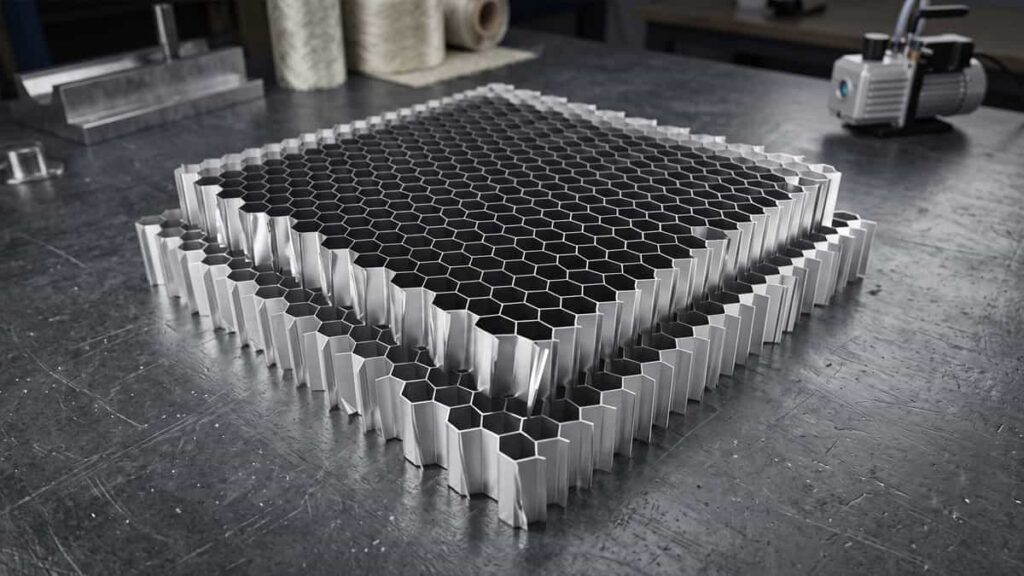
An aluminum honeycomb panel uses an array of cells, commonly hexagonal in form, between the face sheets.
The face sheets are bonded to this cellular core to create a relatively deep sandwich section without requiring a correspondingly large mass of material throughout the interior.
This is why honeycomb construction appears far beyond building façades. Variations of aluminum honeycomb sandwich structures are used in architecture, transportation, marine and industrial applications where stiffness and mass are important design considerations.
Why Honeycomb Can Be So Stiff Without Being Solid
Imagine two aluminum skins placed directly against one another.
Now move those skins farther apart while providing a lightweight structure between them capable of transferring loads.
The overall section becomes much deeper without becoming a solid block of aluminum.
That geometry is central to the stiffness-to-weight advantage associated with sandwich panels.
However, statements such as “honeycomb is five times stronger” are meaningless without defining what is being compared.
Five times the stiffness of what?
At the same thickness?
At the same mass?
With which skin thickness?
Which alloy?
Which cell size and core density?
Under what loading condition?
A credible specification requires those questions to be answered.
Honeycomb Does Not Automatically Mean A2
An all-aluminum-looking construction can create a tempting assumption:
metal skins + aluminum core = non-combustible panel.
Real products demonstrate why that shortcut is unsafe.
Commercial aluminum honeycomb panels can have different EN 13501-1 classifications. Factors beyond the visible metal components—including bonding systems and the construction of the tested product—can influence classification.
The correct approach is therefore to request the classification documentation for the specific panel being specified.
Weight:
There Is No Universal Lightest Panel
Simple comparison charts often list one weight for ACP, one for corrugated-core panels and one for honeycomb panels, then declare a winner.
That comparison can be seriously misleading.
A panel’s mass per square metre depends on variables including:
- overall panel thickness;
- front and rear skin thickness;
- core material;
- core geometry or density;
- coatings and other layers.
Even within one honeycomb product family, changing panel thickness, skin configuration or core specification can change the weight.
The same applies to composite and corrugated-core products.
Therefore:
“Corrugated-core aluminum is always the lightest”
and
“ACP is always the heaviest”
should not be treated as engineering rules.
Compare actual candidate products at the thicknesses and configurations required for the project.
Engineering Callout: Panel Format & System Weight Panel dimensions directly affect total assembly mass. On large-format spans (e.g., wide curtain wall modules or floor-to-floor cladding), thin-section panels may require additional structural stiffeners or heavy back-framing to prevent deflections and oil-canning under wind loads. In these large-span scenarios, deeper honeycomb or corrugated core panels can deliver a lower total installed system weight by providing necessary bending stiffness within the panel section itself.
-Ads-
Stiffness:
Core Geometry Changes the Question
This is where the comparison becomes more interesting.
The purpose of a sandwich panel is not merely to replace solid aluminum with something lighter. The skins and core work together as a section.
ACP, corrugated-core and honeycomb constructions achieve that section in different ways.
A deeper sandwich can potentially achieve substantially greater bending rigidity than a thin panel without increasing mass proportionally. But overall thickness alone does not determine performance.
Skin thickness, core shear properties, bond quality, support conditions, panel dimensions and load direction all matter.
For façade engineering, therefore, a marketing label such as “high strength” is far less useful than product-specific values for properties such as bending rigidity, section modulus, core shear performance and tested system behavior.
Flatness:
Don’t Judge It by the Shape of the Core
Another common assumption is:
ACP is flat, honeycomb is very flat, and corrugated-core panels are wavy.
The last part confuses the internal core with the finished face.
Commercial corrugated-core architectural panels can be manufactured with flat exterior skins and are specifically marketed for façade flatness.
Honeycomb construction is also widely selected where large, lightweight and stiff panels with good surface flatness are required.
ACP itself is well established for producing smooth architectural surfaces.
The useful comparison is therefore not:
Which core looks flatter?
It is:
What flatness, surface-evenness or dimensional-tolerance data does the manufacturer provide for the actual panel configuration being considered?
That is a much more useful question.
Fire Performance:
Compare Certifications, Not Core Names
Fire safety deserves special treatment because simplifying it into a three-row comparison table can be dangerous.
Under EN 13501-1, classifications such as A2-s1,d0 describe the reaction-to-fire performance of a classified product under the applicable testing and classification framework.
A core description alone is not a fire certificate.
An A2-classified mineral-core ACP exists.
An A2-s1,d0 corrugated-core aluminum product exists.
A2-s1,d0 aluminum honeycomb products exist.
Other aluminum honeycomb sandwich products have different classifications.
So the correct procurement question is not:
“Is honeycomb fireproof?”
It is:
“What is the reaction-to-fire classification of this exact product, under which standard, and is that classification applicable to the proposed construction and jurisdiction?”
For façades—particularly high-rise construction—the answer may also require evaluation of the complete wall or façade assembly and compliance with applicable local codes, not merely the panel’s material classification.
Thermal and Acoustic Performance:
Air Space Is Not Proof of Insulation
Both corrugated and honeycomb cores contain substantial void space.
It is easy to turn that observation into a marketing claim that these panels provide “excellent thermal and acoustic insulation.”
That conclusion should not be made from geometry alone.
Thermal performance depends on the complete heat-flow path through skins, core, bonds, joints, substructure and wall assembly.
Acoustic performance likewise depends on mass, stiffness, damping, panel construction, frequency and the surrounding assembly.
If thermal or acoustic performance is a project requirement, compare tested values for the relevant products or complete assemblies.
Do not select a panel merely because its core contains air.
Fabrication May Change Which Panel Is Economical
Purchase price per square metre is only one part of panel economics.
ACP has a major practical advantage: its fabrication methods are mature and widely available. Routing, folding and cassette fabrication are familiar processes throughout the architectural cladding industry.
Corrugated-core and honeycomb panels may require different edge details, joining methods, inserts, reinforcement or fastening strategies depending on the system.
For a large project, therefore, the lowest-priced raw panel is not necessarily the lowest-cost installed solution.
Material utilization, fabrication time, substructure, fixing systems, transport, installation and replacement strategy can all affect the final cost.
So Which Panel Is Better?
There is no technically responsible universal answer.
ACP may make sense when:
A relatively thin architectural panel, broad finish availability, established fabrication methods and project economics are major priorities—and the selected product and façade system satisfy the applicable performance and fire requirements.
Corrugated-core aluminum may make sense when:
An all-metal core architecture, low mass and increased panel rigidity are attractive, while the selected product’s mechanical properties, fire classification and fabrication system fit the project.
Aluminum honeycomb may make sense when:
High stiffness at relatively low weight, greater sandwich depth, large panel formats or demanding architectural and transport applications justify the selected system’s cost, fabrication and detailing requirements.
But none of those statements replaces engineering verification.
Download the 4-page technical comparison guide covering core architecture, key differences, decision factors and a project-dependent specification checklist.
The Specification Sheet Matters More Than the Product Name
Perhaps the biggest mistake is specifying one of these materials only by category.
“Use ACP.”
“Use corrugated aluminum.”
“Use honeycomb.”
Those descriptions leave many engineering questions unanswered.
For a real project, the relevant specification may need to identify the exact panel construction and verified performance requirements, including applicable dimensions, skin and core properties, finishes, mechanical performance, fire classification, tolerances, fixing system and relevant standards.
The importance of each parameter depends on the application.
Final Takeaway
ACP, corrugated-core aluminum and aluminum honeycomb panels are not simply three price levels of the same material.
They are three different approaches to sandwich-panel construction.
ACP uses a continuous core and has become an architectural workhorse because of its combination of finish, fabrication and economics.
Corrugated-core panels use formed aluminum geometry to create a lightweight metallic sandwich structure.
Honeycomb panels use a cellular core to create deeper lightweight sections capable of high stiffness-to-weight performance.
And this leads to a surprisingly simple rule:
Don’t choose the panel by asking which material sounds strongest. Choose it by defining what the panel must do—and then verify that requirement against the tested data for the exact product and system being specified.
On a major façade, transport or infrastructure project, a generic comparison table should start the conversation.
It should never finish the specification.
Engineering Note: This comparison is intended for material understanding and preliminary product evaluation. It is not a substitute for project-specific structural, façade, fire, wind-load or code-compliance engineering. Verify the exact product, test reports, certification scope, fixing system and complete assembly before specification or procurement.
Looking for Aluminum Panel Suppliers?
Find manufacturers, distributors and suppliers of aluminum composite, corrugated-core and honeycomb panels in our supplier directory.
Featured


You May Also Like

Aluminium Baking Tray: Pros and Cons, Health Perspective, Cl…
Best Storm Doors With Screens for Smooth Summer Ventilation

Thermal Insulation for Doors & Windows: Ultimate Guide

What is an Aluminum Billet?
Aluminium 5086 (Aluminum 5086): The Weldable Marine Alloy fo…
