Focus: How to move up the value chain. Discuss the business case for offering micro-extrusions, high-tolerance parts, fabricated and machined components, and fully assembled products.
From Commodity Metal to Custom Value
For decades, the aluminum extrusion industry operated on a straightforward principle: produce standard profiles efficiently and compete on price and volume. Today, that model is reaching its expiration date. The financial reality is that aluminum extrusion is no longer just about the profile itself, but about the engineered value imbued within and around it.
Global market trends—from the relentless pressure of low-cost producers to the sophisticated demands of modern Original Equipment Manufacturers (OEMs)—are making a strategic pivot mandatory. The industry is undergoing a fundamental shift from competing on volume to competing on high value. In this new landscape, “value-added” has transcended buzzword status to become the primary differentiator for survival and growth. It’s the key to unlocking higher margins, securing customer loyalty, and building a resilient, future-proof business.
The Margin Squeeze: Why Commodity Extrusion is Unsustainable
The financial reality for producers focused solely on standard profiles is harsh and getting harsher. Margins are being compressed from multiple directions. The rise of highly efficient, often state-subsidized, extrusion capacity in markets like China and Vietnam has created a global oversupply of commodity-grade aluminum products. For many Western manufacturers, competing on price for simple profiles is a race to the bottom that erodes the profit and loss statement.
This pressure means that differentiation is no longer a growth strategy—it is a survival imperative. A business that cannot distinguish itself beyond the price-per-kilogram of a standard 6063 T5 profile is vulnerable to the slightest shift in global trade flows or energy costs. The future belongs to those who can offer what a low-cost import cannot: specialized expertise, precision, and integrated solutions. You can monitor the market via the current aluminum price to understand the volatility.
Moving Up the Value Chain – The Maturity Model
The journey from a basic extruder to a high-value partner can be visualized as a clear four-stage maturity model:
- The Profile Producer: Focus is solely on extruding profiles. The customer relationship is purely transactional. (Learn more about aluminum extrusion basics).
- The Component Fabricator: The company adds secondary operations like cutting, machining, drilling, and tapping. They sell a finished component, not just a length of metal.
- The System Assembler: The extruder provides fully assembled sub-systems, complete with fasteners, gaskets, and other components, ready for installation.
- The Solution Partner: The company engages in collaborative design from the outset, co-developing parts, sharing IP, and acting as an extension of the client’s engineering team.
The transition roadmap involves a deliberate, phased investment in capabilities and, more importantly, a cultural shift from “we make shapes” to “we solve problems.”
Micro-Extrusions – The Small Revolution, The Big Premium
One of the most potent examples of value addition lies in the world of micro-extrusions. These are profiles so small that several could fit on a coin, with wall thicknesses often below 1mm and tolerances measured in microns.
Industries such as medical devices, aerospace (avionics heat sinks), and electric vehicles have an insatiable demand for these ultra-small, high-precision parts. The technical challenges are significant—requiring specialized micro-presses, advanced die design, and controlled environments. However, the premium pricing opportunities are equally substantial, often commanding margins multiples of those for standard profiles.
The Cost of Error: Mastering High-Tolerance and Quality ROI
In critical applications, the cost of a dimensional error is catastrophic. Mastering high-tolerance extrusion is, therefore, a powerful quality proposition with a clear return on investment (ROI).
This requires investment in state-of-the-art machinery, sophisticated die design software, and a rigorous QA infrastructure featuring 3D scanning and Coordinate Measuring Machines (CMMs). The ROI is not just calculated on the premium price charged; it’s quantified in the drastic reduction of scrap, the elimination of customer line-down situations, and the avoidance of costly liability claims. Comparing alloys, for example, is critical for high-tolerance needs, as seen in understanding the difference between Aluminum 6061 vs 6063.
Secondary Operations: The Immediate Margin Accelerator
Perhaps the most accessible entry point into value-add is through secondary operations. Taking a raw extrusion and performing CNC machining, drilling, tapping, or bending can instantly transform the margin equation. A £10/kg profile can become a £50-100 component with a few minutes of skilled fabrication.
The key strategic decision is the Integration vs. Outsourcing dilemma. While outsourcing initially seems lower risk, bringing these operations in-house creates immense customer stickiness. It gives the extruder full control over quality and lead time, making them a single, accountable source and simplifying the supply chain for the buyer. Understanding the full fabrication process is key to controlling quality and cost.
From Components to Fully Assembled Products

The next logical step is to move from supplying components to delivering fully assembled, ready-to-install products. The business logic is compelling: clients are desperate to reduce their own logistical complexity and labor costs.
An extrusion company that can supply a complete window frame unit—pre-cut, machined, with glazing channels and hardware pre-installed—or a complete solar racking kit becomes indispensable. This simplifies the client’s procurement, accelerates their go-to-market, and locks the extruder into a much more strategic supplier role. This is particularly relevant in areas like thermal break windows or casement doors where assembly complexity is high.
Engineering Partnership: Building the High-Value Customer Moat
The pinnacle of value-add is the engineering partnership. This strategy involves engaging with customers at the concept and design phase. By collaborating on Design for Manufacturability (DFM), the extruder can optimize a part for both performance and production efficiency.
This collaborative model builds a powerful “moat” around the customer relationship. Shared IP and co-development create a long-term dependency and significantly increase the customer’s switching costs. The relationship evolves from transactional to strategic, built on a foundation of B2B trust and shared success.
Capital Investment Strategy: Analyzing the Value-Added ROI
Expanding up the value chain requires capital. The critical question is: what Capex generates superior returns? A phased, disciplined expansion is essential.
- Phase 1: Invest in basic fabrication (saws, drills) which offer a quick ROI.
- Phase 2: Add advanced CNC machining and finishing (anodising, powder coating).
- Phase 3: Develop or acquire assembly line capabilities.
The “Capex Trap” to avoid is making large, unproven investments in capabilities without a confirmed market pull. The most successful companies start small, often piloting a new value-added service with a key strategic customer before making a major investment.
Real-World Success Stories & Benchmarks
Global leaders like Hydro, Capral, and Hindalco have successfully executed this shift, moving from volume producers to branded solution providers. Their success underscores the model’s validity.
For Small and Medium-sized Enterprises (SMEs), the path is not to replicate these giants but to find their own Minimum Viable Value-Add (MVVA). This could mean becoming the world’s best fabricator for a specific niche, like medical monitor arms or specialized heat sinks, dominating a focused domain before expanding further.
ESG as a Differentiator: The Premium Brand of Eco-Extrusion
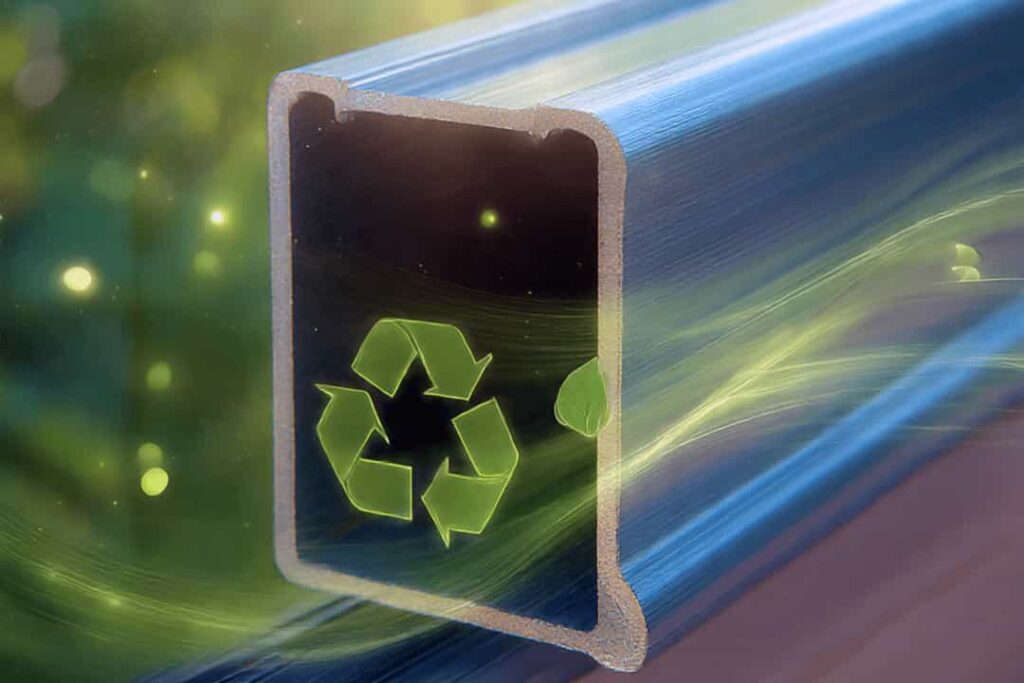
In today’s market, value is not solely defined by function and price. Environmental, Social, and Governance (ESG) credentials have become a crucial value layer. Offering extrusions from certified low-carbon or recycled billets is no longer a niche request but a non-negotiable filter for large global OEMs in automotive, consumer electronics, and construction.
Using sustainable fabrication processes, minimizing waste, and ensuring ethical sourcing provide a powerful brand uplift and grant access to premium markets. An eco-extrusion commands a premium because it helps the end-customer meet their own sustainability targets. You can read more about aluminum recycling and its industry impact.
The Future Is Integrated
The era of the “standard profile” as a standalone, high-margin product is definitively over. The future of the aluminum extrusion industry is integrated, specialized, and solution-oriented.
The roadmap for businesses ready to level up is clear: diagnose your position on the maturity model, identify your Minimum Viable Value-Add (MVVA), and begin the deliberate, phased journey from producer to partner. By investing in precision, fabrication, assembly, and engineering collaboration, extruders can move beyond the volatile commodity game and build a profitable, defensible, and future-proof business. The value is there for the taking—it just requires looking beyond the profile and committing to the long-term work of becoming a Solution Partner.
Related Articles


Featured


You May Also Like

Aluminium Bow Window

Thinking of Bifold Doors? 10 Things You Gotta Know Before Yo…

10 Types of Aluminium Home Doors Based on Operation and Func…
11 Key Energy Efficiency Terms for Windows & Doors Expla…
Aluminium Windows Problem: Dropped Sash in Casement Windows