
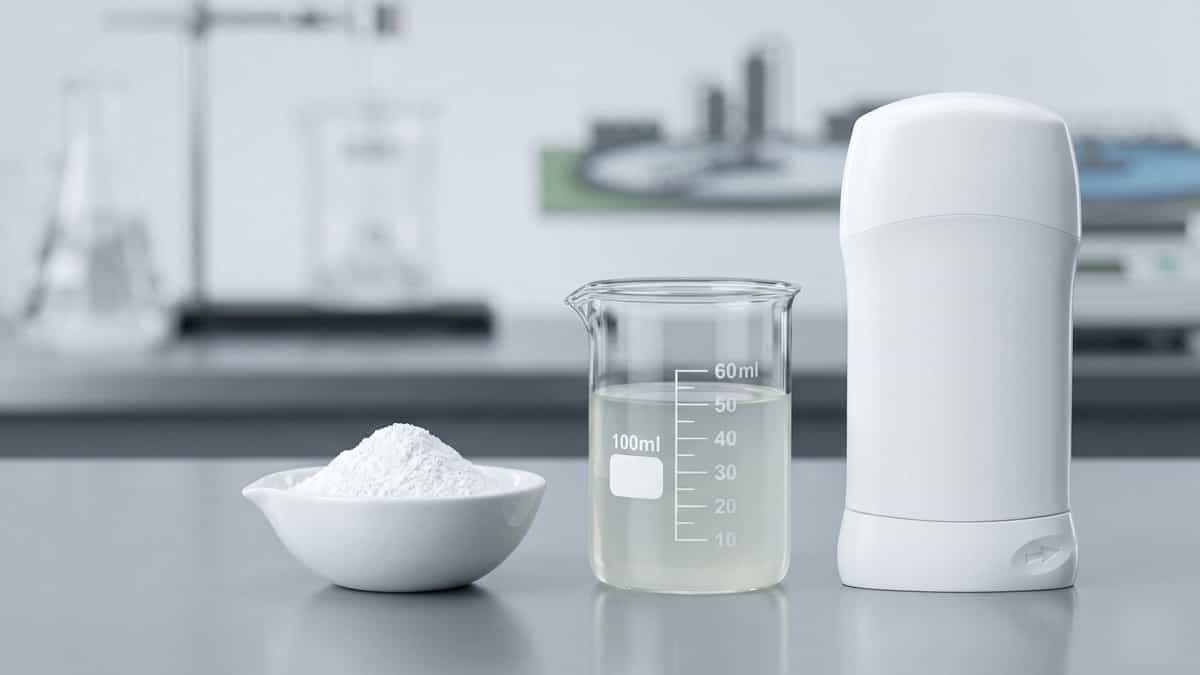
Aluminum chlorohydrate, often abbreviated as ACH, is a water-soluble, polymeric aluminum species that sits comfortably between the violent reactivity of anhydrous aluminum chloride and the benign inertness of aluminum hydroxide. It appears as a white to off-white powder or a clear to pale yellow solution.
Unlike its anhydrous halide cousins, ACH is deliberately designed to be mild, safe, and highly effective in two vastly different domains: underarm antiperspirants and municipal drinking water purification.
1. Basic Identification
Chemical Formula: Typically written as Al₂(OH)₅Cl · 2H₂O (the most common commercial form). The general formula is often represented as [Al₂(OH)ₙCl₆₋ₙ]ₘ, where n ≈ 5.
Alternative Names: Aluminum chlorohydrate, ACH, aluminum chlorhydroxide, basic aluminum chloride, polyaluminum chloride (PAC – related but not identical).
Molecular Weight: Approximately 174.45 g/mol (for the Al₂(OH)₅Cl unit, excluding waters of hydration).
CAS Number: 1327-41-9 (basic aluminum chloride, generic); 12042-91-0 (specific ACH).
Appearance: White to pale yellow free-flowing powder or a clear, slightly viscous solution (often 50% w/w aqueous solution).
2. Physical Properties
Unlike anhydrous AlCl₃, ACH is stable in water and does not fume or hydrolyze violently. Its polymeric structure gives it a mild positive charge, which is key to its applications.
2.1 Key Data Table
| Property | Aluminum Chlorohydrate (Solid) |
|---|---|
| Melting Point | Decomposes above 100 °C without melting, losing water and HCl. |
| Bulk Density | ~0.8–1.0 g/cm³ (powder) |
| Solution pH (50% w/w) | 3.5 – 4.5 (mildly acidic) |
| Solubility in Water | Extremely soluble (>70% w/w at 20 °C) |
| Stability | Stable in sealed containers. Solutions may slowly hydrolyze if heavily diluted. |
2.2 Physical Description
The solid form resembles fine table salt or baking soda – white, free‑flowing, and odorless. When dissolved in water, it forms a clear to faintly opalescent liquid with a mild astringent taste. Unlike anhydrous aluminum chloride, it does not fume in humid air, making it safe for consumer product formulation.
3. Chemical Behavior and Reactions
Aluminum chlorohydrate is a polymeric coordination complex where aluminum atoms are bridged by hydroxide groups. Its chemistry revolves around its positive charge and its ability to neutralize negatively charged particles.
3.1 Interaction with Skin (Antiperspirant Mechanism)
When applied to the skin, the acidic ACH solution diffuses into sweat ducts. There, it undergoes a pH increase (from sweat), causing it to hydrolyze and form an insoluble aluminum hydroxide gel plug.
Observation: The gel physically blocks the eccrine sweat gland ducts, reducing the flow of sweat to the skin surface. The effect is temporary and reversible as skin cells regenerate.
3.2 Coagulation in Water Treatment
In raw water, suspended clay and organic particles carry a negative surface charge, causing them to repel each other. When ACH is added, its highly cationic (positive) polymer chains neutralize these charges, allowing particles to aggregate into larger flocs.
Observation: The flocs settle rapidly, removing turbidity, color, and microorganisms. ACH is preferred over traditional alum (aluminum sulfate) because it works efficiently over a wider pH range and leaves less residual aluminum.
3.3 Synthesis (How It Is Made)
ACH is manufactured by controlled hydrolysis of aluminum chloride solution.
Reaction (simplified):
AlCl₃ + 2.5 H₂O → Al₂(OH)₅Cl + 5 HCl
Process: Aluminum metal, hydrochloric acid, and water are reacted under controlled temperature and pressure. The reaction is carefully monitored to achieve the desired basicity (typically 83% neutralized – meaning 5 out of 6 chloride ions are replaced by hydroxide). The product is then spray‑dried to a powder or sold as a concentrated solution.
4. Industrial and Consumer Applications
Aluminum chlorohydrate is a high‑volume specialty chemical with two dominant uses.
4.1 Antiperspirants (The Most Recognized Use)
ACH is the active ingredient in almost all over‑the‑counter antiperspirants – sticks, roll‑ons, sprays, and creams.
- How it works: As described above, it temporarily blocks sweat ducts.
- Why ACH? It is mild enough for daily skin contact, does not cause significant irritation in most users, and is stable in cosmetic formulations.
- Regulatory status: Approved by the FDA (US), EU Cosmetics Regulation, and other global bodies at concentrations up to 25% (as ACH).
4.2 Water and Wastewater Treatment (High‑Volume Industrial Use)
ACH is a coagulant used in drinking water plants, industrial process water, and municipal wastewater treatment.
- Advantages over alum: Lower pH adjustment needed, produces less sludge, works better in cold water, and removes more natural organic matter.
- Result: Cleaner, safer drinking water with reduced disinfection by‑products.
4.3 Other Specialized Uses
- Paper sizing: Improves ink holdout and water resistance.
- Textile treatment: Enhances dye uptake in some applications.
- Catalyst support precursor: After calcination, it forms high‑surface‑area alumina.
5. Safety and Hazard Management
⚠️
GHS07
Irritant
💧
No Water Reactivity
Stable in water
General Safety: Aluminum chlorohydrate is not a dangerous water‑reactive solid like AlCl₃. It is classified as a mild irritant. Consumer antiperspirants containing it have an exceptional safety record.
5.1 Health Effects
| Route of Exposure | Effect |
|---|---|
| Inhalation | Dust may cause mild respiratory irritation. Not expected to cause pulmonary damage. |
| Skin Contact | Slight irritation possible in sensitive individuals. Prolonged contact with concentrated solution may cause mild redness. |
| Eye Contact | Direct contact with powder or concentrated solution causes stinging and redness. |
| Ingestion | Low toxicity. Large doses may cause gastrointestinal discomfort, nausea, or vomiting. |
5.2 Personal Protective Equipment (PPE)
For industrial handling of powder or concentrated solution:
- Respiratory: Dust mask (N95) when handling powder.
- Hands: Nitrile or rubber gloves.
- Eyes: Safety glasses or goggles.
- Body: Lab coat or industrial apron.
5.3 First Aid Measures
- Eyes: Rinse with water for 15 minutes. Remove contact lenses.
- Skin: Wash with soap and water.
- Inhalation: Move to fresh air.
- Ingestion: Rinse mouth. Drink water. Do not induce vomiting unless directed by medical personnel.
5.4 Firefighting Information
- Suitable Extinguishers: Water spray, CO₂, dry chemical, foam.
- Special hazards: None significant. Decomposes at high temperatures (>200 °C) to release hydrogen chloride fumes.
6. Storage and Handling Guidelines
6.1 Storage Conditions
- Container: HDPE drums, bags, or IBC totes. For solutions, plastic or lined tanks.
- Atmosphere: No special atmosphere required. Keep dry to prevent caking of powder.
- Temperature: Store above freezing (solutions freeze around -10 °C). Avoid prolonged heat above 40 °C.
- Incompatibles: Strong alkalis (causes precipitation of aluminum hydroxide), strong oxidizing agents.
6.2 Disposal Considerations
- Powder/solution: Dilute and neutralize if necessary. Dispose as non‑hazardous waste in most jurisdictions, but check local regulations.
- Empty containers: Rinse thoroughly before recycling.
7. Environmental Impact
ACH is not persistent in the environment. In water treatment, it is consumed by forming flocs that are removed as sludge. Residual aluminum is converted to natural clay‑like minerals. Aquatic toxicity is low at neutral pH. However, large spills into water bodies should be avoided as they can temporarily lower pH and stress aquatic life.
8. Comparison with Other Aluminum Compounds
| Compound | Formula | Water Reactivity | Primary Use | Safety Profile |
|---|---|---|---|---|
| Aluminum Chlorohydrate | Al₂(OH)₅Cl | Stable, soluble | Antiperspirant, coagulant | Mild irritant |
| Aluminum Chloride (anhydrous) | AlCl₃ | Violent (HCl gas) | Friedel‑Crafts catalyst | Corrosive, water‑reactive |
| Aluminum Sulfate (alum) | Al₂(SO₄)₃ | Exothermic, but stable | Water treatment, paper | Irritant |
| Aluminum Hydroxide | Al(OH)₃ | Insoluble | Antacid, vaccine adjuvant | Very low toxicity |
9. Frequently Asked Questions
Q: Is aluminum chlorohydrate in antiperspirants dangerous? Has it been linked to cancer or Alzheimer’s?
A: Extensive scientific reviews (including by the FDA, European Commission, and Cancer Research UK) have found no convincing evidence linking ACH in antiperspirants to breast cancer or Alzheimer’s disease. The aluminum from skin application is minimally absorbed, and the body efficiently excretes it.
Q: Why does my antiperspirant say “aluminum chlorohydrate” on the label?
A: It is the active ingredient that temporarily reduces sweating. It is regulated as an over‑the‑counter drug in the US and as a cosmetic ingredient in the EU.
Q: Can I use aluminum chlorohydrate to clean my pool?
A: No. Pool water treatment uses different aluminum salts (alum or PAC). ACH is suitable for drinking water coagulation but is not formulated for pool use.
Q: What is the difference between aluminum chlorohydrate and polyaluminum chloride (PAC)?
A: Both are polymeric aluminum coagulants, but ACH has a higher basicity (OH/Al ratio ~2.5) and is more pre‑hydrolyzed. PAC typically has a lower basicity (1.0–2.0). ACH is often more effective and produces less sludge.
10. Summary Data Sheet
| Chemical Name | Aluminum Chlorohydrate (ACH) |
|---|---|
| Formula | Al₂(OH)₅Cl · 2H₂O (typical) |
| Appearance | White powder or clear solution |
| Solubility | Freely soluble in water |
| pH (50% solution) | 3.5 – 4.5 |
| Primary Hazard | Mild irritant (dust/eyes) |
| Primary Uses | Antiperspirants; drinking water coagulant |
| Storage | Dry, cool area; keep sealed |
| Regulatory Status | FDA‑approved for antiperspirants; NSF/ANSI 60 for drinking water |
Related Articles

Featured

You May Also Like
Aluminum Powder and Flakes

Are Awning Windows Actually a Good Choice? Here’s the Real A…

Aluminium and Aluminium Business & Things

Don’t Buy Aluminium Windows for Your Home Without This…

Why the Aluminum Industry is Essential for Modern Infrastruc…
