The Aerospace Pioneer: Strength at Extreme Frontiers
While many aluminium alloys excel in commercial or industrial applications, Aluminum 2219 stands as a specialized, high-performance alloy engineered for the most demanding environments imaginable: the vacuum of space, the fuselage of supersonic aircraft, and the intense heat of rocket propulsion. As a cornerstone of the aluminium-copper (2xxx) series, 2219 distinguishes itself through an exceptional combination of high strength, superior toughness, and outstanding weldability, all maintained across an exceptionally wide temperature range. It is the material of choice where failure is not an option.
The Science of Strength:
Composition and Metallurgy
The performance of Aluminium 2219 is dictated by its precise chemical composition, centered around copper (Cu) as the primary alloying element, with critical additions that enhance its high-temperature stability and welding characteristics.
- Copper (Cu): 5.8–6.8% – This high copper content is the primary source of strength through the formation of strengthening precipitates (CuAl₂) during age-hardening.
- Manganese (Mn): 0.20–0.40% – Adds solid solution strength and improves strain hardening.
- Zirconium (Zr): 0.10–0.25% – A crucial addition. Zirconium forms fine, dispersed Al₃Zr particles that inhibit grain growth during welding and high-temperature exposure, preserving toughness.
- Vanadium (V): 0.05–0.15% – Works synergistically with zirconium to enhance thermal stability.
- Titanium (Ti): 0.02–0.10% – Acts as a grain refiner during solidification, improving cast structure and mechanical properties.
- Iron (Fe) & Silicon (Si): Kept to low maximums (0.30% Fe, 0.20% Si) to minimize the formation of brittle intermetallic compounds that can reduce toughness and fatigue resistance.
- Zinc (Zn): 0.10% max – A strict impurity control to prevent stress corrosion cracking.
The alloy is heat-treated to the T8 temper (solution heat-treated, cold worked, and then artificially aged) to achieve its peak strength and stress-corrosion cracking resistance.
Core Properties:
Engineered for Extremes
- Exceptional Strength over a Wide Temperature Range: 2219 retains a significant portion of its room-temperature strength at elevated temperatures (up to 315°C / 600°F), far outperforming most other aluminium alloys. It also maintains good ductility and toughness at cryogenic temperatures down to -425°F (-255°C).
- Superior Weldability and Weld Strength: This is one of 2219’s most defining features. It is readily weldable using conventional techniques (TIG, MIG) and, unlike many other high-strength aluminium alloys, its weld joints can be re-heat-treated post-weld to recover strength nearly equal to the base material. This is critical for aerospace structures.
- High Fracture Toughness: The alloy exhibits excellent resistance to crack propagation, a vital property for critical structures where damage tolerance is a key design criterion.
- Excellent Stress-Corrosion Cracking (SCC) Resistance: When heat-treated to the T8 temper, 2219 displays very high resistance to SCC, a common failure mode in high-strength aluminium-copper alloys.
- Good Machinability: In the T8 temper, it machines well, producing a good surface finish.
Key Tempers:
Optimizing for Application
- O (Annealed): The soft, formable state used for severe forming operations before final heat treatment.
- T3/T4 (Solution Heat-Treated and Naturally Aged): Offers good strength and formability. Used for parts that will be formed after heat treatment.
- T6 (Solution Heat-Treated and Artificially Aged): Provides high strength but is less resistant to exfoliation corrosion.
- T8 (Solution Heat-Treated, Cold Worked, and Artificially Aged): The premier temper for 2219. Cold working (typically through stretching) after solution heat treatment introduces dislocations that promote a more uniform and finer precipitation during aging. This results in the highest strength, superior SCC resistance, and enhanced exfoliation corrosion resistance. This is the standard for aerospace applications.
- T87: A specific T8-type temper used for weld filler wire (ER2319), optimized to match the base metal properties after welding and post-weld heat treatment.
Ubiquitous Usage:
From Earth to Orbit
Aluminum 2219 is synonymous with high-reliability aerospace and defense applications.
- Aerospace Structures:
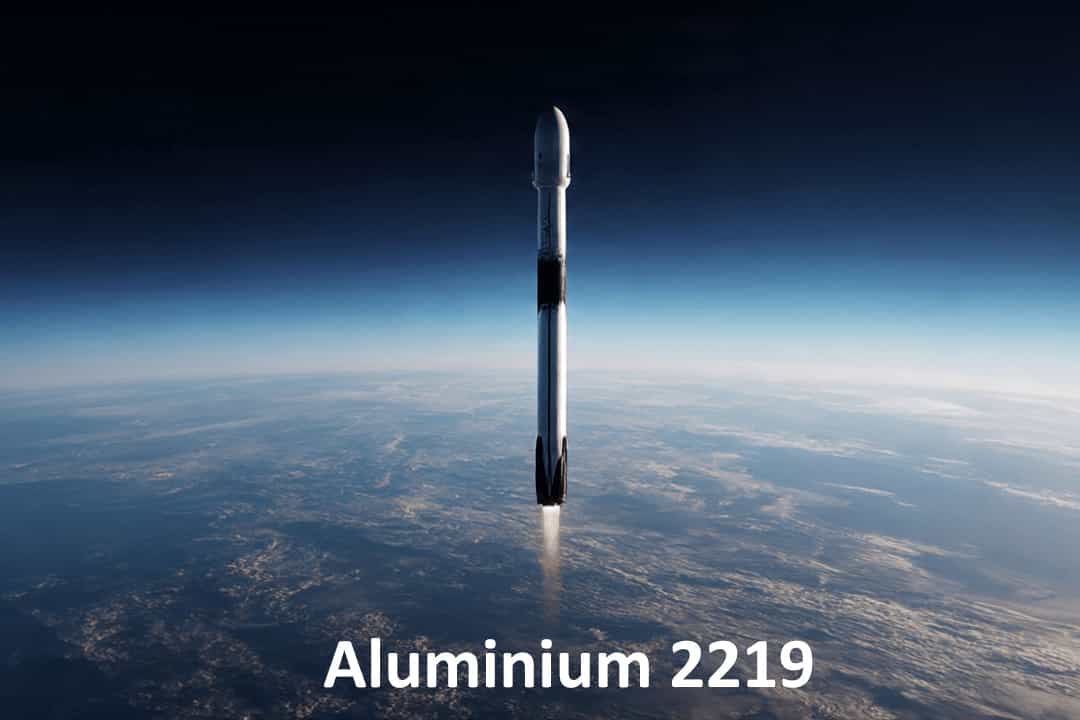
- Space Launch Vehicles: Extensively used for the fuel and oxidizer tanks of rockets, including the SpaceX Falcon 9 and the legacy Space Shuttle External Tank. Its cryogenic toughness and weldability are essential.
- Aircraft Fuselage and Wing Skins: Used in supersonic aircraft and military fighters where its strength-to-weight ratio and durability are critical.
- Aerospace Forgings: For bulkheads, frames, and other primary structural components.
- Related: Why is Aluminum Used for Aircraft Bodies?
- Defense Applications:
- Armored Vehicles: Used in lightweight armor plate applications.
- Military Bridges and Structures.
- High-Temperature Applications:
- Pistons and cylinder heads in high-performance internal combustion engines.
- Heat Shields and other components exposed to aerodynamic heating.
Why Choose 2219? Comparing the Competition
- vs. 2014 & 2024: While 2014 and 2024 offer slightly higher room-temperature strength, 2219 vastly outperforms them in weldability, toughness, and elevated temperature performance. 2024 is generally considered non-weldable, while 2219 welds robustly.
- Related: Aluminium 2014 Alloy Properties
- vs. 7075: 7075 has higher strength but poor weldability and significantly lower fracture toughness. 7075 is preferred for machined parts, while 2219 is the choice for welded structures.
- vs. 6061: 6061 is a general-purpose alloy with good corrosion resistance and weldability but cannot approach the strength or high-temperature capability of 2219.
- Related: Aluminum 6061 vs. 6063
Fabrication and Handling Tips
- Machining: Use sharp, high-speed steel or carbide tools. Lubrication is recommended for optimal finish.
- Welding: 2219 is generally not recommended for arc welding due to hot cracking. Use riveting or fastening instead.
- Corrosion Protection: Apply anodizing or paint to improve corrosion resistance in harsh environments.
- Related: Powder Coating vs. Anodizing
Standards and Specifications
Aluminum 2219 is a premium aerospace alloy produced by specialized mills to stringent quality controls. Key standards include:
- ASTM:
- B209: Sheet and Plate
- B211: Bar, Rod, and Wire
- B221: Extruded Bars, Rods, Profiles, and Tubes
- B247: Forgings
- AMS (Aerospace Material Specification): AMS 4067 (Sheet), AMS 4150 (Plate), AMS 4187 (Alclad Sheet)
- ISO/EN: Less common for this specific grade, but equivalents exist under national designations.
Sustainability and Recycling
Like all aluminium, 2219 is 100% recyclable. While its initial production is energy-intensive, its long service life in critical applications and the high value of its scrap ensure it is actively recycled back into the aerospace and high-performance manufacturing stream, contributing to a circular economy.
- Related: Aluminum Can Recycling Process
- Related: Understanding Aluminium Waste and Scrap
The Future: Pushing Boundaries
The role of Aluminum 2219 is secure in the future of aerospace and advanced engineering. Key growth areas include:
- Reusable Launch Vehicles: Its durability and ability to withstand multiple thermal cycles make it ideal for the tanks and structures of reusable rockets.
- Hypersonic Flight: Development of materials for sustained hypersonic flight builds upon the knowledge base of alloys like 2219.
- Advanced Manufacturing: Its excellent weldability makes it a prime candidate for new additive manufacturing (3D printing) processes using wire-arc directed energy deposition.
Aluminum 2219 is not a general-purpose material; it is a specialized tool for solving the most challenging engineering problems. Its unparalleled blend of strength, toughness, and weldability at temperature extremes has made it a foundational material for humanity’s exploration of space and the upper limits of flight. From the massive tanks that propel rockets orbit to the sleek skins of supersonic aircraft, 2219 represents the pinnacle of aluminium alloy development for critical, load-bearing structures. It is a testament to how precise metallurgical science can create a material capable of performing reliably where few others can.
For more insights into aluminium alloys and their applications, explore our detailed guides:
- Aluminium 1050 Alloy Properties
- What is Aluminium and How Is It Made?
- Understanding the Aluminium Fabrication Process
Related Articles


Featured



You May Also Like

What Frame Material is Best for Pleated Mesh Mosquito Net?

Why Cheap Telescopic Ladders Feel Unsafe

How Aluminium Industry Drives Sustainable Development

How Much Do Storm Doors Cost in 2026?
Aluminium 5052 (Aluminum 5052): The Marine-Grade Alloy for S…