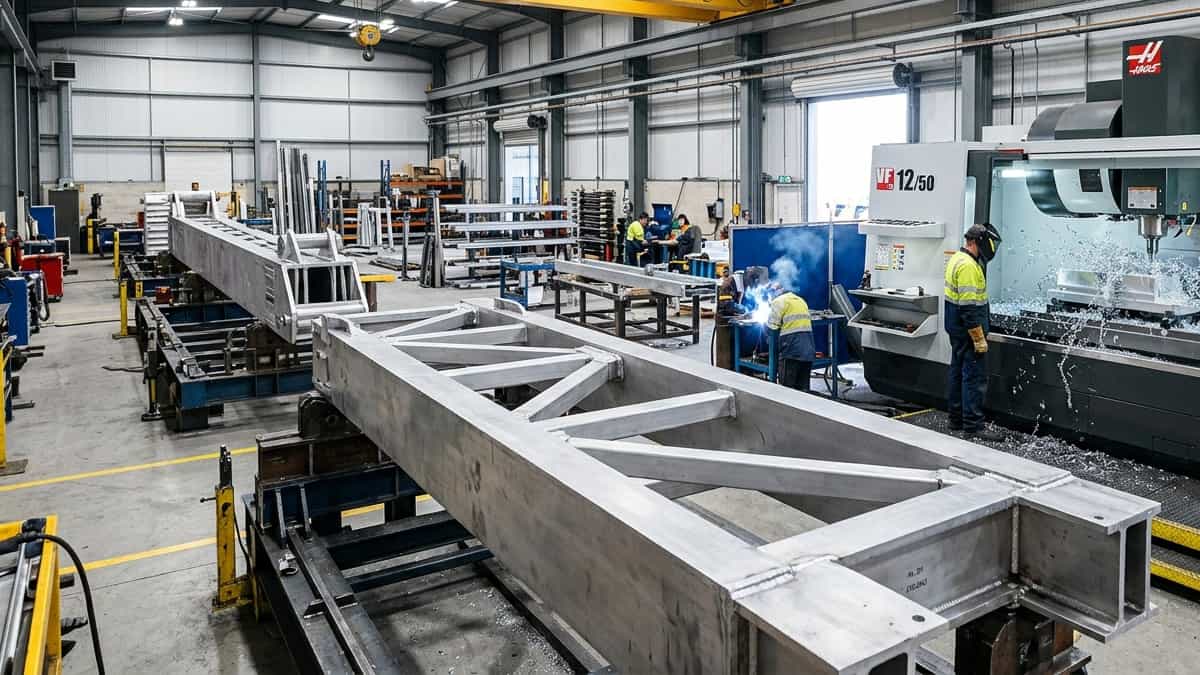
Aluminium 6082 – also known as Aluminum 6082 – is a heat‑treatable aluminium‑magnesium‑silicon alloy that delivers the highest strength of any 6000 series alloy. With a distinctive addition of manganese (0.4–1.0%), 6082 offers excellent corrosion resistance, good weldability, and superior machinability. It has largely replaced 6061 in many European structural applications and is the material of choice for bridges, cranes, trusses, heavy transport, and general engineering where strength cannot be compromised.
What is Aluminium 6082?
Aluminium alloy 6082 belongs to the 6000 series (aluminium‑magnesium‑silicon) – the most versatile family of extruded aluminium alloys. Like 6060, 6063, and 6061, 6082 is heat treatable: its mechanical properties are achieved through controlled thermal processing, not just cold work.
What sets 6082 apart from its 6xxx cousins is its manganese content (0.4–1.0%). Manganese controls grain structure and significantly increases strength. As a result, 6082 offers the highest strength among all 6000 series alloys and has replaced 6061 in countless structural applications across Europe and beyond.
Aluminium 6082 is widely known under designations such as EN AW‑6082, AlSi1MgMn, HE30, DIN 3.2315, and A96082. It is one of the most popular alloys in the 6000 series, alongside 6005, 6061, and 6063.
Key Characteristics at a Glance:
- Density: 2.70–2.71 g/cm³
- Melting range: 555–650 °C
- Thermal conductivity: 180–184 W/m·K
- Modulus of elasticity: 69–70 GPa
- Typical tensile strength (T6 temper): 310–350 MPa
Data compiled from industry specifications
Chemical Composition
| Element | Percentage (%) |
|---|---|
| Aluminum (Al) | 95.2 – 98.3 |
| Silicon (Si) | 0.70 – 1.30 |
| Magnesium (Mg) | 0.60 – 1.20 |
| Manganese (Mn) | 0.40 – 1.00 |
| Iron (Fe) | ≤0.50 |
| Chromium (Cr) | ≤0.25 |
| Copper (Cu) | ≤0.10 |
| Others | ≤0.15 total |
Source: BS EN 573-3:2009
The magnesium and silicon form fine Mg₂Si precipitates during artificial aging – the primary strengthening mechanism. The manganese is the key differentiator, controlling grain structure and substantially boosting strength.
Key Properties of Aluminium 6082
💪 Highest Strength in the 6000 Series
This is the defining feature of 6082. In the T6 temper (solution heat treated and artificially aged), 6082 typically exhibits:
- Ultimate tensile strength: 310–350 MPa
- Yield strength (0.2%): 270–310 MPa
- Elongation: 6–8% (depending on section thickness)
- Hardness: approximately 90–95 HB
These values make 6082 the strongest standard alloy in the 6000 series, exceeding 6061‑T6 and 6005A‑T6 by a noticeable margin.
🌊 Excellent Corrosion Resistance
Aluminium 6082 offers excellent corrosion resistance – a hallmark of the 6xxx series. The natural oxide film protects the alloy in:
- Marine atmospheres (coastal and offshore)
- Industrial environments (chemical exposure)
- Urban and rural settings
The manganese addition actually enhances corrosion resistance compared to similar alloys like 6061. 6082 also responds well to anodising (clear, colour dye, and hardcoat).
🔧 Superior Machinability – The Machinist’s Choice
In plate form, 6082 is the alloy most commonly used for machining. It is often called an “easy‑cut aluminium alloy” because it produces tight coils of swarf when chip breakers are used – unlike many aluminium alloys that create long, stringy chips. This makes 6082 ideal for:
- CNC milling and drilling
- High‑volume precision machining
- Components requiring excellent surface finish
⚡ Good Weldability (With a Note)
6082 has very good weldability using MIG (GMAW) and TIG (GTAW) methods.
- Recommended filler: 4043 wire for welding 6082 to itself; 5356 wire when welding to 7000 series alloys.
- Important limitation: Strength is reduced in the heat‑affected zone (HAZ). Designers must account for this in structural calculations.
Brazing and soldering are also good options.
🔨 Formability and Heat Treatment
- Cold forming: Good in the annealed (O) or T4 temper. For bending or forming, use O or T4 before final heat treatment.
- Heat treatment: 6082 is fully heat treatable. The common tempers are O (annealed), T4 (naturally aged), T5 (artificially aged without cold work), and T6 (solution treated and artificially aged – maximum strength).
🏭 Extrusion – A Trade‑off
While 6082 offers excellent strength, its extrusion characteristics involve compromises:
- It is difficult to produce thin‑walled, complicated extrusion shapes in 6082.
- The extruded surface finish is not as smooth as 6063 or 6005A.
- T6 temper may not be available for all sections due to quenching limitations.
Despite this, 6082 is widely extruded into rod, bar, seamless tubing, and structural profiles.
Applications of Aluminium 6082
The combination of highest‑in‑series strength, excellent corrosion resistance, good weldability, and superior machinability makes 6082 a structural alloy of choice across demanding industries.
🏗️ Heavy Structural Engineering – The #1 Application
- Bridges – structural components and load‑bearing elements
- Cranes – booms, jibs, and frameworks
- Trusses – roof trusses and large‑span structures
- Towers – communication and transmission towers
- Scaffolding – lightweight yet strong
- Ore skips – heavy mining equipment
🚆 Transport & Heavy Vehicles
- Railway vehicle components – including friction‑stir‑welded elements for high‑speed rail
- Truck frames and trailers
- Automobile structural parts requiring high strength‑to‑weight ratio
⚙️ Machined Components & General Engineering
- Mechanical bases and equipment frames – ideal for CNC milling
- Seamless aluminium tubing
- General machining stock – rod, bar, and plate
🏭 Pressure Vessels & Storage
- Beer barrels and milk churns – 6082 has a long history in packaging vessels
- Chemical and food industry containers
- Medium‑pressure vessels
✈️ Aerospace & Defence
- Aircraft parts – including landing gear components
- Aviation structural elements – where strength and light weight are critical
🚢 Marine & Offshore
- Shipbuilding – structural components and fittings
- Offshore structures – corrosion‑resistant applications
🏗️ Building & Construction
- Architectural structures – roof trusses, support frames
- General building – where strength, weldability, and corrosion resistance are required
Fabrication & Workability – Quick Guide
| Aspect | Recommendation |
|---|---|
| Forming | Use O or T4 temper for bending; T6 has limited formability |
| Welding | MIG/TIG with 4043 (to itself) or 5356 (to 7000 series); expect HAZ strength reduction |
| Machining | Excellent – use chip breakers, carbide tools, adequate lubrication |
| Heat treatment | Solution treat at 530–550°C, quench, then age at 160–190°C (T6) |
| Anodising | Good response – clear, colour, and hardcoat |
| Extrusion | Difficult for thin‑wall complex shapes; surface finish less smooth |
Why Choose Aluminium 6082?
✅ Advantages
- Highest strength in the 6000 series – up to 350 MPa tensile
- Excellent corrosion resistance – marine, industrial, outdoor
- Superior machinability – tight chip formation; the most commonly machined 6xxx alloy
- Good weldability – with appropriate filler alloys
- Good cold formability in O and T4 tempers
- Heat treatable – properties can be tailored
- Good anodising response
- Excellent strength‑to‑weight ratio – density 2.70 g/cm³
- Fully recyclable
❌ Limitations
- Difficult to extrude into thin‑walled or complex shapes
- Extruded surface finish is less smooth than 6063 or 6005A
- Weld strength reduction – HAZ is weaker
- Less common in North America (ASTM standards favour 6061)
- T6 temper may not be available for all sections
- Lower ductility than 6061 (6–8% vs 10–12% elongation)
Summary
Aluminium 6082 (Aluminum 6082) is the strength champion of the 6000 series. Its unique manganese addition delivers the highest strength among all 6xxx alloys, making it the natural choice for bridges, cranes, trusses, railway vehicles, and heavy structural engineering. At the same time, its excellent machinability – tight chip formation and high surface finish – makes it a favourite in CNC workshops.
If your application demands maximum strength from a 6000 series alloy, Aluminium 6082 is the proven, trusted solution. Explore its properties relative to other alloys using the Aluminium Alloy Comparison Tool.
📚 Related Articles
- Aluminium Alloy Comparison Tool – Compare 40+ aluminium alloys side by side
- Aluminium 6061 T6: Properties, Machining & Applications – The North American structural standard
- Aluminium 6063: The Extrusion Standard for Windows & Doors – For smooth finishes and complex extrusions
- Aluminium 6005 & 6005A: The Extrusion‑Focused Twin Alloys – For railway profiles and ladders
- What Is Aluminium and How Is It Made? – A foundational guide